
A new studio speaker design from present day productions using hypex and bliesmas drivers, will be unaffordable and unnecessary for my listening at home but I’m interested in what the finished build will be like.

-
WANTED: Happy members who like to discuss audio and other topics related to our interest. Desire to learn and share knowledge of science required. There are many reviews of audio hardware and expert members to help answer your questions. Click here to have your audio equipment measured for free!
You are using an out of date browser. It may not display this or other websites correctly.
You should upgrade or use an alternative browser.
You should upgrade or use an alternative browser.
Interesting new studio speaker design from present day production
- Thread starter Somafunk
- Start date

What are they? I quit after the first minute of BS.
AwesomeSauce2015
Active Member
- Joined
- Apr 14, 2022
- Messages
- 205
- Likes
- 195
Fancy drivers with a fancy amp != a good speaker...
If it's designed correctly then they may be able to make it work. The driver spacing isn't stupid, but no waveguides will mean that crossover design is very important for good directivity...
IDK, I'd rather go DIY my own design or get a Genelec / Revel / Neumann / JBL equivalent...
If it's designed correctly then they may be able to make it work. The driver spacing isn't stupid, but no waveguides will mean that crossover design is very important for good directivity...
IDK, I'd rather go DIY my own design or get a Genelec / Revel / Neumann / JBL equivalent...

What Awesomesauce said. I've spent some time looking at the FR and directivity charts for those Bliesma drivers, I don't think using them both on the same speaker makes a ton of sense. The tweeters go low enough, and the mids go high enough, that it seems they're using them because they're expensive, not because they match particularly well.
Personally I would love to put the purifi aluminum mid with the 34mm tweeter from Bliesma, but this seems like a very different approach...
Personally I would love to put the purifi aluminum mid with the 34mm tweeter from Bliesma, but this seems like a very different approach...
AwesomeSauce2015
Active Member
- Joined
- Apr 14, 2022
- Messages
- 205
- Likes
- 195
I mean, if I was to design an "expensive for expensive's sake" studio monitor, I'd use the JBL D2430K from the M2, and various expensive JBL mid/bass drivers...
D2430K for 20khz-1khz, Some beryllium-modded supertweeter (because expensive), High-power mid from B&C or one of the other expensive pro brands, and 2x JBL Differential drive 18" subs per speaker... Parts cost would be insane, and it could actually perform pretty good, assuming that I used expensive DSP amps (which I would lol)
D2430K for 20khz-1khz, Some beryllium-modded supertweeter (because expensive), High-power mid from B&C or one of the other expensive pro brands, and 2x JBL Differential drive 18" subs per speaker... Parts cost would be insane, and it could actually perform pretty good, assuming that I used expensive DSP amps (which I would lol)
self-builds.What are they? I quit after the first minute of BS.
- Thread Starter
- #8
What are they? I quit after the first minute of BS.
As opposed to the BS talked about supposed high end audio?
Nope. BS is BS.As opposed to the BS talked about supposed high end audio?

Translation: Get off my lawn!What are they? I quit after the first minute of BS.
Hahaha

- Joined
- Feb 23, 2016
- Messages
- 20,761
- Likes
- 37,614
I quit at the 5 minute mark and still don't know what speakers they are on about.What are they? I quit after the first minute of BS.

They are DIY speakers. But there is a part two somewhere that discusses the driver choices. A bit drawn out but interesting to hear a studio guy’s perspective.
Mixing engineers aren't speaker designers, that is for sure.
It seems their thought process was "use drivers like ATC" and the cabinet ended up as an afterthought. No baffle roundovers, symmetrical driver placement, etc. Don't even get me started on directivity. If they are going for a full DIY build, there is no reason they can't rip the coaxial units from some used KEF or Genelec speakers.
It seems their thought process was "use drivers like ATC" and the cabinet ended up as an afterthought. No baffle roundovers, symmetrical driver placement, etc. Don't even get me started on directivity. If they are going for a full DIY build, there is no reason they can't rip the coaxial units from some used KEF or Genelec speakers.
So presumptive and judgmental. You guys ain't Scientists, clearly.
I watched the complete video with an open mind. And guess what, it's a nice/clever teaser- YouTube style. it's just part one of two (or more)
Video 1 summary:
Premise: we want a surround sound Atmos monitoring system, but we don't went buy a whole ATC setup, so we're going to design our own.
We've chosen our amp/DSP, and it's the Hypex FA253.
[emd]
But that's boring. Let's create a video on it.
The keyboard warrior loves to criticize others- but has anyone here designed their own 3 way speaker? And succeeded? (or failed)
Let's see it.
Thanks.
I watched the complete video with an open mind. And guess what, it's a nice/clever teaser- YouTube style. it's just part one of two (or more)
Video 1 summary:
Premise: we want a surround sound Atmos monitoring system, but we don't went buy a whole ATC setup, so we're going to design our own.
We've chosen our amp/DSP, and it's the Hypex FA253.
[emd]
But that's boring. Let's create a video on it.
The keyboard warrior loves to criticize others- but has anyone here designed their own 3 way speaker? And succeeded? (or failed)
Let's see it.
Thanks.
Last edited:
The scientist in me wants to see their measurements. Because as it stands this box design is a terrible choice and goes against everything we know about good loudspeaker design. I guess its because its easy to make a box?So presumptive and judgmental. You guys ain't Scientists, clearly.
I watched the complete video with an open mind. And guess what, it's a nice/clever teaser- YouTube style. it's just part one of two (or more)
Video 1 summary:
Premise: we want a surround sound Atmos monitoring system, but we don't went buy a whole ATC setup, so we're going to design our own.
We've chosen our amp/DSP, and it's the Hypex FA253.
[emd]
But that's boring. Let's create a video on it.
The keyboard warrior loves to criticize others- but has anyone here designed their own 3 way speaker? And succeeded? (or failed)
Let's see it.
Thanks.
Is directivity control necessary for 3-way designs? I though you could just match the surface areas of each driver to each other and you're more or less done?
The lack of round overs is concerning though.
The lack of round overs is concerning though.

Eric.D
Member
- Joined
- Mar 12, 2022
- Messages
- 15
- Likes
- 18
Yeah, these bliesmas tweeter and dome definitely better of with a custom-designed waveguide. They are excellent low distortion linear drivers, just fix the directivity, and they should sound fabulous. Seems like they are using the soft dome version,  would love to see if someone can build a speaker with the be version and good directivity, it would be extremely expensive tho.
would love to see if someone can build a speaker with the be version and good directivity, it would be extremely expensive tho.The scientist in me wants to see their measurements. Because as it stands this box design is a terrible choice and goes against everything we know about good loudspeaker design. I guess its because its easy to make a box?
I'm holding my horses-
What the baffle dimensions? It may or may not make a measurable or audible difference to go the whole 9 yards, particiarly in a design where costs need to be controlled.
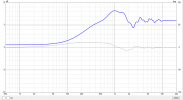
For example, here's the baffle diffraction effect on a 1" dome tweeter on a typical 20cm x 40cm baffle, tweeter 10 cm from the top edge, and centered on the midline.
(1)
The green is what would happen on an infinitely large baffle ie. 6dB gain. The blue is what happens to the response instead-
Yikes! Lots of funkiness between about 550Hz up to about 15Khz, with almost up to +/- 3dB between 550Hz and 3Khz.
In a tweeter, where one would have to crossover around ~2.5Khz- this is what creates all kinds of challenges due to the funkiness that changes the on axis (shown) and the off-axis response (not shown, but equally complex).
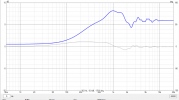
Here's how it looks now with a 1" roundover:
(2)
Ah better, particularly above 6Khz, but still +2/-1dB effects between 550Hz and 3Khz.
(Now a waveguided tweeter, in effect, has it's own concave baffle, so the tweeter is not affected by the flat baffle it's on, thus avoiding the baffle diffraction issue of the lower treble ripple response as seen above. Related to this is the tweeter's output, which has a change in dispersion that closely matches the woofer's dispersion (that's why you want a tweeter on small 5" waveguide when matched with a small 5" mid-woofer and much larger waveguide when matched with a larger 15" midwoofer in a 2 way)
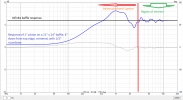
Moving on, here's the same tweeter 10cm from the top of a wider 11" baffle, which is typically what's needed for a 8-10" woofer in a 3 way.
Now you're going to say- well it's not as good as a rounded over cabinet! And I agree.
But certainly it's not as atrocious as the initial cabinet with no round-over.
But guess what? In a 3 way you're typically crossing the tweeter to the midrange cone/dome at or above 3KHz,
(3)
So the funkiness in the region of interest is +/-1 dB, not +/-3dB.
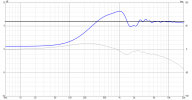
Here's the same, with just a 1/2" roundover:
(4)
So on a 3 way design, for a tweeter on a 11" baffle- the diffraction effects are reduced.
So here are the options:
A) live with the diffraction wonkiness of +/-1 dB (graph 3)
B) do some baffle edge treatments eg. 1/2" round-over (graph 4) or facets (not shown)
So let's be aware of our blind spots: optimal baffle shape and dimensions is but one part of loudspeaker design.
But it depends on what frequencies you're dealing with.
What happens when you put a 3" piston (approximation of a 3" cone or dome) on the baffle?
You can equalize out the peak around 700Hz.
But can you live with that 0.8-1dB wobbliness around 2Khz?
Or do you want a cu$tomi$ed waveguide for your mid-dome?
It's not as "terrible" as you think.... It costs a LOT of money to go with a fully customized diffraction mitigation/adaptation/controlled baffle
ala. Vivid Audio...
Attachments
Last edited:
- Joined
- Feb 23, 2016
- Messages
- 20,761
- Likes
- 37,614
Sorry the video is boring and wastes time. Even more so when you need part two. Your short summary in video form would be highly preferred. What they think is a cute entertaining video isn't plus what they think is a clever bit of reasoning for a diy speaker also isn't.So presumptive and judgmental. You guys ain't Scientists, clearly.
I watched the complete video with an open mind. And guess what, it's a nice/clever teaser- YouTube style. it's just part one of two (or more)
Video 1 summary:
Premise: we want a surround sound Atmos monitoring system, but we don't went buy a whole ATC setup, so we're going to design our own.
We've chosen our amp/DSP, and it's the Hypex FA253.
[emd]
But that's boring. Let's create a video on it.
The keyboard warrior loves to criticize others- but has anyone here designed their own 3 way speaker? And succeeded? (or failed)
Let's see it.
Thanks.
Similar threads
- Replies
- 0
- Views
- 366
- Replies
- 1
- Views
- 601
- Replies
- 26
- Views
- 2K
- Replies
- 14
- Views
- 2K

