
-
Welcome to ASR. There are many reviews of audio hardware and expert members to help answer your questions. Click here to have your audio equipment measured for free!
You are using an out of date browser. It may not display this or other websites correctly.
You should upgrade or use an alternative browser.
You should upgrade or use an alternative browser.
If Room Treatment is difficult, expensive and often ineffective, why are so many on reddit in love with it?
- Thread starter Mort
- Start date
Apparently many believe that room treatments are the key to good sound, even here.I'm speaking of Reddit specifically, not here. What's the appeal? Gatekeeping the hobby?
My approach to room treatment is a rug on the floor (needed anyway), curtains on the windows (ditto), but most important, Dirac ART.
To me, physical room treatment is a hobby for the well-heeled, or folks with a lot of time and energy.

- Joined
- Mar 1, 2021
- Messages
- 3,270
- Likes
- 6,913
I had my room treated before I bought my system 6 years ago and I will never, nor do I have the slightest desire to tinker or change anything as it’s good enough for my needs till i get carried out of my house by the undertaker  , 90%+ of my listening is to electronic music so have an RT of .3secs or thereabouts if I remember correctly
(System in signature)
, 90%+ of my listening is to electronic music so have an RT of .3secs or thereabouts if I remember correctly(System in signature)
I'd like to see some measurements of how effective bass traps are in, say, a typical domestic room. How thick do they have to be, how much area needs to be covered, and what frequency ranges can be tamed?
For those in urban areas, probably the most important thing is reducing ambient noise. I swear my place is next to a Hellmouth of noise -- motorcycles, trucks, fighter jets, helicopters, Ospreys and more -- which can make a mockery of any hi-fi speaker setup, especially if you are trying to reproduce the full dynamic range of recordings.
For those in urban areas, probably the most important thing is reducing ambient noise. I swear my place is next to a Hellmouth of noise -- motorcycles, trucks, fighter jets, helicopters, Ospreys and more -- which can make a mockery of any hi-fi speaker setup, especially if you are trying to reproduce the full dynamic range of recordings.

kemmler3D
Master Contributor
Acoustic treatment can improve sound in ways that EQ and even ART can't. However, no argument that they're generally impractical and expensive.
However if you think about subjectivists and how they sometimes spend their audio budgets, at least room treatments will have a reliable, audible effect.
However if you think about subjectivists and how they sometimes spend their audio budgets, at least room treatments will have a reliable, audible effect.

Has anyone every attacked any and every form of room treatment around here? I wouldn't be aware of it. Room treatment always is a tool worth considering. The degrees to how complete or acceptable the implementation is varies from one audiophile's place to another's.
Last edited:

Just did a quick search and found about 140 ASR threads devoted to room treatment.I'm speaking of Reddit specifically, not here. What's the appeal? Gatekeeping the hobby?
It’s a thing. Toole and Olive’s new 4th edition of Sound Reproduction: The Acoustics and Psychoacoustics of Loudspeakers, Rooms and Headphones includes extensive discussion of and technical information on the acoustical treatment of rooms (this incorporates both recommendations and cautionary perspectives of course — one section is titled “Acoustical Treatments Can Help or Hinder”).
It ain’t just those crazed Reddit freaks who are interested in this valid subject, difficult, expensive, and ineffective though it may sometimes be.


fpitas
Grand Contributor
Yeah. I've maybe spent a couple thousand on room treatments. At no point have I contemplated subjectivist woo-woo cables etc.Acoustic treatment can improve sound in ways that EQ and even ART can't. However, no argument that they're generally impractical and expensive.
However if you think about subjectivists and how they sometimes spend their audio budgets, at least room treatments will have a reliable, audible effect.
BTW...yes, the treatments helped. Both measurements and listening.
Last edited:
Audio Science Pal
Senior Member
- Joined
- Feb 22, 2022
- Messages
- 342
- Likes
- 487
I prefer a non-echoic room.
I don't believe that it is possible to generalize about the effectiveness of ART vs. anything else, as there are wide variations on how ART is implemented in any given audio installation.Acoustic treatment can improve sound in ways that EQ and even ART can't. However, no argument that they're generally impractical and expensive.
However if you think about subjectivists and how they sometimes spend their audio budgets, at least room treatments will have a reliable, audible effect.
For example, I have a 9.1.6 set up with 9 effectively full range floor standing speakers at ear level. ART is extraordinarily effective. Notwithstanding Dirac's marketing, I do not believe that a basic 2.1 or 2.2 system will provide as effective ART room correction, (although it is surely better than nothing.)
I doubt that in my set up, physical room correction would provide anything as good as ART, no matter how much I spent or how extensive the modifications.
Physical acoustic modifications belong in the great concert and recital halls. For the home, DSP is the rational choice. If I had a 2 channel system, I would put my money in more speakers and amplifiers, and therefore a better ART installation, before I bothered with physical room correction.
- Joined
- Mar 1, 2021
- Messages
- 3,270
- Likes
- 6,913
Yeah. I've maybe spent a couple thousand on room treatments. At no point have I contemplated subjectivist woo-woo cables etc.
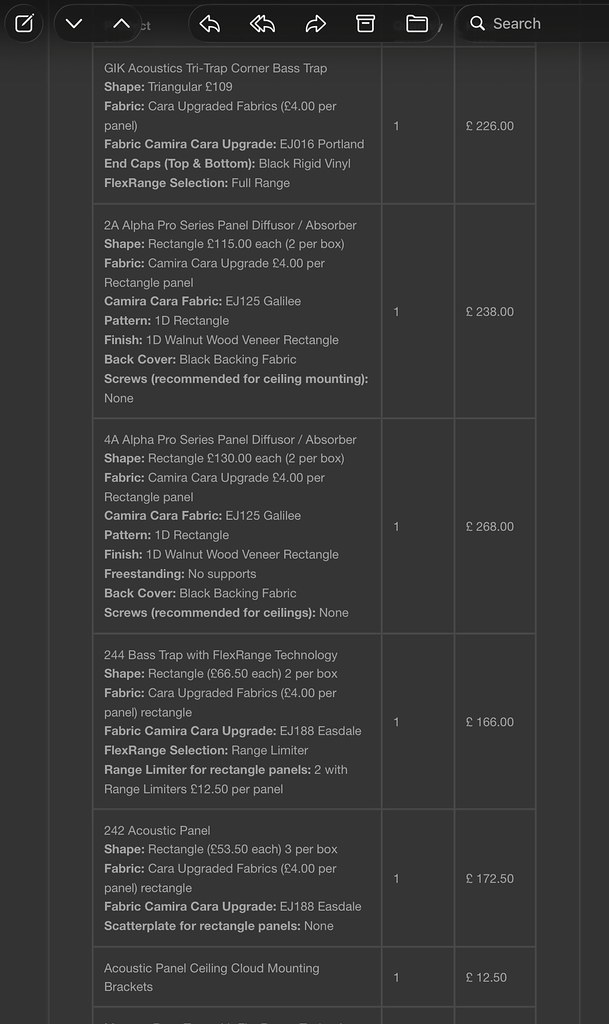
Same here, think I spent around £2.3k for my 4.4m x 3.6m x 2.4m room, not shown below is 3 extra 242 panels for additional ceiling treatments and 2 additional monster bass traps, my mate set my room up and dealt with measurements and suitable peq applied through Roon for bass modes below 300hz ish

OP

- Joined
- Jul 12, 2024
- Messages
- 3,612
- Likes
- 5,718
- Thread Starter
- #13
Yeah I just didn't want it to devolve into naval gazing and camps. So I used Reddit.Just did a quick search and found about 140 ASR threads devoted to room treatment.
It’s a thing. Toole and Olive’s new 4th edition of Sound Reproduction: The Acoustics and Psychoacoustics of Loudspeakers, Rooms and Headphones includes extensive discussion of and technical information on the acoustical treatment of rooms (this incorporates both recommendations and cautionary perspectives of course — one section is titled “Acoustical Treatments Can Help or Hinder”).
It ain’t just those crazed Reddit freaks who are interested in this valid subject, difficult, expensive, and ineffective though it may sometimes be.
kemmler3D
Master Contributor
To some extent you can, though. It's not magic. I'm not saying ART can't do what it says on the tin, and well. However, there are things it cannot do on a conceptual level, like diffusion, or on a practical level, like suppression of high frequency flutter echo.I don't believe that it is possible to generalize about the effectiveness of ART vs. anything else,
I would also argue that combining some low frequency absorbers with ART or similar DSP would tend to produce an even better effect.
I'm not arguing that everyone can or should try to put such things in their room, but if you have the time, money and inclination, and have measured properly to determine what treatments might help, I think it can be a good idea.

Just recently had noticed that the subject of room treatment is popping up across several threads. So this thread seems timely.
Partly due to spousal objections, am not likely to pursue, but cannot help make the observation that if studios are treated and we hope to hear what was intended during the content mastering, room treatment seems desirable. On the other hand, seems pretty clear that we cannot know what room conditions existed during mastering for every studio. Shy of strict studio standards driving more consistency, would it make sense to at least capture some of the major room condition parameters for mastering session(s)? Or does it matter whether the original recording essence is reproducible or not?
Partly due to spousal objections, am not likely to pursue, but cannot help make the observation that if studios are treated and we hope to hear what was intended during the content mastering, room treatment seems desirable. On the other hand, seems pretty clear that we cannot know what room conditions existed during mastering for every studio. Shy of strict studio standards driving more consistency, would it make sense to at least capture some of the major room condition parameters for mastering session(s)? Or does it matter whether the original recording essence is reproducible or not?
Last edited:
Ultimately, it can't be... but one of the goals of all the people who work on records is "will this sound good (or at least make musical sense) anywhere, from any device". We do try and take that into account!Or does it matter whether the original recording essence is reproducible or not?
What do you mean by "even here"? Are room treatments considered something like "snake oil"? I remember reading some comments here on ASR calling room treatments snake oil. I understand it can do more harm than good, but the same logic can be applied for a simple rug, coffee table, curtains, general furniture placements, etc.Apparently many believe that room treatments are the key to good sound, even here.
My approach to room treatment is a rug on the floor (needed anyway), curtains on the windows (ditto), but most important, Dirac ART.
To me, physical room treatment is a hobby for the well-heeled, or folks with a lot of time and energy.
I have a dedicated cinema room in the basement. There are some visible pipes and the room itself is too narrow in height and width to put lots of stuff in there to create a more natural, "known" sound, e.g. talking with someone else inside the room should sound natural to my ears, while also maintaining the cinema room look. Side surround speakers can create mid/high frequency ringing if you sit between them in a room with parallel, bare plastered walls. It can sound horrible. Opening a can of coke sounded like someone was attacking my ears with a sharp knife. You also heard the high frequency sound echoing through the room. You need some form of absorption or diffusion to fix these issues.
For me, room treatment is the key for good sound if you can't create a typical domestic room. It is not always about problematic bass frequencies. I also utilize ART. Awesome tech, a game changer in my case, but it can't fix everything.


Adding some room treatment really helped in my situation but financial investment was minimal, just a few days work with repurposed materials and salvage. Absorption in the soffits and shallow well diffusers at wall first reflection evened out midrange quite a bit. Attempting to take care of glaring issues in measurements with speaker positioning and some treatment goes a long way before you do anything with EQ.
It also really helps that I can do what I want, it's my bindery studio - not my house. I don't need anyone's permission to do anything but I'm not going to do anything crazy like floor to ceiling corner bass traps either.
It also really helps that I can do what I want, it's my bindery studio - not my house. I don't need anyone's permission to do anything but I'm not going to do anything crazy like floor to ceiling corner bass traps either.
OP
- Joined
- Jul 12, 2024
- Messages
- 3,612
- Likes
- 5,718
- Thread Starter
- #20
I wouldn't say that, no. The advice I quickly got was "Work on other stuff first. Room treatment has to be very good to see it in measurements, but it's not impossible."What do you mean by "even here"? Are room treatments considered something like "snake oil"?
It's doesn't get an enthusiastic recommendation like speaker placement, dsp, subwoofers
I personally have not done any, mostly because I don't have much choice, and also I run very nearfield with somewhat narrow monitors, which reduces the impact of the room.
Similar threads
- Replies
- 29
- Views
- 2K

- Replies
- 10
- Views
- 1K
- Replies
- 12
- Views
- 1K


- Replies
- 6
- Views
- 1K
