• Welcome to ASR. There are many reviews of audio hardware and expert members to help answer your questions. Click here to have your audio equipment measured for free!

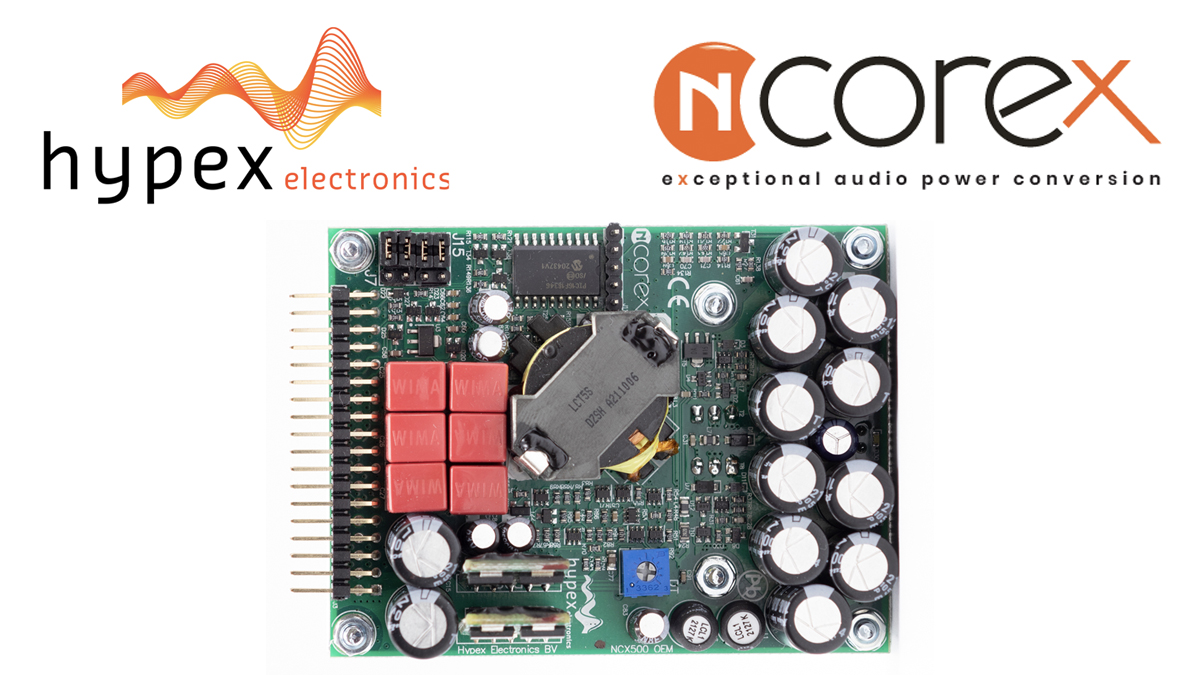
Hypex Announces New and Improved NCOREx Class-D Amplifier Technology

Very interesting but on a marketing level, Hypex was smart in proposing a new module packaged as a Purifi Module.
They proposed a new module packaged as their existing module. https://www.hypex.nl/product/nc500-oem/50
Purifi was smart enough to propose their module packaged as an Hypex module. Not sure if it was a Purifi decision or a NAD requirement BTW.
 
For the moment, the advantage of Hypex over Purifi is pricing power. Something tells me that this will not change anytime soon and that is making a huge difference when talking to the big boys.

The Purifi IP I was talking about is the ability to have a complete mathematical model of the amplifier. This allows to be less conservative on the feedback loop parameters ensuring the ultra high performance we all know about while running extremely cold.

Hypex do not have this ability, the math they use has been published by Bruno P. long time ago.
Beyond technical excellence, it seems like the audible quality should be the same with the same source and speakers... Or shouldn't it be?

The other aspect is heating and power consumption. How are they different in that regard?
 
Let's not forget that the new hotness in audiophile amps is to pair a Purifi or Ncore module with a poorly-designed tube front-end buffer ...
:D
This has always been on the table. I have been receiving same question regarding pairing of the tube front-end with low distortion class A output stage. You get the best of both worlds at once, highest + lowest distortion in one! A good suggestion for an ASR open-project, what do you think? ;)
 
The new NCx500OEM. Only 2 frequencies shown, and assuming the better one is 1kHz and the worst one is 6kHz, and assuming 100Hz is the same as 1kHz. It is all gone better, it's just that 1kHz improved more than 6kHz.

Measured with @22kHz BW, right? How about HF linearity with higher BW? (Yes we are talking about inaudible, we all know that, just tech-talk)

D-killer_1k-15k_thd.png
 
:D
This has always been on the table. I have been receiving same question regarding pairing of the tube front-end with low distortion class A output stage. You get the best of both worlds at once, highest + lowest distortion in one! A good suggestion for an ASR open-project, what do you think? ;)
The only good distortion is the one used in creating artistic sound. For reproduction, the best distortion is the one that does not exist.
 
Beyond technical excellence, it seems like the audible quality should be the same with the same source and speakers... Or shouldn't it be?

The other aspect is heating and power consumption. How are they different in that regard?
Technical excellence allows to run cooler (less losses) with better measured performance. 1.7W idling losses vs 5W is 66% better.
 
Technical excellence allows to run cooler (less losses) with better measured performance. 1.7W idling losses vs 5W is 66% better.
So the effective difference for the customer (let's say, me) between a Hypex and a Purifi based amp is that Slayer will sound equally well, but Purify will waste less electricity.

I'm not mocking it, on the contrary. Less waste in multi channel and for an amp in a rack is amazing news.
 
So the effective difference for the customer (let's say, me) between a Hypex and a Purifi based amp is that Slayer will sound equally well, but Purify will waste less electricity.

I'm not mocking it, on the contrary. Less waste in multi channel and for an amp in a rack is amazing news.
There is one point beyond technical excellence where Hypex and Purifi differ. It is their low pass behavior. Hypex are 1st order, Purifi 2nd order.
The effect is that in the audible band, the Purifi behave like a high bandwidth amplifier, not the case for Hypex. Audibility of this is beyond my competency.
 
There is one point beyond technical excellence where Hypex and Purifi differ. It is their low pass behavior. Hypex are 1st order, Purifi 2nd order.
The effect is that in the audible band, the Purifi behave like a high bandwidth amplifier, not the case for Hypex. Audibility of this is beyond my competency.
From what I read again, Hypex raised the upper f3 from 50 to 80 kHz, against 60 kHz from Purifi? Not that it matters but still.
 
Let's not forget that the new hotness in audiophile amps is to pair a Purifi or Ncore module with a poorly-designed tube front-end buffer ...
Perfect amplification of tube distortions isn't a dream anymore! What a time to be alive :cool:

From the link:
audioXpress is looking forward to the challenge of measuring and reviewing this new Hypex NCx500 OEM module. For now, Niels Burema recommends that judgements should not be just focused on measurements. "We believe listening tests to be more valuable than certain measurements. Even if some setting showed better measurements, if it sounds less than we expect, we would still choose another setting. This process has taken many months, until we were certain that we could get an absolutely wonderful module."
I'm glad they tuned the Hypex NCx500N modules by ear. Everything else wouldn't make sense, right?

Assuming these new Hypex amps are reasonably priced (competitive with Purifi), then is this not the golden age?
It sure is, bud, it sure is. All we need now is to lift the OEM restrictions. Only partners are allowed to buy modules and they are only allowed to sell them if they are integrated., means, they are only allowed to sell complete amps. In the beginning that worked, but then they had to support end users and that they didn't want.
 
Last edited:
From what I read again, Hypex raised the upper f3 from 50 to 80 kHz, against 60 kHz from Purifi? Not that it matters but still.
The Purifi having a second order behavior, you need to take the -6dB point to know the corner frequency, that is 80 kHz.
If you want to compare in the audible band, the Hypex is at -0.25 dB @ 20 kHz, the Purifi is still perfectly flat at the same frequency.
As you write, not that it matters... :)
 
THD+N Comparison_Hypex+Purifi.png

Sources:
 
View attachment 201528
Sources:
Nice! one has to keep in mind that the gain of the different modules is different, strongly influencing the N from the THD+N. The NC400 is 26 dB, the others are around 13 dB. We do not know for the NCx500, but the ultra low noise makes me suspect that this measurement is with buffer bypassed.
 
Nice! one has to keep in mind that the gain of the different modules is different, strongly influencing the N from the THD+N. The NC400 is 26 dB, the others are around 13 dB. We do not know for the NCx500, but the ultra low noise makes me suspect that this measurement is with buffer bypassed.
True. Sadly, it's always tricky to get that info : |
 
We seem to be in the midst of Class-D SINAD wars.

While the main contenders battle with each other, leaving all the old tech dying in a ditch in terms of price/performance and energy efficiency, let's hope it not just an excuse to push prices up for marginal returns in sonic quality....
 
Why would this matter even a bit?
Just wanted to ask the same:

1. Does it really make sense ? (No offense but "old" NCORE is already soo good and there's Purifi at another level, or still not there ?)
2. It's still an analog ClassD, right ? (Not a fully digital one like so called powerDACs)
 
We seem to be in the midst of Class-D SINAD wars.

While the main contenders battle with each other, leaving all the old tech dying in a ditch in terms of price/performance and energy efficiency, let's hope it not just an excuse to push prices up for marginal returns in sonic quality....
Can't wait for more "old"-NCORE standalone modules appear in the DIY lineup, ditching those UcD-s there.
 
View attachment 201528
Sources:
Humm ... so apart from the buffer/no buffer aspect it looks like the Hypex NCx500 beats all up to about 11 watts -- for most people much of the time a lot of listening happens below 10 watts.
 
How do we calculate the wattage used by our amps at normal listening volume? Just have to use a kill-a-watt meter or something?

I have bypassed the buffer on my amps and my pre-amp sits at about -30 dB pretty much all the time unless I have someone over and I am showing off what my system can do. ;)
 
Back
Top Bottom