• Welcome to ASR. There are many reviews of audio hardware and expert members to help answer your questions. Click here to have your audio equipment measured for free!

How XCT Should be Done

Tim Link

Major Contributor
Joined
Apr 10, 2020
Messages
1,161
Likes
995
Location
Eugene, OR
I've been thinking about XTC for many years. I've tried physical divider barriers, Polk Speakers, Carver Sonic Holography, and several DSP implementations. My general sense is that I like what it does for the most part. There's a big wow factor at first and then some contemplation on what it's actually doing wrong.

I propose that we don't want to widen then sound stage beyond what you would expect with a normal stereo listening triangle. I've argued otherwise, but I'm more in line now with the idea that we should, for the most part, hear the sound stage as it was intended to be heard in a standard speaker configuration. I don't always want a hard panned sound to go all the way 180 degrees to my left or right on every recording. But I always want good XTC for center panned sounds.

What I want to get after mostly is crosstalk that colors the sound and reduces clarity. These undesirable side effects mostly happen when sounds are panned center.

So I think a more ideal solution is to keep the stereo speakers where they normally are (like BACCH does) but apply selective crosstalk reduction. Selective crosstalk reduction is going to be fairly processor intensive I fear. Can modern computers do it with high precision in real time? I think maybe they can, with some amount of manageable latency. Maybe not good for video games.

The software will need to figure out which sounds are panned to where in the soundstage, and then make sure they perceptually stay there after crosstalk reduction by properly simulating the sound wave from that phantom source crossing the head at the correct angle. It will also have to figure out what to do with the not-perfectly-in-phase signals between the left and right channels. Are they timed closely enough to be heard as timing panned signals? If so then it needs to make sure both ears hear that sound as they would if it was crossing the head from the correct angle that the time delay normally images to. If not, then they could just be treated as hard panned left and right signals and left alone. Or maybe if they are exactly opposite phase the XTC could be used to maximize spaciousness without inadvertently moving sound sources in the sound stage.

It may be possible to get the speakers to generate the wave front across the head correctly with the DSP. They already produce a time delay with level panning as Blumlein recognized. So maybe converting all the timing panning to level panning would be enough. But if the HRTF is not correct at each ear, then the software would need to apply appropriate HRTF equalization to match the intended wave front direction.

Thoughts anyone? Is this crazy, or should I start working on the software? I think this could be applied to headphone listening as well.

What I'm not sure about is if all this processing could actually result in a net gain in perceived audio quality.
 
Last edited:
I've been thinking about XTC for many years. I've tried physical divider barriers, Polk Speakers, Carver Sonic Holography, and several DSP implementations. My general sense is that I like what it does for the most part. There's a big wow factor at first and then some contemplation on what it's actually doing wrong.
Carver Sonic Holography is a very early and quite basic attempt. It should not be used as a reference for what properly implemented digital XTC is capable of today. It is unfair to promote modern DSP by making claims against the earlier products.
I propose that we don't want to widen then sound stage beyond what you would expect with a normal stereo listening triangle. I've argued otherwise, but I'm more in line now with the idea that we should, for the most part, hear the sound stage as it was intended to be heard in a standard speaker configuration. I don't always want a hard panned sound to go all the way 180 degrees to my left or right on every recording. But I always want good XTC for center panned sounds.
This is interesting because true XTC is not designed as a deliberate stage-widening or depth-enhancing effect. Yes, it does enhance both width and depth on many recordings, but that is simply the perceptual result of restoring the interaural cues that crosstalk had corrupted. Blumlein was already aware of this crosstalk problem in the 1930s; he simply had no practical way to cancel it at the time. The core purpose remains cue correction, not artificial expansion. There is also a valid practical reason why research has long shown that effective cancellation is easier and more robust when the speakers are at a relatively narrow angle. With speakers placed closer together, a hard-panned left or right signal tends to land closer to conventional stereo width rather than shooting out to the extreme sides. At the traditional 60-degree spacing, simple cancellation has more residual issues to address.
What I want to get after mostly is crosstalk that colors the sound and reduces clarity. These undesirable side effects mostly happen when sounds are panned center.
The claim of inevitable or severe coloration is largely inherited from older mathematical models and from poorly tuned early implementations. Even the older Miller Ambiophonics DSP was not particularly colored when set up carefully. There may be a slight difference, but it is not something most listeners would immediately call “colored.” My own CTXMatrix, which uses only delay and attenuation with no EQ, shows essentially no audible coloration with speakers at 20 degrees once the delay and attenuation are properly calibrated by ear. You can hear the comparison for yourself here:

That said, the word “colouration” itself is surprisingly poorly defined in this context. Once the spatial cues change (stage width, externalization, image focus), the brain’s judgment of tonal character is no longer independent of the spatial presentation. Without controlled listening that isolates pure spectral change from the change in spatial cues, it becomes very hard to say definitively which version is “colored.” The video approach of presenting the same material under different processing conditions is therefore more useful than abstract assertions.
So I think a more ideal solution is to keep the stereo speakers where they normally are (like BACCH does) but apply selective crosstalk reduction. Selective crosstalk reduction is going to be fairly processor intensive I fear. Can modern computers do it with high precision in real time? I think maybe they can, with some amount of manageable latency. Maybe not good for video games.
One practical question the published literature still does not answer clearly is how effective cancellation remains when the speakers sit at 30 degrees or wider, where monaural pinna cues for direction are strong. Cancelling the crosstalk at those angles can reduce the level of the contralateral signal, but it does not actively suppress or override the monaural pinna localization mechanism that the ear is still using. To achieve that you would need to apply some form of pinna-related correction filtering to the original signals themselves—something basic delay-and-attenuation processors deliberately avoid. That kind of processing is more CPU-intensive. Basic delay-and-attenuation XTC, by contrast, uses very little processing power. Feel free to measure it yourself with the free version of CTXMatrix.
The software will need to figure out which sounds are panned to where in the soundstage, and then make sure they perceptually stay there after crosstalk reduction by properly simulating the sound wave from that phantom source crossing the head at the correct angle. It will also have to figure out what to do with the not-perfectly-in-phase signals between the left and right channels. Are they timed closely enough to be heard as timing panned signals? If so then it needs to make sure both ears hear that sound as they would if it was crossing the head from the correct angle that the time delay normally images to. If not, then they could just be treated as hard panned left and right signals and left alone. Or maybe if they are exactly opposite phase the XTC could be used to maximize spaciousness without inadvertently moving sound sources in the sound stage.
That level of content-aware analysis goes beyond the purpose of crosstalk cancellation and starts to become an effects processor.
It may be possible to get the speakers to generate the wave front across the head correctly with the DSP. They already produce a time delay with level panning as Blumlein recognized. So maybe converting all the timing panning to level panning would be enough. But if the HRTF is not correct at each ear, then the software would need to apply appropriate HRTF equalization to match the intended wave front direction.
When we eventually have practical beam-forming speakers that can focus sound to just one ear, we will already have perfect stereo reproduction without needing XTC at all. Unfortunately the usable range and bandwidth of current beam-forming designs are still limited.

ST
 
Thanks for your detailed responce STC! I'm writing this response while listening to my own custom implementation of XTC that is producing a 180 degree soundfield. It's a little crazy but I love it. I'm listening to Herb Alpert and it's clearly just mixed hard left, center, and hard right. Nothing in between. It sounds like 3 mono sources arranged in a triangle around me.
Carver Sonic Holography is a very early and quite basic attempt. It should not be used as a reference for what properly implemented digital XTC is capable of today.
I was just giving some history of myself. My point was that I've been interested in this idea since before much better digital implementations were available.

The claim of inevitable or severe coloration is largely inherited from older mathematical models and from poorly tuned early implementations. Even the older Miller Ambiophonics DSP was not particularly colored when set up carefully.
I'm not complaining about the coloration from crosstalk reduction. I'm assuming that's resolved. I'm talking about the inherent coloration from crosstalk itself, and why we need crosstalk reduction, especially for the phantom center. Not so much for side panned sounds. With the speakers closer together that might help narrow the soundstage some but we still want side panned sounds to produce the correct 30 degree angle across the head HRTF, not the straight ahead HRTF from narrow spaced speakers.

That level of content-aware analysis goes beyond the purpose of crosstalk cancellation and starts to become an effects processor.
My argument is that it does not go beyond the purpose of crosstalk cancellation but actually more fully addresses the intent. There's no reason to use XTC on hard panned left or right signals. THAT is an effects processor - and a fun one. But ideally I just want to restore tonality and clarity of phantom imaging between the speakers. Content aware analysis allows us to reduce unwanted artificial effects by not applying XTC where it isn't needed. Unforutnately it's difficult to do from what I can tell so far. But probably not impossible. It might sound really good. I guess I'll never know unless I try it, or somebody else does.

When we eventually have practical beam-forming speakers that can focus sound to just one ear, we will already have perfect stereo reproduction without needing XTC at all. Unfortunately the usable range and bandwidth of current beam-forming designs are still limited.
Maybe that's ultimately the solution I'm looking for. I'm not sure how that would work. When I think about it from what little I understand it seems like it would still need to be content aware to know which frequencies to beam from where.
 
Last edited:
  • Like
Reactions: STC
Maybe dumb question maybe not, if crosstalk is so objectionable why not listen on headphones?

Crosstalk coloration is accounted for in the mix because all stereo setups have some. So the comb filtering you get in the upper mids and treble should be handled already, at least in terms of tonality.


I'm listening to Herb Alpert and it's clearly just mixed hard left, center, and hard right. Nothing in between. It sounds like 3 mono sources arranged in a triangle around me
This sounds like my typical headphone listening experience... Which is why I use cross feed to avoid it ;).
 
Maybe dumb question maybe not, if crosstalk is so objectionable why not listen on headphones?

Crosstalk coloration is accounted for in the mix because all stereo setups have some. So the comb filtering you get in the upper mids and treble should be handled already, at least in terms of tonality.


This sounds like my typical headphone listening experience... Which is why I use cross feed to avoid it ;).
Headphones solve the problem of crosstalk interference. If you can just get them EQ'd to match your HRTF you should get a magnificent externalized sound field that appears to be filling whatever environment you are in. However, I'd argue that to optimize the experience the crossfeed software should be content aware and apply appropriate HRTF to sounds coming from whatever direction they're supposed to sound like they're coming from in a standard 60 degree listening triangle. How much improvement that would make perceptually is a good question. I'm imagining it would make many stereo recordigns sound very close to a customized binaural recording that was made just for you if it was done correctly.

Crosstalk coloration cannot be accounted for in the mix. I've asked people who do mixing and they explain that fixing it is not practical because people will be listening in different environments and sometimes on headphones, and trying to optimize the tone for one specific listening situation will screw up everything else. The mix has to to mix down to mono and still sound good. What they count on is room reflections to mask it.

Do you use crossfeed with time delay? I've always thought that was the right way to do it, but without the complex software I'm proposing it may be best just to mix some mono with maybe some EQ to account for HRTF. By just mixing mono in without time delay you can avoid mucking things up, at least on purely level panned recordings, which is most of them.
 
Last edited:
My response to kemmler3D leads me to an obvious and simple solution for many recordings when they get too wide when using XTC on stereo speakers. Just mix some mono in! This seems like an excellent fix for level panned recordings. You avoid crosstalk intereference nulls while restoring a reasonable width soundstage! I've been playing with it and for some recordings it seems to work great. It's sort of funny to go through the work of getting the stereo separation maximized like you have with headphones and then narrow it back down by adding mono back in - essentially crossfeed. LOL! But I can't think of what's wrong with it for pure level panned recordings.

Update: I've been playing around mixing mono in to the stereo and this isn't best for most recordings. The mono can sometimes produce multiple stereo images instead of moving the imaging inboard. Apparently most recordings I listen to are not purely level panned so I really can't get away with this.
 
Last edited:
Firstly, XTC DSP is a hard sell for many because most discussions start from three common presumptions:
  1. that XTC is inherently coloured,
  2. that it produces a weak centre, and
  3. that the recordist intended the crosstalk to be part of the recording.
The actual purpose of loudspeaker crosstalk cancellation is simpler and more fundamental: to deliver the interaural cues to the ears so that they correspond to the positions that would exist in real space. The goal is natural perception of a frontal stage, not an artificial effect that places sounds all around the listener the way games or surround modes do.

Very few people outside laboratories have heard proper crosstalk cancellation without DSP. The correct reference is a free-field or highly damped room with a barrier between the speakers, the speakers themselves placed at less than 20° (not the conventional 60°). In that condition a hard-panned signal emerges further outside from the physical speaker location. This is what the occlusion method tries to achieve. If you then occlude the contralateral ear, the image typically shifts only a modest amount outward — often just a few degrees beyond the speaker, but for some people with greater pinnae sometimes barely at all depending on the speaker’s angle. That modest outward shift is what the soundstage “should” do.

When we hear hard-panned signals fly out to 90° or beyond with DSP, we have to ask whether that is correct, or whether it is the result of over-cancellation, or of applying the cancellation at the conventional 60° speaker angle. The difference between listening at <20° versus 60° is large enough that many observations made at one angle simply do not transfer to the other.

Ralph Glasgal of the Ambiophonics Institute addressed the pinna contribution decades ago. A simple experiment demonstrates it: a sound source directly in front, one ear blocked — the image usually shifts only 10–20°, and with good pinnae may not move at all. Monaural pinna cues are stronger than many people expect, and any system that ignores them will not sound fully natural.

There is also a widespread presumption that higher crosstalk attenuation automatically equals better performance. For music this is not true. In nature a sound arriving from 25° is still heard by both ears, with a specific level difference, timing difference and pinna filtering. When cancellation pushes the contralateral attenuation to 30 dB or more while the timing still indicates ~25°, the brain receives conflicting information. That mismatch is a plausible explanation for the reports of “weird” hard-panned images or a subjectively weak centre that some listeners experience with aggressive XTC.

Another common complaint is a weak or hollow centre. This is largely a self-inflicted problem that appears when XTC is applied at the conventional 60° speaker angle.

Every experienced listener already knows that bringing the speakers closer together strengthens and solidifies the phantom centre, while spreading them too wide creates a hollow-centre feeling. When strong crosstalk cancellation is performed at 60°, the sides are pushed far outward and the centre relative balance suffers in much the same way. Listeners who remember the old “Stereo / Wide Stereo” switches on 1980s–90s TVs and receivers will recognise the effect: the widened mode could sound impressive but often felt less natural and mismatched the picture, so many preferred the ordinary stereo setting.

At narrow angles (around 20° or less) the situation is different. The close spacing itself already produces a strong, coherent centre image. Applying proper XTC at that geometry removes the comb-filtering and interaural interference that normally weaken and colour the centre, while the acoustic summation of the two closely spaced sources further supports centre level. The result is usually a solid, well-balanced centre rather than a hollow one.

In short, the extreme 180° stage is not the natural or necessary outcome of correct crosstalk cancellation. It is often the result of applying the process more aggressively (or at a wider speaker angle) than the reference condition requires.

Just like what feels natural with crossfeed for headphones, you also need some residual crosstalk with XTC. Not too much and not too little. That can only be determined by listening. Microphones cannot measure what the brain decodes.

ST
 
However, I'd argue that to optimize the experience the crossfeed software should be content aware and apply appropriate HRTF to sounds coming from whatever direction they're supposed to sound like they're coming from in a standard 60 degree listening triangle. How much improvement that would make perceptually is a good question. I'm imagining it would make many stereo recordigns sound very close to a customized binaural recording that was made just for you if it was done correctly.
Yep, my understanding is that hrtf conversation compensation with head tracking is pretty next-level but I haven't tried it myself.


Crosstalk coloration cannot be accounted for in the mix
I think the mixing requirements you mention are related but not necessarily the same thing as not correcting for the change in tonality due to crosstalk. Mixes need to sound good in many situations and you can't have full inversion between left and right because it will wreck a mono mixdown, but that doesn't mean that they just leave the tonality sounding wrong when crosstalk is present... It's present in the studio like any other stereo setup.
Do you use crossfeed with time delay?
I use a plug-in that I think introduces the right amount of delay for each ear. Subjectively it's not dramatic but it kinda breaks up the headphone stereo image from the hard LCR thing mentioned to a more continuous/ smooth one. I can't claim that it makes the soundstage seem further away from my head unfortunately, just prevents the soundstage from being locked to three distinct points.
 
Firstly, XTC DSP is a hard sell for many because most discussions start from three common presumptions:
  1. that XTC is inherently coloured,
  2. that it produces a weak centre, and
  3. that the recordist intended the crosstalk to be part of the recording.
The actual purpose of loudspeaker crosstalk cancellation is simpler and more fundamental: to deliver the interaural cues to the ears so that they correspond to the positions that would exist in real space. The goal is natural perception of a frontal stage, not an artificial effect that places sounds all around the listener the way games or surround modes do.

Very few people outside laboratories have heard proper crosstalk cancellation without DSP. The correct reference is a free-field or highly damped room with a barrier between the speakers, the speakers themselves placed at less than 20° (not the conventional 60°). In that condition a hard-panned signal emerges further outside from the physical speaker location. This is what the occlusion method tries to achieve. If you then occlude the contralateral ear, the image typically shifts only a modest amount outward — often just a few degrees beyond the speaker, but for some people with greater pinnae sometimes barely at all depending on the speaker’s angle. That modest outward shift is what the soundstage “should” do.

When we hear hard-panned signals fly out to 90° or beyond with DSP, we have to ask whether that is correct, or whether it is the result of over-cancellation, or of applying the cancellation at the conventional 60° speaker angle. The difference between listening at <20° versus 60° is large enough that many observations made at one angle simply do not transfer to the other.

Ralph Glasgal of the Ambiophonics Institute addressed the pinna contribution decades ago. A simple experiment demonstrates it: a sound source directly in front, one ear blocked — the image usually shifts only 10–20°, and with good pinnae may not move at all. Monaural pinna cues are stronger than many people expect, and any system that ignores them will not sound fully natural.

There is also a widespread presumption that higher crosstalk attenuation automatically equals better performance. For music this is not true. In nature a sound arriving from 25° is still heard by both ears, with a specific level difference, timing difference and pinna filtering. When cancellation pushes the contralateral attenuation to 30 dB or more while the timing still indicates ~25°, the brain receives conflicting information. That mismatch is a plausible explanation for the reports of “weird” hard-panned images or a subjectively weak centre that some listeners experience with aggressive XTC.

Another common complaint is a weak or hollow centre. This is largely a self-inflicted problem that appears when XTC is applied at the conventional 60° speaker angle.

Every experienced listener already knows that bringing the speakers closer together strengthens and solidifies the phantom centre, while spreading them too wide creates a hollow-centre feeling. When strong crosstalk cancellation is performed at 60°, the sides are pushed far outward and the centre relative balance suffers in much the same way. Listeners who remember the old “Stereo / Wide Stereo” switches on 1980s–90s TVs and receivers will recognise the effect: the widened mode could sound impressive but often felt less natural and mismatched the picture, so many preferred the ordinary stereo setting.

At narrow angles (around 20° or less) the situation is different. The close spacing itself already produces a strong, coherent centre image. Applying proper XTC at that geometry removes the comb-filtering and interaural interference that normally weaken and colour the centre, while the acoustic summation of the two closely spaced sources further supports centre level. The result is usually a solid, well-balanced centre rather than a hollow one.

In short, the extreme 180° stage is not the natural or necessary outcome of correct crosstalk cancellation. It is often the result of applying the process more aggressively (or at a wider speaker angle) than the reference condition requires.

Just like what feels natural with crossfeed for headphones, you also need some residual crosstalk with XTC. Not too much and not too little. That can only be determined by listening. Microphones cannot measure what the brain decodes.

ST
Thanks for that reply. My attempts at using a barrier had the speakers very close together and I liked the results. I've never heard anything yet that I liked better. Some recordings would sound perfectly normal, but others would reveal hidden beauty that was mind boggling, and sometimes sound would spread all around me to 180 degrees. But usually the sound stage seemed very natural, much more so than with a standard stereo setup.

I currently have my speakers widely spaced because of my living arrangements, but it delivers a surprisingly solid and stable center image, very bright and clear. My thinking is it has to do with improved head shadowing at the wider angles, and a longer ITD, which moves the lowest frequency null down lower into a range that doesn't bother me as much as the typical 2 kHz range. There's a bump there now. I looked at some dummy head data for narrow vs wide angles and calculated the crosstalk. It's posted somewhere on this forum. It looked pretty bad either way but I prefer the wider arrangement. The standard 60 degree spread is tonally the worst for me, especially on many female vocals. Either closer or wider. Nothing in between.
Honestly I haven't been happy with any digital crosstalk reduction I've heard so far. It just seems too messy. But I may just not have heard it at it's best yet. The divider panel was very pure and lovely sounding.
 
I've been thinking about XTC for many years. I've tried physical divider barriers, Polk Speakers, Carver Sonic Holography, and several DSP implementations. My general sense is that I like what it does for the most part. There's a big wow factor at first and then some contemplation on what it's actually doing wrong.

I propose that we don't want to widen then sound stage beyond what you would expect with a normal stereo listening triangle. I've argued otherwise, but I'm more in line now with the idea that we should, for the most part, hear the sound stage as it was intended to be heard in a standard speaker configuration. I don't always want a hard panned sound to go all the way 180 degrees to my left or right on every recording. But I always want good XTC for center panned sounds.

What I want to get after mostly is crosstalk that colors the sound and reduces clarity. These undesirable side effects mostly happen when sounds are panned center.

So I think a more ideal solution is to keep the stereo speakers where they normally are (like BACCH does) but apply selective crosstalk reduction. Selective crosstalk reduction is going to be fairly processor intensive I fear. Can modern computers do it with high precision in real time? I think maybe they can, with some amount of manageable latency. Maybe not good for video games.

The software will need to figure out which sounds are panned to where in the soundstage, and then make sure they perceptually stay there after crosstalk reduction by properly simulating the sound wave from that phantom source crossing the head at the correct angle. It will also have to figure out what to do with the not-perfectly-in-phase signals between the left and right channels. Are they timed closely enough to be heard as timing panned signals? If so then it needs to make sure both ears hear that sound as they would if it was crossing the head from the correct angle that the time delay normally images to. If not, then they could just be treated as hard panned left and right signals and left alone. Or maybe if they are exactly opposite phase the XTC could be used to maximize spaciousness without inadvertently moving sound sources in the sound stage.

It may be possible to get the speakers to generate the wave front across the head correctly with the DSP. They already produce a time delay with level panning as Blumlein recognized. So maybe converting all the timing panning to level panning would be enough. But if the HRTF is not correct at each ear, then the software would need to apply appropriate HRTF equalization to match the intended wave front direction.

Thoughts anyone? Is this crazy, or should I start working on the software? I think this could be applied to headphone listening as well.

What I'm not sure about is if all this processing could actually result in a net gain in perceived audio quality.
The inventor of 5.1 surround sound (Tom Holman) was experimenting with this prior to 1977, when he released the APT/Holman Preamp:
Apt Holman Preamplifier

Apt Holman Preamplifier. enlarge.​

Stereo Mode Controls

Leave the MODE knob in the middle at STEREO, and leave the L > R and R > L switches down for normal stereo.

For mono, turn the knob to the left. The left-side of the control slowly narrows the image from stereo into mono. Controls like this were popular in the 1960s because people, used to mono, were sometimes uncomfortable with the full stereo effect.

Turning the knob to the right expands the stereo image. This doesn't excite me as much as I thought it would; it mostly just sucks out the center of the image.

The L > R and R > L switches select what input channels go to what output channels.

Here's what they do:

L > RR > L
downdownNormal Stereo
UPdownLeft channel input heard as mono in both output channels
downUPRight channel input heard as mono in both output channels
UPUPReversed Stereo
If you'd like more detail, Tom ran out of panel space to label these more clearly as MONITOR INPUT SELECT RIGHT and MONITOR INPUT SELECT LEFT, which is what they're really doing.

If you lift the L > R switch, it puts the left channel into the right channel. The left channel remains in the left channel. You now are listening to the left channel (in mono of course) in both channels.

Lifting the R > L switch does the same thing, playing the right channel in both channels.

Lifting both switches at the same time simply flips the channels: left goes to right, and right goes to left.

These two switches allow the six line-level stereo inputs (including the tape and EPL loops) as up to twelve discrete mono inputs!

(EJ3: Playing with the controls, you could have a perceived widening or narrowing effect on the stereo imaging).

And with 2 of these: one could do this (which I have proven with my pair):
Quadraphonic Synthesis

With two Holman Preamplifiers, you can synthesis and control four output channels from just two input channels.

Apply all your inputs to the first Holman Preamplifier. Use it for all your tone controls, filters and source and tape selections. Leave its Stereo Mode in Stereo.

Connect the first Holman Preamplifier's MAIN 1 output to one power amplifier and your two front speakers.

Connect the first Holman Preamplifier's MAIN 2 output to any line-level input of the second Holman Preamplifier.

Connect the second Holman Preamplifier's MAIN 1 output to the power amplifier for your two rear speakers.

Rotate the second Holman Preamplifier's stereo mode control to L-R, and start by setting it to about unity gain or a bit less, and keep its tone controls flat. The tone and filter settings of the first Holman Preamplifier are fed automatically to the second Holman Preamplifier.

Set balance on the first preamp. Set front-rear balance on the Volume control of the second preamp.

Leave the power switch of the second preamp ON, and plug its power cord into a switched outlet of the first Holman Preamplifier. Now the power is controlled by the first Holman Preamplifier, too.
 
Last edited:
Crosstalk coloration cannot be accounted for in the mix. I've asked people who do mixing and they explain that fixing it is not practical because people will be listening in different environments and sometimes on headphones, and trying to optimize the tone for one specific listening situation will screw up everything else. The mix has to to mix down to mono and still sound good. What they count on is room reflections to mask it.

I have a fun little listening test for you (I hope).
Have a listen to the following vocal tracks and tell me if you prefer any one over the others when it comes to the clarity and tonality of phantom sound imaging. It's meant to be purely a listening test, so please don't try to analyze the sound files looking for differences. :)

1. How do you find the clarity between the sound files?
2. How do you find the tonality between the sound files?
3. Do you have a different preference between the sound files when listening to them on a single mono speaker compared to listening to them in stereo for a phantom sound?

Ape A: https://www.dropbox.com/scl/fi/vgjb...ey=q5xauutyjmvzxcssvlfnvew5g&st=sa03cb1l&dl=0

Ape B: https://www.dropbox.com/scl/fi/nfmc...ey=mxzrrjas1nixqh6b0dplv11f0&st=sabwfhua&dl=0

Ape C: https://www.dropbox.com/scl/fi/bc35...ey=ggzx85943xv87kdfi5vzx03bc&st=lqv3m6ly&dl=0
 
The inventor of 5.1 surround sound (Tom Holman) was experimenting with this prior to 1977, when he released the APT/Holman Preamp:
Apt Holman Preamplifier

Apt Holman Preamplifier. enlarge.​

Stereo Mode Controls

Leave the MODE knob in the middle at STEREO, and leave the L > R and R > L switches down for normal stereo.

For mono, turn the knob to the left. The left-side of the control slowly narrows the image from stereo into mono. Controls like this were popular in the 1960s because people, used to mono, were sometimes uncomfortable with the full stereo effect.

Turning the knob to the right expands the stereo image. This doesn't excite me as much as I thought it would; it mostly just sucks out the center of the image.

The L > R and R > L switches select what input channels go to what output channels.

Here's what they do:

L > RR > L
downdownNormal Stereo
UPdownLeft channel input heard as mono in both output channels
downUPRight channel input heard as mono in both output channels
UPUPReversed Stereo
If you'd like more detail, Tom ran out of panel space to label these more clearly as MONITOR INPUT SELECT RIGHT and MONITOR INPUT SELECT LEFT, which is what they're really doing.

If you lift the L > R switch, it puts the left channel into the right channel. The left channel remains in the left channel. You now are listening to the left channel (in mono of course) in both channels.

Lifting the R > L switch does the same thing, playing the right channel in both channels.

Lifting both switches at the same time simply flips the channels: left goes to right, and right goes to left.

These two switches allow the six line-level stereo inputs (including the tape and EPL loops) as up to twelve discrete mono inputs!

(EJ3: Playing with the controls, you could have a perceived widening or narrowing effect on the stereo imaging).

And with 2 of these: one could do this (which I have proven with my pair):
Quadraphonic Synthesis

With two Holman Preamplifiers, you can synthesis and control four output channels from just two input channels.

Apply all your inputs to the first Holman Preamplifier. Use it for all your tone controls, filters and source and tape selections. Leave its Stereo Mode in Stereo.

Connect the first Holman Preamplifier's MAIN 1 output to one power amplifier and your two front speakers.

Connect the first Holman Preamplifier's MAIN 2 output to any line-level input of the second Holman Preamplifier.

Connect the second Holman Preamplifier's MAIN 1 output to the power amplifier for your two rear speakers.

Rotate the second Holman Preamplifier's stereo mode control to L-R, and start by setting it to about unity gain or a bit less, and keep its tone controls flat. The tone and filter settings of the first Holman Preamplifier are fed automatically to the second Holman Preamplifier.

Set balance on the first preamp. Set front-rear balance on the Volume control of the second preamp.

Leave the power switch of the second preamp ON, and plug its power cord into a switched outlet of the first Holman Preamplifier. Now the power is controlled by the first Holman Preamplifier, too.
Is this simply a preamp with a mid/side matrix? These days it's very easy to get this functionality in vst plugins, and I guess you could implement your 'quad' thing if you had a DAC with 4+ outputs, although if I'm reading this right you're putting Mid/Mid on the front and Side/Side on the back?
 
The actual purpose of loudspeaker crosstalk cancellation is simpler and more fundamental: to deliver the interaural cues to the ears so that they correspond to the positions that would exist in real space.
While I agree that perceptually the closely located speaker positions work well and sound very good, they don't actually mimic the interaural cues from corresponding positions that would exist in real space. The timing cues are missing - unless they actually are in the recording. The level cues are stronger than they should be, assuming strong XTC, so the pinnae have to compensate. The pinnae cues are locked and do not change as they should as sounds come from different virtual directions. The pinnae cues being locked is a fundamental shortcoming of having only two speakers.

My experience matches what Ralph Galsgal said about blocking one ear. My brain understands a blocked ear and compensates immediately. A divider panel with stereo speakers is a somewhat different thing, a situation that my brain isn't as aware of because both ears are locally unblocked. The imaging may be narrow during the first few minutes of a listening session as I am visually aware of the sound source being blocked by a divider, but then gradually widens as I turn down the lights and forget the divider so my brain can relax into the illusion. I recall the perceptual effect taking a few minutes to fully realize.

I think we could make a better version of XTC that would solidly anchor the perceived locations with more perfect inter-aural cues, including correct timing and pinnae and head shadowing cues, whether the speakers are narrowly or more widely spaced. This should mimic upmixing to many more speakers between the normal stereo pair, and some outboard too for reverse polarity signals between the ears, which could be panned to whatever position is most satisfying.

This whole thought experiment came to me as I have been pondering how to ideally upmix stereo. Ideally we'd upmix to lots of speakers - so many that there'd be one about every 2 degrees of listening angle. But many speakers and amp channels is impractical. Better to just virtualize them over 2 speakers using either headphones or stereo speakers with XTC. So my idea of XTC would require maximum crosstalk elimination for center panned items. Maybe all the way across if the software converts all level difference cues to timing cues. I'm not sure which way would be best. It's easier on headphones since the XTC part can be eliminated all together. These Airpod Pro 3 are convincing me that HRTF externalization on headphones really works. The dream has been realized - at least to a fair degree.
 
Last edited:
I have a fun little listening test for you (I hope).
Have a listen to the following vocal tracks and tell me if you prefer any one over the others when it comes to the clarity and tonality of phantom sound imaging. It's meant to be purely a listening test, so please don't try to analyze the sound files looking for differences. :)

1. How do you find the clarity between the sound files?
2. How do you find the tonality between the sound files?
3. Do you have a different preference between the sound files when listening to them on a single mono speaker compared to listening to them in stereo for a phantom sound?

Ape A: https://www.dropbox.com/scl/fi/vgjb...ey=q5xauutyjmvzxcssvlfnvew5g&st=sa03cb1l&dl=0

Ape B: https://www.dropbox.com/scl/fi/nfmc...ey=mxzrrjas1nixqh6b0dplv11f0&st=sabwfhua&dl=0

Ape C: https://www.dropbox.com/scl/fi/bc35...ey=ggzx85943xv87kdfi5vzx03bc&st=lqv3m6ly&dl=0
Thanks for doing this. We'll see what kinds of insights this might bring once you reveal what has been done to these three samples.

They sound pretty similar. I can't make out exactly all that he's saying on any of them. A seems slightly rolled off on top. B seems more balanced. C seems a little hollower. I'm getting a sort of hollow, canned, harsh and edgy sound from all of them so that may just be me. I get similar impressions on headphones, over speakers in stereo, and in mono. Frankly, they all sound rather strange. Maybe I'm just not used to hearing a dry track like that.
 
Thanks for doing this. We'll see what kinds of insights this might bring once you reveal what has been done to these three samples.

I didn't have to do anything, as I already had these sound files prepared since a similar discussion a few years ago. :)

They sound pretty similar. I can't make out exactly all that he's saying on any of them. A seems slightly rolled off on top. B seems more balanced. C seems a little hollower. I'm getting a sort of hollow, canned, harsh and edgy sound from all of them so that may just be me. I get similar impressions on headphones, over speakers in stereo, and in mono. Frankly, they all sound rather strange. Maybe I'm just not used to hearing a dry track like that.

Sound file A is the original vocal recording, B has a +3 dB compensation at around 1.8 or at 2 kHz (don't remember exactly) for the largest HRTF-related dip, and sound file C has +6 dB compensation for that same frequency area.

The smaller compensation of +3 dB seems to work best for you, and it doesn't seem like that compensation introduced any obvious problem when you changed between listening on headphones, stereo speakers, or a mono speaker.

Of course, there are other HRTF-related frequency areas that may need compensation, but I think I made my point that the problems can be addressed in mixing without introducing new problems for headphones or mono listening. The reason for that is that the compensations doesn't have to be as large as the HRTF-related dips looks like in measurements made in an anechoic chamber, for the reason you point out, that a normal listening room will be masking most of these problems. :)
 
Is this simply a preamp with a mid/side matrix? These days it's very easy to get this functionality in vst plugins, and I guess you could implement your 'quad' thing if you had a DAC with 4+ outputs, although if I'm reading this right you're putting Mid/Mid on the front and Side/Side on the back?
First: I am well aware that one could use computers and plug-ins to do these things.
Some of us do not use computers in our systems (that is not to say that some things in our systems don't have processors inside of them) I was forced to use computers while working (even though the jobs could be done quicker without using a computer [they don't have much use when you are in the hold of a ship, as there is a serious lack of connectivity]) and I have to use them to do some of my automotive hobby things Tuning engines, deleting or bypassing limitations put on by the manufacturer, etc).
But, for something for my own pleasure, I personally have no use case for desktop/laptop/tablet computers in my audio system. (I'm not saying that it won't happen, but so far, I haven't had the need for it) and having to use a computer to get something done does not give me pleasure).
I was only trying to show that this could EASILY be done in 1977.
And that that was what I did then and is what I use now.
Apt Holman Preamplifier

(You may have missed the fact that these preamps have [1 external processor loop in and out {each}] as part of the circuit design, which means that there were/are many ways that you could integrate circuitry then and now to do all sorts of things, matrix or discrete).

This is the (successful part) of the history behind the multi-channel sound. Tomlinson Holman was hired out of MIT by Henry Kloss (who attended MIT but did way better leaving it and doing his own thing). Tomlinson Holman went on to make the APT/Holman preamps (APT=The companies name. The word “apt” is an adjective that means suitable, appropriate, or fitting for a situation.)
And he, the person that came up with this, also was the person that invented and patented all the surround sound systems back then. He was hired by Georg Lucas to help create Lucas Film and he devised the THX system, and had Movie theatres paying him a monthly fee to use that system.
He is still in the game:

Sound for Film and Television; Third Edition - AWS​


Sep 11, 2026 ... , Tomlinson Holman. All rights reserved. The right of Tomlinson ... Appendix IV Bibliography . . . . . . . . . . . . . 207. Glossary ...

https://eu3-browse.startpage.com/av...sGfxjd4XeKItZGtargjU4ppVeZCzgtAM3k0vZAFVrzAKh
Another, earlier reference for a bit more info (Please check the 3rd name of the various authors [you may also recognize others):
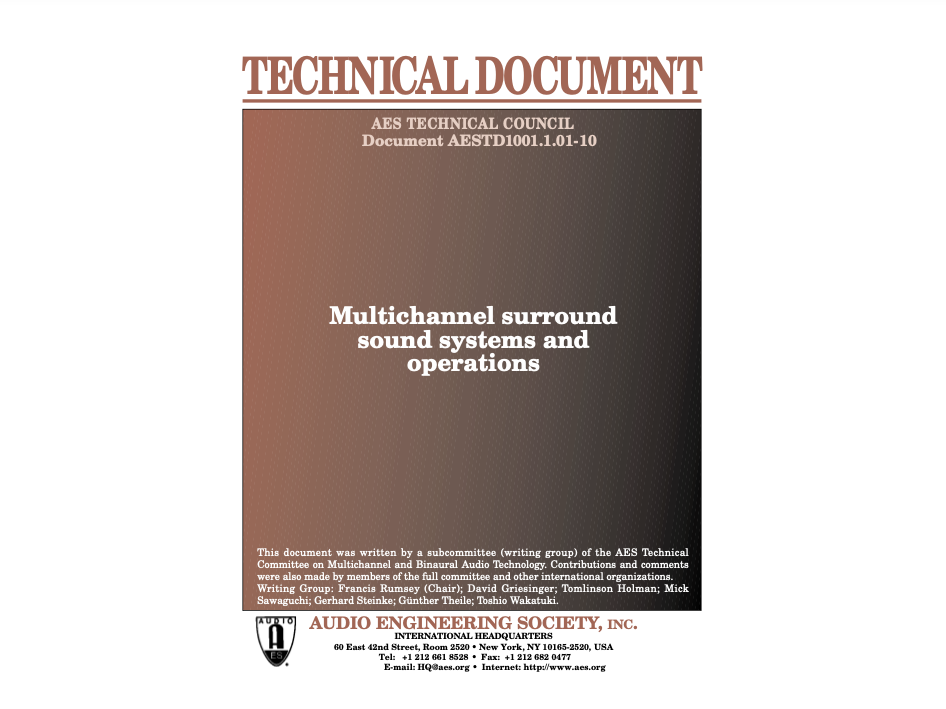
Writing Group: Francis Rumsey (Chair); David Griesinger; Tomlinson Holman; Mick Sawaguchi; Gerhard Steinke; Günther Theile; Toshio Wakatuki
Prepared by: AES Technical Committee on Multichannel and Binaural Audio Technology (TC-MBAT)

Abstract​

This AES Technical Document reports developing practices for the configuration and operation of multichannel surround sound systems based on the ITU-R BS.775-1 3/2 (5.1-channel) model. It summarizes international standards and accepted industry practices for multichannel recording, monitoring, loudspeaker configuration, listening environments, low-frequency extension, program interchange, and system alignment. The document is intended to provide practical guidance to studios, broadcasters, recording engineers, and equipment manufacturers while documenting the current state of the art in multichannel audio reproduction.

Keywords: multichannel audio; surround sound; 5.1 audio; 3/2 stereo; ITU-R BS.775-1; loudspeaker configuration; monitoring environments; LFE; program interchange; studio monitoring; audio reproduction; broadcast audio

Technical Document: AESTD1001.1.01-10
Published: October 2001
Version: 1.01-10

References: See the PDF for the complete list of references.


This whole thought experiment came to me as I have been pondering how to ideally upmix stereo. Ideally we'd upmix to a ver large number of speakers - so many that there'd be one about every 2 degrees of listening angle. But many speakers and amp channels is impractical.

Thanks Tim for explaining in detail, and I’m glad you’ve also had experience with physical barriers. Although, complete isolation is rather compromised with physical barriers due to lower frequencies easily escapes the barrier, I decide another method by using binaural recording mixing individually recorded channel where I can have perfect cancellation. Using this method you get a chance to figure out which level of attenuation would be the best. Maybe will write about it in detail one day.

I think we may be pursuing somewhat different objectives. From your latest reply it sounds as if you want a system that can generate or correct interaural cues more completely (timing, pinna, head-shadow) and effectively virtualise a denser set of directions. That is closer to advanced spatial enhancement or binaural upmixing (tools such as Nugen Stereoizer, DearVR Pro, etc.) than to classic crosstalk cancellation.

On the pinna point with closely spaced speakers: the brain relies less on fine pinna cues for sources near the front than for sources well off to the side. In addition, at narrow angles the signals reaching the two ears are naturally more similar (less head-shadow difference) than at a conventional 60° spacing. So the “locked pinna” limitation is real, but it is less critical for the frontal stage where most musical energy usually sits.

Even when a recording is captured with correct ITD and ILD, conventional stereo loudspeaker playback cannot reproduce the intended soundstage accurately because of inherent crosstalk. Engineers therefore have to compensate — usually by adjusting intensity panning (and sometimes timing) — to push the stage boundaries and try to overcome those playback errors. The final mix is already a compromise shaped by the limitations of ordinary stereo reproduction.

My own aim remains narrower. We already have a huge catalogue of stereo recordings. Ordinary loudspeaker stereo gets us reasonably close to a real performance, yet the brain still detects a subtle lack of naturalness caused by conflicting cues from crosstalk. Removing that crosstalk lets the cues that are in the recording reach the ears more intact. Even when true ITD information is limited, the cleaner ILD and the absence of interaural interference usually make the result sound more natural. Of course, this a pure XTC method and cannot compete if you compare with XTC plus enhancer which can make dramatic stage. Whether it is real or not is another question.

ST
 
I have been experimenting with a somewhat different XTC approach as part of an open-source DSP project called NatAmbio.

The implementation uses parametrizable ITD/ILD models to approximate the loudspeaker-to-ear paths, and generates FIR direct/cross filters from a recursive cancellation model. I have documented the design and some of the practical trade-offs here:

https://github.com/raul-fernandez-ortega/natambio/blob/main/docs/xtc/xtc_filters_en.md

The complete project is here:

https://github.com/raul-fernandez-ortega/natambio

It may be relevant to this discussion, and comments or criticism are very welcome.
 
Engineers therefore have to compensate — usually by adjusting intensity panning (and sometimes timing) — to push the stage boundaries and try to overcome those playback errors. The final mix is already a compromise shaped by the limitations of ordinary stereo reproduction.
I was afraid of that. I also read that stereo imaging shifts with different frequencies due to inherent issues with the microphones. They do some fancy things to correct that to some extent, but I'm realizing there's a limit to what I should expect to achieve with upmixing. Maybe a more realistic presentation of a stereo sound stage, but not necessarily the exact stereo sound stage that was intended. A fancy enough algorithm may be able to take in info about the microphone placements and do some further magic with that. It seems to me that with the 3 microphone arrays like Mercury Living Presence used, it should be possible to accurately map the horizontal locations of the instruments in relation to the microphones.
My own aim remains narrower. We already have a huge catalogue of stereo recordings. Ordinary loudspeaker stereo gets us reasonably close to a real performance, yet the brain still detects a subtle lack of naturalness caused by conflicting cues from crosstalk.
I think your narrower aim is wise. Aiming for the extras that I'm talking about will still require crosstalk reduction to work, and properly implemented XTC may be 95 percent as good as making it 100 times more complicated to implement.
That is closer to advanced spatial enhancement or binaural upmixing (tools such as Nugen Stereoizer, DearVR Pro, etc.) than to classic crosstalk cancellation.
I should check those out.
 
  • Like
Reactions: STC
I have been experimenting with a somewhat different XTC approach as part of an open-source DSP project called NatAmbio.

The implementation uses parametrizable ITD/ILD models to approximate the loudspeaker-to-ear paths, and generates FIR direct/cross filters from a recursive cancellation model. I have documented the design and some of the practical trade-offs here:

https://github.com/raul-fernandez-ortega/natambio/blob/main/docs/xtc/xtc_filters_en.md

The complete project is here:

https://github.com/raul-fernandez-ortega/natambio

It may be relevant to this discussion, and comments or criticism are very welcome.
I'm going to take a close look at that tonight. My brief skim tells me you've got a lot of good info compiled there.
 
Back
Top Bottom