The sound changes due to comb filtering. Hopefully you have them toed in correctly. I have the .7 model and the 1.6 and can say for sure the horizontal dispersion is wider than the old series.When did they switch to foil? My 1.7i definitely change sound immensely if you move a foot to the left or the right of the main listening position

-
Welcome to ASR. There are many reviews of audio hardware and expert members to help answer your questions. Click here to have your audio equipment measured for free!
You are using an out of date browser. It may not display this or other websites correctly.
You should upgrade or use an alternative browser.
You should upgrade or use an alternative browser.
How to Measure Magnepan LRS
- Thread starter amirm
- Start date

I use absorption behind to reduce comb filtering -- that is one thing that always drove me nuts (admittedly a short drive) and I rarely had a big enough room for it not to be a problem.
The smaller models are more like line sources over a wider range than the larger models.
Placement of dipoles is a PITA but the rewards are great. For measured response, I must bow to the Scrutinizer ( @RayDunzl ), who has shown great in-room responses for any speaker let alone dipoles.
The smaller models are more like line sources over a wider range than the larger models.
Placement of dipoles is a PITA but the rewards are great. For measured response, I must bow to the Scrutinizer ( @RayDunzl ), who has shown great in-room responses for any speaker let alone dipoles.
Vladimir Filevski
Addicted to Fun and Learning
- Joined
- Mar 22, 2020
- Messages
- 964
- Likes
- 1,496
The tweeter is a thin, long vertical strip positioned close to the outer edge (mirrored left-right pair) of the panel. Measurement axis should not be aimed directly at the tweeter (close to the panel edge), but some 5" closer to the mid vertical line of the panel, (assuming 12" measuring distance from the panel). Essentially, measurement axis will be at about the vertical simetral of the panel, with assumed 12" measuring distance.
Vertical measurement axis should be in the panel half-height, with vertically oriented panel. (For listening at the usual distances, panels are tilted a little bit back because panel half-height is 24", and average listening height is about 35".)
You need several thousands measurement points, because of the large panel dimension. It will be a looong day...
Last edited:

- Joined
- Jan 23, 2020
- Messages
- 4,511
- Likes
- 7,125
They don't have limited horizontal dispersion, that's ancient history since they changed to using foil.
Wait, really? I'll ask the two Maggie owners I know again(not sure how new their models are), but that seems at odds with what they tell me. If they've really done away with the limited horizontal dispersion, then that's a shame
 . Their limited horizontal dispersion was their greatest strength(from what I've been told) and why I was most interested in trying this speaker(depending on the review).

Their limited horizontal dispersion was their greatest strength(from what I've been told) and why I was most interested in trying this speaker(depending on the review).
MartinLogan (black, 30 degree curved panel) vs JBL LSR 308 (red), both with EQ to "flat".
The JBL are immediately to the outside of ML, so, almost the same location.
My interpretation of this unsmoothed frequency response taken at the listening position is less "interference" from room reflections upon the direct sound.
The hole around 50Hz is a room problem, the phase of the standing wave of the bass from the two channels goes into 180 degree opposition.
This is how it looks on an extended impulse response:
Last edited:
Vladimir Filevski
Addicted to Fun and Learning
- Joined
- Mar 22, 2020
- Messages
- 964
- Likes
- 1,496
Please use 1/24 (or 1/12) octave averaging, unsmoothed response is unusable.My interpretation of this unsmoothed frequency response taken at the listening position ...
Please use 1/24 (or 1/12) octave averaging, unsmoothed response is unusable.
It illustrates a symptom of what I hear - more focused vs less focused "image" in-room.
1/48
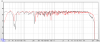 1/24
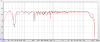 1/12
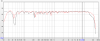 1/6
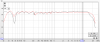 1/3
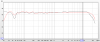
Frequency response is not a noticeable problem, but sense of location is affected, when critically listening in the sweet spot.
Last edited:
Vladimir Filevski
Addicted to Fun and Learning
- Joined
- Mar 22, 2020
- Messages
- 964
- Likes
- 1,496
For me, the difference it is an even more noticeable with 1/24 octave averaging.
For me, the difference it is an even more noticeable with 1/24 octave averaging.
No problem.
I figure it might be rare for anyone to have (and use) both panel dipoles and direct radiating speakers, in the same room, at nearly the same speaker location, with the ability to measure, so, when I can, I have the wherewithal to contrast them, and post my observation.
I listen to the JBL daily, mostly for TV (like right now), and fire up the ML when I plan to be paying attention and want loud and clean for CD or for a special movie.
Audio Buddy brought over some new (so to speak) Wes Montgomery and Charlie Christian last evening. We started with "The Men Who Stare at Goats" on the JBL, and switched to the ML for the music. Audio Buddy is a guitarist, and is presently fascinated by those two, who pick the strings using only the flesh of their thumbs.
Someone demonstrating that...
Wes himself...
Last edited:

Wait, really? I'll ask the two Maggie owners I know again(not sure how new their models are), but that seems at odds with what they tell me. If they've really done away with the limited horizontal dispersion, then that's a shame
Not sure what versions were supposed to have this, but the MG1.6/QR and 3.6/R clearly do not have limited horizontal dispersion. In fact they're pretty wide -- although also very uneven, which could certainly cause sound changing depending on where you sit.
In my experience with 1.7is, it's not as bad as these graphs would imply. The comb filtering caused by dipole wave is very obvious though and almost impossible to eliminate with placement unless you have a truly cavernous room -- it's still present even as far as 4' away from the wall which is as far as I've ever been able to justify.
MG1.6 and 3.6 dispersion graphs below


OP

- Thread Starter
- #31
This doesn't matter with my Klippel NFS measurement system. And sound in the far field also exists in near field. The system uses the latter, to compute the former. If you were measuring the speaker in a room or anechoic chamber, those would be concerns. Not here.I doubt you'll need to attenuate the tweeters. Centerline of the speaker vertically will be ok, but typically the drive units need 6-8 feet listening distance to "integrate". They don't need a back wall for bass reinforcement. They behave like classic line arrays. They don't have limited horizontal dispersion, that's ancient history since they changed to using foil.
Limited vertical distribution is a strength, no floor or ceiling bounce, plus the deep null directly to the side allowing fairly close wall placement. They exhibit a figure of 8 polar response when viewed from above.
I'll be interested to see what the Klippel comes up with, seeing as it seems, in my understanding, to be optimized for point source behaviour.
Measure away, let's see what you get!
I'll be interested to see what the Klippel comes up with, seeing as it seems, in my understanding, to be optimized for point source behaviour.
Measure away, let's see what you get!
D
Deleted member 2944
Guest
The transducers on these are approximately three feet high. If your microphone is only one foot away you're going to see comb filtering embedded into the measurement because of the large discrepancy in microphone distance. The acoustic path lengths from the top of the panel to the microphone and from the center of the panel to the microphone are different. I don't know how the NFS can "compute" that 'out' of the measurement. But, we'll see I guess.This doesn't matter with my Klippel NFS measurement system. And sound in the far field also exists in near field. The system uses the latter, to compute the former. If you were measuring the speaker in a room or anechoic chamber, those would be concerns. Not here.
Regarding horizontal polar responses......it's going to be a complicated pattern with multiple lobes and more discrepancies relative to a conventional speaker. And remember, adjacent lobes are 180 degrees out of phase with each other.
I predict a complicated mess here and a challenge to interpret the results.
Dave.
Last edited by a moderator:

OP
- Thread Starter
- #35
The wave equations have no discoutinuity. Whatever happens at 10 feet, it has an original of what happens at 1 foot.The transducers on these are approximately three feet high. If your microphone is only one foot away you're going to see comb filtering embedded into the measurement because of the large discrepancy in microphone distance. The acoustic path lengths from the top of the panel to the microphone and from the center of the panel to the microphone are different. I don't know how the NFS can "compute" that 'out' of the measurement. But, we'll see I guess.
The measurement is not just one point, It is an entire scan around the speaker so that it can then solve the partial differential wave equations. Once there, the soundfield can be computed for any point in space. This is not just a measurement at one point.
The individual measurement points are NOT used to compute what happens farther in space as I think you are imagining. They are a raw data point to be used to compute the soudfield.
By the way, this speaker is already measured using Klippel NFS.
D
Deleted member 2944
Guest
I understand there's many many many measurements, but unless you have two microphones, every measurement is performed at one point. And each one of those measurements will have comb-filtering embedded into it. That was my point.The wave equations have no discoutinuity. Whatever happens at 10 feet, it has an original of what happens at 1 foot.
The measurement is not just one point, It is an entire scan around the speaker so that it can then solve the partial differential wave equations. Once there, the soundfield can be computed for any point in space. This is not just a measurement at one point.
The individual measurement points are NOT used to compute what happens farther in space as I think you are imagining. They are a raw data point to be used to compute the soudfield.
By the way, this speaker is already measured using Klippel NFS.
But I'm with you on how it can/will compute a sound-field from that information.
What's the hold up? Let's see the results.
Dave.
OP
- Thread Starter
- #37
I have to build a platform to put it on. The current platform is just 5 inches by 5 inches. Meanwhile, we are picking 50 pound+ worth of fruit and vegetables daily from the garden that then needs preserving. I like you guys but not at the expense of letting our harvest go bad!What's the hold up? Let's see the results.

Newman
Master Contributor
- Joined
- Jan 6, 2017
- Messages
- 5,241
- Likes
- 7,494
It appears that they are normally attenuated. You are only supposed to bypass it if the room is especially dead sounding.I doubt you'll need to attenuate the tweeters.
Having tweeter and mid side by side is a recipe for horizontal lobing issues, so the horizontal dispersion will vary wildly with frequency....They don't have limited horizontal dispersion, that's ancient history since they changed to using foil.
Newman
Master Contributor
- Joined
- Jan 6, 2017
- Messages
- 5,241
- Likes
- 7,494
Where did you get that idea?I understand there's many many many measurements, but unless you have two microphones, every measurement is performed at one point. And each one of those measurements will have comb-filtering embedded into it. That was my point..
Maybe @NTK could comment on measuring a panel, as he seems to be quite familiar with the Klippel.
https://www.audiosciencereview.com/...-how-the-klippel-nfs-works.13139/#post-393407
https://www.audiosciencereview.com/...-how-the-klippel-nfs-works.13139/#post-393407
Similar threads
- Replies
- 12
- Views
- 1K


- Replies
- 5
- Views
- 604
- Replies
- 7
- Views
- 723

