I recorded a 800W 15us peak with my 1.4ohm magnetostatic drivers. 23.9A.You can find numerous posts on this and other audio fora touting the importance of high current output capacities of amplifiers. For example, in this post the poster wrote about the alleged ability of the NAD 2200 to output 60 A peaks. If you have a speaker with 2 Ω impedance, 60 A current means I²×R = 60²×2 = 7200 W! And the required voltage to drive 60 A across a 2 Ω load would be 120 V! Few speakers have 2 Ω or lower impedance, and per Ohm's law, the "peak power" and voltage that go along with the 60 A current increase proportionally with impedance. Therefore clearly these 60 A peak output current claims (if these claims were actually made) cannot have any real world relevance and are enitrely bogus. At best these claims of 60 A peak current are for short circuit output currents, or into loads that are almost shorts, conditions that are far from (I hope) anything close to real life. Competently designed loudspeakers aren't shorts. (OK, car subwoofers can get close but I am not talking about them. They are designed to work with 12 VDC electronics.)
But the question of how much current a normal speaker will draw remains and is a valid one, especially when the signal is not a simple sine wave. Let's see if we can answer that.
People have developed reasonably faithful loudspeaker electrical models, at least when they are operating in their (mostly) linear operating ranges which ideally we don't want to exceed. It should be straight forward to simulate the current draw for any arbitrary signal with these electrical models.
There are almost infinite variations of speakers and audio signals, and nobody will have the time to analyze them all. In this exercise I will use the combination of the Stereophile simulated speaker load and the AES75 music noise (aka M-noise). M-noise is supposed to be a good surrogate of the high dynamic range audio typically encountered in live sound situations.
The electrical model of the Stereophile simulated speaker load is shown here.
View attachment 539927
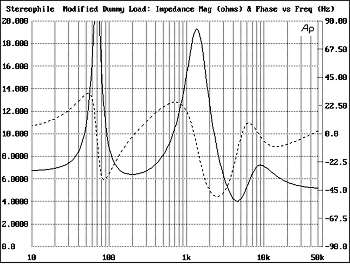
The simulated impedance of this circuit matches the Stereophile measurements of their actual implementation quite well.
View attachment 539929
As a second verification test of this circuit I simulated the current draw in response to a sine sweep (chirp). The amplitude envelop of the current draw closely followed the inverse of the impedance, as it was expected. The voltage amplitude to current amplitude ratio should be the same as the impedance magnitude, as Z = V/I. There was a small difference between the maximum voltage to current ratio of 3.69 to the minimum impedance of 3.72 Ω. The transfer function was converted into a discrete time version to make the simulations more efficient, but discrete time model is a non-exact approximation of the continuous time model. (See this MATLAB documentation page for more details.) Also, the "sampling rate" of slightly higher than 15x the chirp bandwidth was used for the discrete time model. This sampling rate should be able to capture the system dynamics with adequate accuracy. Increasing the sampling rate while keeping the total simulation duration the same can improve accuracy (higher sampling rate, same simulation duration = more time steps to compute). Note that this sampling rate is not the same as and unrelated to the Nyquist sampling frequency of the Shannon-Nyquist sampling theorem.
View attachment 539933
Here are the results from the M-noise simulation. The peak voltage to peak current ratio was 7.79, significantly higher than the 3.72 Ω minimum impedance. This means if you estimate the peak current draw as the peak signal voltage divided by the minimum impedance, you would have overestimated the peak current draw by nearly 2x.
View attachment 539977
Below are the histograms of the M-Noise signal voltage and current samples. The vast majority of samples have voltages <0.35 and currents <0.04, giving a ratio of ~8.8, which is close to the peak voltage to peak current ratio of 7.8.
View attachment 539976
In the case of the Stereophile simulated load, the minimum impedance occurs at ~4 kHz, a frequency range which the M-Noise (and most music/audio signals) does not contain a lot of energy. The peak voltage to peak current ratio depends heavily on the spectral energy distribution of the signal, and the speaker impedance to frequency characteristics. If a speaker has low impedance for a substantial portion of the low frequencies and the signal has a lot of energy in the low frequencies, this ratio could potentially be significantly lower and be closer to the minimum speaker impedance, meaning a higher demand for current from the amplifier.
What if we don't have the electrical models of our speakers? Theoretically we should be able to estimate a model when we have the frequency response (magnitude and phase). This is the topic of system identification. I haven't tried and have no experience with these tools yet. I leave you with a link to MATLAB's documentation page for "Estimating Models Using Frequency-Domain Data". May be some day I'll dip my toe into this topic.
So back to the question of how much current capacity do we need. The answer still depends on the signals and the speakers. But it is something that we can find out relatively easily and is no mystery. We just need access to some technical details and/or measurements of the gear. But it is not going to be some huge ungodly number, and it is not going to exceed the maximum anticipated amplifier output voltage (readily calculable from speaker sensitivity and listening SPL requirements) divide by the minimum speaker impedance, regardless of the phase angle.
ZIP file contains the Julia source code for the simulation in jmd (Julia markdown) format. The html file is the viewable output.
[Edit] Found a small error in my code that had a negligible effect on the results. I left out the resistor R5 (0.6 Ω) which meant it was 0 Ω in the previous calculations. Uploaded the updated ZIP file.
[Edit 2] In the off chance that someone may run my Julia code, I forgot to include the M-Noise WAV file. So here it is as a separate attachment.

-
Welcome to ASR. There are many reviews of audio hardware and expert members to help answer your questions. Click here to have your audio equipment measured for free!
You are using an out of date browser. It may not display this or other websites correctly.
You should upgrade or use an alternative browser.
You should upgrade or use an alternative browser.
How Much Current Capacity do we Need from our Amplifiers?
- Thread starter NTK
- Start date


Torin Krell
Active Member
- Joined
- Jun 28, 2025
- Messages
- 209
- Likes
- 280
Can anyone generate a list of non-esoteric amps (current (!) and classic) that put out significant power into low impedance loads - preferably through "real world" experience?

Look for a list of amplifiers that worked with the original Apogee speakers.
Ability to source significant current is not just about driving 2 ohm subwoofers etc. Many speakers have low EPDR due to "difficult" combinations of impedance phase and magnitude. Remember, impedance is a vector quantity, not a scalar!
Ability to source significant current is not just about driving 2 ohm subwoofers etc. Many speakers have low EPDR due to "difficult" combinations of impedance phase and magnitude. Remember, impedance is a vector quantity, not a scalar!

If you got 1000 moneys to spare, you can always get an NCX500 build and be done with it. Huge power into 2Ω, and naturally doesn't care about EPDR either.Can anyone generate a list of non-esoteric amps (current (!) and classic) that put out significant power into low impedance loads - preferably through "real world" experience?

MRC01
Major Contributor
The Adcom 5800 I've owned for about 30 years puts out 400 wpc into 4 ohms continuous, minimum across its power bandwidth, both channels driven. That's 40 volts and 10 amps into each speaker. It has 2.1 dB of headroom which means 648 watts. It's a traditional high (800 mA) bias, class AB and can draw up to 1800 VA from the wall.Can anyone generate a list of non-esoteric amps (current (!) and classic) that put out significant power into low impedance loads - preferably through "real world" experience?
It's non-esoteric for sure. Does that qualify as "significant" power into "low impedance" loads? Depends on who's asking.
Class D – see Purifi
Buckeye Amps Purifi 1ET400A / NCx500:
NAD C298 uses Purifi Eigentakt
budget - VTV Amplifier Hypex NC252MP
Class AB
integrated
Hegel H190
Cambridge Audio CXA81 Mk II
power only
Schiit Vidar 2 dual-mono
Parasound Halo A23+
Buckeye Amps Purifi 1ET400A / NCx500:
NAD C298 uses Purifi Eigentakt
budget - VTV Amplifier Hypex NC252MP
Class AB
integrated
Hegel H190
Cambridge Audio CXA81 Mk II
power only
Schiit Vidar 2 dual-mono
Parasound Halo A23+
OP

- Thread Starter
- #228
I have been preparing materials for a thread on a deep dive into EPDR/EADR and class B/AB amp heat dissipation. Still have a bit of work left to do.
For the time being, I'd recommend taking a look at this blog post:
 speakermakersjourney.blogspot.com
[Edit] The conclusion from the above linked post (note: JOB = Dr Jack Oclee-Brown):

For the time being, I'd recommend taking a look at this blog post:
Stereophile and Equivalent Peak Device Resistance
EPDR is Not What I thought EPDR is Not What I thought Author ...
speakermakersjourney.blogspot.com
[Edit] The conclusion from the above linked post (note: JOB = Dr Jack Oclee-Brown):
Last edited:
Crown amps are bullet proof and put out a lot of power (current) into 2 ohms, have DSP for both protection and EQ and don't cost very much.Can anyone generate a list of non-esoteric amps (current (!) and classic) that put out significant power into low impedance loads - preferably through "real world" experience?

Hegel was exposed on ASR about five years ago. Check out Amir's review of the H95, H95 review.Class D – see Purifi
Buckeye Amps Purifi 1ET400A / NCx500:
NAD C298 uses Purifi Eigentakt
budget - VTV Amplifier Hypex NC252MP
Class AB
integrated
Hegel H190
Cambridge Audio CXA81 Mk II
power only
Schiit Vidar 2 dual-mono
Parasound Halo A23+
Can be represented as a vector in the imaginary plane, phasor. But it is not a true vector. It has no direction in 3D space.Look for a list of amplifiers that worked with the original Apogee speakers.
Ability to source significant current is not just about driving 2 ohm subwoofers etc. Many speakers have low EPDR due to "difficult" combinations of impedance phase and magnitude. Remember, impedance is a vector quantity, not a scalar!
EJ3
Master Contributor
All figures are in watts, done on a certified amp dyno:Can anyone generate a list of non-esoteric amps (current (!) and classic) that put out significant power into low impedance loads - preferably through "real world" experience?
If 650+ in stereo into 4 Ohms or 944+ stereo into 2 Ohms or (in bridged mono mode) 1799 into 4 Ohms is needed, look here.? I own 6 of these, so, yes, personal experience:
They are also considered to be Class G amps.
Amirm has tested one of my NAD 2200's here:
NAD 2200 vintage review
Last edited:
Can anyone generate a list of non-esoteric amps (current (!) and classic) that put out significant power into low impedance loads - preferably through "real world" experience?
Of note here (a class G amp I believe), the Outlaw Audio 2220, may be of interest. Amir reviewed it, here.

Interested in seeing your work! I looked into EPDR briefly some years ago but struggled to find a good definition, and that link explains why. I ultimately mostly ignored it and just looked at the mag/phase plots.I have been preparing materials for a thread on a deep dive into EPDR/EADR and class B/AB amp heat dissipation. Still have a bit of work left to do.
For the time being, I'd recommend taking a look at this blog post:
Stereophile and Equivalent Peak Device Resistance
EPDR is Not What I thought EPDR is Not What I thought Author ...
[Edit] The conclusion from the above linked post (note: JOB = Dr Jack Oclee-Brown):
View attachment 560689
OP
- Thread Starter
- #235
Will do. Hopefully I can get at least an initial post out in a week.Interested in seeing your work! I looked into EPDR briefly some years ago but struggled to find a good definition, and that link explains why. I ultimately mostly ignored it and just looked at the mag/phase plots.
Denon PMA 2500 still throw huge amount of power up to 1 Ohm. This amp has been measured on several forums and clearly wins his award of beast of powerCan anyone generate a list of non-esoteric amps (current (!) and classic) that put out significant power into low impedance loads - preferably through "real world" experience?
Similar threads
- Replies
- 19
- Views
- 3K

- Locked
- Replies
- 85
- Views
- 5K

- Replies
- 14
- Views
- 1K
- Replies
- 7
- Views
- 949
