
• Welcome to ASR. There are many reviews of audio hardware and expert members to help answer your questions. Click here to have your audio equipment measured for free!

How loud do you like your music?

How loud do you like your music?

  • Under 70dB

    Votes: 81 19.4%
  • Around 75dB

    Votes: 147 35.3%
  • Around 80dB

    Votes: 105 25.2%
  • Around 85dB

    Votes: 51 12.2%
  • Around 90dB

    Votes: 22 5.3%
  • It has to be over 90dB to enjoy

    Votes: 11 2.6%

  • Total voters
    417
@Axo1989 some of what you're saying was a part of the original propositions; I stressed it needs to be measured at the listening point.

What I don't agree with is the sub region. Since I was interested in what people actually use in every day life, how much power from the amp is getting used and not just sitting there, subs make no sense because they are, for the most part, powered. So you mains amp can still be considerably weaker.

Sure, I'm interested in everyone's measurements, there's no wrong answer. It's just how loud you listen to, but extremes will always be extremes. If you're not getting a 10w amp any time soon, sure. Great. That's your specific case. I think 105dB is ear damaging (and ear bleeding, if I may add)

I used to own 2x200w Hitachi
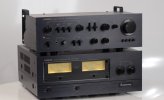
1785144894045.jpeg

And I spent some time looking at those VU meters and I've noticed how rarely they jump to 4w or over. (even if they are not perfectly accurate) This made me think, when people demand their amps to be stable down to 2 ohm and give something like, I don't know, 2x180 in 2 ohm, it's not really all that needed to say the least. Small to mid room, 86dB peaks at the listening position for the majority of "test-subjects"... Unless you're going for that Arendal that Gene from Audioholics praises so much, you'll get by with a 2x40 into 8, if it can do at least 2x75w into 4.
 
Main noise floor in room comes from lows.
My open floor plan leaves the refrigerator about 20' to the right of the MLP. :facepalm:

That's A-weighting.
C or Z-weighting would be people knocking at your door :p
I take that it's a language barrier why he just doesn't get what I'm saying.

I never use crest measurements --- I believe the common CD/SACD measurements that are often called DR in new HiFi literature are crest. They seem to measure from from the average on that recording, to the max on that recording. I don't see that gives me the real peaks in the room, which is what I want to measure for that recording, when I'm in that particular mood.
Just a sampling

foobar2000 v2.25.10 / DR Meter v1.0.8

--------------------------------------------------------------------------------
Analyzed: Santana / Amigos
--------------------------------------------------------------------------------

DR Peak RMS Duration Track
--------------------------------------------------------------------------------
DR10 -3.56 dBFS -15.62 dBFS 8:16 01-Dance Sister Dance (Baila Mi Hermana)
DR10 -3.66 dBFS -15.72 dBFS 5:26 02-Take Me With You
DR11 -3.34 dBFS -16.12 dBFS 4:51 03-Let Me
DR11 -3.65 dBFS -16.76 dBFS 6:13 04-Gitano
DR10 -2.90 dBFS -15.50 dBFS 5:41 05-Tell Me Are You Tired
DR10 -3.33 dBFS -16.03 dBFS 5:06 06-Europa (Earth's Cry Heaven's Smile)
DR10 -3.24 dBFS -16.62 dBFS 5:55 07-Let It Shine
--------------------------------------------------------------------------------

Number of tracks: 7
Official DR value: DR10

Samplerate: 88200 Hz
Channels: 2
Bits per sample: 1
Bitrate: 5645 kbps
Codec: DSD64
================================================================================
AlgorithmTT DR Offline Meter (or compatible)
 
. I think 105dB is ear damaging (and ear bleeding, if I may add)

It may well be a matter of duration, frequency, as well as SPL, measured by various weightings like Z, C, and A. Actually, at most music peaks [except for Rock, Metal, and some Electronic, -- the ones sometimes characterized as "all loud," I am convinced that the SPL of music -- especially Classical, Romanticist, and more Contemporary (Stravinsky through Adams) will be nearly meaningless without duration specified.

Within music ranges, THX suggests instantaneous peaks in the bass of up to 115 dB.

What is considered instantaneous? I've seen 1/4 of a second repeatedly, and that is consistent with my experience; the leading edge of a peak seems to be about that long. But let's double that and call it 1/2 of a second. So, 1/2 second vs the 1 Hour OSHA allows. Of course, there are caveats- too bad most published sources don't use them!
1785201041686.png


Caveat #1: As you can see, NIOSH is more conservative than OSHA. That's one of the reasons I'm for being a little more conservative than them and using dBC or dBZ.

Caveat #2: Both of above are designated as "Permissible Workplace Sound Levels." Many "loud workplaces" are very different than loud orchestras. A "loud workplace" may produce that SPL from morning to noon, and then again from 1PM to 4PM so, one can understand a recommendation of no SPL higher than 85 dBA for 8 hours duration. That doesn't mean that "85 dB" is ear damaging regardless of the duration of the sound or the frequencies involved, although some sources sometimes say so.

I've played in several orchestras and one band, and heard very loud peaks, regularly. I always plugged my ears when exposed to outrageous Rock (I liked it, just was being cautious). I didn't begin to lose some hearing until sometime in my 70s. Now I'm 84 and
I have some loss above 10K, but all seems to be O.K. below that. I don't dare turn up the volume too far on steady test tones , for fear of blowing my tweeters. But loud cymbal crashes seem to shimmer as much as ever, and other instruments with high signatures sound fine (orchestra bells, violins, piccolos, female vocals etc.).


O
 
@Axo1989 some of what you're saying was a part of the original propositions; I stressed it needs to be measured at the listening point.

Yes I am repeating some things, I decided to collect my previous thoughts and elaborate a bit after you explained your underlying question re how much amplifier power is really necessary. You certainly specified measuring at listening position. What I think you underplay is the effect this has on power requirements once you start listening at higher levels.

For example, at your preferred 75 dB level we do indeed have flea-scale wattage: < 0.1 at one metre, 0.5 watts at three metres and 1.2 watts at five metres (for my 88 dB speaker spec). Take it up to my 85 dB average poll answer and we get 0.5, 4.5 and 12.5 watts respectively. Try the 95 dB average I'd use for a decent classical or metalcore or techno session and we'll need 5, 45 and 125 watts. And that's specifying only 3 dB headroom, which isn't enough for most music.

What I don't agree with is the sub region. Since I was interested in what people actually use in every day life, how much power from the amp is getting used and not just sitting there, subs make no sense because they are, for the most part, powered. So you mains amp can still be considerably weaker.

I just mentioned powered subwoofers because systems that include them will require less power from the main amp, that's all. I'm not using them myself, so the main amp is the only amp. Subs bring things a bit closer to your A-weighted test scenario. But not really. No one crosses their subwoofer over at 1000 Hz.

Sure, I'm interested in everyone's measurements, there's no wrong answer. It's just how loud you listen to, but extremes will always be extremes. If you're not getting a 10w amp any time soon, sure. Great. That's your specific case. I think 105dB is ear damaging (and ear bleeding, if I may add)

That's a common misconception. The effect of sound on the ear is a function of pressure and duration [@garyrc has just popped this point into the thread while I've been typing].

Instantaneous peaks of 105 dB (or even the 115 dB some posters note for classical concerts) are nothing like sustained sound pressure at that level, in terms of hearing damage particularly.

Take a look at your Decibel X app, and try out the dosimeter (if you haven't already). I routinely start running the app if I'm listening to loud music myself. I find playing at the level used for my calculator screenshot—105 dB peak, 90-95 average—is good for the length of an album or two, as indicated by the dose in that view. Also interesting is the stratification by dB level and time. For the length of that album or two, you can see the accumulated duration at each dB level.

Try it yourself: play an album too loud for your stated taste (you can retreat to the next room) and see what your dose would be. It's probably not what you think.

I used to own 2x200w Hitachi

View attachment 547441

And I spent some time looking at those VU meters and I've noticed how rarely they jump to 4w or over. (even if they are not perfectly accurate) This made me think, when people demand their amps to be stable down to 2 ohm and give something like, I don't know, 2x180 in 2 ohm, it's not really all that needed to say the least. Small to mid room, 86dB peaks at the listening position for the majority of "test-subjects"... Unless you're going for that Arendal that Gene from Audioholics praises so much, you'll get by with a 2x40 into 8, if it can do at least 2x75w into 4.

It's not so much the accuracy of the VU meter, rather the display mode. That ballpark sounds ok for your stated levels, but you'll need fast+peak (and probably some peak-hold) to really see the wattage (otherwise you'll be looking at a somewhat smoothed reading).

The underlying question you've revealed overlaps your headline question, but isn't identical. We don't need the amplifier power for the soft bits. We need it for the loud bits. If you specify wattage for average levels, you'll come up short for peaks. Fortunately most decent amps will deliver more peak power than RMS, so we tend to get by.

To summarise, your headline question/poll has three answers for me: How loud do I like to listen to Steely Dan? I'd say 70 dBA. How loud do I listen to music I like? 85 dBA. And some music doesn't "have to be" over 90 dBA, but it certainly sounds better that way (for an album or two).

And to look at your A-weighted test criteria another way, ask yourself: how would Steely Dan sound if you rolled off everything below 1000 Hz? You probably wouldn't be quite as happy listening like that. So why would you (only) measure like that?
 
Last edited:
I sit 13' back at MLP and base my SPL with no weighting or C because I want to know more about what's actually happening at a greater frequency range. Maybe because of my background in live audio where you would never run a RTA in free space with A or B, those are constructs for OSHA safety standards.

My meter is old but 98% of the time it matches the "db Volume" app on my iPhone 15pro. When doing critical listening and I'm curious or speaker driver/room measurements I use the peak hold feature on both (the analog burst measurements are better) for tuning with C weighting. As mentioned, I live in the middle of nowhere and with the windows open and no birds chirping my noise floor is around 39dB mainly because of the river outside.

All the math is great but if your system can't handle it that's the end of the game. Plenty of amp power for peaks, speakers that can deliver, DSP to taste and a low noise floor is truly the secret sauce. Math is essential for headphones and near field monitors.

I understand that many of you are urban and have to be considerate of neighbors, loved ones and pets. It is pure joy to crank it up to clean 107dB (C weighted!) anytime I want and get fully immersed.
 
I crossover to the sub at 40 Hz, because my front speakers actually sound a little better above 40 than the sub.

@ 13 feet (main listening position)
in a 4,257 cu.ft. room.

A highly sensitive ("efficient")
speaker [101 dB, 2.73v (1 Wt. into .
8 Ohms) @ 1m]. No EQ. It's a
coincidence that 101 is also the
first SPL entry, below.

4 Wt.
101 dB

128 WT 116 dB

-----------------------------------------------------------------
With a lower [more normally sensitive ("lower efficiency")] speaker
[90 dB, 2.73v @1m]. No EQ. We get:

4 Wt 90 dB

128 Wt 105 dB

-------------------------------------------------------------------

To match the SPL of the more sensitive/"efficient" speaker (101 dB sensitive, producing 116 dB @128 Wt), using the less efficient (90 dB) speaker, it would take 2,000 wts. We might employ McIntosh's 2K 2,000 wt. per channel power amp. As someone else put it, we should have a fire extinguisher handy.
 
Last edited:
Yes I am repeating some things, I decided to collect my previous thoughts and elaborate a bit after you explained your underlying question re how much amplifier power is really necessary. You certainly specified measuring at listening position. What I think you underplay is the effect this has on power requirements once you start listening at higher levels.

For example, at your preferred 75 dB level we do indeed have flea-scale wattage: < 0.1 at one metre, 0.5 watts at three metres and 1.2 watts at five metres (for my 88 dB speaker spec). Take it up to my 85 dB average poll answer and we get 0.5, 4.5 and 12.5 watts respectively. Try the 95 dB average I'd use for a decent classical or metalcore or techno session and we'll need 5, 45 and 125 watts. And that's specifying only 3 dB headroom, which isn't enough for most music.


I just mentioned powered subwoofers because systems that include them will require less power from the main amp, that's all. I'm not using them myself, so the main amp is the only amp. Subs bring things a bit closer to your A-weighted test scenario. But not really. No one crosses their subwoofer over at 1000 Hz.


That's a common misconception. The effect of sound on the ear is a function of pressure and duration [@garyrc has just popped this point into the thread while I've been typing].

Instantaneous peaks of 105 dB (or even the 115 dB some posters note for classical concerts) are nothing like sustained sound pressure at that level, in terms of hearing damage particularly.

Take a look at your Decibel X app, and try out the dosimeter (if you haven't already). I routinely start running the app if I'm listening to loud music myself. I find playing at the level used for my calculator screenshot—105 dB peak, 90-95 average—is good for the length of an album or two, as indicated by the dose in that view. Also interesting is the stratification by dB level and time. For the length of that album or two, you can see the accumulated duration at each dB level.

Try it yourself: play an album too loud for your stated taste (you can retreat to the next room) and see what your dose would be. It's probably not what you think.


It's not so much the accuracy of the VU meter, rather the display mode. That ballpark sounds ok for your stated levels, but you'll need fast+peak (and probably some peak-hold) to really see the wattage (otherwise you'll be looking at a somewhat smoothed reading).

The underlying question you've revealed overlaps your headline question, but isn't identical. We don't need the amplifier power for the soft bits. We need it for the loud bits. If you specify wattage for average levels, you'll come up short for peaks. Fortunately most decent amps will deliver more peak power than RMS, so we tend to get by.

To summarise, your headline question/poll has three answers for me: How loud do I like to listen to Steely Dan? I'd say 70 dBA. How loud do I listen to music I like? 85 dBA. And some music doesn't "have to be" over 90 dBA, but it certainly sounds better that way (for an album or two).

And to look at your A-weighted test criteria another way, ask yourself: how would Steely Dan sound if you rolled off everything below 1000 Hz? You probably wouldn't be quite as happy listening like that. So why would you (only) measure like that?
You make a lot of good points. However, we think alike when it comes to subs. Them being active "alleviates" some suffering from the amp.

When it comes to Hitachi, this is just something that made me explore and the inaccuracy I mentioned to try and be fair, like saying even if it's not accurate and you double it just to make sure, it's still a couple of watts.

Then, peaks fall under the dynamic or max power. That's why one would look at what his amp can do under stress. Anyhow, since I've mentioned the standard SPL calculator, let's just say that my 2,5m distance from the speaker is already compensated with a few dB you get from having more than one speaker and having a 1,5dB from side walls reinforcement. So it's:
1w 85dB
2w 88dB
4w 91dB
8w 94dB
and
16w far more than I ever listen to.
and 10dB -/+ for music listening i got covered in my listening session.

Still. This is a rule of thumb and a generalization.

Again, I'm not saying you don't need it. I'm saying when the topic of power amp comes up, people tend to overestimate the amount they need.

Let's say my speakers drop to 3,6Ohgm as LS50 do, over a rather significant portion of bandwidth of 200-300Hz. This, roughly saying, doubles it. Let's say it's:
2w 85dB
4w 88dB
etc.

And let's give it 10dB +/- for dynamics, so for me, it's 70 - 90dB. And let's see what my speakers need for 90dB at roughly 4ohm... It's 8w. Let me be generous and double it just for the argument's sake; it's 16w.

So, the point is, just like hi-res, very thick cables running 6feet, balanced cables for a 6 feet distance etc. people often overestimate how much power they really need. Of course it won't cover all cases, but a lot of them.
 
1) The person who (presumably) authored the Peak SPL Calculator, gets dialog SPL so wrong, I wonder about the data coming out of his online calculator:

"Most moderate HT systems are capable of 102 to 107 dB peaks at a decent (10+feet)
listening position; at these peak levels the normal dialog is going to be at least 85- 90 dB, within the range where permanent hearing loss can occur."

I made repeated measurements, and here is what I got with dialog:

Movie
dialog:
Mean: 62.5dBC and Peaks 75dBC, except for the outlier Lily Tomlin, very rarely, on peaky peaks.

Live dialog (friends in our music/movie room, at the same distance):
Mean: 62 dBC and peaks 70 dBC

2) The THX figure I reported earlier can be supplemented. Their measurements. including bass, for The Empire Strikes Back, from seats 2/3 of the way back in the theater were peaking at 110 dB. That's dBC or, perhaps (?) dBZ for professionals who know what they are doing; according to real projectionists and 2 set-up guys I have talked to, those are few and far between. What sometimes happens is somebody complains that the sound is too loud, there is no projectionist on duty, a candy counter person figures out how to turn it down, but doesn't ever turn it back up; "soundcheckers" used to fine theaters for doing that. Dolby cautioned against turning up the sound for "Previews of Coming Attractions" in a dandy white paper, because, like as not, it would receive complaints, get turned down, and the main title, or the whole film, would be too soft. The suits shot themselves in the foot. As one of my projectionist friends put it, "Showpersonship is dead."

Here is a THX fleeble for sound effects, i.e., for bass, not music:

Subwoofer_reference_level.png

My goodness, 2/3 of the way back (I know that was an oft-used standard for THX) in my favorite 70mm 6 channel theater (now torn down, naturally) 2/3 back was at about 100 feet. As in many 70mm theaters first "four walled" by Mike Todd, there was no stage, and no junk in front of the screen to move it away, so the seats went down almost to the front edges of the curved screen.
1785298034803.png

We film buffs, several groups, of several descriptions, usually sat somewhere between the 4th row from the screen, to the 14th row (about 20 to 50 feet). So, we got it about 3 to 6 dB louder, depending on reflectivity (outdoors would be about 6dB softer atop the proverbial measurement flag pole, indoors about 3 dB). That might be bass heavy, because the mid/high drivers in the theater would be angled up toward 2/3 of the way back.
 
Last edited:
I just got another "watch" email reminder as I was listening to Alan Parsons - On Air DTS-CD 5.1.
While listening at what I'd consider a very "relaxed" level, my 35+ year old meter reports peak C weighted levels around 85+ db.
My "relaxed level" subjective claim being based on what I would never considered possibly damaging, just a nice comfortable level.
I know today most everyone has smartphones etc but still I consider one of these dirt cheap SLM's a "must have" for any audiophile.
I've had this original model I bought new somewhere in the very early 1990s, just keep a fresh 9v battery in it and it will last you a lifetime..
Newer models with more tricks like peak hold, etc are available on ebay etc, most for under $25.00, get yourself one.

Some good, not overly tech info,
 
As requested in the first post, here's Steely Dan - Hey Nineteen measured with REW+UMIK-1. Volume is randomly set to the upper end of "I can easily listen whole album with it, but ears probably won't thank me after".

Youtube:

dB(A) slow:
hey_nineteen_a.png


For comparison, first few minutes with dB(C) (Z is exactly the same but +1dB so won't bother posting it)
hey_nineteen_c.png


Another example: Journey - Mother, Father (Live)

Youtube:

Did not verify replaygain-like perceived volume difference (would be interesting to compare, edit: I did it, see later*), this one might be tiny bit more loud, but could still enjoy whole album.

dB(A):
mother_father_a.png


So even dB(A) could easily show 6 or 7 (lol) dB difference between tracks. My 85dB answer still stands. And yes <70dB practically sounds elevator music after this.

*edit: I run both tracks through ffmpeg ebur128 filter, which suggests Journey should be played -9.3dB quieter. Gotta test later how it affects perceived volume and enjoyment.

Code:
Steely Dan

  Integrated loudness:
    I:         -18.4 LUFS
    Threshold: -28.7 LUFS

  Loudness range:
    LRA:         3.3 LU
    Threshold: -38.7 LUFS
    LRA low:   -20.0 LUFS
    LRA high:  -16.7 LUFS

Journey

  Integrated loudness:
    I:          -9.1 LUFS
    Threshold: -19.5 LUFS

  Loudness range:
    LRA:        10.7 LU
    Threshold: -29.5 LUFS
    LRA low:   -17.8 LUFS
    LRA high:   -7.1 LUFS

edit2: Dumb me, you can see the same volume info in Youtube's stats for nerds directly. Might have been normalized automatically, not sure. edit3: I think youtoob player adjusted Journey -4.9dB (per Volume/Normalized 100%/57% (cont.-9.1dB tgt.-14.0dB)), so there's still 4.4dB perceived difference for the tracks played on youtube, Steely Dan is below the normalization threshold.
 
Last edited:
It's nice and quiet around here today, so I thought trying a live song with the usual, catchy, "only-piano-and-voice" at the start and "all-hell-break-loose" near the end as some rock songs try to imitate classical :p

So, "My Immortal" by Evanescence from the live album "Anywhere but Home"

C weighting with a catch here, spectrum at most of the song is 100Hz-6kHz (piano-voice) before the rest of the band follow so the C weighting does not count much there, the peak at the start are just people cheering and screaming.
Two snaps so you can see the level rise at the loud part down at the level chart.

Thought to start at a comfortable 75dB (C) average so to be reproducible even by small gear, although it bangs heavy down to '30's at the loud part:

low.PNG

high.PNG
 
That looks about right for a satisfying listen at home. Not as loud as a live performance but subjectively I think loud enough in a domestic listening room for good emotional impact.

I have question, that's REW I assume (which I must install on new computer but haven't needed yet) so what is the teal line LCE? I understand LCpeak and LZpeak but that one goes higher.

Now that you've bumped, I thought I posted this upthread but didn't actually (probably just thought about it). Here's Decibel X listening to Poppy's recent Empty Hands album when I was having a good listen after her live performance here and the album release earlier this year. Levels at one point plus dosimeter after 50 minutes, I think it interesting that the dose is fine at those levels. For an hour or so certainly (not for eight, obviously).

IMG_9974.PNG

IMG_9975.PNG


Also interesting that my new neighbour was driven to despair/rage at what I thought was fairly reasonable (and entirely legal) levels on a Saturday night. A text requesting that I listen to 'metal' on headphones came in rather quickly. Being a good neighbour, I followed with her previous album. We have standards here, quiet Saturday nights every time aren't a reasonable expectation, and it's important to train one's neighbours. I expect the reaction was a function of content and volume, but they were still quivering when I discussed in person some time later. My old neighbour on the other side was fine. There's no accounting for taste, of course.
 
Last edited:
That looks about right for a satisfying listen at home. Not as loud as a live performance but subjectively I think loud enough in a domestic listening room for good emotional impact.

I have question, that's REW I assume (which I must install on new computer but haven't needed yet) so what is the teal line LCE? I understand LCpeak and LZpeak but that one goes higher.

Now that you've bumped, I thought I posted this upthread but didn't actually (probably just thought about it). Here's Decibel X listening to Poppy's recent Empty Hands album when I was having a good listen after her live performance here and the album release earlier this year. Levels at one point plus dosimeter after 50 minutes, I think it interesting that the dose is fine at those levels. For an hour or so certainly (not for eight, obviously).

View attachment 559880
View attachment 559881

Also interesting that my new neighbour was driven to despair/rage at what I thought was fairly reasonable (and entirely legal) levels on a Saturday night. A text requesting that I listen to 'metal' on headphones came in rather quickly. Being a good neighbour, I followed with her previous album. We have standards here, quiet Saturday nights every time aren't a reasonable expectation, and it's important to train one's neighbours. I expect the reaction was a function of content and volume, but they were still quivering when I discussed in person some time later. My old neighbour on the other side was fine. There's no accounting for taste, of course.

LCE is REW's Sound Exposure Level, just like the dosimeter at Decibel X.

Now, about the levels, truth is that this is not my kind of music so the urge to turn it to "11" (more like one 'o' clock for my pre's log pot that reaches five 'o clock for starting serious loud with good recordings), so eleven it was with that while it would be way up for Rachmaninoff's second for example.

Nice example of rock though, REALLY interesting sound engineer choices (10dB difference between the low and loud part for example, heavy deesser around 5kHz, smiley EQ for the loud part along with deep bass starting at 30Hz, etc) .

I would expect it to be a lot more interesting if I started it at 85dB average, maybe tomorrow :cool:
 
Back
Top Bottom