• Welcome to ASR. There are many reviews of audio hardware and expert members to help answer your questions. Click here to have your audio equipment measured for free!

How loud do you like your music?

How loud do you like your music?

  • Under 70dB

    Votes: 81 19.4%
  • Around 75dB

    Votes: 147 35.3%
  • Around 80dB

    Votes: 105 25.2%
  • Around 85dB

    Votes: 51 12.2%
  • Around 90dB

    Votes: 22 5.3%
  • It has to be over 90dB to enjoy

    Votes: 11 2.6%

  • Total voters
    417
Ron Tutt, he's a rock and roll drummer. LOL
I know, that was just one of the DR kings in general :p

For classical dynamic stuff, seek for Sir Simon Rattle's works, its one of those a little heavy on the baton :p
 
OK. I didn't mean to be too pedantic, but i my initial proposal for this "usual listening SPL" I asked for the volume during a prolonged listening session because I was hoping this would represent ones listening habits more precisely. I also sometimes crank it way up to the red line just to see how my speakers perform, or how much they distort or, as you say, because some music draws you into crank it up. But that's the loudest, that's not how loud i Usually listen to.

Anyway, thank you for your input. I hope you cast your vote!
I selected 75 dB. For me, it's a comfortable level that allows for extended listening without fatigue.
 
Anyway, for everyone involved, I'd like to stress the fact that the majority of votes go to an SPL that is even lower than the lowest sensitivity in speakers.

Very inefficient speakers play 84dB with 1w (and all the usual numbers concerning the voltage and the distance etc.) 35,5% go to around 75 and 24,7% go to 80dB.

So, relatively speaking 60% of people listen to their speakers under the nominal sensitivity. Basically it's a couple of watts you need. Even moving further away from speakers and doubling it, you're still fine with something like 16w.

I remember having an amp with VU meters, cranking it up and seeing the needle jumps only to 2 or 3 watts. Back then, first time I saw this in reality, I was amazed.

The second coming of this thread has been interesting. And your recent posts make clearer what you were getting at with the weighting and music content stipulations too.

If the underlying question is about amplifier power I'd comment (perhaps repeating things said originally) that A-weighting might make sense for eg a system powered by said amp supplemented by powered subwoofers. The amp will be delivering power to the circumscribed frequency range. But that's rolling off quite steeply below 1000 Hz which is a significant reduction. B-weighting—rolling off below 300 Hz and somewhat less steeply—would be a better choice for your investigative goal I think.

Acoustic_weighting_curves_(1).svg.png


But if we are interested in amplifier power needed to drive a full range system then it makes no real sense to ignore bass output. You'd want C-weighting at worst, or flat—hence the Z-weighting that I routinely use in Decibel X.

We should also factor listening distance—watts producing given dB at one metre won't suffice at three or four, obviously. So at my current ~3 metre setup the calculations run this way:

Screenshot 2026-07-26 at 11.22.14 am.png


I've set sensitivity and listening distance for the system, and used 105 dB as true peak with headroom at zero (for argument's sake, we could enter those numbers the other way with the same result). That number is also around the highest I've measured playing music at the listening position. My amp—a stereo Krell KAV-2250—is rated to deliver 500 watts/channel into 4 ohms so we're good, for the highest levels I'm likely to play at home with any regularity. That's quite loud of course although it corresponds to much lower dBA (maybe 90-95). And if I'm playing metalcore or techno (eg the genres I'm more likely to play loud) certainly most of the power delivery is needed for the bass, and the corresponding average dB level for the midrange is often more like 80-85. In other words, the levels are not ear-bleeding or unrealistic (nor as loud as actual performance in those genres or indeed classical). That latter number was also my poll selection.

Now I'm also running Sonarworks DSP with a maximum boost of 6 dB. If we add that number as headroom, the required power increases to 898 watts. Looks like I need a bigger Krell. I can mostly get away without that because actual peaks are instantaneous and my amp has a stiff power supply (2kW) and a good bank of output capacitors. We are also helped by room gain and may not need to provision for absolute worst case.

We are pushing my amp though, it's getting pretty hot and I'm likely hearing distortion increased at that range on the output curve—at least when I've listened to the bigger Krell monoblocs (driving bigger speakers admittedly) the sonic effect is cleaner at the same 105 dB peaks. Let's also consider when my renovations are done, deploying in a larger room will increase listening distance to the 4-5 metre range. I'm not going to rely on a 10-watt amp any time soon.

 
Last edited:
IMO, A weighting is no good at all for most Music, because, as you can see from the blue curve on Axo1989's post, it cuts out too much of the bass. I believe it was inherited from a tradition of industrial noise measurements, which, although they can be damn loud, usually don't have hugely intense sound below, maybe, 80 Hz. In a full symphony orchestra with pipe organ, contrabassoon, bass end of the piano, tuba, maybe Souzaphone, Telarc-sized bass drum, etc., it can really get up there. Multiple measurements have shown peaks of 115 dB, 120 dB for some opera. I'm pretty sure that the orchestra, brass band and pipe organ, conducted by Carmine Coppola for the "silent" film Napoleon, was that loud at the end, but I forgot my meter. Speaking of meters, some (cheap?) ones can read up to 13 dB too low, thanks to needle ballistics. As Axo points out, most people (with limited budgets) use C weighting. If you listen carefully while they are measuring, you might hear them mumbling, "Close enough for Rock 'n Roll," and, from Axo's 1989's orange curve, you can see that C is not too bad. Expensive meters can have Z weighting, which is perfectly flat.

In my 4,257 cu. ft., very slightly dead, room, through my Klipschorns [101* dB, 2.73V (1 wt into 8 Ohms), @ 1M] I get 114.5dB at the main listening position at 13 feet, with120 watts per channel input from my NAD 150 watt continuous / channel power amps.
*Corrected from the manufacturer's 105 dB.
 
IMO, A weighting is no good at all for most Music, because, as you can see from the blue curve on Axo1989's post, it cuts out too much of the bass.
Agreed. Also I believe a large part of the reason we see so many votes for the 80 db and under levels. I could be wrong but I don't think that many of our members
are listening to music that softly, only that they're using a improperly set meter/software?
 
I believe our poll here is a bit inaccurate due to users using a averaging mode rather than one accurately showing peak levels.

Peak levels are not relevant when comparing these things, but a short-term loudness meter could be useful when comparing listening levels between different music genres, which generally have large differences in average loudness.
 
Peak levels are not relevant when comparing these things, but a short-term loudness meter could be useful when comparing listening levels between different music genres, which generally have large differences in average loudness.
I disagree on that but regardless if we're going to put up a number we should all be on the same page. That's where I think something is amiss in the current results.
They currently show 55% of the members listening at under 75 db, does that seem right to you? Thats elevator background levels. o_O
 
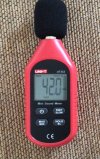
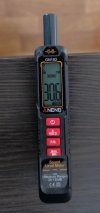
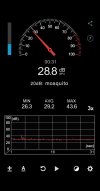
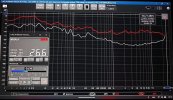
Measured 82 dBA with Beethoven Tripple concert. My background noise is about 42 dBA. Proof below.

IMG_4631.jpeg
 
I disagree on that but regardless if we're going to put up a number we should all be on the same page. That's where I think something is amiss in the current results.
They currently show 55% of the members listening at under 75 db, does that seem right to you? Thats elevator background levels. o_O

I agree that it’s likely that people in this thread are using loudness meters with different weightings, but comparing peak levels will tell us even less as that has very little bearing on the perceived loudness.
 
I wish my room was that quiet ;)
You just can't get over the fact that people listen to music quietly :) . If you don't trust sound meters, here are some voltmeter readings. They don't depend on any curves. Radio Paradise is convenient because its RMS loudness is known. It's -14 LUFS. I listen to it at the maximum level, which corresponds to peaks of 0 dBFS - 1.65 V and RMS of -14 dBFS - 0.33 V. This, on two 4-ohm 90 dB speakers, adds up to 1.4 W and 55 mW, respectively. It's up to you to decide whether that's loud or not.
NoiSl.jpgNoiSm.jpg
 
The second coming of this thread has been interesting. And your recent posts make clearer what you were getting at with the weighting and music content stipulations too.

If the underlying question is about amplifier power I'd comment (perhaps repeating things said originally) that A-weighting might make sense for eg a system powered by said amp supplemented by powered subwoofers. The amp will be delivering power to the circumscribed frequency range. But that's rolling off quite steeply below 1000 Hz which is a significant reduction. B-weighting—rolling off below 300 Hz and somewhat less steeply—would be a better choice for your investigative goal I think.

View attachment 547148

But if we are interested in amplifier power needed to drive a full range system then it makes no real sense to ignore bass output. You'd want C-weighting at worst, or flat—hence the Z-weighting that I routinely use in Decibel X.

We should also factor listening distance—watts producing given dB at one metre won't suffice at three or four, obviously. So at my current ~3 metre setup the calculations run this way:

View attachment 547150

I've set sensitivity and listening distance for the system, and used 105 dB as true peak with headroom at zero (for argument's sake, we could enter those numbers the other way with the same result). That number is also around the highest I've measured playing music at the listening position. My amp—a stereo Krell KAV-2250—is rated to deliver 500 watts/channel into 4 ohms so we're good, for the highest levels I'm likely to play at home with any regularity. That's quite loud of course although it corresponds to much lower dBA (maybe 90-95). And if I'm playing metalcore or techno (eg the genres I'm more likely to play loud) certainly most of the power delivery is needed for the bass, and the corresponding average dB level for the midrange is often more like 80-85. In other words, the levels are not ear-bleeding or unrealistic (nor as loud as actual performance in those genres or indeed classical). That latter number was also my poll selection.

Now I'm also running Sonarworks DSP with a maximum boost of 6 dB. If we add that number as headroom, the required power increases to 898 watts. Looks like I need a bigger Krell. I can mostly get away without that because actual peaks are instantaneous and my amp has a stiff power supply (2kW) and a good bank of output capacitors. We are also helped by room gain and may not need to provision for absolute worst case.

We are pushing my amp though, it's getting pretty hot and I'm likely hearing distortion increased at that range on the output curve—at least when I've listened to the bigger Krell monoblocs (driving bigger speakers admittedly) the sonic effect is cleaner at the same 105 dB peaks. Let's also consider when my renovations are done, deploying in a larger room will increase listening distance to the 4-5 metre range. I'm not going to rely on a 10-watt amp any time soon.
Is that calculator on the www?
 
Nu sunt de acord cu asta, dar indiferent dacă vom publica o cifră, ar trebui să fim cu toții pe aceeași lungime de undă. Aici cred că ceva nu este în regulă cu rezultatele actuale.
În prezent, arată că 55% dintre membri ascultă la sub 75 dB, ți se pare corect? Acestea sunt nivelurile de fundal ale liftului.o_O
Am reglat fiecare subwoofer individual la 75 dB, astfel încât la final să am o valoare bună pentru exploziile din filme, dar le ascult în medie la 85 dB, depinde ce stil de muzică ascult.
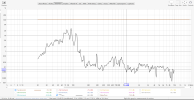
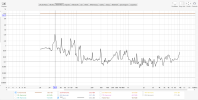
Vă las THD-ul la volum mic și la volum mare, unde puteți vedea de ce majoritatea oamenilor preferă să asculte la 75dB.

Captură de ecran 2026-07-26 131257.pngCaptură de ecran 2026-07-26 131428.png
Dacă cresc volumul (și am făcut-o și în teste), atunci automat distorsiunile cresc și nu-mi mai place ce aud, așa că până la 90dB este ok pentru ascultat în camera mea, pe echipamentul meu audio.

IMG_20260726_124127_851~2.jpg
 
Last edited:
There is no dB for how loud.
I know I'm at the level I want to listen to when I hear my wife screaming from the other room, "It's too loud, turn it down"
 
Agreed. Also I believe a large part of the reason we see so many votes for the 80 db and under levels. I could be wrong but I don't think that many of our members
are listening to music that softly, only that they're using a improperly set meter/software?
I agree.
Peak levels are not relevant when comparing these things, but a short-term loudness meter could be useful when comparing listening levels between different music genres, which generally have large differences in average loudness.
Here, I disagree with goat76 on the relevance of peak levels.
 
Do you have a DR measurement for a classical album you'd call dynamic ? Just curious.

Hi Sal,
  1. I never use crest measurements --- I believe the common CD/SACD measurements that are often called DR in new HiFi literature are crest. They seem to measure from from the average on that recording, to the max on that recording. I don't see that gives me the real peaks in the room, which is what I want to measure for that recording, when I'm in that particular mood. So, for music I use the good old fashioned Dynamic Range measurement techniques than were popular when I became a hobbyist in high school, and started borrowing an SPL meter from the science storeroom to measure our 100 member (+) orchestra from a) inside the orchestra [up to brief peaks of 115 dB -- I think it must have been C weight --] b) and from 10 rows away [where a wealthy student put his delicious Telefunken (Neuman) condenser microphones]. From that position I got brief peaks of 90 something dB in our huge auditorium, with the Great Gate of Kyiv (Kieve), and other such.
  2. Because I usually want to see the SPL in the listening room, at the main listening position, not what happens to be on the CD, I just measure the C weighted, "FAST" level at that main listening position. a) An oldish (1967) CD by DG, 479 4150, Argerich & Abbado, music by Prokofieff and Ravel regularly peaked at 80 dB "moderate level." So, I'd call the dynamic range, as I played it, to be 80 dB ("0" + peak intensity of 80 dB = 80 dB [room noise isn't usually assessed when measuring orchestras, so why do it here? Anyway our room noise is usually hovering around the old standard of 30dB. b) A 1988 CD (originally Direct to Disc) Richard Morris and The Atlanta Brass Ensemble, SONIC FIREWORKS, VOLS 1&2, cut #1 Fanfare for the Common Man, Peak Levels of 98 dB for unknown guests, and 105 dB for known and appropriate guests. A while back, one of our number gave me the crest DR for that disc, and it did not inform. c) Our system had gotten up to 115 dB for certain Beethoven or Mahler endings.
 
When I started this thread, I consulted one member back then (but it was in another thread that got deleted to avoid confusion bc the topic was similar). I explained to him what I'm interested in and he proposed the weighting. I'm not saying it's carved into stone, but this is how it was chosen.

I think a couple of comments are needlessly going back (IMO) on what was already proposed in initial post: yes, I chose A in the end, but then I also proposed the song that is not low-end heavy. I tried to standardize it, so keeping on an on about what if there was more low end kinda goes the wrong way.

SINCE I proposed a song to be used in tests, that is not bass heavy, choosing weighting that is more bass sensitive made no sense to me.

The problem of people using different weight should've been circumvent by proposing the standardized weight.

I don't think peaks are the most relevant metric because they are usually shorter and most people sort of go through them. You don't turn the volume down as soon as some peak comes up.

This is also why I was interested in average dB. I simply don't think people sit with their rc in their hands and turn up every quiet part and turn down every loud part.

DON'T GET ME WRONG - I love all of you because you're ready and more than willing to complicate it when it comes to audio. :D This is also why many of you were willing to take the measurement in the first place.

I just think sometimes complicating does no one no good and it doesn't bring anything new or relevant.

If a company (and I mean the decent ones) is perfectly capable of putting a dB spec on their speaker and say what dB you'll get when putting 1 watt at certain voltage and measured at a certain distance, it shouldn't be so difficult to measure your speakers SPL much the same way you do when calculating the power you need for the speakers you have and the room they'll be playing in. - If this speaker spec is not standardized and companies put all sorts of different weights in the sensitivity spec. then it's simply useless.
 
Back
Top Bottom