• Welcome to ASR. There are many reviews of audio hardware and expert members to help answer your questions. Click here to have your audio equipment measured for free!

How important is imaging to you?

How important is imaging to you?

  • Don't really care about it

    Votes: 14 8.8%
  • Good imaging is nice to have but I can live without it if the rest is fine

    Votes: 42 26.3%
  • It is very important for me so I don't want to compromise on it

    Votes: 104 65.0%

  • Total voters
    160
Not needed;) your ears are seperated by a distance- agreed and that’s the reason why we hear everything binaural. And that’s the reason why we can have ITD and ILD, which helps us locate a sound object in space. Otherwise without that distance, every sound at every angle would reach both ears simultaneously

Yes.

And the arrival time difference at the two ears is how the ear/brain system calculates the horizontal angle, or azimuth, of the sound source. The ear largely stops paying attention to repetitions of the original signal (reflections) for directional purposes after a short interval which corresponds to the amount of time it takes for a sound wave to travel from one ear around the head to the other ear, like if the sound was arriving from the side. After this short interval (in which all repetitions of the original sound contribute directional cues) the Precedence Effect (or Haas Effect) kicks in, and further repetitions of the original sound are largely (but not entirely) ignored for directional purposes.

If the speakers have reflections or diffraction that arrive BEFORE the Precedence Effect kicks in (so, within .68 milliseconds of the first-arrival sound, or within 1 millisecond, or something like that, the exact figure given by researchers varies somewhat), the result can be FALSE azimuth cues. These false azimuth cues can blur the sound image solidity or specificity. Typically something like edge diffraction varies with frequency so the image solidity can also vary with frequency.

I speculate that the earlier-onset edge diffraction of a narrow-baffle loudspeaker results in smaller-angle false azimuth cues than is the case with a wider-baffle loudspeaker, and this may account for the observation that "small speakers usually image better". Or to put it another way, a wider baffle generally results in a larger angle for the false azimuth cues, which blurs the image location moreso than a smaller false azimuth angle would.

And just to be clear, this phenomenon all happens before, and independent of, the in-room reflections.
 
Last edited:
Yes. That’s what I said, and that spatial cues or extra parameters other than ILD and ITD Is an incomplete science. That’s what we still don’t have headphones which can make us feel sound infront of us. There are certain exceptions like smiths realizer.
I think it’s a bit more complete than you might think. And HTF is the big factor. Perhaps the biggest. The Smyth Realizer is just one of a few headphone based immersive sound systems
 
Yes.

And the arrival time difference at the two ears is how the ear/brain system calculates the horizontal angle, or azimuth, of the sound source. The ear largely stops paying attention to repetitions of the original signal (reflections) for directional purposes after a short interval which corresponds to the amount of time it takes for a sound wave to travel from one ear around the head to the other ear, like if the sound was arriving from the side. After this short interval (in which all repetitions of the original sound contribute directional cues) the Precedence Effect (or Haas Effect) kicks in, and further repetitions of the original sound are largely (but not entirely) ignored for directional purposes.

If the speakers have reflections or diffraction that arrive BEFORE the Precedence Effect kicks in (so, within .68 milliseconds of the first-arrival sound, or within 1 millisecond, or something like that, the exact figure given by researchers varies somewhat), the result can be FALSE azimuth cues. These false azimuth cues can blur the sound image solidity or specificity. Typically something like edge diffraction varies with frequency so the image solidity can also vary with frequency.

I speculate that the earlier-onset edge diffraction of a narrow-baffle loudspeaker results in smaller-angle false azimuth cues than is the case with a wider-baffle loudspeaker, and this may account for the observation that "small speakers usually image better". Or to put it another way, a wider baffle generally results in a larger angle for the false azimuth cues, which blurs the image location moreso than a smaller false azimuth angle would.

And just to be clear, this phenomenon all happens before, and independent of, the in-room reflections.
Thanks, this clears up my earlier confusion!
 
Additionally, as the SPL increases, the phase errors introduced by diffractions in the sound also increase. The phase errors introduced by diffractions are level dependent. In blind tests conducted by Geddes, participants easily detected on-axis phase errors at high levels.
 
Additionally, as the SPL increases, the phase errors introduced by diffractions in the sound also increase. The phase errors introduced by diffractions are level dependent. In blind tests conducted by Geddes, participants easily detected on-axis phase errors at high levels.

Any links on that? Thx.
Never known Geddes to conduct any increased SPL, blind tests
 
Any links on that? Thx.
Never known Geddes to conduct any increased SPL, blind tests
1707174195017.png


page 28.

He talks about this also in his articles about compression drivers and waveguides.
 
Reflections are the ones that messes up imaging. You add more acoustic panels to your room to cancel the reflections, you notice the imaging to get better on wider directive speakers. On narrow beaming speakers like Kef, it’s the wall reflections are less and the imaging is better therefore.
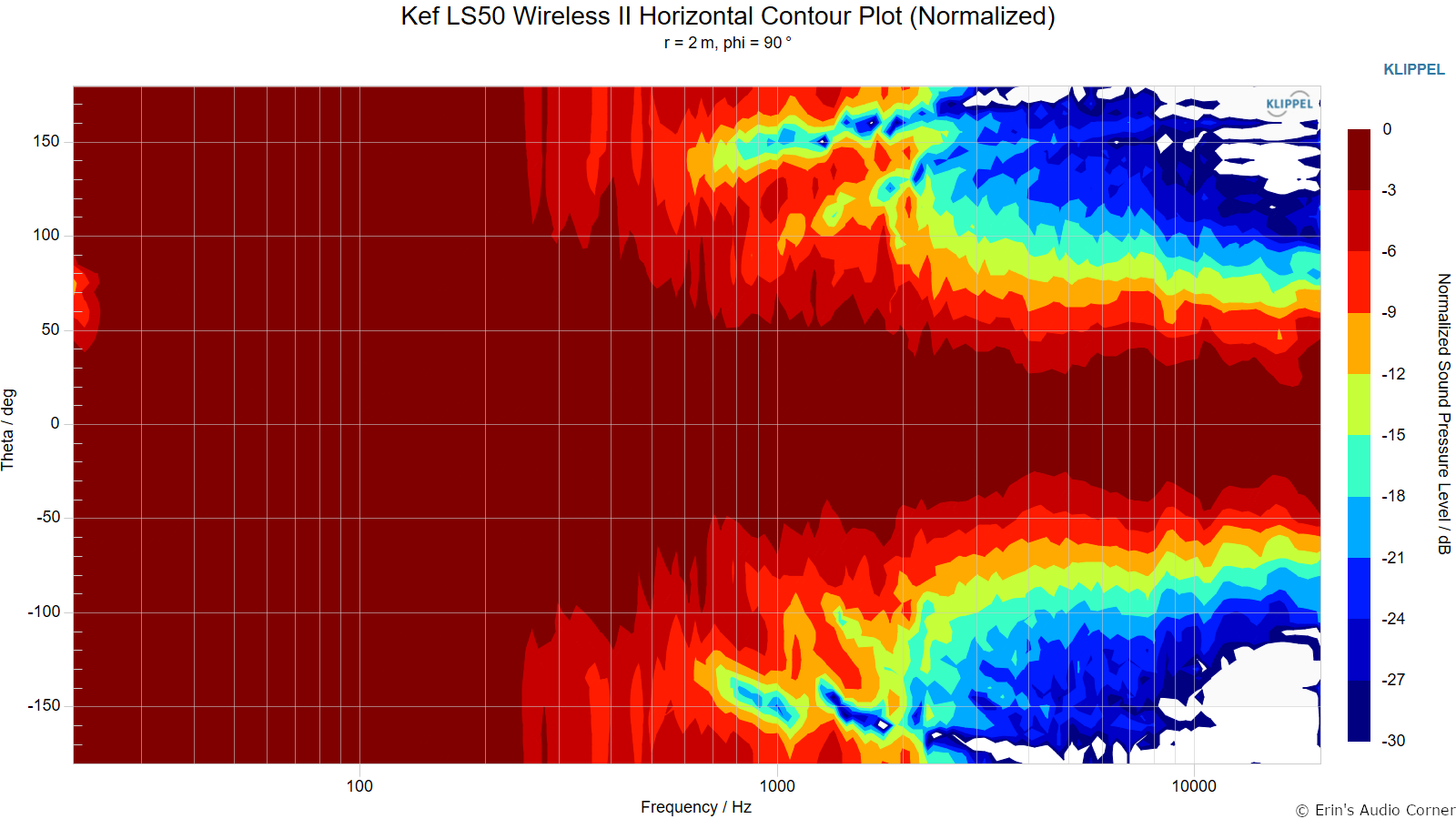
Also, slightly confused by this point. Are KEF typically narrow beaming? Or am I using a different definition of narrow?
For instance a couple of KEF speakers' measured horizontal contour plots:
KEF-R5-Meta-Horizontal-Contour-Plot-Normalized.png

Kef%20LS50%20Wireless%20II%20Horizontal%20Contour%20Plot%20%28Normalized%29.png

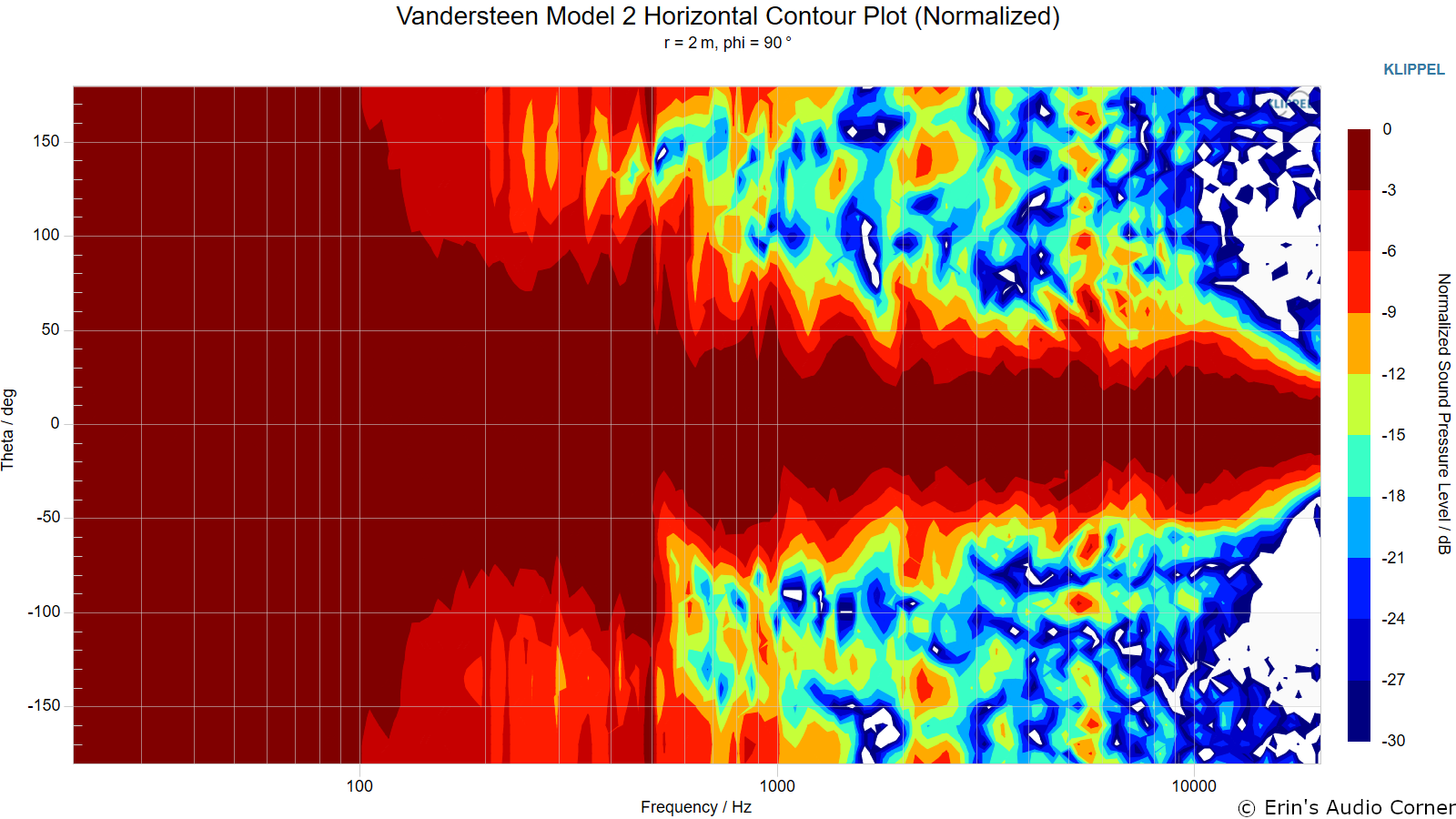
Those aren't really narrow, they are constant and smooth off-axis behavior above 1kHz. Maybe they don't have the variation that includes regions with wide vs. narrow dispersion:
ELAC%20Debut%202.0%20B6.2%20Horizontal%20Contour%20Plot%20%28Normalized%29.png

Vandersteen%20Model%202%20Horizontal%20Contour%20Plot%20%28Normalized%29.png

Parts%20Express%20Copperhead%20Desktop%20Full-Range%20Speaker%20Horizontal%20Contour%20Plot%20%28Normalized%29.png


Of course vertical on the Vandersteen and Elac are much worse. And non-normalized even more so. But I am not clear on your use of narrow.
 
Back
Top Bottom