• Welcome to ASR. There are many reviews of audio hardware and expert members to help answer your questions. Click here to have your audio equipment measured for free!

Horn Speakers - Is it me or.......

with Goto drivers :p
I don't remember exactly anymore, and it's not easy to ask. There were probably low-pass filters as well. Or not)). Theoretically, a multi-way horn system without low-pass filters (and w\o esoteric drivers also)) is possible. The result would may be audiophile-grade :cool: .
 
Last edited:
I wonder if they were banging the diaphragms against the pole pieces.
Nope! There were definitely first-order audiophile-grade high-pass filters there. Actually, I haven't heard the phragm hitting the phase plug even once so far.
 
first-order audiophile-grade high-pass filters there
My tin ear prefers the LR4 I use. But then, I never claimed to be an audiophile.
 
I once heard speakers with probably five (but no fewer than four) horn-loaded bands—possibly with just a capacitor in each band (each band operates below Fhm).

Could very well be, especially if that was the horn designer's intent and priority from the outset.
 
Yes the 2" thick batts. I just cut them a slight bit over the width size with a box cutter, or large bread slicing knife and slid them in sitting on the window sill, that's it.
They've been just sitting there for over 4 years now, no problems. ;)
Amazing how a relatively inexpensive acoustic treatment like yours can be very beneficial to the sound of music in a room!
 
You do understand that EQ is vital to correct the inevitable dowward-tilting frequency response of a constant-directivity horn, right? And, that once you've corrected the on-axis response of a constant-directivity horn, you have simultaneously corrected the off-axis response as well?

Yes, that is why i added the note about changing the tonal balance. Without it, it sounds pretty far from neutral.

To put it another way, EQ is an inevitable part of using a constant directivity horn, if sound quality is a consideration.


Well... there is one school of thought that says a top priority should be having a minimalist crossover design, and another that says a top priority should be having the off-axis response track the on-axis response. In practice, those two priorities end up being somewhat at odds with one another.

Schools of thaught are usually not very useful unless they adress the actual physics. They tend to be attempts for simplified solutions to a problem that is far more complex.

One great example of this is when you compare first order and second order cross over with Harsch-filter. The first order filter is in theory the simple way while the second order filter has some obvious other advantages. But the Harsch filter sound just so minimalist, light weight and fluid. The depth perspective is rock solid and you get this point source like presentation from two way (MT) units.
 
EQ is useful for changing the tonal balance, and altering the response of low order modes. But it normally sounds better if you can avoid them in the first place. My point is that in many cases, EQ-ing away something is very often not the same as completely removing the audible impact of it.

You can EQ something if it is minimum-phase, which implies it is linear-time invariant / LTI.
 
I think your accusations towards horns are a bit unfair. As far as I can see, there are four claims here connected to horns:

1: Horns are outdated.
There are different types of horns made for different purposes. They have all sorts of different properties depending on the task they are made to fit. For hifi, you need a few properties that are kind of interconnected. One is very low HOM. Another one is freedom of resonances. Controlled dispersion is a third factor. It is easy to find a horn that is developed for an entirely different purpose, only to perform very poorly on one or more of these parameters.

2: There are good and bad dynamic qualities.
This is a very unreasonable claim. There is no way of improving dynamics. It can only be degraded, meaning you move away from the dynamic linearity of the original track. I believe you may be talking about uneven frequency response that is being mistaken for some kind of dynamic behavior.

3: Horns cause uneven response.
If you have the three parameters above under control, you do not get uneven response. It is that simple.

4: Removing the horn removes these problems.
Removing the horn usually degrades the dispersion control and increases non linear distortion. If you have a very good horn, you will not improve the frequency response or dynamic qualities by removing the horn.

You are off course entitled to having an opinion, but I think your reasoning is confusing and in some ways misleading. I suspect you simply have not yet heard a very good horn that is correctly integrated into the rest of the system.

Here are some raw measurements of a 46cm horn at 15 degree steps horizontally and vertically:
View attachment 562341
View attachment 562342

These measurements are gated, but not smoothed. It is easy to achieve a very smooth response with the tonal balance you want with this starting point, and it sounds pretty damn great.
Yes I spoke prematurely based on preconceived notion and insufficient sample size. Thank you for the correction. I will be more careful in the future. I am here to learn as well as share. Thanks again. Cheers.
 
Last edited:
You can EQ something if it is minimum-phase, which implies it is linear-time invariant / LTI.

Yes, since EQ is typically minimum phase it will fully correct both frequency and time domain. In most cases it is not.

Typically there will be a component of excess phase.

An LTI system also requires a distinct input and output of the system, but at low frequencies the entire human body contributes so much to our perception that a single point measurement is insufficient.
 
Last edited:
I realize the first line of my last post can be confusing. EQ is normally minimum phase. But what you measure, even in an anechoic environment, is in most cases not purely minimum phase.
 
But I have a couple of questions if you don't mind. What is the purpose of a horn and how does it achieve it's objective? Because I was under the impression that the purpose of a horn was to make a sound source louder and it did that by directing sound energy that would otherwise disperse to the sides into a louder more concentrated frontal pattern increasing direct sound pleasure at the expense of directivity. Is this wrong? Because this belief system, if correct, seems to support the original posters subjective opinion that horns are "highly directional". Please help me understand this. Thank you.
 
That is not a small question, but I will give it a try to keep it pretty simple anyway.

Firstly, a horn is not a separate addition to a driver what would otherwise work as intended without the horn. When a horn is added to a driver that works well as a direct radiating driver, it is kind of not the same.

So it starts with the compression driver. That is what causes the high efficiency, not the horn. The high efficiency comes from the strange relationship between the force and the mass. The force completely dominates, while the mass is rather insignificant with that much force. This leads to a driver that will roll off, starting at hig frequencies, and just lose its efficiency completely. When measured with a PWT (plane wave tube) which is just a long pipe with the same cross section as the driver exit, it will perform quite well towards lower frequencies since it does not loose its energy in other directions.

But this can be thought of in another way as well. There is a concept called acoustic impedance. This is very low for a direct radiating driver, and very high for a PWT. However, the sound from the PWT does not exit out in the surroundings to create a meaningful usable output for a loudspeaker. This is what the horn does, it gradually lowers the acoustic impedance from the driver in order to transform the waves from the driver so that we can maintain the high PWT-like output from the driver to the surroundings. As you now clearly understand, dispersion is an important part of this equation, but in order to understand the rest, we can use a different form of method to explain it.

Inside the compression driver, there is a rear chamber, a diaphragm, and a phase plug. The phase plug reduces the effective radiating area from the diaphragm to something smaller, normally referred to as loading. It can be 1:2, 1:3, 1:4 etc, but this tranformation causes the air speed to increase. When we add a horn to the driver, there will be an air column added in front of this phase plug as well, and this air has mass. So we increase the effective moving mass significantly, but all of the added mass is air itself. This added mass enables the driver to maintain its output lower in frequency, but not with the same tradeoff that we experience when the mass is just the diaphragm.

A great comparison to this impedance transformation circuit would be to compare a 1 inch dome to an 15 inch midwoofer. The dome could have 0,5 grams of moving mass, while the 15 inch could have 100 grams, but still the 15 inch can have significantly higher efficiency. This is easily explained by the effective diaphragm area. We can not reach high efficiency from a 1 inch dome by adding a lot of mass, even with an extremely powerful motor. At the same time, we do not get very good high frequency performance from a 15 inch driver. So a horn is a very nice way of transforming the effective radiating area to something much bigger than what we get out of a small tweeter.
 
... this belief system, if correct, seems to support the original posters subjective opinion that horns are "highly directional".

I assume this is what you're referring to, from the opening post: "... they were clearly highly directional. Unless I was right bang in the firing line on axis they had no high frequencies."

I don't doubt him at all; that is absolutely true of some horns... and not at all true of others. In other words, like so many things in speaker design, when it comes to horns the answer is often "it depends." In this case, the directional characteristics depend on the shape of the horn.

Please help me understand this.

Here are three concepts that are imo useful background information:

1. If you control what a sound wave is doing for least 1/2 of a wavelength, you have controlled its direction (and even down at 1/4 wavelength you can still influence its direction).

2. When a sound wave encounters a sharp discontinuity, it diffracts, or spreads out in all directions, as if that discontinuity is a secondary sound source.

3. In general the longer the horn, the lower in frequency it can go.

Here is an image I cobbled together showing three different horn shapes, each representative of a different general category of horns (and it's quite possible that there are better terms for these categories; this is just me winging it):


Three horns-001.jpg


At the risk of over-simplifying, here are descriptions of these three general categories:

1. Trumpet-style horns have long continuous curves, which start out very narrow in the throat and gradually widen at a slowly-increasing rate, until finally smoothly flaring out wide at the mouth. Trumpet-style horns tend to be fairly long relative to how wide the mouth is. Now let's look at how the directionality is narrow at high frequencies and widens as we go down in frequency: Notice how narrow the angle of the walls of the horn are way down in the throat. This is the part of the horn controlling the angular coverage of the shortest wavelengths. As the wavelengths become progressively longer, more and more of the horn's length is required to control their direction, and since the horn's walls are gradually flaring outwards, the coverage angle becomes gradually wider and wider as we go lower and lower in frequency, and then the coverage angle is pretty wide by the time the wavelengths are long enough for the wall angles near the mouth to be in play. This type of horn does indeed beam the high frequencies.

2. In prosound there is a need for wide and fairly uniform horizontal coverage so that the audience members all get enough high frequency energy for acceptable sound quality. Diffraction slots, and/or diffractive kinks in the walls of the horn, are used to broaden the coverage pattern and make it more uniform. In the example shown the diffractive features result in good pattern uniformity over about 90 degrees horizontally and maybe 40 degrees vertically. Diffraction horns can be either deep or shallow or in between, depending on the characteristics the designer wants.

3. Waveguide-style horns tend to be quite shallow compared to their lengths, so they don't go very low unless they are very large. Their wall angle transitions to the coverage pattern very early, way down in the throat, so the high frequencies have as wide a pattern as the rest of their frequency range... in theory. In practice there is often some beaming of the high frequencies if the natural radiation pattern arising from the compression driver's exit diameter becomes narrower than the walls of the horn.

There is far more that could be said about each of these general categories, even moreso the specific horn designs within each, and there are other categories including "hybrids", so this is just barely scratching the surface.

My guess is that the opening post's description of directionality is in response to hearing a horn from the trumpet-style category.

When you come across sweeping generalities being made about horns, often the reality involves "it depends" to some extent.
 
Last edited:
I assume this is what you're referring to, from the opening post: "... they were clearly highly directional. Unless I was right bang in the firing line on axis they had no high frequencies."

I don't doubt him at all; that is absolutely true of some horns... and not at all true of others. In other words, like so many things in speaker design, when it comes to horns the answer is often "it depends." In this case, the directional characteristics depend on the shape of the horn.


Here are three concepts that are imo useful background information.

1. If you can control what a sound wave is doing for least 1/2 of a wavelength, you can control its direction (and even down at 1/4 wavelength you can still influence its direction).

2. When a sound wave encounters a sharp discontinuity, it diffracts, or spreads out in all directions as if that discontinuity is a secondary sound source.

3. In general the longer the horn, the lower in frequency it can go.

Here is an image I cobbled together showing three different horn shapes, each representative of a different general category of horns (and it's quite possible that there are better terms for these categories; this is just me winging it):


View attachment 562540

At the risk of over-simplifying, here are descriptions of these three general categories:

1. Trumpet-style horns have long continuous curves, which start out very narrow in the throat and gradually widen at a slowly-increasing rate, until finally smoothly flaring out wide at the mouth. Trumpet-style horns tend to be fairly long relative to how wide the mouth is. Now let's look at how the directionality is narrow at high frequencies and widens as we go down in frequency: Notice how narrow the angle of the walls of the horn are way down in the throat. This is the part of the horn controlling the angular coverage of the shortest wavelengths. As the wavelengths become progressively longer, more and more of the horn's length is required to control their direction, and since the horn's walls are gradually flaring outwards, the coverage angle becomes gradually wider and wider as we go lower and lower in frequency, and then the coverage angle is pretty wide by the time the wavelengths are long enough for the wall angles near the mouth to be in play. This type of horn does indeed beam the high frequencies.

2. In prosound there is a need for wide and fairly uniform horizontal coverage so that the audience members all get enough high frequency energy for acceptable sound quality. Diffraction slots, and/or diffractive kinks in the walls of the horn, are used to broaden the coverage pattern and make it more uniform. In the example shown the diffractive features result in good pattern uniformity over about 90 degrees horizontally and maybe 40 degrees vertically. Diffraction horns can be either deep or shallow or in between, depending on the characteristics the designer wants.

3. Waveguide-style horns tend to be quite shallow compared to their lengths, so they don't go very low unless they are very large. Their wall angle transitions to the final coverage pattern very early, way down in the throat, so the high frequencies have as wide a pattern as the rest of their frequency range... in theory. In practice there is often some beaming of the high frequencies if the natural radiation pattern arising from the compression driver's exit diameter becomes narrower than the walls of the horn.

There is far more that could be said about each of these general categories, and there are other categories including "hybrids", so this is just scratching the surface.

My guess is that the opening post's description of directionality is in response to hearing a horn from the trumpet-style category.

When you come across sweeping generalities being made about horns, often the reality involves "it depends" to some extent.
Thank you.
 
My guess is that the opening post's description of directionality is in response to hearing a horn from the trumpet-style category.

The easiest way to find any kind of significant horn sound would be within commercial speakers, like Avantgarde Acoustics as an example. What we often see in those types of speakers is that they use horns quite a bit below the range where they would maintain dispersion control. It is common for them to use horns that beams significantly, and, maybe most important, they often just use normal dynamic drivers with relatively high moving mass insted of proper compression drivers.

I think this type of products do sound somehow the way TS describes them, but that is not a result of what is possible, but rather the choices made by the designer.
 
What's the difference between horn and waveguide like you find for example on many JBL monitors, e.g. 708P?
The difference lies in the way the words are spelled.
Isn't it generally said that the purpose of a horn—by virtue of its design—is to increase sensitivity through acoustic efficiency, whereas a waveguide is viewed more as a means of achieving better control over the dispersion?

BUT, on the other hand, doesn't a horn also do what a waveguide does, and vice versa? Although perhaps a waveguide doesn't provide quite as much acoustic boost as a horn. Or is my conclusion incorrect?

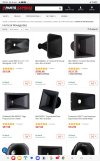
In any case, Parts Express has grouped them together in the category:
Horns & Waveguides:
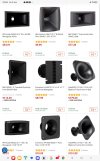
Screenshot_2026-10-03_220546.477.jpgScreenshot_2026-10-03_220612.704.jpg
 
Back
Top Bottom