• Welcome to ASR. There are many reviews of audio hardware and expert members to help answer your questions. Click here to have your audio equipment measured for free!

Horn Speakers - Is it me or.......

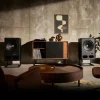
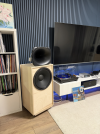
This system Images even better than my Legendary "Beveridge" speakers do.

No beaming, No harshness, No odd resonances...

Finally a monster midranger worthy of my system. :)

faIjw6P.jpeg

O54GzBN.jpeg


bJFXBHO.jpeg


moigW51.jpeg


YuxpuE6.jpeg
 
Last edited:
It seems to me like the mid horns have been flipped 90 degrees. The slot is normally there to improve horizontal dispersion to widen listening window and even out the frequency response of early reflections.
 
Good catch...

Even tried measuring the dispersion radiation pattern... Hopeless endeavor.

Had them mounted vertically but there was no difference in Near Field sonic performance.

The sound is perfection.

JBL 18" X 2 @ 600 watts. 96db.

JBL 15" X 2 @ 600 watts. 94db.

Altec Mantaray EV DH-1 X 2 @ 300 watts. 112 db

18" Phenolic Tweeter X 2 @ 300 watts. 106 db.

Ashly XR4001 crossover. A3/24 24-192 DAC.
 
Last edited:
Only tapped horn is not horn. As for the rest—yes, I agree.

I think the definition of a horn is very vague. It seems waveguides and transmission lines seem to be a bit more clearly defined, while both of them seem to be put inside the horn definition together with some resistive ports and Helmholtz resonators in different orders. Even acoustic loading alone seems to be regarded as a horn by some, while of you ask the Chinese, they often just see a driver as a "horn". That last bit might be a language thing...
 
Good catch...

Even tried and measuring the dispersion... Hopeless endeavor.

Had them mounted vertically but no difference in performance.

The sound is perfection.
Yes, measuring large horns indoors is very tricky. That slot causes a sudden drop in acoustic impedance, a known source of HOM, and the flare seeks to remedy this and re-fuse the wavefront. But in order for this to make it in to the measurement mic, you need to measure at a distance. This pretty much rules out gating as an effective tool.
 
I'm also using them in a very limited frequency range.

Crossover points are 80 / 450 / 1,800.

Helps to have a business where there was a constant flow of expensive hard to source audio electronics.

Only ended up with horns after building a few hundred systems for customers.
 
Last edited:
I think the definition of a horn is very vague.
It has become that way. My definition is it loads the diaphragm, and you can see that by it raising the impedance and damping it. My drivers measure purely resistive on the horn I use.
 
For example
View attachment 562087
View attachment 562088
, very for example :), nothing optimal. That is a volume roughly equal to five such benchs. Can you play with Hresp?

I didn't do anything other than take two screenshots; I had this hresp record saved.
Tapped horn could hit 30Hz no problem.

A 2.4m long one (4.8m path) will hit 20Hz with a 15".
With some more folding you might get it into that Cabinet size.

You can't quite squeeze an18" driver in..

The Don Synder 30Hz with a 12" has 220.5lt horn volume.

They are only any good to around 90-100 Hz though.
Sound better if crossed even lower I've found.
Thanks. That’s pretty much what I suspected. No, I don't have hresp, but I can certainly download it.:)

The challenge—or one of them—for me isn't really the very deepest bass (I have a sub for that) or my conventional two-way speakers (woofer and dome tweeter), which I think sound good. It’s the area around the crossover point between the sub and the main speakers, extending a few hundred Hz upwards. I can never quite get that good, punchy mid-bass.
It just ends up being a sort of weak "thump-thump" rather than real mid-bass impact.

Punchy mid-bass. Horns ought to do an excellent job of that, right? And they wouldn't be so extremely large physically, either.That would be nice to have. Perhaps unnecessary, strictly speaking, since I don't want to disturb the neighbors, but sometimes it’s nice (they’ll just have to put up with it) to really "put the pedal to the metal." :)
 
Last edited:
In my experience of 12" and 15" driver bass to mid bass exponential horns - 90Hz to say 350Hz, using what looks good in Hornresp doesn't give that punchy sound unless you can sit 4m+ away from the mouths.
Multiple driver solutions give more punch.
 
In my experience of 12" and 15" driver bass to mid bass exponential horns - 90Hz to say 350Hz,
Could you tell more about it?
I tried it a long time ago and didn't get any noticeable benefit.
 
Thanks. That’s pretty much what I suspected. No, I don't have hresp, but I can certainly download it.:)

The challenge—or one of them—for me isn't really the very deepest bass (I have a sub for that) or my conventional two-way speakers (woofer and dome tweeter), which I think sound good. It’s the area around the crossover point between the sub and the main speakers, extending a few hundred Hz upwards. I can never quite get that good, punchy mid-bass.
It just ends up being a sort of weak "thump-thump" rather than real mid-bass impact.

Punchy mid-bass. Horns ought to do an excellent job of that, right? And they wouldn't be so extremely large physically, either.That would be nice to have. Perhaps unnecessary, strictly speaking, since I don't want to disturb the neighbors, but sometimes it’s nice (they’ll just have to put up with it) to really "put the pedal to the metal." :)

This is a very common problem, and, while typically room related, you can look at the speakers dispersion pattern and how they integrate into the room. I think it can be discussed in the light of several aspects.

The first and probably most obvious one is the capacity and frequency response out of the speaker itself. A speaker with inferior capacity will typically produce a lot of IMD that in turn alters the frequency response. Motor related distortion is usually an important contributor to this, but pure running out of excursion will sometimes also be the issue. If the system is tuned with incorrect frequency response bass may lack initial impact or sustaining weight, both connected to the frequency response.

But I guess horns are the main topic, and therefore an interesting consideration for you as well. PhD horn guru Bjørn Kolbrek did some testing on an in room bass horn that can be read here:

In short, he had issues with the room. Horns are in no way superior when wavelengths become large compared to the room size. We see the same in the pro audio and club audio systems industries. Bass horns are not popular, simply because where the sound ends up being strongest is really unpredictable. More bass in the local neighbourhood, or in the bar rather than on the dance floor is a very common problem. Function One, who is one of the biggest players in the club industry, started supplementing their dance stacks with bass reflex subwoofers years ago.

I think the easiest way to understand this is that a horn is often acoustically far larger than the physical dimensions of the speaker. It is the same problem as line array speakers. We are simply not far enough away for the waves to fully develop. It is partly the same problem that @Buck_Rogers ran into when trying to measure his midrange horns, it requires more distance than a direct radiating driver.

The most effective way to reduce the challenges with in room modes seems to be cardioide, since they can be placed both relatively close to walls, but also further out in the room. They do not feed directly into either pressure peaks or nodes, so they connect far less to the modes. In addition, they can be made much more compact for the same capacity.

 
This is a very common problem, and, while typically room related, you can look at the speakers dispersion pattern and how they integrate into the room. I think it can be discussed in the light of several aspects.

The first and probably most obvious one is the capacity and frequency response out of the speaker itself. A speaker with inferior capacity will typically produce a lot of IMD that in turn alters the frequency response. Motor related distortion is usually an important contributor to this, but pure running out of excursion will sometimes also be the issue. If the system is tuned with incorrect frequency response bass may lack initial impact or sustaining weight, both connected to the frequency response.

But I guess horns are the main topic, and therefore an interesting consideration for you as well. PhD horn guru Bjørn Kolbrek did some testing on an in room bass horn that can be read here:

In short, he had issues with the room. Horns are in no way superior when wavelengths become large compared to the room size. We see the same in the pro audio and club audio systems industries. Bass horns are not popular, simply because where the sound ends up being strongest is really unpredictable. More bass in the local neighbourhood, or in the bar rather than on the dance floor is a very common problem. Function One, who is one of the biggest players in the club industry, started supplementing their dance stacks with bass reflex subwoofers years ago.

I think the easiest way to understand this is that a horn is often acoustically far larger than the physical dimensions of the speaker. It is the same problem as line array speakers. We are simply not far enough away for the waves to fully develop. It is partly the same problem that @Buck_Rogers ran into when trying to measure his midrange horns, it requires more distance than a direct radiating driver.

The most effective way to reduce the challenges with in room modes seems to be cardioide, since they can be placed both relatively close to walls, but also further out in the room. They do not feed directly into either pressure peaks or nodes, so they connect far less to the modes. In addition, they can be made much more compact for the same capacity.
Thanks for the interesting information. :) I’ve sorted out the frequency response using EQ. The issue stems simply from the small 5-inch, 50-watt bass driver. It’s a good unit—the SB15NBAC30—though I think it’s best suited for a three-way speaker, even though Revel uses it in their two-way M105 model.

I have a small living room, but I could always add two bass modules at some point in the future (turning it into a DIY three-way system). I’d need some suitable mid-bass drivers for that—either for sealed or ported enclosures. According to Gemini AI, they should have the following parameters:
Screenshot_2026-10-01_203604.670.jpg
(I take all AI-generated hi-fi recommendations with a pretty big grain of salt.)
By the way, I have four Peerless SLS 10s; they’re good bass drivers (considering the price), but I don’t think they’d work well for powerfull punchy mid-bass—at least, that’s my guess.
I could always sell them, I suppose.
 
Last edited:
Thanks for the interesting information. :) I’ve sorted out the frequency response using EQ. The issue stems simply from the small 5-inch, 50-watt bass driver. It’s a good unit—the SB15NBAC30—though I think it’s best suited for a three-way speaker, even though Revel uses it in their two-way M105 model.

I have a small living room, but I could always add two bass modules at some point in the future (turning it into a DIY three-way system). I’d need some suitable mid-bass drivers for that—either for sealed or ported enclosures. According to Gemini AI, they should have the following parameters:
View attachment 562133
(I take all AI-generated hi-fi recommendations with a pretty big grain of salt.)
By the way, I have four Peerless SLS 10s; they’re good bass drivers (considering the price), but I don’t think they’d work well for powerfull punchy mid-bass—at least, that’s my guess.
I could always sell them, I suppose.

It does sound like you have some limitations in the driver itself for this application. You will run into at least three different issues with the SB 15cm.

- Firstly, the motor is not designed for midrange or midbass, it is designed for bass/mid, used in 2 way speakers. It is simply not suitable for handling much power.

- Secondly, and related to the first issue, is that the motor will not be very stable when you push it. It will run into issues with the permanent field giving in under the magnetic force from the coil, resulting in heavy modulation of the force factor.

- Lastly, you quickly run out of excursion.


I would recommend that you take a look at some 10 or 12 inch pro audio drivers.

Here is a good example:

What makes this driver interesting is that it has low moving mass and with a short and relatively small diameter voice coil, much of the mass is in the diaphragm. This means the magnetic field from the coil can be held relatively small compared to the fixed field, even at high SPL levels. You will have about 2mm to play with, but the diaphragm area is more than 4 times that of your current driver, so it would be comparable to pushing your current driver to about +/-9mm of excursion, but without that significant tradeoff in sound quality. I believe this gives you a hint of what to look for. A couple of other hints are low inductance (remember that an 8 ohm driver has naturally twice the inductance of a 4 ohm driver when they are comparable in quality), low rise in impedance towards high frequencies, and little to no ripple on the impedance curve in the working range of the driver.

I would also like to point out that EQ-ing the response to flat can be countless different approaches with countless different results. How you get the response curve flat (ish) is far more important than getting it measurably "flat".
 
Last edited:
It does sound like you have some limitations in the driver itself for this application. You will run into at least three different issues with the SB 15cm.

- Firstly, the motor is not designed for midrange or midbass, it is designed for bass/mid, used in 2 way speakers. It is simply not suitable for handling much power.

- Secondly, and related to the first issue, is that the motor will not be very stable when you push it. It will run into issues with the permanent field giving in under the magnetic force from the coil, resulting in heavy modulation of the force factor.

- Lastly, you quickly run out of excursion.


I would recommend that you take a look at some 10 or 12 inch pro audio drivers.

Here is a good example:

What makes this driver interesting is that it has low moving mass and with a short and relatively small diameter voice coil, much of the mass is in the diaphragm. This means the magnetic field from the coil can be held relatively small compared to the fixed field, even at high SPL levels. You will have about 2mm to play with, but the diaphragm area is more than 4 times that of your current driver, so it would be comparable to pushing your current driver to about +/-9mm of excursion, but without that significant tradeoff in sound quality. I believe this gives you a hint of what to look for. A couple of other hints are low inductance (remember that an 8 ohm driver has naturally twice the inductance of a 4 ohm driver when they are comparable in quality), low rise in impedance towards high frequencies, and little to no ripple on the impedance curve in the working range of the driver.

I would also like to point out that EQ-ing the response to flat can be countless different approaches with countless different results. How you get the response curve flat (ish) is far more important than getting it measurably "flat".
Thanks for the very interesting information. Now, this is a thread about horns, so this will be my last post here regarding non-horn speakers.

Just a general reflection: I find the enthusiasm here on ASR for two-way speakers—using (small) 5- to 6.5-inch woofers and dome tweeters paired with subwoofers—a bit puzzling. Why does this combo seem to be treated as a "one-size-fits-all" solution?
I might be wrong about this assumption, but that is my impression, at any rate.

I mean, if you have a large room, no neighbors to consider, and want to play at high volume, surely that isn't the optimal setup. A decent three-way hi-fi speaker with an 8- to 10-inch woofer, combined with subwoofers, ought to be preferable. Then, the next step up—if the situation allows (room size, WAF, appropriate listening distance, etc.)—would be horns or perhaps line arrays?

In my case, with a small living room and neighbors to consider in an apartment complex, high-SPL monsters that pump out massive bass would be a bit of a waste of money. I mean, they’re supposed to sound good (low distortion) at high volumes, but my speakers manage that at low-to-normal volumes too. That said, having a pair of good mid-bass drivers would be nice.:) I’m a bit torn on this.

I suppose I’ll just have to bite the bullet and use headphones when I want to really crank up the volume.
I have nice neighbors whom I want to remain nice.
 
Last edited:
small living room and neighbors to consider in an apartment complex
I used one bedroom to enlarge the living room. There are 20 apartments in our building. Even in a 20-square-meter room, though, I didn't want a 6+1 setup. A friend recently diys a 15+xt1464 system in a 14-square-meter room; I think I posted photo of it in this thread.

ps: https://www.audiosciencereview.com/...s/horn-speakers-is-it-me-or.9633/post-2642795
pps: It cost around 1,000 euros for the drivers, horns, plywood, plywood cutting, and materials.
ppps: for moderately limited levels 15s LF responce may be simply EQed. Even I adjusted the low frequencies of my 15-inchers in an IB setup a long time ago)).
 
Last edited:
I used one bedroom to enlarge the living room. There are 20 apartments in our building. Even in a 20-square-meter room, though, I didn't want a 6+1 setup. A friend recently diys a 15+xt1464 system in a 14-square-meter room; I think I posted photo of it in this thread.

ps: https://www.audiosciencereview.com/...s/horn-speakers-is-it-me-or.9633/post-2642795
pps: It cost around 1,000 euros for the drivers, horns, plywood, plywood cutting, and materials.
ppps: for moderately limited levels 15s LF responce may be simply EQed. Even I adjusted the low frequencies of my 15-inchers in an IB setup a long time ago)).
They could certainly be an alternative to bookshelf speakers (on stands) or "traditional" three-way hi-fi speakers—especially now that slightly wider speakers are becoming popular. Think of the Wharfedale Linton 85th Heritage (which, in my opinion, isn't actually all that big or wide).

Hi-Fi Klubben, which sells across the Nordic countries, is a commercial retailer; they wouldn't stock Vestlyd (wide) speakers unless they actually sold well:
vestv15c.webpvestv12c.webp

By the way, I like those acoustic panels.
1784658331434.png
I'm thinking of putting some up myself—mainly because I think they look good. :)
They might still have some effect, even though they're thin. Probably not for absorption (though you could place mattresses between them and the wall), but rather as diffusers.

Edit:
Personally, I don't really have any restrictions regarding speaker size—provided there's still room for my other furniture. Okay, I suppose the limit is around the point where speakers physically take up about a third of the room's floor space. Somewhere around there. Maybe a quarter, come to think of it.
 
Last edited:
Back
Top Bottom