• Welcome to ASR. There are many reviews of audio hardware and expert members to help answer your questions. Click here to have your audio equipment measured for free!

Horn Speakers - Is it me or.......

IMHO if the bass is not horn loaded as well as mid/high its not a horn speaker.
Almost all modern designs for home use are hybrid designs. Aside from the well-known corner horns, the only other options are folded-horn designs, which are usually non-linear and extend down into the low-bass range.
To reproduce 30 Hz, a horn aperture of approximately 10 square meters is required.
You could build a house around it, and it would work.
In hybrid designs, there are horns that reproduce frequencies cleanly starting at around 500 Hz, and some starting at 800 Hz.
Below that, a conventional bass system with a large diaphragm area ensures you’re on the safe side. What you choose to call it is actually completely irrelevant.
 
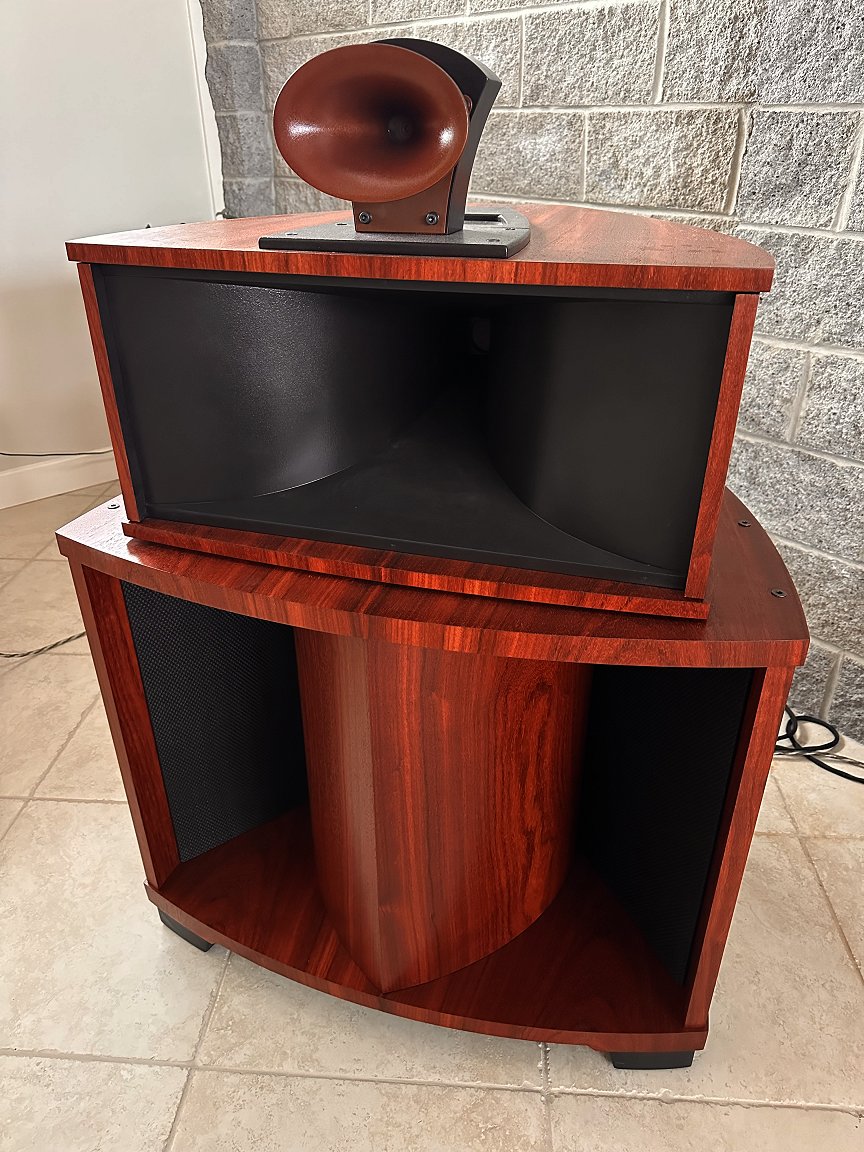
We're working on a smaller horn speaker than our Vera Audio Sagarmatha (which is 126 cm in width). May end up with something around 80 cm width. Using a horn loaded midbass also, which is IMO the only way to make a high-end horn speaker. That's important both to match the direcitivty to the top horn, but horn loading also benefits from lower distortion and gives higher SPL. A folded horn is generally problematic though, so we're not using that. That means one needs to use subwoofer(s) for the lowest frequencies. But that's really better anyway due to what can be achieved with multiple units and Dirac Art.

Smaller horns with a front firing woofer below is IMO not a great speaker design. One ends up with a crossover at a suboptimal frequency area, not a very good directivity match, and too wide directivity for part of the frequencies which causes more room issues and uneven frequency response.

I obviously understand the part about making a speaker smaller to reach a market, but in that case I would combine a tall top horn with a cardioid woofer. That would be a better design, though not as good as a hornloaded midbass.
 
Almost all modern designs for home use are hybrid designs.
Almost being the operative word. Besides cornerhorns, the Klipsch LaScala type designs have been copied by a number of manufacturers. The Volti Vittora being one of the most well know. The laws of physics being what they are, a bass horn this size has problems going much below 50hz, but it does have it's advantages for producing a full range horn system.
NV121a.jpeg
 
Almost all modern designs for home use are hybrid designs. Aside from the well-known corner horns, the only other options are folded-horn designs, which are usually non-linear and extend down into the low-bass range.
To reproduce 30 Hz, a horn aperture of approximately 10 square meters is required.
You could build a house around it, and it would work.
In hybrid designs, there are horns that reproduce frequencies cleanly starting at around 500 Hz, and some starting at 800 Hz.
Below that, a conventional bass system with a large diaphragm area ensures you’re on the safe side. What you choose to call it is actually completely irrelevant.

I get a -6dB point around 32Hz in room with mine in the room corners to use the walls and floor to extend the horn as recommended by the manufacturer.
 
About Verdande Cook said the compression driver is 3.4" with a carbon fiber cone and is "completely stable to 17kHz. It looks like HF1460, and the orange throat too.
I don't know which model is in the photo above.
https://www.stereophile.com/content/ø-audio-verdande-loudspeaker-measurements -- somewhat strange..


It would be interesting to see evidence. And lower than what?))
It was Ymir, the 'smaller' but 20kg heavier model... a little weird actually. Sounded quite coherent.... but I'll admit that many speakers at the exhibition did not... so I'm definitely biased :D
 
About Verdande Cook said the compression driver is 3.4" with a carbon fiber cone and is "completely stable to 17kHz. It looks like HF1460, and the orange throat too.
I have to mention my surprise when I read this review a month or so back when I received the printed mag. In Tom Fine's subjective side, he goes on and on over the need for extended break-in, listener seating placement being very critical along with ear height, much more. Overall about the most luke-warm review I've heard at Stereophile in a very long time.

John Atkinson's measurements being what they were, he drove some final nails in the coffin with his subjective comments.
"As I listened I tried to forget the measured performance, with which I was by then overfamiliar. I found that there was insufficient low bass and too much upper bass. Organ pedal notes and orchestral bass drum didn't have sufficient weight, and cellos sounded over-ripe in their lowest register. The midrange lacked clarity, and while high frequencies seemed smooth and uncolored, the treble balance was consistently polite. Stereo imaging was precise and stable, though there was significantly less soundstage depth on the Portland choral track than I am used to. John Atkinson"
Ouch

"What surprised me was that despite the lack of tonal accuracy, the Verdande's sound quality was acceptable, particularly with rock recordings. J A"
Well he threw them a small bone there, but still it only sounded "acceptable" not even just good? LOL


All and all a very surprisingly negative review for "phile". Anyone else starting to detect at least a minor change in policies over there?
 
About Verdande Cook said the compression driver is 3.4" with a carbon fiber cone and is "completely stable to 17kHz. It looks like HF1460, and the orange throat too.
I don't know which model is in the photo above.
https://www.stereophile.com/content/ø-audio-verdande-loudspeaker-measurements -- somewhat strange..


It would be interesting to see evidence. And lower than what?))
Not the best picture, but...drivers:

1000053590.jpg
 
Besides cornerhorns, the Klipsch LaScala type designs have been copied by a number of manufacturers.
I said so, Sal:
"Aside from the well-known corner horns, the only other options are folded-horn designs, which are usually non-linear and extend down into the low-bass range."

There are several variations, including back-loaded horns and corner horns with larger drivers.

1781001860869.jpeg


1781001919442.jpeg

Each additional boundary surface halves the radiating volume and increases acoustic coupling of a horn. This allows the horn mouth to be significantly smaller.

That is why the classic Klipschorn primarily uses the side corner walls as an extension of the horn.

What interests me especially is a horn in which I raise the corner horn to also use the space between the enclosure and the floor as part of the horn mouth.
Floor + two walls in the corner: one-eighth of the room (π/2)

I'd like to try that sometimes and I am working on the specific folding design.
 
Last edited:
Almost being the operative word.
yes..and I enjoy my Jubilees with Danley TH subs....TY very much.
And yes what I call it or my stinking opinion don't mean dick...
 
1781027354961.png
 
Yes, that horn also connects to the floor and the walls in the corner.
I'm not the only one with that idea, but I would choose a different high-midrange combination. The horn geometry shown is a bit outdated.
 
This was meant to be a static display rather than playable demo, but Hydra generated significant interest for us. It's been a fun project to work on ahead of it's release later this year.

With the exception of the compression driver, the 6.5 inch mids and 15 inch bass driver are designed and made by us as is theodel with 10 inch bass driver.

They will ship as passive designs but can be updated to fully active with parametric EQ and FIR filter optimization.

Our acoustics team worked with John White on the project.

Measurements are quite impressive I must say
 
bass horns are alway or very big, or not going low. Therefor most more advanced designers left them and use other quarter wave resonators to get deep bass on high volume. Tapped horn (that are actually not really a horn) and transmission line speakers do it better, but today you got a big variaton of relative new design bass cabinets that are using the same quarter wave system and do deliver strong deep bass in good audio quality. You don't see them in hifi mostly because they are not that small, and mostly won't fit a fancy decor, but in live audio, especially electronic music, they are all over the place. Some designs like Josh Ricci's SKHorn or Skram are open source and very popular now in electronic music rigs here in Europe, in that sense that they are even used for big rigg as they perform better than many big names in pro audio. They were designed with ABEC/Abakak and other BEM/FEM based software and do require dsp to work right. 18Sound also got an open design like that (their double 21" "bandpass" system) on their websites that is used in big raves a lot.

I guess you could use the same tech for hifi also (but with smaller drivers). But hifi is very conservative, and is stuck in outdated crude horn systems or way to small sealed subs with a plate amp since decades. I don't know if people would buy such a new speaker as the layout looks counterintuitive for many, and they will not trust those.
 
TH and TL have been experimented with for in-home hifi. IIRC they tend to output a lumpy response?
 
Last edited:
What is a lumpy response? And can you measure that?
Uneven frequency response--some frequencies are reproduced louder or quieter than others. It's measurable with a voltmeter that has adequate frequency range and an audio signal generator.
 
TH and TL have been experimented with for in-home hifi. IIRC they tend to output a lumpy response?

I have no experience with tapped horns, but during my amateur years I built several dozen different transmission lines.

With a classic transmission line geometry (single woofer at or near one end of the line), there tends to be a measurement bump centered on the frequency where the line length is equal to one-half wavelength, and a measurement dip centered on the frequency where the line length is equal to one wavelength. The bump is because that one-half wavelength line length delays the out-of-phase backwave energy by the right amount to put it in-phase with the energy from the front of the cone. And likewise the dip is because that one-wavelength line length delays the backwave energy by the right amount to put it back to being out-of-phase with the front of the cone.

Imo this bump and dip look worse in the measurements than they are in "real life" because they are comb-filter effects. The same amount of energy is still going out into the room, it is not actually increased at the bump frequency nor decreased at the dip frequency. Those artifacts DO show up in the first-arrival energy so they do have some effect on perception, but in the bass region our perception tracks the steady-state (in-room) measurement much better than it tracks the close-miced or anechoic or quasi-anechoic measurements. The bump and dip will still be there, but will not be nearly as pronounced as in the close-miced or anechoic or quasi-anechoic measurements.

There are alternative transmission line geometries that mitigate this bump-and-dip pattern.
 
Back
Top Bottom