• Welcome to ASR. There are many reviews of audio hardware and expert members to help answer your questions. Click here to have your audio equipment measured for free!

Headphone Measurements Using Brüel & Kjær 5128 HATS

My ear molds were made by Australian ACS dealer Pacific Ears. Looking at the way they made my patterns and the final product it appears my ear drums are only one or two mm from the tip of the ear mold.

The foam in the image was pressed against my eardrum before the mold was made. They were following instructions from Etymotic while making the patterns.

When my ear molds aren't properly seated they feel very uncomfortable, but can't be felt at all when they are in properly.
Random question, but based on the width of your ear canal, do you have trouble getting earbuds to fit?
 
Not random at all, I wondered exactly the same thing before I bought them. I've used Etymotic HF5 and ER20s before and hated the feel of the silicon Christmas trees they use. It was a bit of a leap of faith buying the ER4XRs and the earmolds at the same time. I knew I'd never love the foam sleeves or the Christmas trees.

As it transpires I have quite narrow ear canals with a funky upwards bend in the middle. You can see what I mean by looking at the photo of my impression above. The first three or four times it took a bit if fiddling getting them in, but now that I've figured out a system it's really quick and easy. I have some ACS PRO17 earplugs that were made from the same impressions. They don't have the earphone body sticking out of them like the Etys and I can get them in and out really easily too. The trick is to rotate them through 90 degrees as you are inserting them, a bit like inserting an airway into a mannequin during your first aid training.

Anyway the $500 gamble paid off. My ER4XRs are my best friend on long haul plane flights, pure bliss with absolutely no discomfort.
 
Hello all.

My wife (pianist) told me to buy her a good pair of headphones to use with the Silent system of her Yamaha Piano (this is btw a curious system you should review some day Amir, the Silent system of Yamaha that permits pianists to play piano without disturbing neighbors). Despite she's a pianist, she's not very "quality-of-sound" oriented, so I have put the 100€ limit. Should be over-ear. After checking the review, I ended up choosing the TASCAM TH-07, but since I cannot EQ because the sound is coming right out from the Silent system, it should be a pair that won't need EQ. Any recommendation then?

Thanks for the advice!
 
Hello all.

My wife (pianist) told me to buy her a good pair of headphones to use with the Silent system of her Yamaha Piano (this is btw a curious system you should review some day Amir, the Silent system of Yamaha that permits pianists to play piano without disturbing neighbors). Despite she's a pianist, she's not very "quality-of-sound" oriented, so I have put the 100€ limit. Should be over-ear. After checking the review, I ended up choosing the TASCAM TH-07, but since I cannot EQ because the sound is coming right out from the Silent system, it should be a pair that won't need EQ. Any recommendation then?

Thanks for the advice!
You're in the wrong thread, but if she's not gonna EQ, then I think a Sennheiser HD600 would be spot on and I think very good for piano....it's my most accurate sounding headphone without EQ, and the measurements of this model prove why (the mids are excellent, super smooth frequency response & accurate in that area). You'll need to up it above 100 Euro though, but I think it would be worth it. If you really don't want to stretch to an HD600, then get the HD560s which is also good without EQ but not as accurate without EQ as the HD600, but the HD560s is less than double the 100 Euro limit you set.
 
Thanks! I mean, I know this is an audiophile forum (albeit not in the bad sense of the adjetive) so I understand that recommendations will range above couple of hundred euros. However, i decided to ask (sorry for the place btw, maybe I should open a new thread?) because I saw a couple of headphones reviews below 100$. Since that was the limit and, usage will be only in some specific moments (just an hour that goes beyond the time at night when is permitted to play acoustic) i would like to stick to 100€.
 
Thanks! I mean, I know this is an audiophile forum (albeit not in the bad sense of the adjetive) so I understand that recommendations will range above couple of hundred euros. However, i decided to ask (sorry for the place btw, maybe I should open a new thread?) because I saw a couple of headphones reviews below 100$. Since that was the limit and, usage will be only in some specific moments (just an hour that goes beyond the time at night when is permitted to play acoustic) i would like to stick to 100€.
Post over here, there's already a headphone recommendation thread:
I'll answer with the same response but I'll also see if I can add something for under 100 Euro

EDIT: may as well include the answer here, only one answer, the only headphone under 100 Euro I can find with a decent frequency response, I'm convinced you should get this one:
JBL Tune 710.jpg

Normally headphone frequency responses of headphones under $100 are an utter mess, but this one is really a very nice frequency response for any price of headphone.
 
Last edited:
hi everyone, I was looking for an over-ear, open, wired (no wireless), without MIC with an excellent soundstage, as the main feature an excellent Binaural sound, so that it has a good 360 ° immersive and enveloping audio, especially with a projection of the sound in front of you and around, then headphones that bring out the sound from inside your head and make you perceive it in the foreground, as in a real sound scenario, like an orchestra. Could you give me a list of the headphones reviewed and analyzed with the machinery presented at the beginning of the presentation from @amirm please? For now I have seen the HiFiMan-400i, Sony MDR-7506, AKG N700NC, Sony MDR-V6, AKG K92, N700NC, are there any other models analyzed? especially the analysis regarding the (passive) soundstage.
if there is anyone who could help me it would do me a great pleasure

 
hi everyone, I was looking for an over-ear, open, wired (no wireless), without MIC with an excellent soundstage, as the main feature an excellent Binaural sound, so that it has a good 360 ° immersive and enveloping audio, especially with a projection of the sound in front of you and around, then headphones that bring out the sound from inside your head and make you perceive it in the foreground, as in a real sound scenario, like an orchestra. Could you give me a list of the headphones reviewed and analyzed with the machinery presented at the beginning of the presentation from @amirm please? For now I have seen the HiFiMan-400i, Sony MDR-7506, AKG N700NC, Sony MDR-V6, AKG K92, N700NC, are there any other models analyzed? especially the analysis regarding the (passive) soundstage.
if there is anyone who could help me it would do me a great pleasure
I don't think you can really get headphones to sound like you've described in terms of how you're describing the soundstage, as that's not possible even with just stereo speakers when you're talking about "360 degree immersive audio" - not unless you're using something like the Smyth Realizer or the Impulcifier project and to a lesser extent Virtual 7.1 Surround systems from companies like Creative. You can get headphones that have a good soundstage and they sound a bit more like speakers than other headphones in terms of it being a bit more out of your head and wider than your head - for these types of headphone I'd recommend the K702 and the HD560s. Unfortunately the K702 has some higher unit to unit variation and some quality issues associated with reliability of the solder in the connections in the headphone (so they break easily unless you solder the wires back on). The HD560s is very reliable though with low unit to unit variation and a soundstage that's good, but not quite as wide as the K702 - the HD560s also generally measures better than the K702 in both frequency response & distortion. I'd probably just recommend you the HD560s and then ask you to tone down your expectations of how good soundstage can really be in headphones as you've described it beyond what is possible from normal stereo channel headphone listening. There's always the HD800s if you want to spend more.....but you're likely to need EQ with that one.....in fact it's best to use EQ with almost every headphone, but out of the ones I've listed the HD560s is the one that requires less EQ than the others and you can get away with stock headphone listening on that one just about depending on who you are.
 
AKG N700NC che ha prodotto uno dei punteggi di preferenza più alti e il rispetto dell'obiettivo Harman:

View attachment 78343

E la curva di Harman compensata:

View attachment 78344

La risposta dei bassi corrisponde abbastanza bene alla curva di Harmon, dandoci fiducia. Al di sopra dei 3 kHz, tuttavia, la risposta oscura Harman ma a livelli elevati. Dovrei fare alcuni test di ascolto dell'equalizzazione per vedere se suona meglio con quella regione ridotta.
Hi, among the headphones analyzed which are the open or semi-open ones, under $ 400?
 
Non credo che tu possa davvero far suonare le cuffie come hai descritto in termini di come stai descrivendo il palcoscenico sonoro, poiché ciò non è possibile nemmeno con solo altoparlanti stereo quando parli di "audio immersivo a 360 gradi" - non a meno che tu non stia utilizzando qualcosa come il progetto Smyth Realizer o l'Impulcifier e, in misura minore, i sistemi Virtual 7.1 Surround di aziende come Creative. Puoi ottenere cuffie che hanno un buon palcoscenico sonoro e suonano un po' più come altoparlanti rispetto ad altre cuffie in quanto sono un po' più fuori dalla tua testa e più larghe della tua testa - per questi tipi di cuffie consiglierei il K702 e gli HD560. Sfortunatamente il K702 ha alcune variazioni da unità a unità superiori e alcuni problemi di qualità associati all'affidabilità della saldatura nelle connessioni nelle cuffie (quindi si rompono facilmente a meno che non si saldano di nuovo i fili). L'HD560s è molto affidabile anche se con una bassa variazione da unità a unità e un palcoscenico sonoro buono, ma non così ampio come il K702 - l'HD560s misura generalmente anche meglio del K702 sia nella risposta in frequenza che nella distorsione. Probabilmente ti consiglierei semplicemente l'HD560 e poi ti chiederei di attenuare le tue aspettative su quanto possa essere davvero buono il palcoscenico sonoro in cuffia come l'hai descritto oltre a ciò che è possibile dal normale ascolto in cuffia del canale stereo. C'è sempre l'HD800 se vuoi spendere di più.....ma probabilmente avrai bisogno di un equalizzatore con quello.....in effetti è
@Robbo99999
I don't think you can really get headphones to sound like you've described in terms of how you're describing the soundstage, as that's not possible even with just stereo speakers when you're talking about "360 degree immersive audio" - not unless you're using something like the Smyth Realizer or the Impulcifier project and to a lesser extent Virtual 7.1 Surround systems from companies like Creative. You can get headphones that have a good soundstage and they sound a bit more like speakers than other headphones in terms of it being a bit more out of your head and wider than your head - for these types of headphone I'd recommend the K702 and the HD560s. Unfortunately the K702 has some higher unit to unit variation and some quality issues associated with reliability of the solder in the connections in the headphone (so they break easily unless you solder the wires back on). The HD560s is very reliable though with low unit to unit variation and a soundstage that's good, but not quite as wide as the K702 - the HD560s also generally measures better than the K702 in both frequency response & distortion. I'd probably just recommend you the HD560s and then ask you to tone down your expectations of how good soundstage can really be in headphones as you've described it beyond what is possible from normal stereo channel headphone listening. There's always the HD800s if you want to spend more.....but you're likely to need EQ with that one.....in fact it's best to use EQ with almost every headphone, but out of the ones I've listed the HD560s is the one that requires less EQ than the others and you can get away with stock headphone listening on that one just about depending on who you are.
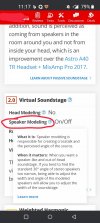
I know that the modeling of the head plays an important role in the soundstage. Is it the same for "speaker modeling", this feature improves the soundstage and the perception of sound more around you, or is it commercial bullshit like 7.1 surround? Is this a function that can be emulated via software even if the headset itself does not support? Or can only headphones that on RTINGS in correspondence of the function have: "On / Off"? Because I was also looking at the Astro A40 2019 + MixAmp and wanted to know if this feature would further improve the soundstage parameter mentioned above. Plus it also has Dolby 7.1 virtual surround, is it better than the audio format I could find or buy online? Or will better audio formats come out in the following months, and will the headset's own format always remain at 7.1? if you could clarify this thing above all, you would solve a lot of doubts for me.
 

Attachments

  • Screenshot_2022-06-23-11-17-50-60_40deb401b9ffe8e1df2f1cc5ba480b12__01.jpg
    Screenshot_2022-06-23-11-17-50-60_40deb401b9ffe8e1df2f1cc5ba480b12__01.jpg
    156.2 KB · Views: 126
I don't think you can really get headphones to sound like you've described in terms of how you're describing the soundstage, as that's not possible even with just stereo speakers when you're talking about "360 degree immersive audio" - not unless you're using something like the Smyth Realizer or the Impulcifier project and to a lesser extent Virtual 7.1 Surround systems from companies like Creative. You can get headphones that have a good soundstage and they sound a bit more like speakers than other headphones in terms of it being a bit more out of your head and wider than your head - for these types of headphone I'd recommend the K702 and the HD560s. Unfortunately the K702 has some higher unit to unit variation and some quality issues associated with reliability of the solder in the connections in the headphone (so they break easily unless you solder the wires back on). The HD560s is very reliable though with low unit to unit variation and a soundstage that's good, but not quite as wide as the K702 - the HD560s also generally measures better than the K702 in both frequency response & distortion. I'd probably just recommend you the HD560s and then ask you to tone down your expectations of how good soundstage can really be in headphones as you've described it beyond what is possible from normal stereo channel headphone listening. There's always the HD800s if you want to spend more.....but you're likely to need EQ with that one.....in fact it's best to use EQ with almost every headphone, but out of the ones I've listed the HD560s is the one that requires less EQ than the others and you can get away with stock headphone listening on that one just about depending on who you are.
thanks for the advice, however now I would be undecided between the HiFiMan HE-400i, HE-400i 2020 (edition), and the HoFiMan HE-400SE. On the HE-400i I have the RTINGS review and I'm sure, especially on the soundstage, on the others I can only rely on the reviews unfortunately. What would you recommend to me? Do you know a reliable reviewer who reviewed all 3 headphones?
 
Hi, this off-topic for this thread, but I'll answer here one time.......PM me if you want to discuss further.
@Robbo99999

I know that the modeling of the head plays an important role in the soundstage. Is it the same for "speaker modeling", this feature improves the soundstage and the perception of sound more around you, or is it commercial bullshit like 7.1 surround? Is this a function that can be emulated via software even if the headset itself does not support? Or can only headphones that on RTINGS in correspondence of the function have: "On / Off"? Because I was also looking at the Astro A40 2019 + MixAmp and wanted to know if this feature would further improve the soundstage parameter mentioned above. Plus it also has Dolby 7.1 virtual surround, is it better than the audio format I could find or buy online? Or will better audio formats come out in the following months, and will the headset's own format always remain at 7.1? if you could clarify this thing above all, you would solve a lot of doubts for me.
Virtual 7.1 Surround can be really really good for gaming, but I wouldn't recommend it for anything else (although would be fine for movie watching/listening, but not music listening). I'd recommend Creative Virtual 7.1 Surround Sound, it's the only one that works properly for me. Thread here with more information: https://www.audiosciencereview.com/...urround-sound-processing-in-headphones.25613/
You can use any headphones with that, but I've found you want to use a headphone with good soundstage as that enhances the Virtual 7.1 Surround Sound - K702 & HD560s work the best for me with this.

You mentioned "Cross Talk", that's part of how Virtual 7.1 Surround Sound is done, but that's only part of it - they would change the frequency response and volume levels based on which virtual speaker was playing and where & how far away the sound in the game world was coming from.

I just recommend Virtual 7.1 Surround Sound from the company Creative, and also just for gaming & also maybe movie watching, but not for music listening.
thanks for the advice, however now I would be undecided between the HiFiMan HE-400i, HE-400i 2020 (edition), and the HoFiMan HE-400SE. On the HE-400i I have the RTINGS review and I'm sure, especially on the soundstage, on the others I can only rely on the reviews unfortunately. What would you recommend to me? Do you know a reliable reviewer who reviewed all 3 headphones?
I've got the HE4XX which is very similar to those, it has an OK soundstage, but the HD560s & K702 are better in this regard. I recommend you the HD560s like I did before, for the reasons I mentioned in that earlier post.

PM me if you want to discuss some more, as it's off-topic to this thread.
 
This is an investigation thread into feasibility of ASR adopting the Brüel & Kjær Type 5128 "high-frequency" Head and Torso Simulator (HATS). It is on kind short-term loan from the company. As configured, it costs around US $41,000. This is quite a bit more money than competing solution. The premium comes from the 5128 benefiting from a more accurate representation of our hearing system. How much difference this makes in real life is something we need to determine in short order before I have to return the unit in four days.

Not that it matters but I like the somewhat friend/crash dummy look of the 5128 :)
View attachment 78325

There is an external CCLD signal conditioner model 1704 which can operate on internal battery for USB. Using the latter, I saw a noise spike in upper band of the audible spectrum. Not an issue for frequency response measurements but will impact distortion data. So for that, I will be using it on battery.

One of the challenges with this fixture is that in higher frequencies it invalidates and is compatible with other measurement systems that are compliant with the so called "711" standard. Sadly, Harman target curve is not yet available either but we need something to know what the measurements mean. Without such, we would have no idea what is the property of the headphone, the measurement fixture or both.

I have been working with our resident headphone metrologist, ahd headphone technology researcher, @Mad_Economist, who has crunched a bunch of spreadsheets and models to provide two different potential target curves, the Harman one and the diffused field as provided by BK. Here it is in his words:

----------------
This file should hopefully contain everything needed to understand how this works and nothing not needed for that. To give a narrative account of how this worked, to start with I interpolated Oratory1990's Harman target data into the same divisions as the B&K data (R40 or 1/12 octave bands). I then subtracted the flat in-room baseline from the 2013 paper from the final preferred targets of the 2013, 2015, and 2018 papers to get the adjustments which were preferred on average by the listener panels.

In past, I'd have just added these to DF, since the DF-HRTF isn't that far away from the response you'd see in-room, but since I'd already done the work of making a spreadsheet with Chris Struck's methodology for in-room HRTF approximation, I decided to use that. I took the directivity data for the Revel F208 from your measurements of it, the RT60 and volume of the Harman listening room from Olive 2009, and the free and diffuse field HRTF data from the files you sent me, and plugged them into the calculator I made for Struck 2013's in-room HRTF/target inference.

As Sean has described the in-room measurement as consisting of an average of +30 degrees, -30 degrees (330 degree FF HRTF), and 0 degrees in past
index.php


I approached the in-room flat response of the 5128 two ways: first, I did an in-room response for each of the three angles and averaged them together ("Average of B+C+D" in workpage "5128 approximations of Harman"); IMO this is the closest approximation of what Todd actually did, since using three different positions gives triple weight to the indirect sound. However I additionally averaged the three free field HRTFs prior to processing through the Struck calculator to give a picture of what the flat response would be without factoring the reflections three times over ("In room flat from average of 30, 0, 330 deg FFs" in workpage "5128 approximations of Harman"). Unsurprisingly, this response was less smooth in the higher frequencies and preserved more HRTF features in fine detail.

I then applied the preference adjustments to these two "in-room baselines", and compared the results with the original Harman targets - this is in workpage "5128 Harman vs Harman". The notch like features of the 2018 adjustments strike me as odd and I have not seen any justification of them in detail from Olive, so I opted to present both the 2018/current versions and versions based on the much simpler filters in the 2015 paper in the "5128 targets" workpage.

If there's anything unclear or which you'd like elaboration on - or if you have any feedback - please let me know! I'm sort of taking this as it comes...
-------------------

I am very appreciative of his work around the clock in the last couple of days to compute this data. As he notes, the information is included in the zip file.

Note: these are draft measurements to test the fixture and for discussion. They are not formal measurements. I have performed no averaging of multiple measurements, nor playing with many headphone positions. I have a ton of headphones to measure and want to get the data out quickly. Stereo measurements are provided which should give some idea of variability although transducer differences will compound that issue.

The thread is for technical discussions only. Please don't voice objections, complaints, etc. This is a collective effort to evaluate this fixture and nothing more.

I will be measuring headphones one by one as I process them. If there is feedback on other things to do, I can include them in the ones not yet measured.

Let's see if we can figure this out everyone! Appreciate all the help in advance.
This doesn't include the mouth simulator correct?
 
Back
Top Bottom