• Welcome to ASR. There are many reviews of audio hardware and expert members to help answer your questions. Click here to have your audio equipment measured for free!

Fun with vinyl measurements

i picked up a denon dp-31l today locally. everything was looking cool-speed locks quickly, auto lift works no problem, not very resonant and pretty resistant to feedback which was surprising with its light plastic construction. then i took a frequency response measurement with the m97xe that came with it and noticed a weird blip at around 200hz that i dont normally see with that cart. it was still there with the brush up or down. out of curiosity, i mounted a heavier cart with higher tracking force (vm45xml) and the same anomaly was still there. is that just some type of arm resonance?
View attachment 563858
Yes. If you can use REW it will show up mord clearly. Or if you can share the file I could visualize it.
 
Yes I see such blips on both my Denon 21F and 51F, I think it is an arm resonance . I manage to get rid of the 51F blit for a while by tightening the screws holding the arm to the plinth.. but it partly came back. Very obvious on AnalogMagik pink noise track for some reason
 
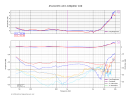
heres what the 45xml looked like on a technics arm (the high end peak was because it was hot july weather). would the resonances present on the denon arm cause any mistracking, tracing or distortion issues? im guessing we ideally want an arm as free of resonances as possible, but in casual listening, im not really hearing any issues. do the issues prop up more when we get in the weeds and start taking different distortion measurements?
45xml 47k 180pf.png
 
heres what the 45xml looked like on a technics arm (the high end peak was because it was hot july weather). would the resonances present on the denon arm cause any mistracking, tracing or distortion issues? im guessing we ideally want an arm as free of resonances as possible, but in casual listening, im not really hearing any issues. do the issues prop up more when we get in the weeds and start taking different distortion measurements?
View attachment 564138
My take is that one can see peaks/dips in some measurements in the library where the arm is probably the cause of resonance. When looking at my Moerch arm, the resonance is not obvious from the scripted frequency response, but it is there, and revealed much better using REW and by the crosstalk from that. What the resonance does is to decrease/increase level when hitting a note at the resonance. This is obvious looking at static signals.

Structural resonance always exists in arms, but some are well damped and not showing up in frequency response or in the crosstalk. The Moerch UP-4 unipivot arm does not show any signs of structural resonance while the DP-8 does, despite the same arm tube. The most likely explanation is that the UP-4 unipivot is "free to move" and movement damped only by the silicon fluid and the underhung counterweight. The DP-6 and DP-8 arms have dual pivots+higher mass of the pivot assembly, which increases Q of the arm tube. The primary resonance is quite low 50-60 Hz, and a longer 12 inch arm would probably decrease this further in frequency, perhaps below the music signal (30-40 Hz).

Now what happens if I put damping at the arm tube pivot or at the cartridge? I would guess that the mass relation between mass of stylus vs combined mass of cartridge+arm tube would restrict any distortion due the "looser connection", but that the damping would lower the high-Q resonance. Not ideal, but I will do some experiments when time allows. Right now time is eaten up by other stuff in life, but I will come back to this.

Could you share a wav file from the Denon result?
 
Last edited:
Strange, worksfine in 3 browsers inkluding Firefox here


Here is an arc protractor generator app I asked AI to make me . Read the guideline for use .
https://arc-protractor.streamlit.app/

You can print curves with different overhang/pivot-spindle (P2S) distance for a given Arm length. If your stylus does not fit the expected curve in first try, you can use the text in the bottom to help you.

You can also print a curve with more and less than specified overhang to see the effect find if your arm/overhang is too long or short. In my case my SME V was past the 146mm point at 214mm PS2 and behind at 215.35 , the actual PS2 was 215.08…

I can plot and see the effect of this in the Bauer alignment app , or try to adjust the P2S 0.27mm
 
Last edited:
New web app for Merolemez Azimuth/crosstalk testing
 
Have you quantified sub-sample analog skew of your interface, inter-channel phase offset, etc.? One sample of skew at 96 kHz is 10.4 µs ≈ 6 µm. Is there a test strap/synth signal set used to validate anything?

I'd also consider feeding this to your model to see if the design choices are defensible:

The per-channel argmax of |x| can lock onto different ringing lobes in L and R, giving a systematic half-cycle error that MAD rejection won’t catch. Consider using cross-correlation of the two windowed segments with sub-sample peak interpolation instead. scipy.signal.resample assumes a periodic segment, and the unwindowed ±60-sample cut truncates the RIAA pulse tail, so the upsampled waveform has edge ringing right where the peak is found. The radius model is anchored to the first and last detected pulse, so any pulse dropped by the global-max threshold shifts the radius axis and the µm conversion.
 
I will have to send your question to Claude, Claude explained me some upsamling stuff when I asked about the resolution smaller than sampling to me but I am not able to repeat it.

See PM with Claude reply
Do you want to see the script ?
 
Last edited:
Using the sperling L-R phase app to check cartridge alignment, wtth Clear audio 3150Hz

I have struggled with always getting negative phase angles in my SME V/Gyro/OC9MLii

But thist time I moved spindle Pivot a bit and used Clearaudio Trackability record long 3150hz track , and started negative and by turning the carteridge conter clockwise(. Less angle towardse centre.) I managed to go from nagative to positve. and a bit less angle midwag gave perfect shape match , but value 1.5degrees to much positive..., I leave it her for now, continue another day

One strange thing: The shap should not change shape when twisting cartridge, but is seem like it does, not us ut is the script or reality

MAX inwards, mostly negative error...
1793820296599.png


MAX OUTWARDS, all positive error

1793820394031.png


MIDWAY, perfect shape but 1.5 degree offset from nulls, only small portion negative.

1793820217973.png


But comparing the mid1 position above on Clearaudio 3150hz with Sperling 1000hz gives, a slope and still all negative error... I start to suspect visual alignement is the best if records deviate soo mch
1793822800315.png
 
Last edited:
The Michell Gyro belt drive has 3 grooves in the platter to choose from, picking the correct one( elevation vs motor pod pulley etc) can make a remarkable difference

2S speed variation 0.2 or 0.05%..rpm as radians per second
IMG_2202.jpeg
 
Using the sperling L-R phase app to check cartridge alignment, wtth Clear audio 3150Hz

I have struggled with always getting negative phase angles in my SME V/Gyro/OC9MLii

But thist time I moved spindle Pivot a bit and used Clearaudio Trackability record long 3150hz track , and started negative and by turning the carteridge conter clockwise(. Less angle towardse centre.) I managed to go from nagative to positve. and a bit less angle midwag gave perfect shape match , but value 1.5degrees to much positive..., I leave it her for now, continue another day

One strange thing: The shap should not change shape when twisting cartridge, but is seem like it does, not us ut is the script or reality

MAX inwards, mostly negative error...
View attachment 569387


MAX OUTWARDS, all positive error

View attachment 569389

MIDWAY, perfect shape but 1.5 degree offset from nulls, only small portion negative.

View attachment 569386


But comparing the mid1 position above on Clearaudio 3150hz with Sperling 1000hz gives, a slope and still all negative error... I start to suspect visual alignement is the best if records deviate soo mch
View attachment 569404

I don't recall now, but did you manage to adjust with the Sperling on your other turntable?
 
On the Fisher 6330thie is the best I got National 270CII

1794069913802.png


on Clearaudio 3150hz I manage to go from negative to positive on the SME V / OC9, extremely sensitive to angle. Twisting cartridge on SME V
1794070070612.png


Sperling and Clearaudio is not only diffrent in frequency 1000 vs 3150hz, but aso on cutting HTA... Everything the same her except record.
1794070180408.png
 
On the Fisher 6330thie is the best I got National 270CII

View attachment 570182


on Clearaudio 3150hz I manage to go from negative to positive on the SME V / OC9, extremely sensitive to angle. Twisting cartridge on SME V
View attachment 570183


Sperling and Clearaudio is not only diffrent in frequency 1000 vs 3150hz, but aso on cutting HTA... Everything the same her except record.
View attachment 570184
It's all very odd, given that the Sperling has numbered copies, few pressings. It should not differ much between the records.

With your Fisher, when you twist cartridge, do you also correct overhang? Since twisting it also change overhang. I find it quite difficult to adjust to get both aligned. My intuition says a fixed zenith or record error will cause a shift of the curve up or down.
Checked this again, and a fixed zenith error will not show a parallell curve to the zero zenith curve. So if the curve is parallell, it must mean that both zenith/offset angle and overhang is wrong.
 
My intuitive though is the a zenith error will shift the circumvent up or down, but I a but sure anymore. How did you ( or AI) conclude that zenith error/cartridge twist does more than shift the curve.’? my Claude is re-assessing the code, method as we chat….
 
Back
Top Bottom