
• Welcome to ASR. There are many reviews of audio hardware and expert members to help answer your questions. Click here to have your audio equipment measured for free!

Four Corner Subs positioning with Bass traps in all corners

eric-c

Member
Forum Donor
Joined
Jun 8, 2021
Messages
89
Likes
123
Location
Toronto, Canada
All, I just finished reading chapter 8 in Dr Floyd E Toole's Sound Reproduction 3rd edition where it discusses room nodes, sub positioning, solutions (bass traps). When I rebuilt my theatre 3 years ago, I stayed with the four identical subs (SVS Ultra passive cylinder) in each of the four corners to achieve high Mean Output Level (MOL) and good Mean Spatial Variance (MSV). I didn't want to build bass traps at that time because of preconceived notion of space issues (lack thereof) as I planned on using large deep floor standers for LCR. I have changed my mind now that I read chapter 8 and knowing I have the space now (JBL 708Ps replacing Polk LSIM 705 floor standers)

My questions are:

1. I plan to build four floor to ceiling bass traps as per the diagram below indicated by the red triangles. If I want the subs in the "corners", it will be approximately be 1.5" from the corner vs being flush pre corner bass traps. Will having the subs out from the corners 1.5' still provide the high MOL and good MSV? Are there gotcha's I should be aware of?

2. How effective will adding partial eg not floor to ceiling bass traps indicated by the gold triangles on the short 16" walls adjacent to the screen be? These bass traps will need to be about 3.5-4' tall with the midpoint mounted midway on the wall as I have a return air vent facing the seating area on the bottom of the wall and wall sconce near the ceiling. The "wall" is really only a 3/4" sheet of ply on the theatre side
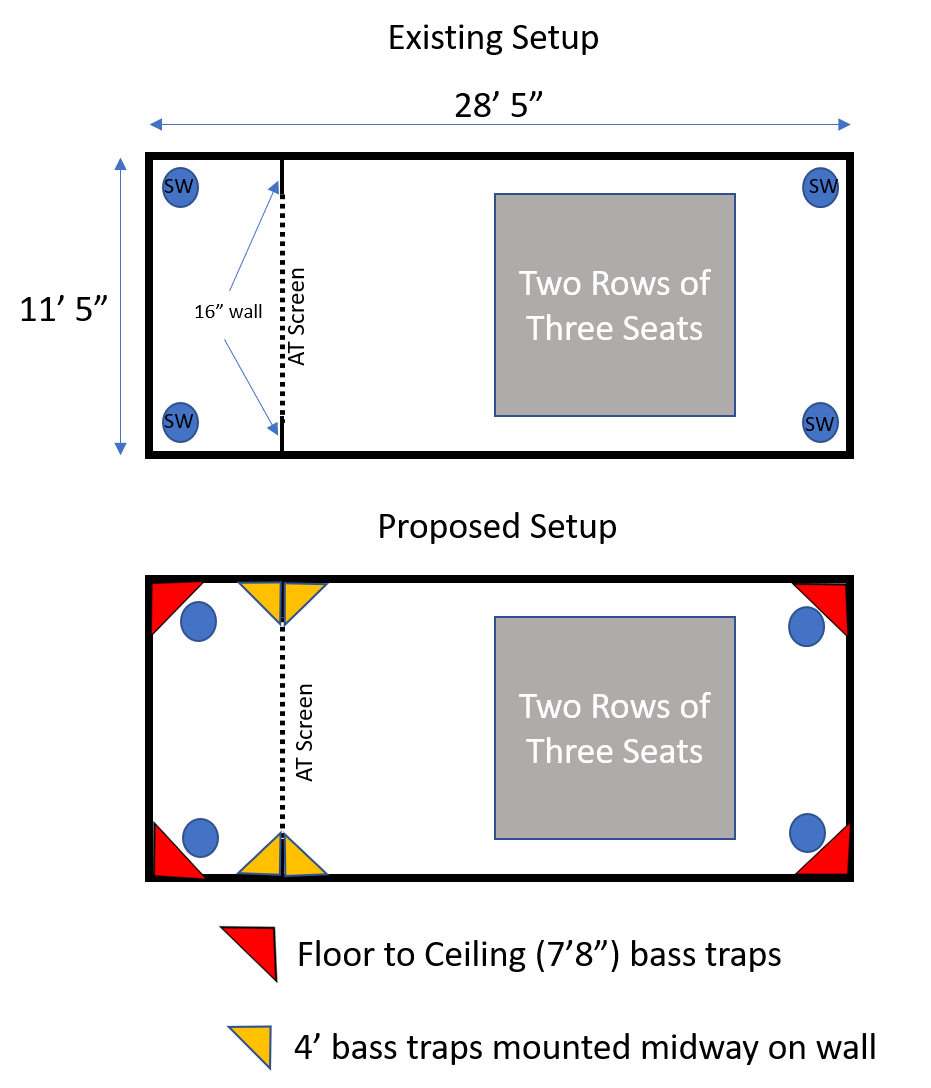
1673316234802.png
 
Thanks for all the responses. From what I read, the Double Bass Array may be challenge for me practically as it requires delays and some tuning. Also my seating is tiered so I am guessing that will affect the effectiveness of the DBA solution (ok all solutions). Lastly, I am a KISS person where possible. Right now I am using the Emotiva XMC-1 prepro. My dream propro which I am in the hunt for is a Bryston Sp3 which from my understanding very little (no) in PEQ. I can't recall if you can configure it for more than one sub for LFE. I may need an external processing box to dial in the DBA (see KISS reference lol). Saw your thread on "your DBA". I will definitely need time to get acquainted with tools like REW. @Flaesh what software are you using for Room Simulation in the above post?

The 25% spacing of the subs behind the screens is easily doable but for the back wall, I would need to move two of my three racks. On the back wall right now it is sub3, rack1, rack2, rack3, sub4. It would need to change to: rack1, sub3, rack2, sub4, rack 3 which provides a slight practical challenge as my universal player is on rack 3 and my record player on rack 1 so all the gear is not together.
 
what software are you using for Room Simulation in the above post?
REW RoomSim:
1673622421503.png

Imo [in suitable room] DBA is very KISSy, it keeps simple travelling wave instead of multiple interacting modes.
Tuning is simple, you need some mic, measurement software and ajustable delay for rear channel.
 
All, I just finished reading chapter 8 in Dr Floyd E Toole's Sound Reproduction 3rd edition where it discusses room nodes, sub positioning, solutions (bass traps). When I rebuilt my theatre 3 years ago, I stayed with the four identical subs (SVS Ultra passive cylinder) in each of the four corners to achieve high Mean Output Level (MOL) and good Mean Spatial Variance (MSV). I didn't want to build bass traps at that time because of preconceived notion of space issues (lack thereof) as I planned on using large deep floor standers for LCR. I have changed my mind now that I read chapter 8 and knowing I have the space now (JBL 708Ps replacing Polk LSIM 705 floor standers)

My questions are:

1. I plan to build four floor to ceiling bass traps as per the diagram below indicated by the red triangles. If I want the subs in the "corners", it will be approximately be 1.5" from the corner vs being flush pre corner bass traps. Will having the subs out from the corners 1.5' still provide the high MOL and good MSV? Are there gotcha's I should be aware of?

2. How effective will adding partial eg not floor to ceiling bass traps indicated by the gold triangles on the short 16" walls adjacent to the screen be? These bass traps will need to be about 3.5-4' tall with the midpoint mounted midway on the wall as I have a return air vent facing the seating area on the bottom of the wall and wall sconce near the ceiling. The "wall" is really only a 3/4" sheet of ply on the theatre side

View attachment 256174
FWIW and in general bass-traps are much more efficient if they are in corners.
 

A full CABS implementation also requires the subwoofers to be positioned mid way between the floor and ceiling, which may be less convenient than floor placement for large, heavy subwoofers.
An interesting result of the Welti paper simulations is that maximum output is achieved with placement of a single sub in the corner. Adding additional subs in other locations can smooth the response for multiple listening positions, but will actually lower output, if only by a bit.
It is also interesting that CABS follows a similar scheme for placement as recommended in the Toole book, i.e., one subwoofer at 1/4 width of the front wall, and a second sub at 3/4. Whereas in the Welti paper, which was derived from a math model and confirmed empirically, the best result was obtained with four subs, one at the midpoint along each wall. Notably, this is done with a single subwoofer channel.
Having to add a delay to the back-wall subs, as is done in CABS and SSS, is an added layer of complexity, requiring precision if it is to be done correctly. You would also most likely need an acoustically transparent screen to set up in a home theater. I agree that the Welti paper methods are simpler and easier.
 
A full CABS implementation also requires the subwoofers to be positioned mid way between the floor and ceiling, which may be less convenient than floor placement for large, heavy subwoofers.
The devil is in the details. This is definitely a show stopper in my environment as the cylinder subs I use are 17" in diameter by 40" tall/long.
REW RoomSim:
Thanks for the info. I will purchase the Umik mic and start playing with this to see where my room is at. My current prepro does have the ability for PEQ which I currently use for bass freq only. I used a velodyne SMS-1 to get the measurements.

If I do get the Bryston sp3 (no PEQ), I'll have to use my old Velodyne SMS-1 for bass PEQ if I want to KISS. Otherwise, I will need to start tinkering with other stuff like mini dsp which I want to avoid.
I just printed it. I will reread it (last time was like 11+ years) when I setup my first HT in a different house and that is why I went with four identical corner subs. Pretty sure it was the same paper.

The earliest I will get to the bass traps will be in May / June when its warmer and can build everything outside and get the insulation delivered in decent weather. it is good to get the preliminary work and planning done in advance.
 
I'll have to use my old Velodyne SMS-1 for bass PEQ if I want to KISS
I don't use bass EQ. In a simple case, only the level and delay needs to be adjusted for the rear subs. Can Velodyne provide a delay of around 25ms and a decent increment of manual adjustment? I know two guys who failed to build SSS correctly; one with Trinnov, the other with AVR))
Roomsim can show in general terms how inaccurate tuning affects the result:
1673678673903.png

1673678866338.png
 
Can Velodyne provide a delay of around 25ms and a decent increment of manual adjustment?
Just checked the velodyne sms-1 manual and ..... no. The XMC-1 prepro you can set speaker distance (supports dual independent sub outputs) which I trust will affect the delay but I would need to calculate what distance would equate to 25 ms and see if that distance is in the range of the prepro.

As previously posted If there is a requirement for the sub to mounted midway height wise then this is a no go. In my setup the room height is 92" The woofer is about 3" from the floor and the ports are 40" from the floor. Wall mid point would be 46".

Would using the ports on top of the cylinder would be considered "mid points"? if so this is easy as I can raise the subs 6"

Or is it a case where the woofer has to be mid point? This will be hard as I would need build 42-46" stands (far from ideal). Inverting the sub is tough because it is bottom/woofer heavy with a built in base for standing upright. The top is a metal grill no designed to have any weight on it.

Or is it a case where the mid point of the sub be midpoint? in which case I would need to build 26" stands (not that bad)

Bass traps sound and a bit of EQ sound more KISS (and time) friendly :)
 
A few years ago I designed a theater for a client with similar dimensions. I used a pair of in room JL Audio F113V2s up front and in-wall IWS-113s along the walls as shown below. The results were quite good throughout the room. You might try moving the subs... not sure if you can have subs in your aisles though.

We used the Bryston SP4 processor which is basically a rebadged Storm Audio. I wasn't terribly pleased with the processor. If you don't care about ATMOS, the SP3 will be a fine choice.
Screen Shot 2023-01-14 at 9.05.48 AM.png
 
set speaker distance (supports dual independent sub outputs) which I trust will affect the delay but I would need to calculate
Rears must be setted 25'8" (with possible some correction de facto) later than fronts instead of the usual "time aligment". If it still seems contrintuitive https://www.audiosciencereview.com/...of-the-double-bass-array-configuration.37943/ may help.
is it a case where the woofer has to be mid point?
Yes. I think it's not hard to flip the subs. The lower the frequency, the less critical the location of the transducer, so port position isn't very sufficient. How high do you use subs?..
Bass traps sound and a bit of EQ sound more KISS (and time) friendly :)
Nope. Such bass traps will never be so effective. And minimum phase EQing may be exceptionable if room responce isn't minimum phase and in any case EQing will be unperfect for second row.
 
How high do you use subs?..
I assume you mean the crossover frequency which is 80 Hz.


Thanks be
not sure if you can have subs in your aisles though.

You hit it bang on. The subs at the rears will be blocking the aisle access to where the equipment racks are. Again, you are a mind reader. I want the "best" fidelity in a 7.1 (even 5.1 works) with HDMI pre pro as I have no intention using more than a 7.1 environment. The only prepro's that meet this requirement are the Classe SSP 800 and Bryston SP3. The SP3 has the option/later models for 4k HDMI I have a bunch of Bryston SST power amps and previously a Bryston SP 1.7 which I was very satisfied with. Bryston doesn't believe in EQ'ing with the exception of Bass. Thus I want to find a simple solution for good to best MSV physically (eg sub placement and bass traps)


index.php
 
Thanks again. I do not have access to the AES paper (for free otherwise it is $33) as I am not a member. I have gone through the powerpoint that DonH56 referenced. I still need to go through the paper you provided earlier from audioroundtable and the hometheatrehifi when I get a moment. If I feel I need more knowledge, I may purchase the AES paper but I suspect it maybe too technical for me.
 
Fast forward 2.5 years. Some changes:
- PrePro: Bryston SP3 (7.1 and no ability for any EQ). One LFE output
- Speakers: JBL 708p LCR and four JBL 705i surrounds
- LFE remains the same: four SVS CS Ultras tuned to 16 Hz (one of three ports plugged) powered by two Crown K1 Power amps. I recall the 16 Hz tune would allow you to go deeper but with less spl output than the 20Hz tune (all three ports open) and that the 16 Hz was generally preferred by most.
- Still have a Velodyne SMS-1 but for the testing below did not use it (wasn't in the lfe signal path)

I was planning to make my own bass traps. Never got to it so I am having them built and should arrive in a few weeks. It will look like this:

floor plan with subs.jpg


I did finally get REW installed. First used Room SIM as per Flaesh did previously with dimensions where I measured the actual main listening position.

rew room simulator.jpg


Super big hump at 40 Hz in room sim. New to REW so used the generator to generate test tones for subs (30-80 hz) and spl meter. More SPL and you can clearly see a 35 Hz hump.

SPL

98 db - blue (prepro -6 db)
95 db - orange (prepro -9 db)
92 db - fuscha (prepro -12.5 db)
82 db - purple (prepro -22 db)
75 db - green (prepro -29 db)

room sweeps from -6db to -29 db.jpg


I'll measure again once I have the bass traps. Even if the bass traps smooth out the bass a little bit, I'll be happy.

In terms of EQ, is the best practice is to set the spl at the high level of what I listen to eg 85 db and then EQ for a flat or downward sloping response?

I'll use the old SMS-1 for EQing to hold me over till I get a minidsp flex in the near future.
 
Super big hump at 40 Hz in room sim. New to REW so used the generator to generate test tones for subs (30-80 hz) and spl meter. More SPL and you can clearly see a 35 Hz hump.

Do not play test tones, particularly loud test tones, through your sub for a long period of time. You run a risk of overheating the voice coils on your sub and damaging it. If I send a sine wave test tone to the sub, I play it for 5 seconds tops.


Why does the bass fall off a cliff at lower volumes? It almost looks as if your subwoofers are not detecting signal.

In terms of EQ, is the best practice is to set the spl at the high level of what I listen to eg 85 db and then EQ for a flat or downward sloping response?

Best practice is to take the measurement at normal listening volume and EQ that. It is best to leave the high frequencies alone, but if you need to you can apply a gentle tilt.
 
Back
Top Bottom