• Welcome to ASR. There are many reviews of audio hardware and expert members to help answer your questions. Click here to have your audio equipment measured for free!

Fosi BT20A Max Amplifier Review

Rate this amplifier:

  • 1. Poor (headless panther)

    Votes: 2 1.3%
  • 2. Not terrible (postman panther)

    Votes: 33 20.9%
  • 3. Fine (happy panther)

    Votes: 106 67.1%
  • 4. Great (golfing panther)

    Votes: 17 10.8%

  • Total voters
    158
There may be some call for doing the opposite: measuring SINAD at low enough frequency that its harmonics won't be masked. This would be in upper bass region.
That's a really good idea.

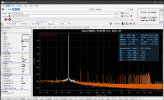
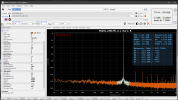
It can potentially reveal stuff that are no visible at 1kHz, like the ESS hump energy for example:
1792744536886.png
Not visible

1792744581144.png
Now all the "hump" grass is visible.
 
FCC's new tests are ambiguous and screwed up. But see my 40 Hz test as a sane shortcut for it.
Why are they ambiguous and screwed up?

Is the 40Hz measurement continuous power during 5 minutes into 8 ohms with less than 1% THD+N?
 
Would a 48V really help this device? 24V is good enough and 32V is more than enough.
That depends, it can make a power/current output difference.

3e A7 Mono allows 51V

But the higher output does not make any audible difference if the lower levels are already cleanly driving YOUR speakers loud enough

which depends on your Room (and not only its size), placement, LP distance

and your "need" for higher SPL.
 
Why are they ambiguous and screwed up?
We have had extensive discussions about them. For now, the spec doesn't specify bandwidth so THD+N measurement specs are meaningless. Class D switching noise also screws up the computation even though is in ultrasonics. Finally, some amps may produce just a watt or two if you include ultrasonics in their THD+N computation which obviously is flawed as in real use, they deliver their rated power.
 
We have had extensive discussions about them. For now, the spec doesn't specify bandwidth so THD+N measurement specs are meaningless. Class D switching noise also screws up the computation even though is in ultrasonics. Finally, some amps may produce just a watt or two if you include ultrasonics in their THD+N computation which obviously is flawed as in real use, they deliver their rated power.
Good thread, it confirms my experience, amps that go into protection mode or start to smell when asked to deliver power specified in sales sheet.

What about the 40Hz test on this site, is it 40Hz into 8ohms for 5 minutes with less than 1% THD+N?
 
What about the 40Hz test on this site, is it 40Hz into 8ohms for 5 minutes with less than 1% THD+N?
No. It is 40 Hz into 4 ohm after the device has been through full suite of tests including power sweeps. 8 Ohm is useless as there is hardly any speaker that has that impedance in bass. I can't even remember measuring one speaker that had such high impedance. Another reason the FTC spec is so misguided.

And it is for sure period as no use pattern involves running sine wave at 40 Hz into a speaker for 5 minutes. Your speaker will likely cook before the amp does.

So we would have to describe BT20a max as a ~20W amp into 8 ohms, if we wanted to compare it to amps doing FTC measurements and specifying their power accordingly (20Hz-20KHz into 8 ohms continuous with under 1% THD+N).

On top of it, we would not know if it would even survive working five minutes continuously at all frequencies between 20Hz and 20KHz at rated power and THD+N.
 
if it would even survive working five minutes continuously at all frequencies between 20Hz and 20KHz at rated power and THD+N.
there's nothing 'even' about that, that's a far far far more strenuous load than even very high SPL music / movie audio through typical speakers
 
That depends, it can make a power/current output difference.

3e A7 Mono allows 51V

But the higher output does not make any audible difference if the lower levels are already cleanly driving YOUR speakers loud enough

which depends on your Room (and not only its size), placement, LP distance

and your "need" for higher SPL.
Yeah, it really depends on what speakers you have and at what volume you're listening. I live in a small apartment inside a big complex of about 20 units. I can't really push more than 60-70dB on my Dali Z3 (88dB and 6ohm, 5ohm minimum) at a 6ft distance, so I don't really need more than 10-20W of power. Any 20-24V amp should be more than enough for my use case.
 
So we would have to describe BT20a max as a ~20W amp into 8 ohms, if we wanted to compare it to amps doing FTC measurements and specifying their power accordingly (20Hz-20KHz into 8 ohms continuous with under 1% THD+N).
Didn't you read what I wrote about FTC measurements? Where is your 8 ohm speaker?
 
Disconnect the RCA inputs, set the treble to the maximum, turn the volume up to the maximum, and place your ear close to the speaker, hear a hissing sound?
 
I am not big on having a headphone jack on a power amp. If it is in the main system, then it is not useful to have it there as it is too far from where one sits. If it is on a desktop, then they tend to not be nearly as performant as a dedicated headphone amplifier which I actually like to see combined with the DAC, not the power amp.

For a main system it can be a bit tricky to choose the best alternative for using headphones.

You can use an extension cable for your headphones. It would be interesting to see a test of how much this would (or would not) affect things when using different types of cables and with headphones of varying impedance.

You can sit somewhere that is closer to your amp or preamp than your main listening chair This is what I do on the few occasions when I want to listen via headphones in my living room.

You can run a low-level (SE or balanced) cable from your main system to a headphone amp in a spot next to your listening chair. Then you also need to get power there, plus have somewhere to put the headphone amp. I think this is probably the best-performing choice if you want to use your regular listening chair/sofa, etc. when using headphones.
 
I'm happy to see this device tested because the results show that FOSI has improved the BT20 pro across its overall performance to offer this device. We’re on the right track for a cheap chip amplifier to reach 16-bit transparency, which would place it among the 'excellent' category products. The most obvious area for improvement left is refining the distortion profile in the highs to get it under 95 dB at 20 KHz (multi-tone test).
That said, this doesn’t stop you from getting this product as it is.
Thanks to Amir for this test.
 
Why do TPA3255 amplifiers vary so much in their output power?
Is it solely due to the type of power supply used and the fact that two TPA3255s are used instead of one (or one TPA3255 per channel), or do other factors also play a role?

Or to put it another way: Shouldn't all TPA3255 amplifiers with two TPA3255 chips and the same 48V 10A power supply also have the same output power? Shouldn't all TPA3255 amplifiers with one TPA3255 chip and the same 48V 10A power supply also have the same output power?

1793702598711.png
 
Why do TPA3255 amplifiers vary so much in their output power?
Is it solely due to the type of power supply used and the fact that two TPA3255s are used instead of one (or one TPA3255 per channel), or do other factors also play a role?

Or to put it another way: Shouldn't all TPA3255 amplifiers with two TPA3255 chips and the same 48V 10A power supply also have the same output power? Shouldn't all TPA3255 amplifiers with one TPA3255 chip and the same 48V 10A power supply also have the same output power?

View attachment 569106
No the TPA3255 chip is only part if the overall design.

For power output BTL vs PBTL mode make a big difference

quality of op-amps, inductors and capacitors

current limiting, gain factors on input stages

And a designer like 3e spending more on more robust other components allowing for drawing higher current and especially higher voltages in the A7 Mono

thermal implementation details like heatsinks and case thickness, thermal paste, ventilation design ...
 
Ive noticed the button on rc with fan. What does it do, its fan stop function?
 
Back
Top Bottom