• Welcome to ASR. There are many reviews of audio hardware and expert members to help answer your questions. Click here to have your audio equipment measured for free!

Folding@home vs Covid-19

BillG

Major Contributor
Joined
Sep 12, 2018
Messages
1,755
Likes
2,371
Location
Auckland, New Zealand
I know a number of you out there have high spec personal computers, but even a used, $100 laptop can help. Please download the application at https://foldingathome.org/ and join team number 225605, and let's put them to work...

89774694_3076017419077685_2250443179545329664_o.jpeg
 
How do we know this is real, that I’m not mining cryptocurrencies for instance?
 
How do we know this is real, that I’m not mining cryptocurrencies for instance?

I saw an announcement from Nvidia on this.
 
How do we know this is real, that I’m not mining cryptocurrencies for instance?

They've been doing this for years (since 2000) and have a lot of published research. For example

https://www.ncbi.nlm.nih.gov/pubmed/30287685

Their inspiration was SETI@Home, a project that started in 1999 (It has just been announced that those would stop sending data to users on the 31st of March)
 
How do we know this is real, that I’m not mining cryptocurrencies for instance?
Because it pre-dates cryptocurrencies (by many years)? Honestly they're not new, fully reviewed, and no problems for about 2 decades. They're definitely more trustworthy than Microsoft or Apple IMO. ;)

>ask for help from random strangers
>while making their client proprietary software for bullshit reasons
Yeah, no. BOINC exists and is free software.
That's a perfectly viable alternative. But both are free... just not OSS. F@H isn't suspicious however... but I understand the concern.

On the other hand, since I don't care to release anything as FOSS myself - I also understand the other side as well.
 
Because it pre-dates cryptocurrencies (by many years)? Honestly they're not new, fully reviewed, and no problems for about 2 decades. They're definitely more trustworthy than Microsoft or Apple IMO. ;)


That's a perfectly viable alternative. But both are free... just not OSS. F@H isn't suspicious however... but I understand the concern.

On the other hand, since I don't care to release anything as FOSS myself - I also understand the other side as well.
Well, I meant freedom as in free speech, not as in free beer, but you get it. By being proprietary for no reasons, it is suspicious, though; you basically run something and you have no idea what it's not doing, mandating the use of a sandbox (which I'm sure 99% of people don't use).

And it means some (minor) performance losses: if you could compile it yourself, you could optimize it for your specific CPU microarchitecture.
 
Well, I meant freedom as in free speech, not as in free beer, but you get it. By being proprietary for no reasons, it is suspicious, though; you basically run something and you have no idea what it's not doing, mandating the use of a sandbox (which I'm sure 99% of people don't use).

And it means some (minor) performance losses: if you could compile it yourself, you could optimize it for your specific CPU microarchitecture.
Yep... just like Apple and Microsoft - which was why I mentioned them. Although depending on what drivers or 3rd party apps you're running... you can throw Linux in there as well. But I understand your reasoning and I applaud your dedication. To me the problems with privacy and security are far too massive and pervasive in the infrastructure itself to worry too much about established and well-governed non-profits who choose to keep their software closed-source. I'll worry about that when the NSA data-center closes down and we go at least 3 months without a serious CVE in a router, OS, or cloud service. :p
 
>ask for help from random strangers
>while making their client proprietary software for bullshit reasons
Yeah, no. BOINC is an alternative and is free software (https://boinc.berkeley.edu/).

Participate in Folding@home or not, it's of no concern to me. However, if you've got an alternative distributed computing project that you wish to promote, I suggest you open your own thread about that instead of acting like an ass on mine... :confused:
 
Still working on getting my second GPU to go... maybe driver issue, was previously fine to run both. :confused:
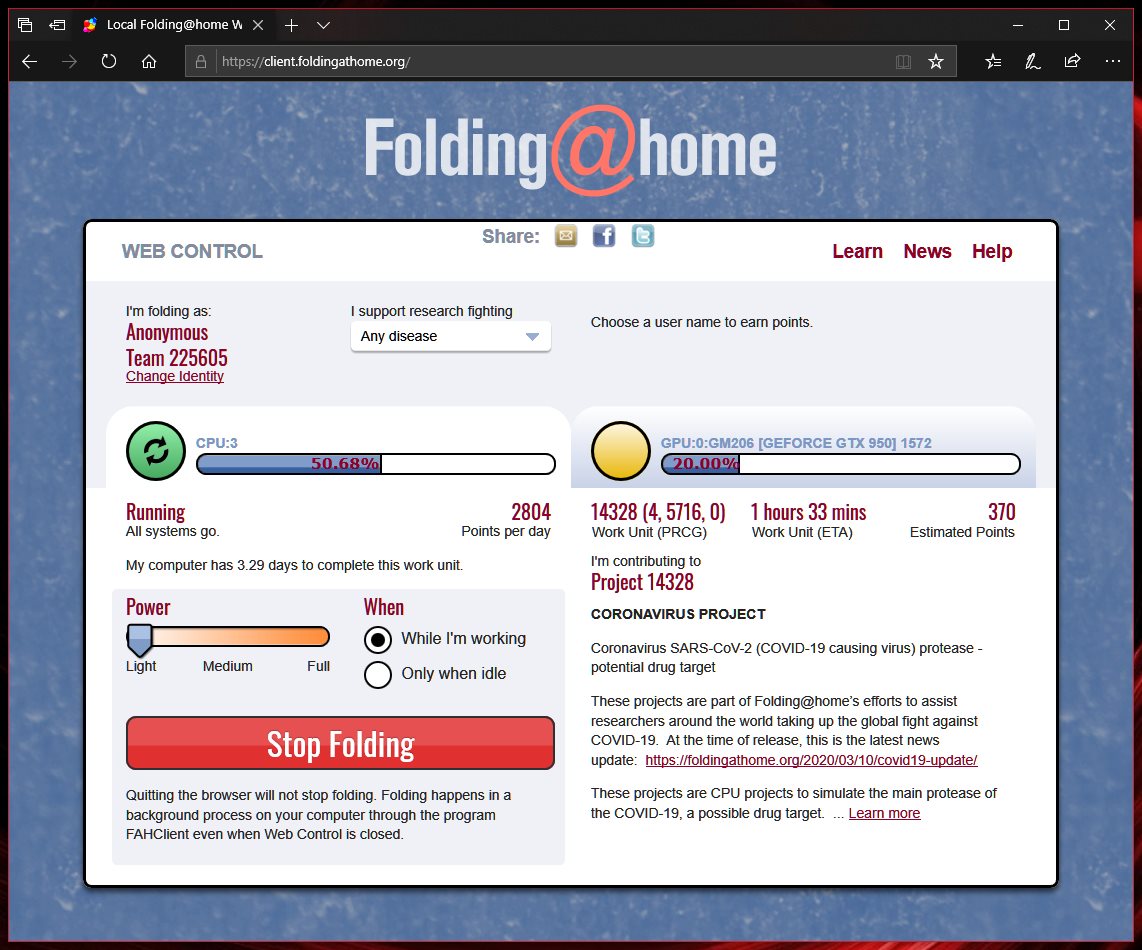
GPUs in this can pull off ~189K ppd each but CPU can only do ~17K ppd. Best cooling in this workstation however, so I'll probably just set it to running full and grab a "pedestrian" one for work with only 8 cores. :D
F@H_1.png
 
LOL... well, whatever... I guess it's actually better this way... system stays more than responsive enough for work and way higher ppd values (but not quite as high as they're capable of). ;)
F@H_2.png
 
https://www.anandtech.com/show/1566...0000000000-operations-per-second-for-covid-19

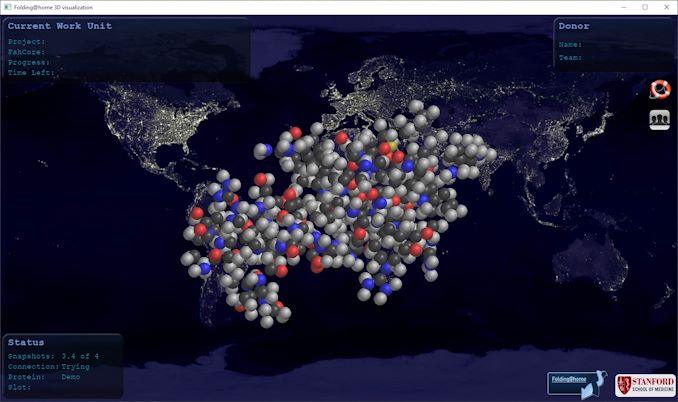
Folding@Home Reaches Exascale: 1,500,000,000,000,000,000 Operations Per Second for COVID-19
by Anton Shilov on March 26, 2020 6:00 AM EST
59 Comments | Add A Comment

Protein_Viewer_678x452.jpg


Folding@home has announced that cumulative compute performance of systems participating in the project has exceeded 1.5 ExaFLOPS, or 1,500,000,000,000,000,000 floating point operations per second. The level of performance currently available from Folding@home participants is by an order of magnitude higher than that of the world’s most powerful supercomputer.
Right now, cumulative performance of active CPUs and GPUs (which have returned Work Units within the last 50 days) participating in the Folding@home project exceeds 1,5 ExaFLOPS, which is 10 times faster than performance of IBM’s Summit supercomputer benchmarked for 148.6 PetaFLOPS. To get there, Folding@Home had to employ 4.63 million CPU cores as well as nearly 430 thousand GPUs. Considering the nature of distributed computing, not all CPU cores and GPUs are online at all times, so performance available for Folding@home projects varies depending on availability of hardware.

The outbreak of COVID-19 has been taxing for a number of computational biology and chemistry projects. IBM recently formed its COVID-19 High Performance Computing Consortium that pools together major supercomputers run by various research institutions and technology companies in the USA to run research simulations in epidemiology, bioinformatics, and molecular modeling. Cumulative performance of supercomputers participating in IBM’s COVID-19 HPC Consortium is 330 PetaFLOPS.

 
Screenshot (2).png


16 threads 24/7. My wife is a CNA in a small rural hospital. They were going to make a Covid ward but the CDC says there not capable to handle this. I agreed with them. The medical system here is minimal. The hospital was built in the 1930's and was originally a government ran county hospital until Reagan privatized them. It constantly changes ownership, the last owners left owing money. No one seems able to make it here.
I do not use the medical system in this area and travel out. When you live in rural America, you get to see how the medical system in America isn't working.
 
Last edited:
When you live in rural America, you get to see how the medical system in America isn't working.
You see it plenty in the metro areas as well... there are just a different set of problems. New equipment and better facilities sure, but good luck getting to see the doctor for more than about 5 minutes... and I say "doctor" but you're often lucky if it's a P.A. :( At least until you're dropping thousands on an elective surgery... then they line up and give you flowers and chocolates. ;)
 
Back
Top Bottom