• Welcome to ASR. There are many reviews of audio hardware and expert members to help answer your questions. Click here to have your audio equipment measured for free!

DSPi users (and prospects) projects discussions

Looking at Ground strategies. Likely not sensitive as long as gnd's are connected but nice to navigate through Kicad and look into common layout practises
 

Attachments

  • GNDB.jpg
    GNDB.jpg
    172 KB · Views: 154
  • GNDA.jpg
    GNDA.jpg
    324.2 KB · Views: 140
I started working on this but never really finished it. Would it be something interesting?
 

Attachments

  • Screenshot_20260709_081616.png
    Screenshot_20260709_081616.png
    153.9 KB · Views: 177
  • Pico2_ESS_DSP_v2.png
    Pico2_ESS_DSP_v2.png
    98 KB · Views: 198
I started working on this but never really finished it. Would it be something interesting?
That definitely looks like an interesting board! But if I'd personally would use that I'd like to have pinoutas for extra controls such as rotary encoders, buttons and LEDs :)
 
That definitely looks like an interesting board! But if I'd personally would use that I'd like to have pinoutas for extra controls such as rotary encoders, buttons and LEDs :)
Yeah it was designed when I didn't really know what exactly DSPi will support in terms of external control. But that could be added.
 
My test boards have arrived.. Now I can wire and test control surfaces and more, then design a more complete DSP/Preamp board.
 

Attachments

  • 73960f6b-83f2-46cd-bee7-41f5e1aa3397.jpg
    73960f6b-83f2-46cd-bee7-41f5e1aa3397.jpg
    316.5 KB · Views: 190
I have a Syn and I liked the surround effects it extracted. My problem with it was I couldn’t eq and I nowadays I don’t mind adding a decent adc to dac eq device to my chain.

But with a few Dspi’s in the chain.
Well EQing in stereo upstream of the SYN splitting the signals up is ofc straightforward. As for bass management crossovers after, only a bit more of a challenge depending in the details if what you want.

Most straightforward is collecting the SYN analog inputs into an ADC interface, 8-port is common and gives you spares, get a unit with BNC to sync with the outputs.

My conundrum is, you need a PC or SBC to host the DSPi(s)
 
"someone" should make a finished box based on DSPi that can convert either from ADAT 8x channels input (44.1/48Hz) splitting to TOSlink out

or v/v, simultaneously bidirectional even better.

Supporting S/MUX both ways, best of all.

Working standalone once routing configured?

I dunno what's possible there...

Slightly clunky but muxing four SPDIFs to ADAT via DSPi can be done using four of these ASRC TOSLINK modules. Still quite inexpensive when compared with the alternatives. :)
 
I've been thinking about developing a dedicated PCB based on 2 MCU's: an RP2350 running DSPi + an ESP32-S3 running squeezelite-esp32, cspot and DSPi web-based control.
It would also incorporate 4 x PCM5102A for analog outputs, ADAT and toslink/spdif output.
The DSPi would still be usable in raw USB soundcard mode (essentially bypassing the esp32) as well.
I've also included some quality of life features such as IR control, rotart encoder for volume control, OLED display support and 12v amp trigger output.

I realize this would be achievable as well on a RPi with camilla DSP (with the added advantage of FIR), but I really like the appeal of a true embedded, MCU based solution.

Open to suggestions before I start working on the schematics!
 
Please enable output channels to be mirrored concurrently across different media, rather than switched either/or

as e.g. with Wiim Ultra, Topping D10s and Eitr 2
 
Came across this project by an article in a magazine -> awesome stuff !
Setting it up (compiling and playing around with the mac gui) went rather smoothly.
Then I thought about adding an analog ouput with a piggy-back board to the pico (audiopack, PCM5100), should work according to the pinout with I2S4, unfortunately it keeps silent… anyone else tried this ?

 
Came across this project by an article in a magazine -> awesome stuff !
Setting it up (compiling and playing around with the mac gui) went rather smoothly.
Then I thought about adding an analog ouput with a piggy-back board to the pico (audiopack, PCM5100), should work according to the pinout with I2S4, unfortunately it keeps silent… anyone else tried this ?
In case you use the Pimoroni Audio Pack: here how it worked for me immediatey:
 
I made a dongle DSP/DAC using a Waveshare RP2350 Zero and a WeAct I2S Headphone amp. Drives my 7Hz Zero 2 even better than my JCally dongles and with variable loudness as well! Well no loudness on Android since it doesn't send user volume data unfortunately, but on Windows it works perfectly :)
Need to adjust some things on the 3D print, but can publish the files later if someone is interested.
1000050796.jpg

1000050798.jpg
 
Sorry but you did not mention DSPi, is that included?

To get a LC independent of the host, your volume level should be controlled by the same board.
 
Sorry but you did not mention DSPi, is that included?

To get a LC independent of the host, your volume level should be controlled by the same board.
Of course, it's on the Waveshare RP2350 Zero :)

Loudness compensation should not be independent on the host, that the whole point since it uses the so called "user volume" data in the bitstream to set the amount of loudness compensation, but since Android doesn't provide that data and instead bakes the volume into the bitstream DSPi can't do the variable loudness compensation.
 
Of course, it's on the Waveshare RP2350 Zero

OK, interesting tiny and cheap, any other advantages over stock Pico 2?

I asked Gemini, says even with just 20 GPIO pins can still wire up 8ch I/O – ADC and DACs for analog I/O, USB built in (both directions? concurrently?) plus ADAT in & out, convertible to TOSlink (2ch only).

Proposed pin map:

Clocking shared across all I/O devices?

I2S_CLK (Bit Clock BCK) GP0
I2S_WS (LR Clock / Word Select LRCK) GP1

DAC_D1 to DAC_D4 8ch total GP2 – GP5

ADC_D1 to ADC_D4 8ch total GP6 – GP9

ADAT/TOSlink
OPT_RX GP10
OPT_TX GP11

PIO-USB Control Port (or MIDI?)
USB_D+ GP12
USB_D- GP13

with plenty of pins left for knobs or buttons

...

> Loudness compensation should not be independent on the host, that the whole point since it uses the so called "user volume" data in the bitstream to set the amount of loudness compensation, but since Android doesn't provide that data and instead bakes the volume into the bitstream DSPi can't do the variable loudness compensation.

Yes, got that. I have no desire to use windoze for anything, and will likely need multiple DSPi units

therefore I will continue to assume I need to look elsewhere for that functionality.

But my main point - in my years of interest in auto LC varying with user volume control, I've never come across ANY device doing that where the user volume is adjusted on an upstream device, no matter the host OS.

If there are other examples I've missed I would appreciate learning about them
The Waveshare RP2350 actually has more GPIO outsputs than the regular Pico 2, and it's also smaller and it has USB-C. For me it was the size that mattered with USB-C being a nice bonus. Though I guess the regular Pico 2 is easier to work with.

MacOS and Linux also sends user volume data, and some (but unfortunately not all) Android devices, so as long as your using USB to send audio loudness compensation should work. I have no idea about other Apple things though, but hopefully they do send that UAC data as well :)

For my main DSPi box in my living room I have a IR remote though to change any user volume even for the sources that doesn't send them themselves, that way I get loudness compensation for my CDs which is just lovely and a big game changer imo!
 
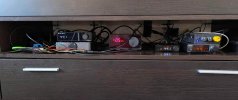
The project for a 6-channel stereo amplifier for 3-way speakers is slowly moving forward. Once was the core of this project – the DSPi , everything else is just a matter of time. The amplifiers will be assembled around one of the best inexpensive and underrated Class D microcircuits, the MA12070p. Four microcircuits will be used. The mid/high frequencies are in BTL mode. The subwoofers are in PBTL mode. The speakers will also be homemade. The mid/tweeter are already ready. The subwoofers are still in the works. For now, the working prototype, consisting of three DACs and three stereo amplifiers, looks like this :) .
Ma-6.jpg
Nevertheless, it is already fully operational, with room correction and crossover fully configured. So far, I'm thrilled with the price/quality ratio of this system.
 
Back
Top Bottom