• Welcome to ASR. There are many reviews of audio hardware and expert members to help answer your questions. Click here to have your audio equipment measured for free!

Does anyone have a Williamson tube amplifier?

specs never really explain how an amp sounds
But basic measurements do. 100%.
You can use 6L6 (bright sound) 5881 Dark sound) KT66..nice and balanced.
Goldilocks nods. Serious question: did you use any ears-only controls to determine this remarkable result?

IME, the Williamson amp has no sound of its own, an excellent piece of engineering.
 
But basic measurements do. 100%.

Goldilocks nods. Serious question: did you use any ears-only controls to determine this remarkable result?

IME, the Williamson amp has no sound of its own, an excellent piece of engineering.
The fact that we have a 90 year old valve design that is for all practical purposes transparent never seems to put them off though :facepalm:
 
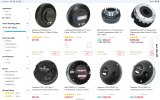
It would be cool to have a sleeper solution. Let a Williamson tube amplifier with its 15 watt power up a pair of 109 dB sensitive compression drivers. Maybe then preferably 16 Ohm ones?
Screenshot_2024-12-12_125632.jpg

The rest is taken care of by modern class d amplification. All other stuff except the Williamson amp placed so they are not visible.:)

People would wonder; but how the hell does that little old tube amp manage to get that much bass out of your speakers that have dual 15 bass drivers in them?
66bbc45f77602b47ac1895c8df45c6ea (3).png

Not my speakers.I just put that photo in to visualize my thought

Okay, maybe a slightly childish thought, but still.:)
 
Last edited:
It’s almost as if some would like to say you’re not allowed to enjoy such inferior sound reproduction. You should fixate on the delivery system and scrutinize it until it sounds identical to his masters voice. Try to enjoy things for what they are, and don’t forget the musician who makes the pure fidelity. I know my late father who was an avid electronics engineer raised on tubes and weaned on transistors would be slack jawed over how good chip amps sound. Fundamentally, he was trying to achieve higher fidelity with every project. We have it easy.
 
People would wonder; but how the hell does that little old tube amp manage to get that much bass out of your speakers that have dual 15 bass drivers in them?
Of course, large speakers (counterintuitively) tend to be more efficient than smaller ones... :cool:
 
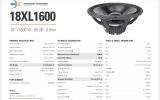
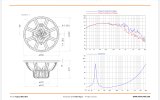
An 8 Ohm, 98 dB sensitivity, 18 inch bass driver such as the FaitalPRO 18XL1600. That driver in a vented box of around 6ft³ would result in f3 of 34 Hz
(according to Parts Express).
I wonder how it would sound with a 15 watt Williamson tube amplifier?

That combo is absolutely nothing I intend have, but wonder, for the sake of curiosity, I can always do.:)
Screenshot_2024-12-12_140611.jpgScreenshot_2024-12-12_140621.jpg


Edit:
In contrast, 83 dB sensitive speakers, which dip down to 2.2 Ohms, and....EPDR dips to 1 ohm and it spends a wide area below 2 ohms: (page 5, #100)


Or..

Or for the amplifier more Ohm "kinder" speakers but with 81 dB sensitivity:


With those speakers, no matter how good they are, it doesn't exist in my world to power them with a 15 watt tube amp. :oops:
(a fairly obvious observation)
 
Last edited:
Post #66 brings up speaker sensitivity and amp power. A hi-fi speaker with 90dB/W/m sensitivity can ball-park provide an 80dB average listening SPL at 3 meters with 12dB peak-to-average recorded material without exceeding a 15W power capability where waveform clipping starts. For comparison, a very loud cinema type experience may operate up to 85dB average SPL with up to 20dB peak-to-average recorded material.

We had a recent talk/demonstration of Williamson amps to an Audio Club in a moderate size room with 50 or so people, and used a pair of Leak Sandwich speakers (vintage with circa 86dB sensitivity, but quite modern compared to the amps being demonstrated). The speakers sounded great with a range of familiar CD music - the amps were as expected 'neutral' and indistinguishable from each other.

I've been able to restore 3 vintage Williamson's of original WW design, and a few other variants, and all can be made unconditionally stable at LF and HF with some insight and test tools, so I see no good reason to adjust the design per se to 'improve it'. Quite a few over on Audiokarma are also restoring or remaking commercial Heathkit variants, and similarly avoiding original concerns with stability, and have been able to use modern stock output transformers and valves.
Interesting. :) I have been to similar DIY/Vintage fairs and listened to a few different low powered tube amplifiers. For example, if I remember correctly, a couple of Quad II tube amps classics. Then in smaller listening rooms, no disco high volume with (of course) DIY speakers (so I don't know their sensitivity). High ohmic speakers to match the tube amp well I remember the builder saying. In any case, at normal listening volume, that combo sounded good. :)

BUT what I would be more interested in listening to is a modern - vintage combination. Two bass boxes powered up with modern powerful class D amplifiers up to around 500 Hz. Anything above these 500 Hz a low powered tube amp together with a pair of at least 90 dB sensitive speakers would take care of that. With that combination it would be interesting to see what SPL levels it could get up to and still sound good.:) :D
 
Or have had, listened to a Williamson tube amplifier? Impression?

Are they available?
What can one, in reasonable condition, cost?

I could really imagine having one. Mostly for its HiFi history. :) Not as a main amp but in some nice secondary system. Then together with a subwoofer + LP/HP filter sub-speaker. Speakers that the Williamson tube amplifier would like to drive.:)
I might add that when I say have such an old amplifier as a general tip, you should be knowledgeable about electronics or, as in my case, have a friend who is knowledgeable (I help him with other things). Taking amplifiers to professional repairman, who charge by the hour, can be expensive.

Do you think the technical data in the Wikipedia link below is correct?:
15 W, 0.1% distortion, straight FR?
Good damping (factor) is mentioned. What kind of damping factor it is and what it is compared to, one might wonder.

The Williamson amplifier is a four-stage, push-pull, Class A triode-output valve audio power amplifier designed by D. T. N. Williamson during World War II. The original circuit, published in 1947 and addressed to the worldwide do it yourself community, set the standard of high fidelity sound reproduction and served as a benchmark or reference amplifier design throughout the 1950s. The original circuit was copied by hundreds of thousands amateurs worldwide.[1] It was an absolute favourite on the DIY scene of the 1950s, and in the beginning of the decade also dominated British and North American markets for factory-assembled amplifiers.

The Williamson circuit was based on the 1934 Wireless World Quality Amplifier by Walter Cocking, with an additional error amplifier stage and a global negative feedback loop. Deep feedback, triode-connected KT66 power tetrodes, conservative choice of standing currents, and the use of wide-bandwidth output transformer all contributed to the performance of the Williamson. It had a modest output power rating of 15 Watts[a] but surpassed all contemporary designs in having very low harmonic distortion and intermodulation, flat frequency response throughout the audible frequency range, and effective damping of loudspeaker resonances. The 0.1% distortion figure of the Williamson amplifier became the criterion for high fidelity performance[2][3] that remains valid in the 21st century.
[4]

Or maybe one should let such an old amplifier remain in some radio museum for display only, considering this:

The Williamson amplifier was sensitive to selection and matching of passive components and valves, and prone to unwanted oscillations at infrasonic and ultrasonic frequencies. Enclosing four valve stages and an output transformer in a negative feedback loop was a severe test of design, resulting in a very narrow phase margin or, quite often, no margin at all. Attempts to improve stability of the Williamson could not fix this fundamental flaw. For this reason, and due to high costs of required quality components, manufacturers soon abandoned the Williamson circuit in favour of inherently more stable, cheaper and efficient three-stage, ultralinear or pentode-output designs.


Here is a video for the technically interested:


Edit:
I don't even really know what it looks like. There are pictures online but I think it mostly looks like variations on that amp. Can anyone produce a picture of the original? It would be nice to see what it looks like.:)
Thank you for this thread, it is fabulous to read about some of the earlyer topologys/implementations.... nice memorys and way less angst. appreciated :=)
 
Last edited:
I have a Williamson that my Dad constructed nI 1950. It is built upon two chassis, power supply and amp. Originally the amp used two 6SN7's driving a pair of 807 transmitting tubes in push-pull driving a Peerless output transformer. It was meticulously built, to military standards. When the 807 supply dried up shortly after 1957, Dad changed to a pair of 7027's. I sat at his side and watched him build.
 
Times change over the decades. 7027's are now quite rare, whereas NOS 807's are very common - as soooo many were made during WW2, but perhaps still kept in DoD stock during the 1950's.
 
oh hey I can chime in here, I have a pair of Heathkit W2Ms dating from the mid 50s if I'm not mistaken, that were rebuilt(not by me) using the method advocated by dcgillespie in this thread. https://audiokarma.org/forums/index.php?threads/regilding-the-gilded-lily-heaths-w-2m.767851/

I didn't get the original power supplies so mine are built from scratch from the same builder. I've got 5881 tubes in mine and I would say that they sound pretty neutral, not "tubey" or "warm"

I haven't used mine since I got a class D Apollon, but it's mostly an issue of the heathkit's not fitting well on my rack, not that I don't like em.
 
Yes, I have a pair of Eico HF-22 monoblocks that have KT-66s installed. I believe these were modified to a Williamson design by the previous owner.
 
Back
Top Bottom