Well, rise of digital era must have chopped off its already messed up copper lines. Good or bad is up to the user but the new design is fully compatible with modern male outputs.As a sidenote, not sure if anyone has mentioned it before. But I'll compare backside of an older Denon AVR-2105
View attachment 523771
With a current model AVR-X2800H (a more expensive model)
View attachment 523772

-
Welcome to ASR. There are many reviews of audio hardware and expert members to help answer your questions. Click here to have your audio equipment measured for free!
You are using an out of date browser. It may not display this or other websites correctly.
You should upgrade or use an alternative browser.
You should upgrade or use an alternative browser.
Do You Miss Knobs and Dials and Switches?
- Thread starter MattHooper
- Start date

Bleib
Major Contributor
- Joined
- May 13, 2021
- Messages
- 4,140
- Likes
- 10,580
Well, many of the older amps also used to have double outputs for stereo. So you can change to a different pair of front speakers with the push of a button. I loved that.Well, rise of digital era must have chopped off its already messed up copper lines. Good or bad is up to the user but the new design is fully compatible with modern male outputs.

Found this multi functional knob from minidsp. Just a heads up in hopefully the right thread: https://www.soundimports.eu/nl/minidsp-kd-1.html

Anybody here using this with a shd studio?Found this multi functional knob from minidsp. Just a heads up in hopefully the right thread: https://www.soundimports.eu/nl/minidsp-kd-1.html
cavedriver
Addicted to Fun and Learning
Saw this image of a beautiful Sony shortwave radio. Have to admit this thing is gorgeously well designed:

Wow, very "steampunk" almost, and yes beautifulSaw this image of a beautiful Sony shortwave radio. Have to admit this thing is gorgeously well designed:
View attachment 547482


- Joined
- Dec 12, 2019
- Messages
- 18,098
- Likes
- 41,804
Sony made some very fine general coverage (portable) receivers over the years. 

tmtomh
Major Contributor
- Joined
- Aug 14, 2018
- Messages
- 3,609
- Likes
- 10,852
Saw this image of a beautiful Sony shortwave radio. Have to admit this thing is gorgeously well designed:
View attachment 547482
I generally prefer minimalism, but that thing is undeniably beautiful. Never saw it before - thanks for sharing!

Before the days of world wide distribution via internet, having a "Shortwave" radio for scanning international broadcasts was all the rage.Saw this image of a beautiful Sony shortwave radio. Have to admit this thing is gorgeously well designed
I'd bet most folks born after around 1980 have no idea what a shortwave radio is. LOL
- Joined
- Dec 12, 2019
- Messages
- 18,098
- Likes
- 41,804
Worse than that -- the shortwave broadcast bands are wastelands now. There's some programming, but it's mostly... bizarre.Before the days of world wide distribution via internet, having a "Shortwave" radio for scanning international broadcasts was all the rage.
I'd bet most folks born after around 1980 have no idea what a shortwave radio is. LOL
rando internet images -- not mine, sadly.

MRC01
Major Contributor
Same here. I looked it up, the CRF-330K is model from around 1980 that Sony doesn't make anymore. It's a premium radio, weighs about 30 lbs and one can buy an operational one used for a few kilobucks.I generally prefer minimalism, but that thing is undeniably beautiful. Never saw it before - thanks for sharing!
At least we still get the US Naval Observatory Master Clock on 5, 10 and 15 MHz. Many years ago, that came in handy when I was on a ship in the middle of the ocean and had to track a satellite, but that's a whole 'nuther story.Worse than that -- the shortwave broadcast bands are wastelands now. There's some programming, but it's mostly... bizarre.
- Joined
- Dec 12, 2019
- Messages
- 18,098
- Likes
- 41,804
Yes, but CHU Canada is gone.Same here. I looked it up, the CRF-330K is model from around 1980 that Sony doesn't make anymore. It's a premium radio, weighs about 30 lbs and one can buy an operational one used for a few kilobucks.
At least we still get the US Naval Observatory Master Clock on 5, 10 and 15 MHz. Many years ago, that came in handy when I was on a ship in the middle of the ocean and had to track a satellite, but that's a whole 'nuther story.


Canada's CHU Shortwave Time Station to Be Silenced - Radio World
Last month, the National Research Council of Canada revealed its decision to shut down shortwave station CHU, with its operations concluding on June 22.
 www.radioworld.com

Members may salivate over that SONY shortwave radio; at the thread "Does anyone else like FM radio?"... if you post it there!Saw this image of a beautiful Sony shortwave radio. Have to admit this thing is gorgeously well designed:
View attachment 547482

I have to say - in my EV, which has the usual control knob and an LED screen to access many setting, I wish I could do far more with direct buttons, because in some cases the knob rotations and clicks are cumbersome... and can distract from looking at the road.
At home listening to music... for fun I rotated in an early 90s Luxman amp that is all manual... and after a few days I prefered the tablet controlled approach I typically use. Far more user friendly. Got too lazy, I guess. And my GF went "Get rid of the time machine, dude!"
At home listening to music... for fun I rotated in an early 90s Luxman amp that is all manual... and after a few days I prefered the tablet controlled approach I typically use. Far more user friendly. Got too lazy, I guess. And my GF went "Get rid of the time machine, dude!"
Last edited:
Does short wave broadcast still exist?Before the days of world wide distribution via internet, having a "Shortwave" radio for scanning international broadcasts was all the rage.
I'd bet most folks born after around 1980 have no idea what a shortwave radio is. LOL
- Joined
- Dec 12, 2019
- Messages
- 18,098
- Likes
- 41,804
Yes, but it's bleak.Does short wave broadcast still exist?
It's only bleak currently because there has not be any bleak-to-total communication breakdowns occurring and hope one never does.Yes, but it's bleak.
For the record:
I am fully ready and equipped... if/when!Shortwave radio is a form of radio transmission using frequencies in the High Frequency (HF) band, typically ranging from 3 to 30 MHz (wavelengths of approximately 10 to 100 meters). It is called "shortwave" because these wavelengths are shorter than those used in traditional AM broadcasting, allowing signals to travel vast distances by bouncing off the Earth's ionosphere rather than traveling in straight lines. [<< copied from a Q to some AI]
Long before anyone had ever heard of those Asian imports, it was the Zenith Trans-Oceanic, The "Royalty of Radios" that ruled the day for consumer shortwave broadcast listening. I can clearly remember my father being very desirous of owning one, though it was never something he could have ever afforded.Worse than that -- the shortwave broadcast bands are wastelands now. There's some programming, but it's mostly... bizarre.

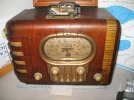
Back in the day, most every radio beyond the most basic tabletops included a band or two of shortwave frequencies. Even my little 1939 Zenith Racetrack has one band of SW besides it's normal AM band. (5.5 - 18.5 megahertz.) With so many US citizens being foreign immigrants wishing to hear something from home in their native language, etc; SW radio was the only option of the time, most specially valued during the WW II era.
Attachments
MRC01
Major Contributor
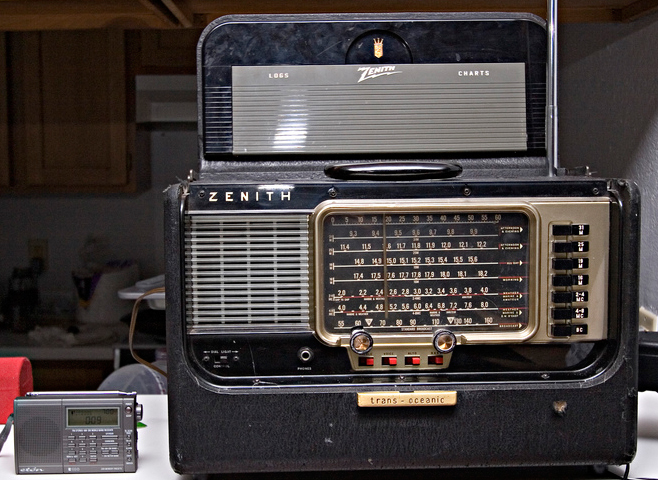
Transoceanic was a brand name for several different models of Zenith shortwaves. I got my first shortwave in the late 1980s and it was a "portable" Transoceanic from the 1960s that my neighbor gave me - "portable" in quotes because it was so big & heavy, even though it had a handle and could run on batteries. IIRC, the model was "Royal 1000". It was solid state, though the tuning mechanism was multiple capacitors on an axle that rotated via strings tied to the tuning knob.Long before anyone had ever heard of those Asian imports, it was the Zenith Trans-Oceanic, The "Royalty of Radios" that ruled the day for consumer shortwave broadcast listening. I can clearly remember my father being very desirous of owning one, though it was never something he could have ever afforded.
Royal 1000 circa 1957. A cool feature was the rotating cylinder dial scale which only showed the band you were tuning.Transoceanic was a brand name for several different models of Zenith shortwaves. I got my first shortwave in the late 1980s and it was a "portable" Transoceanic from the 1960s that my neighbor gave me - "portable" in quotes because it was so big & heavy, even though it had a handle and could run on batteries. IIRC, the model was "Royal 1000". It was solid state, though the tuning mechanism was multiple capacitors on an axle that rotated via strings tied to the tuning knob.
Trans-Oceanic - Wikipedia

Similar threads

- Replies
- 2
- Views
- 487
- Replies
- 35
- Views
- 2K


- Replies
- 7
- Views
- 558