• Welcome to ASR. There are many reviews of audio hardware and expert members to help answer your questions. Click here to have your audio equipment measured for free!

DIY 3D Speaker Scanner - the Mathematics and Everything Else

But wouldn't you want people to benefit from this full system? I'd be happy to test it, but I have zero time to do anything but purchase the full thing as a kit. So then someone has to offer that.
You say it as if they are mutually exclusive. My issue is profiting from someone else's work. I can't imagine you would be happy if someone offered one of your speaker designs as a kit to allow access to all ;)
 
You say it as if they are mutually exclusive. My issue is profiting from someone else's work. I can't imagine you would be happy if someone offered one of your speaker designs as a kit to allow access to all ;)

Sure, but I am not offering my designs as open source.

Perhaps it could be offered as open source but required to be licensed for commercial purposes or something.
 
Jan hasn't licenced the hardware design but the software is. He signalled his intent in providing the information to allow others to follow. It's up to him to update that if he thinks it needs it. I don't think anyone is going to be prepared to sue anyone for breaching the licence so it relies on the good will of others respecting the original intentions.

The tolerances needed are quite tight, any kit might be more expensive than you imagine when that labour is someone elses. This is one time when DIY can really save some money.
 
DIY often saves money, that's part of the point.

But not useful for those who have more money than time, and/or can make more money by spending their time on other things than building something like this.

If the point of this project is explicitly to offer it to DIYs, that's fine of course.
 
It could help to have a seller make a kit like for Voron 3D printer. But I doubt enough buyers will need HALS to be worth to the seller. Or they charge big profit which doesn't make me feel good.

I also thought the large extrusion is a difficult part and I designed a way without it that I shared on DIYA. I did not build it.

At this time I wanted a metal gear because I had doubts about the accuracy of the 3d printed one, but after testing Jan's machine and also the required accuracy I don't worry now. I would use 3D print gear, bit mount it underneath the wheel hub so it is not squashed by the large steel plate.


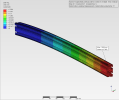
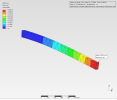
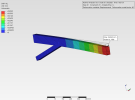
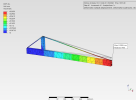
First to look at main arm deflection. All force is 39N (4Kg):

Aluminium extrusion alone:

Ali Profile.png


Aluminum Rectable Tube (3mm walls):

Ali Tube.png


Aluminium Rectangle Tube with Brace Arm Under:

Ali Tube Brace.png


Aluminium Rectangle Tube with Steel Wire Truss over:


Ali Tube Truss.png


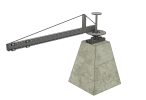
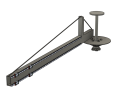
Over all Design:


Screenshot 2026-01-20 122624.png


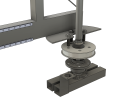
Close View of Hub:


Hub Exploaded.png


I did not design the mount for motor it is just quick visual example. I found if the hub is fixed on some square ali or steel tube it gives vertical space enough for motor and also wider foot to fix on stand. I imagine a concrete pour stand, or maybe wood with sand fill. Wood box with hinge to fold closed and sand bag inside to easily take out and pack in storage?
System Draft.png
 

Attachments

  • System Draft.png
    System Draft.png
    556.7 KB · Views: 40
  • Ali Profile.png
    Ali Profile.png
    577.9 KB · Views: 48
  • Ali Tube.png
    Ali Tube.png
    131.9 KB · Views: 36
  • Ali Tube Brace.png
    Ali Tube Brace.png
    298.2 KB · Views: 40
  • Ali Tube Truss.png
    Ali Tube Truss.png
    155.4 KB · Views: 57
  • Screenshot 2026-01-20 122624.png
    Screenshot 2026-01-20 122624.png
    94.8 KB · Views: 43
  • Hub Exploaded.png
    Hub Exploaded.png
    388.6 KB · Views: 42
DIY often saves money, that's part of the point.

But not useful for those who have more money than time, and/or can make more money by spending their time on other things than building something like this.

If the point of this project is explicitly to offer it to DIYs, that's fine of course.
I can build for you and give support. Only $80,000.
 
I understand that for some (like companies) a kit or ready-built system with support and guarantee is a better fit. In the past, when I was young and had no kids yet, I did a lot myself during renovation of my house. In my current situation I'd do a lot less myself and spent the time on the kids (next to all other tasks and the day time job).

For me it is the journey of learning new things and get a prototype working that got me started on this project. With the help of Jan and Dimitri it has become much more 'professional' than I ever envisioned.

Ps. I, too, can solve your 'money problem', not even limited to $80.000 ;-)
 
I'm a dumb when it comes to programming but just ran into Plotly, this noble open-source plotting engine for Python. You guys probably are aware of this but wanted to put it here if it could be any good for the HALS software you are concocting.

 
Why not to make a HALS Scanner Simulator in Pyhton with all the actual machanic and dimensions of actual robot and connect it to HALS Controller making it think an actual hardware is already built. The controller doesn't need to know it's just a simulation. By doing this eveyone can get familiar with the whole thing before even tapping a single hole or cutting a an aluminum extrusion. We can even add a virtual driver to it making it sending artificial measurement data to the controller and thus to the post-processing of HALS so we can see the results of measurement, spinorama graphs, field separation, All the sherical harmonic and henkel functions will be testified.
 
It's basically already there. You can use 'mocks' for the mechatronics and audio. The only step we could do extra is use a virtual speaker to produce the measurement. Now it's just a fixed IR.

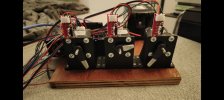
I don't have a full HALS systeem. Jan is the only one. I have this setup for testing:

Screenshot_2026-09-15-11-14-32-05_965bbf4d18d205f782c6b8409c5773a4.jpg
 
I whole heartedly agree that this should stay open source. Not for profit. The mechanical work is Jan's and what a job he did! Respect!
There is precedent for this in the 3D printing community. The Voron is a high performance open source 3D printer. E: I see @d.fapinov already mentioned that.

BOM and plans are the open source part. There is a cottage industry of people selling kits and even full builds for money.

I would say that people making a little profit from open source plans tends to strengthen the project and help deliver on its aims to more people.

You see this all over the place in software too... WordPress is free OSS but plenty of people make money from it in various ways.

It's probably true that there isn't a big market for these so the non-diy route will tend to be expensive.

 
Last edited:
Yes, this is CNC but for some reason people only think of routers when you use the term.
Or mills or lathes. Maybe water jet, plasma or laser cutters too. But I've yet to find anyone who would describe an embroidery machine as CNC although technically they are. And of course the NFS itself is technically another CNC machine.
I'll just say that even if you don't have a printer yourself, someone local to you is probably eager to make a few dollars printing stuff for others.
Or a makerspace where they'll help you do it using one of their printers - there will be a cost involved, but they're usually non-profit organisations. Failing that there are companies like SendCutSend and JLC that offer low volume manufacturing via the web - just search for 3d printing services.
I would say that people making a little profit from open source plans tends to strengthen the project and help deliver on its aims to more people.

You see this all over the place in software too... WordPress is free OSS but plenty of people make money from it in various ways.
It can help or hinder depending on how the people making money interact with those working on the project, and whether they're seen as giving to or taking from the project. WordPress is an interesting example with a bit of both given the recent toxicity between WordPress, Automattic and WP Engine.
 
There is precedent for this in the 3D printing community. The Voron is a high performance open source 3D printer. E: I see @d.fapinov already mentioned that.

BOM and plans are the open source part. There is a cottage industry of people selling kits and even full builds for money.

I would say that people making a little profit from open source plans tends to strengthen the project and help deliver on its aims to more people.

You see this all over the place in software too... WordPress is free OSS but plenty of people make money from it in various ways.

It's probably true that there isn't a big market for these so the non-diy route will tend to be expensive.
I think many of the busiest people on the diyaudio thread are capable of making more than one of these. All that needs to be done is reach out and touch someone? You remember the phone commercial I am sure.

Mark
 
Or mills or lathes. Maybe water jet, plasma or laser cutters too. But I've yet to find anyone who would describe an embroidery machine as CNC although technically they are. And of course the NFS itself is technically another CNC machine.

Or a makerspace where they'll help you do it using one of their printers - there will be a cost involved, but they're usually non-profit organisations. Failing that there are companies like SendCutSend and JLC that offer low volume manufacturing via the web - just search for 3d printing services.

It can help or hinder depending on how the people making money interact with those working on the project, and whether they're seen as giving to or taking from the project. WordPress is an interesting example with a bit of both given the recent toxicity between WordPress, Automattic and WP Engine.
Makerspaces, totally, sometimes even public library have printers you can use. These days access to a printer is not a huge obstacle except maybe in very rural areas.

The WPE / Automattic thing is arguably an exception but it definitely doesn't give a good example for this project! My main point is that paid services that help less technical people make use of an open source project can be a really healthy thing.
 
Back
Top Bottom