• Welcome to ASR. There are many reviews of audio hardware and expert members to help answer your questions. Click here to have your audio equipment measured for free!

Dirac ART Update

Paul McNeil

Active Member
Forum Donor
Joined
Jul 5, 2025
Messages
187
Likes
94
Well, I've upgraded my system, adding two SVS SB 17 (EQed with the new SVS app, super), they are front right and left (near corners). Now two SVS cylinders are positioned behind the listening position and the left and right, mid walls (large room). Now the listening position is surrounded by big bass. AI says this is important. Does having four subwoofers, surrounding the listener, in front and behind, optimize Dirac ART optimization of bass, particularly in the time domain.

So I did a Dirac ART calibration on this system, now with four potent subwoofers, directed at a Marantz AV10.

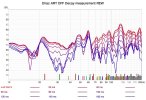
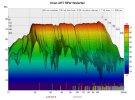
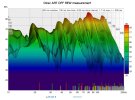
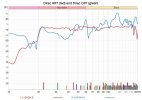
Here is the REW data.

Let me know what you think, or of any questions. Based on my past experience here, I expect some!!

It sure sounds good to me.
 

Attachments

  • Dirac ON and OFF Oct 5.jpg
    Dirac ON and OFF Oct 5.jpg
    128.1 KB · Views: 211
  • Dirac Art Decay measurement REW.jpg
    Dirac Art Decay measurement REW.jpg
    160.2 KB · Views: 194
  • Dirac ART OFF Decay measurment REW.jpg
    Dirac ART OFF Decay measurment REW.jpg
    154.6 KB · Views: 216
  • Dirac ART waterfall rew measurement.jpg
    Dirac ART waterfall rew measurement.jpg
    142.9 KB · Views: 202
  • Dirac ART OFF waterfall REW measurement.jpg
    Dirac ART OFF waterfall REW measurement.jpg
    133.4 KB · Views: 215
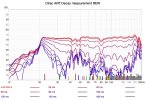
Well, I've upgraded my system, adding two SVS SB 17 (EQed with the new SVS app, super), they are front right and left (near corners). Now two SVS cylinders are positioned behind the listening position and the left and right, mid walls (large room). Now the listening position is surrounded by big bass. AI says this is important. Does having four subwoofers, surrounding the listener, in front and behind, optimize Dirac ART optimization of bass, particularly in the time domain.

So I did a Dirac ART calibration on this system, now with four potent subwoofers, directed at a Marantz AV10.

Here is the REW data.

Let me know what you think, or of any questions. Based on my past experience here, I expect some!!

It sure sounds good to me.
Question, did you adjust the svs with the app before doing Dirac ?
If yes, turn of the correction on the subs and re-measure Dirac
 
OK, I'm 73 and struggled with this but does this help? Please ignore the second ot these three files. The first and third are Dirac ART ON and the OFF.
 

Attachments

Question, did you adjust the svs with the app before doing Dirac ?
If yes, turn of the correction on the subs and re-measure Dirac
Yes, I said I did in the original post and called it 'super'! Thanks.
 
Changing the scale to 60dB makes things easier to judge
If possible i would have done the sweep at 85dB, but it looks good
Except around 40-50hz, are you using the front as support ?
Could also change support lvl to -24dB

Also, infra is on ?

1791303255554.png
 
Changing the scale to 60dB makes things easier to judge
If possible i would have done the sweep at 85dB, but it looks good
Except around 40-50hz, are you using the front as support ?
Could also change support lvl to -24dB

Also, infra is on ?

View attachment 562983
Yes, well 'support channels' is something I don't understand, comceptually, as regards DIRAC ART. And I have not seen anywhere an explanation. I'm a former scientist, and so understand experimentation, with REW as readout. But that is painful! But I will try. I just wish some 'general principles' were available.
 
Changing the scale to 60dB makes things easier to judge
If possible i would have done the sweep at 85dB, but it looks good
Except around 40-50hz, are you using the front as support ?
Could also change support lvl to -24dB

Also, infra is on ?

View attachment 562983
PS No infra is OFF. I've turned it on before, and it does not seem to matter. Dirac cuts off bass output at 20 htz. Those SVS monsters will do lower, for sure...
 
Hi

@Paul Mac Neil.. What do you mean by "Daisy Chained"? SIgnal goes in and comes out from one of these? I suggest to leave the DSP off on the SVS (Seems to be the case) , and each Sub is connected to one of the individual (and independent outputs of the Marantz AV10. Let Dirac do its stuff. For some reasons I would have expected more output below 20 Hz with such a complement of subwoofers. The response below 20 Hz IMO could be better ,even if DIRAC leaves it untouched...
People more knowledgeable about ART would chime in.
I did not mention 'Daisy Chained'. But it sounds like fun! Thanks for the input.
 
I did not mention 'Daisy Chained'. But it sounds like fun! Thanks for the input.
your signature kind of does it ;)
1791305397345.png


Regarding ART, Storm has a great guide with a lot of info on how ART works

If you have question best is to post them in the Dirac ART thread
It is full of useful information and we are a big bunch that are using it

Quick guide
Use the same target on every speaker
1791305712574.png
= dotted target curve

1791305767493.png

Fsiso - upper freq ART will work with
Support lvl, is inverted -24dB will give you more support
F support low - how low will support go
F support High - upper lvl

You will need to check every group when you do changes in the above setting


Lower center, it is a history meny so it easy to jump around
1791306007598.png
 
Last edited:
By this point I have seen so many ART measurements that when I see this:

1791306498641.png


... I know it's ART. No other DSP would do this.
 
your signature kind of does it ;)
View attachment 562994

Regarding ART, Storm has a great guide with a lot of info on how ART works

If you have question best is to post them in the Dirac ART thread
It is full of useful information and we are a big bunch that are using it

Quick guide
Use the same target on every speaker
View attachment 562995 = dotted target curve

View attachment 562996
o - upper freq ART will work with
Support lvl, is inverted -24dB will give you more support
F support low - how low will support go
F support High - upper lvl

You will need to check every group when you do changes in the above setting


Lower center, it is a history meny so it easy to jump around
View attachment 562997


Fsis
Thanks for the 'daisy chained' problem, which, by the way, I did not mention.. I will fix that problem. So many details...

And thanks for the reference to the Dirac Art thread, which I did not see, obviously. Will do.

The 'support settings' recommendations will take some time to digest.

I am still interested in the question of wtether Dirac ART improves sound, and how to measure it. Did I include the most relevant REW measurements.
 
By this point I have seen so many ART measurements that when I see this:

View attachment 563000

... I know it's ART. No other DSP would do this.
Yeah, I knew you would not like it! Am I nuts for thinking is sounds good. What about the other data?
 
By this point I have seen so many ART measurements that when I see this:

View attachment 563000

... I know it's ART. No other DSP would do this.
The question is: how audible is this pre-ringing? Is it an issue at all?

And: is this compromise acceptable given the benefit of decay reduction Dirac ART can offer?
 
Last edited:
The question is: how audible is this pre-ringing? Is it an issue at all?
I don't hear any problem, what I hear is clearer bass, "Ringing' problems is what Dirac is all about, I think. Maybe is is also called time delay, which can be seen to be vastly improved in the waterfall and delay graphs I showed. Please have a look at these. I really wish that Dirac would clarify this issue, how to measure their improvements, for example by REW. What was not shown was the impulse response from the Dirac OFF condition.
 
The question is: how audible is this pre-ringing? Is it an issue at all?

And: is this compromise acceptable given the benefit of decay reduction Dirac ART can offer?
PS I don't know how audible 'pre-ringing' is. And don't even understand the emphasis on this measurement. I think it is possible that Dirac ART renders some conventional REW measurements such as impulse response irrelevant. What about the other measurements I show, which one can hear, such as waterfall and decay. I'm sure I hear those quantified by REW in Dirac ART improved souls.
 
PS I don't know how audible 'pre-ringing' is. And don't even understand the emphasis on this measurement. I think it is possible that Dirac ART renders some conventional REW measurements such as impulse response irrelevant. What about the other measurements I show, which one can hear, such as waterfall and decay. I'm sure I hear those quantified by REW in Dirac ART improved souls.
You surely hear the improved decay. The pre-ringing caused by linear phase correction filters may be inaudible by pre-masking - that is why I was questioning its relevance, even if it looks ugly in measurements.
 
Back
Top Bottom