I think many are claiming so here or on YouTube. The claim is that it compresses the dynamic range. My understanding is that pure DAC mode is basically digital volume at 100. So a digital volume at 95 should not be that different from pure DAC mode? Is there anything deeper than the simple math that I showed?

-
WANTED: Happy members who like to discuss audio and other topics related to our interest. Desire to learn and share knowledge of science required. There are many reviews of audio hardware and expert members to help answer your questions. Click here to have your audio equipment measured for free!
- Forums
- Audio, Audio, Audio!
- DACs, Streamers, Servers, Players, Audio Interface
- Digital To Analog (DAC) Reviews and Discussion
You are using an out of date browser. It may not display this or other websites correctly.
You should upgrade or use an alternative browser.
You should upgrade or use an alternative browser.
Digital volume pre-amp on DAC produces inferior sound than a proper analog pre-amp?
- Thread starter shinewu
- Start date

staticV3
Master Contributor
- Joined
- Aug 29, 2019
- Messages
- 7,855
- Likes
- 12,547
Digital attenuation reduces SNR.
The signal amplitude goes down, but noise amplitude stays the same.
Now, that may sound bad, until you realize that the noise floor of modern DACs is so low, that even after it's amplified and played through speakers, the DAC's noise is in the majority of cases below the noise floor of the listening environment and below the self-noise of the Amplifier. Therefore inconsequential.
So yes. Digital attenuation reduces DR, but not in a way that could affect fidelity, unless you're dealing with severe gain mismatch.
The signal amplitude goes down, but noise amplitude stays the same.
Now, that may sound bad, until you realize that the noise floor of modern DACs is so low, that even after it's amplified and played through speakers, the DAC's noise is in the majority of cases below the noise floor of the listening environment and below the self-noise of the Amplifier. Therefore inconsequential.
So yes. Digital attenuation reduces DR, but not in a way that could affect fidelity, unless you're dealing with severe gain mismatch.

DVDdoug
Major Contributor
- Joined
- May 27, 2021
- Messages
- 3,016
- Likes
- 3,966
And analog attenuation does something similar... You reduce the signal into the preamp/amp any noise generated inside the amp stays the same for a lower signal-to-to noise ratio. (All analog electronics generate some noise).Digital attenuation reduces SNR.
When you lower the level digitally you are aren't using all of the bits. Each bit represents 6dB so if you have a 16-bit file and you reduce it by -6dB you're only using 15 bits. If you are down around -90dB you're only using a couple of bits and the quality is terrible but you can't hear anything at -90dB anyway. You don't hear quality loss as you go-down in volume.
With 24-bits you can reduce the level by about -48dB and still have 16-bit quality.
The problems (with analog or digital) usually come-in when you re-amplify or if you have "excess amplification" so you're always listening with a reduced SNR.
With 8-bit audio you can hear quantization noise, assuming you are playing it at full volume. But if you have a 16-bit file and you lower the volume by about -48dB (where you're only using 8-bits) the quantization noise remains the same and you still can't hear it... Unless you re-amplify... and then the quantization noise gets amplified and it sounds like an 8-bit file.
It reduces the dynamic range capability of the system.The claim is that it compresses the dynamic range.
Dynamic compression is something different... It reduces the "dynamic contrast" in music by making the loud parts quieter and/or the quiet parts louder. Compression is mostly used in audio production to make "everything loud". The only way you get compression accidently is if you drive your levels into clipping (where the peaks are reduced/clipped).
Last edited:

Many modern DACs have separate digital volume control. The volume change commands are sent through the serial control interface instead of having to modify the values of the signal samples (when the software and device driver support it).
See ESS presentation: https://www.esstech.com/wp-content/uploads/2021/02/digital-vs-analog-volume-control.pdf
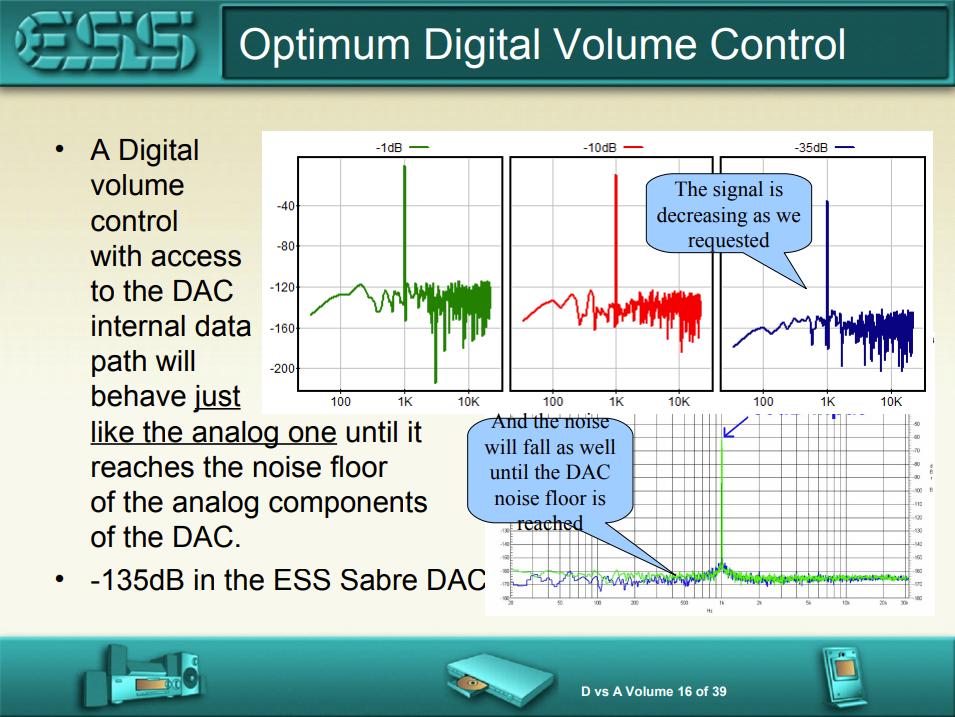
See ESS presentation: https://www.esstech.com/wp-content/uploads/2021/02/digital-vs-analog-volume-control.pdf


MaxwellsEq
Major Contributor
- Joined
- Aug 18, 2020
- Messages
- 1,717
- Likes
- 2,569
Current DACs based on recent chipsets should allow a change in volume with minimal audio impact.Cool, now I see that when folks claim the digital attenuation makes sound "flat", it is probably just confirmation bias.
Early implementations were not as good and had possibly audible impacts. This may be how the legend emerged.

Just to clarify that slightly - the number of bits you start with depends not on the source (eg redbook v higher res files) but the volume processing pipeline.When you lower the level digitally you are aren't using all of the bits. Each bit represents 6dB so if you have a 16-bit file and you reduce it by -6dB you're only using 15 bits. If you are down around -90dB you're only using a couple of bits and the quality is terrible but you can't hear anything at -90dB anyway. You don't hear quality loss as you go-down in volume.
With 24-bits you can reduce the level by about -48dB and still have 16-bit quality.
In modern DACs or software this will (should) always be 24 bit or higher, so if for example you are playing redbook files, they will come into the dac - be upshifted to 24 bit (or higher), and the volume reduction done from there. So you will still have 16 bit resolution after a volume reduction of 48dB.
It’s about implementation and total gain structure of your system .
In practice a digital volume might perform better and as tony said for typical content your -48dB down before anything significant happen .
And digital volume has perfect channel balance and no wear and tear of potentiometers.
I think RME as pro manufacturer has a hybrid system with some coarse steps in the analog circuit and then digital volume . Most likely to accommodate a vide range of system gain.
So in practice in a setup without traditional power amp ( with a DAC with volume control as source for example ) you set your power amp gain as low as possible to be able to crank up the digital volume pretty high for your normal listening level . Or use analog inline attenuators before the amp if it does not have selectable gain.
Rant:
Gain everywhere !
Traditionaly we alway had to much gain in our amps due to some legacy sources before CD joe blows old vhs who only gives 0.1 volt output or something.
So many amps and preamps have to much gain . Heck I even saw a test where the tested a Rotel pre and power amp combo where the pre amp gain was ridiculous compared to the needs of the “matched” power amp who already have quite a lot of gain resulting in that the tester only being able to use the first not so linear part of the volume pot.
If you ever wondered why you can only use a third of the volume put or less in some of systems it’s because everyone is hedging their bets and provides enough gain for the most decrepit old source component playing a very quiet classic lute composition this later morphed to need to not appear “weak” and your products must go to “11” and be loud with just a slight turn on the volume knob, a surprisingly lot of people associate the position of the volume knob with how powerful the product is
In practice a digital volume might perform better and as tony said for typical content your -48dB down before anything significant happen .
And digital volume has perfect channel balance and no wear and tear of potentiometers.
I think RME as pro manufacturer has a hybrid system with some coarse steps in the analog circuit and then digital volume . Most likely to accommodate a vide range of system gain.
So in practice in a setup without traditional power amp ( with a DAC with volume control as source for example ) you set your power amp gain as low as possible to be able to crank up the digital volume pretty high for your normal listening level . Or use analog inline attenuators before the amp if it does not have selectable gain.
Rant:
Gain everywhere !
Traditionaly we alway had to much gain in our amps due to some legacy sources before CD joe blows old vhs who only gives 0.1 volt output or something.
So many amps and preamps have to much gain . Heck I even saw a test where the tested a Rotel pre and power amp combo where the pre amp gain was ridiculous compared to the needs of the “matched” power amp who already have quite a lot of gain resulting in that the tester only being able to use the first not so linear part of the volume pot.
If you ever wondered why you can only use a third of the volume put or less in some of systems it’s because everyone is hedging their bets and provides enough gain for the most decrepit old source component playing a very quiet classic lute composition
this later morphed to need to not appear “weak” and your products must go to “11” and be loud with just a slight turn on the volume knob, a surprisingly lot of people associate the position of the volume knob with how powerful the product is 
Set up your system so a crash can't blow everything up....the problem I have with digital implementation is how it crashes and blows up the system sometimes...
Similar threads
- Replies
- 12
- Views
- 618

- Replies
- 3
- Views
- 2K
- Replies
- 7
- Views
- 905
- Replies
- 18
- Views
- 1K