• Welcome to ASR. There are many reviews of audio hardware and expert members to help answer your questions. Click here to have your audio equipment measured for free!

Dayton Audio MKSX4 Passive Subwoofer Review

Rate this passive subwoofer:

  • 1. Poor (headless panther)

    Votes: 51 46.4%
  • 2. Not terrible (postman panther)

    Votes: 46 41.8%
  • 3. Fine (happy panther)

    Votes: 11 10.0%
  • 4. Great (golfing panther)

    Votes: 2 1.8%

  • Total voters
    110
Well, that's what I was trying to say. It's not terrible. If you have tiny cube speakers hooked up to your PC and you're looking for a unit that can produce mid 80dB spl in the 50-100 hz range to fill out those cubes then, well, yeah, it kind of works. But I suspect multitude distortion patterns would look pretty woeful and the unit would fall apart quickly if pushed.

Yeah, kind of the definition of mid fi. Mid fi is, well, not terrible. Just kinda mid...

You could take a small 8" sealed sub with a solid class D amplifier, a Linkwitz transform filter in the dsp of your choice, and have a way better unit. Might cost a little more, but not terribly much so.
Why do you believe the multitone distortion is going to be bad? My (not so great) intuition assumed: 4 small woofers, 4 independent ports -> okay multitone distortion?

EDIT: Scratch the "independent ports" bit. I see they share a chamber.
 
Not sure how accurate this is, as I don't usually use VituixCAD like this.
Most cheap little Class D 2.1 amps that have a variable low pass, have a 12dB per octave filter.
Below (blue) is an estimate of room gain in addition to a 12dB per octave low-pass-filter centered at 100Hz.
I doubt it is all that accurate, but my only point is that it is closer to what the in-room response is likely to be than the anechoic measurement (pink).

View attachment 564429
Well, you make it look almost reasonable. I still think it ought to go a tad lower to call itself a subwoofer, but if this were the response in practice, it'd be fine.
 
Unless an additional low pass filter is applied, the positioning of the sub in a stereo setup is critcal - with a peak at 400 hz it's surely acoustically locatable.
 
Why do you believe the multitone distortion is going to be bad? My (not so great) intuition assumed: 4 small woofers, 4 independent ports -> okay multitone distortion?

EDIT: Scratch the "independent ports" bit. I see they share a chamber.
Well, it depends, I suppose on the signal you feed it. HD testing, though interesting for peak output and determining xmax, doesn't really resemble any real world signal. Going with the Fourier transform idea that any repeating periodic signal is just a series of sine waves of different amplitudes and phases, a real world signal will be better represented by a multitude burst than running HD sweeps. Now, if you use a HP filter at 50 Hz, maybe you can get away with using something like this. (is it really a sub if it doesn't produce any appreciable sound below 50hz?)

But a full range stream into this is going to cause problems. Any low frequencies below 50 hz will not produce meaningful output given the drop-off. But they will cause excess excursion of the VC and loads of distortion. Look at the below graph.

The stimulus is a 5 tone equal level signal at 20, 28, 44, 64 and 92 hz. I unfortunately don't have the single signal HD plots, but you can see that the envelope of the distortion spectra is only 10-30 dB down. Now this is an entirely different setup. But, I'm willing to wager that, if we played a random 5-20 signal (or, whatever multitude signal strikes your fancy), even in levels at the 80dB range, the stream of distortion products and their levels would look something like this graph.

1792039289591.png


Now, without actually running the test, it's only my conjecture. But, I've done enough of these tests on a dozens of drivers to know what these will look and sound like.

Your choices are to filter signals below 50 hz, or, give it a full range signal, and at louder SPL's listen to a lot of overtones and accept that your brain will fill in the missing fundamentals. Because you won't hear the 30 hz fundamental, but you will hear 60, 90, 120 overtones, as well as a plethora of IM products .

Like I said, I'm not saying it's terrible. It's the kind of thing I might have had in my work office. But I think you can design better if you're willing to spend just a little more.

It's also true that, given distortion is nonlinear and level dependent, yes, in a small room at lower levels with some room gain, yeah, it's less of a problem .

I'm still of the opinion that below a certain Sd, in a typical listening space, there is a minimum Sd required to generate subwoofer bass. Maybe if they just called this thing a woofer I'd be less critical. But I tend to think that anything called a subwoofer has to generate 30-80 hz at reasonable spls in a reasonable living space

. This thing, maybe 50-100 at modest levels or with small room/cabin gain. If that's good enough, for less than $150, I mean, you could do worse...

 
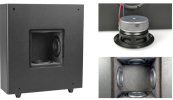
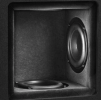
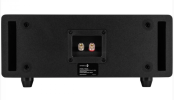
Thanks, Amir, for the review. These subwoofers are classified as "low-profile" subs. They can be positioned either vertically or horizontally; this one features four passive woofers.

See attached pictures
 

Attachments

  • Capture+_2026-10-15-07-11-44.png
    Capture+_2026-10-15-07-11-44.png
    853.9 KB · Views: 163
  • Capture+_2026-10-15-07-07-04.png
    Capture+_2026-10-15-07-07-04.png
    1.2 MB · Views: 169
  • Capture+_2026-10-15-07-06-39.png
    Capture+_2026-10-15-07-06-39.png
    402.9 KB · Views: 156
With such a frequency response, it would be interesting to see a waterfal/CSD and step response (with adjusted axis/settings if need be) to see if there are major resonances or lack of damping in low frequencies, which is a key factor to know how to EQ it too.
The peak at 350Hz in impedance probably already gives it away.
 
Unless an additional low pass filter is applied, the positioning of the sub in a stereo setup is critcal - with a peak at 400 hz it's surely acoustically locatable.

Surely some type of low pass filter and dsp is essential with any subwoofer. Otherwise they are just a noise machine
 
So, this is not entirely fair. I have tested a fair number of Dayton drivers and some of them rival higher end drivers. OK, maybe not Purifi, but I would put their better drivers on par with Peerless, SB and say, lower end Vifa/Peerless/Scan/Seas/SB drivers.

The problem is that this unit isn't one of them, and they sell some very, ahem, budget drivers.

The problem with this unit is it's not one of Dayton's better offerings. Not sure what they were thinking with the design. The math of low frequency SPL says you can't, you know, you just can't get any meaningful spl below 100-200 hz with 4" drivers, even if you have four of them. You really need at least as 10" driver just to get in the door of low frequency extension. A 10" driver has 25 times the Sd of a 4 inch driver. Even if you quarter that, it's still six times less. And that is assuming the same Xmax which is dubious. You need a 10 or two 8"s. I mean, I guess you can count on some cabin gain(I'm not a car audio guy particularly), but yeah, these actually measure about right for the driver Sd and design...

No drivers, not even if they were Purifi 4" drivers, could produce decent bass. The physics doesn't allow it.

My old, old test data, courtesy of the wayback machine.

Oh, snap!!! THE MarkK! I used to read yours and John K’s sites often. I learned a lot from your driver tests and often referenced them in my own testing when I started reviewing drivers back in 2009.

Thank you for all your work.

Erin
 
So, this is not entirely fair. I have tested a fair number of Dayton drivers and some of them rival higher end drivers. OK, maybe not Purifi, but I would put their better drivers on par with Peerless, SB and say, lower end Vifa/Peerless/Scan/Seas/SB drivers.

The problem is that this unit isn't one of them, and they sell some very, ahem, budget drivers.

The problem with this unit is it's not one of Dayton's better offerings. Not sure what they were thinking with the design. The math of low frequency SPL says you can't, you know, you just can't get any meaningful spl below 100-200 hz with 4" drivers, even if you have four of them. You really need at least as 10" driver just to get in the door of low frequency extension. A 10" driver has 25 times the Sd of a 4 inch driver. Even if you quarter that, it's still six times less. And that is assuming the same Xmax which is dubious. You need a 10 or two 8"s. I mean, I guess you can count on some cabin gain(I'm not a car audio guy particularly), but yeah, these actually measure about right for the driver Sd and design...

No drivers, not even if they were Purifi 4" drivers, could produce decent bass. The physics doesn't allow it.

My old, old test data, courtesy of the wayback machine.

This 'subwoofer' is not ideal by any margin but it will measure 'flat' in-room down to 36Hz (-10 dB anechoic from 100Hz) and potentially even lower.

I have a modern 12-inch woofer that I retro fitted into a rather tiny but gorgeous Sansui SP-1000 from the 70s. I got something similar with regards to extension to be honest but it's not the end of the world.

the distortion also seems pretty low and output at 96db will be respectable.

This is honestly better than I thought, could make an excellent support subwoofer for Dirac ART if you EQ it a little bit. Specially for people with budget or space constraints.

It could also make a reasonable office subwoofer for people who don't have a lot of leg room to sacrifice.
 
Passive subwoofer with one note bass, this thing gives some 90s vibes from the Bose Acoustimass era (which has active though). :facepalm: :D
Also rare and interesting to see a full directivity spin of a sub which is rare as usually they are only measured in the bass region where directivity doesn't play a significant role.
But with equalisation it can be useable since distortion is quite decent for it size and price.
 
Flip its response down to the right as 24dB/oct filter would do at its useful 120Hz or so and you have a lot of help down low-ish in a confined space like an old vintage 2-seat sports car for example.

Its low distortion would also help a lot.

The unfiltered response looks exactly like what a bunch of small drivers would do.

Thanks Amir!
 
I think these kind of products should also be positioned in a corner or wall and EQed flat and then see what it can do. What was the "non-anechoic" situation?

//
 
It is indeed a sprinter. It is an Airstream though so already fully finished with no ability to modify anything. It had a crappy subwoofer in an enclosed cabinet (!) which I took out to make room for Lithium batteries. As bad as that sub was, without it the sound was all midrange and treble so not pleasant. I put the JBL S2 in there and it does sound a lot better but has long ways to go to sound really good.

It was a nightmare install, having to take out the seats to place the amp, the entire dash for new head unit, etc.
Amir, seriously, make a custom enclosure for a JL Audio 10TW3 and you will be shocked at how good a small sub can be.

If you want something "easy" check out the Kicker 51HS10. It is really close to the JBL dims, but will likely go deeper and have more output.
 
Flip its response down to the right as 24dB/oct filter would do at its useful 120Hz or so and you have a lot of help down low-ish in a confined space like an old vintage 2-seat sports car for example.

Its low distortion would also help a lot.

The unfiltered response looks exactly like what a bunch of small drivers would do.

Thanks Amir!

I'd argue raw response is closer to what drivers look like when placed inside a cavity, but is it not typical of what one would see with a small driver on a more typical baffle. Looks a lot like what we see in multi entry horn woofer responses.
 
Amir, seriously, make a custom enclosure for a JL Audio 10TW3 and you will be shocked at how good a small sub can be.

If I'm not mistaken, there's a ready-to-use version with this ultra-flat woofer?
1792075371735.png


I am zeroed in on the 85dB amplitude and thinking with boundary / room gain, a low pass filter, and PEQ, this little sub could reach down to ~30Hz with reasonable distortion in a small setup. It might not be terrible.
 
I do agree that the low profile aspect is unique. So maybe this is a major push/selling point.
Oh, snap!!! THE MarkK! I used to read yours and John K’s sites often. I learned a lot from your driver tests and often referenced them in my own testing when I started reviewing drivers back in 2009.

Thank you for all your work.

Erin
Hey, good to hear from you. I remember you from those days. In fact, not sure you remember, but we had some messaging back then and I thought highly of you. Glad to see you've gone on to fame and fortune, so to speak, along with Amir. ("fortune" being used liberally here!).

I do still recall the old days, the Madisound Board and John K and Sigfried LInkwitz getting into the mathematical acoustic esoterica. One of their interactions actually made me interested enough to buy a copy of Beranek's Acoustics and try to re-derive the acoustic wave equation. Even then I was a long way from my engineering calculus classes...

Life got in the way. Didn't seem profitable for me to give up a career in medicine to keep testing loudspeaker drivers. But I've recently retired and think I have a few speaker building projects left in me. So will lurk a bit and probably have a project online in the next year.

But the cost of high end design has gone up in the last decade or two. Man, I wish I had a Klippel... This is indeed the gold standard. But the price of admission is high.

Glad that you and Amir are testing with cutting edge equipment and unbiased reviews. It's I who should thank you and Amir for the work you've done in the last decade!


Sorry for the OT thread highjack/walk down memory lane...
 
Maybe another comment has mentioned - but why in the world does the review go on and on about what this "sub" does above 200Hz? It shows beaming? Any sub would. It has a nasty resonance above 1KHz? Any sub would. The thing I find disappointing is the lack of mention of how this sub would perform with a typical LPF included with most any subwoofer amp. What I find most notable is what this sub does between 50Hz and 150Hz. It's relatively flat. Now yes, it does knock 400Hz out of the park, really excels at that frequency. But if a 150Hz or 200Hz LPF were applied, I think it would level out that 400Hz peak, and give relatively flat performance from 50Hz to 400Hz, which could really pair well with some smaller speakers, smaller home theater satellites, car speakers, etc.

The true shortcomings, as I see them:
  • Lack of low frequency extension - I find what this sub does (or doesn't do) below 50Hz is far more important that what this sub does above 500Hz
  • Inefficient - would need a bit of power to play in the 90db to 100db range
  • Lack of amplification - I guess this allows for flexibility to use in a car, but a proper amp with a LPF that pairs well with the sub's capabilities. Sure, it's got a great price, but the fun price fades when you have to find an amp to go with it.
A better review would have been applying a 200Hz LPF and seeing what this speaker does between 20-200Hz. I don't think this sub is great, but I don't think it's as bad as the review frames it either. No one ever is running or planning to run this full range.
 
I don't want to beat a dead horse, but do want to reiterate the point that something like this has to be high pass filtered at 50Hz. Folks are making a mistake interpreting the HD graphs showing good distortion above 50Hz to mean it will not distort above 50Hz. Again, any real world bass/sub bass signal will have musical power between 20-50Hz. Although this sub can't really reproduce a meaningful 20-40Hz signal, those signals, with an unloaded woofer in a ported box will cause high levels of excursion and lots of IM distortion when mixed with the other frequency components. That's the whole point of my graph above.

If you don't high pass filter the signal at 50Hz or so, you're going to get a string of IM distortion products that you will be able to hear because they go up to 10x the fundamental in frequency. How bad it will be depends on how loud, and how much gain, but yeah, it will be there. At low levels, maybe just perceived as "rich bass."

But it will distort. This is the problem with subwoofers with port tunings that aren't in the 20-30Hz range.
 
I think these kind of products should also be positioned in a corner or wall and EQed flat and then see what it can do. What was the "non-anechoic" situation?

//
Look at the distortion graphs. The frequency response there is in room, albeit on top of the klippel stand in the middle of large space and nearfield.
 
Back
Top Bottom