• Welcome to ASR. There are many reviews of audio hardware and expert members to help answer your questions. Click here to have your audio equipment measured for free!

DAC listening test files - updated with new filters files

Example better than hundreds of explanations: Almost perfect result, hoorah, or rather not? :)The answer is no.

Code:
foo_abx 2.1 report
foobar2000 v2.0
2026-08-08 10:19:45

File A: file_1.wav
SHA1: 21b718084cbefae84cc1723ec49976b3c9ffa9ee
File B: file_2.wav
SHA1: 53949d842b273ee3b08edcc880344359b6e6ad50

Output:
ASIO : Focusrite USB ASIO
Crossfading: NO

10:19:45 : Test started.
10:20:26 : 01/01
10:20:40 : 02/02
10:21:19 : 03/03
10:21:33 : 04/04
10:21:46 : 05/05
10:22:00 : 06/06
10:22:14 : 06/07
10:22:29 : 07/08
10:22:44 : 08/09
10:22:58 : 09/10
10:22:58 : Test finished.

 ----------
Total: 9/10
p-value: 0.0107 (1.07%)

 -- signature --
e25daaa470c6d4f2dbd66313982523f7c7f0a3bd

And so what?? I got 9/10, p = 0.0107, by listening. But I am hiding that I had about three unsuccessful test runs before. And they all have to be taken into account. This is a random result based on not enough trials during the test.
It's odd that when @josh tries to validate his tests with the DAC trial, he use 10 trials. Easy to cherrypick that result. I use normally 20 trials.
 
Audibility of DACs has been discussed in another thread and I have been asked to post the test files in the new thread. So I am opening this new thread and posting some info:

Original info was posted here. There are two 96kHz/24bit wav files in the Dactest.zip file. The zip file is to be downloaded and unzipped. I did my best to match the files in level and time alignment. The link to download the files is:


Feel free to listen to or analyze the files, but most of all I will appreciate a foobar abx protocol report, to show if there was or was not an audible difference.
I may be missing something obvious here, but I have a question about this test.

Let's say I want to compare DAC A vs DAC B using the supplied listening files. Both files have to be played back through my own DAC/interface — in my case a Steinberg CI1.

If the Steinberg is significantly worse than DAC A and DAC B, how can I know that it isn't masking the differences between them?

In other words:

DAC A recording → my Steinberg CI1 → headphones
DAC B recording → my Steinberg CI1 → headphones

If my playback DAC is the weakest link, aren't I effectively trying to compare two high-quality DACs through a much poorer DAC?

Wouldn't I need a playback chain that is transparent enough to reproduce any differences between A and B before I can conclude that A and B sound the same?

I'm asking because this seems analogous to comparing two high-resolution photographs on a very poor-quality display. If the display can't resolve the difference, how can I conclude that the photographs are actually identical?
Possible but not probable. Your unit needs to be quite poor to mask any (additive audible) errors made by one of the DACs, e.g. high noise floor.
 
The test (file_1 vs. file_2) is an original file 96/24 (shorted duration and bit perfect) vs. DAC/ADC path recorded in 96/24 format as well to E1DA Cosmos ADC. The recorded file is time aligned to the original file, level matched (in average rms level) and the clock drift is corrected in DeltaWave. Clock drift is in fact the only possible technical issue of the DAC/ADC path, but only for analysis reason. 96/24 format is chosen to avoid possible filter ringing in the audio band. If the files are time aligned, level is properly matched and DAC frequency response is reasonably flat in the audio band, then there is no audible difference. Of course I speak about DACs without evident design flaws like extra high nonlinear distortion. This test is to show that the DAC/ADC path is audibly transparent. DAC/ADC path audible non-transparency is the main argument of those who rely on sighted impressions exclusively and do not admit to deal with recorded test data.

I almost forgot to mention what is the biggest difference between the test files, in technical terms, regarding possible audibility and what to get concentrated on during listening. As Deltawave delta file shows, after you put the files into Deltawave, the “biggest” technical difference is at lowest frequencies. This is most probably due to very low Cosmos input impedance in combination with its input electrolytic coupling capacitors. The low input impedance may also play a game if the DAC has output coupling capacitors. The big question is if the lowest frequencies slight difference might be audible at all, take into account human ear insensitivity in this frequency region. So, we need more ABX results, and get concentrated on bass, the test files have plenty of it.
Why are the statistics in DeltaWave not so great? I have tried using Paul's DC correction to improve the low end matching. I have also tried making a new "reference" by applying a 1 Hz HP filter to the original file. Those don't help. @pkane any thoughts? Is there something about the track that causes the nulling statistics to be not as good as expected? Maybe because it is bass heavy?
 
I may be missing something obvious here, but I have a question about this test.

Let's say I want to compare DAC A vs DAC B using the supplied listening files. Both files have to be played back through my own DAC/interface — in my case a Steinberg CI1.

If the Steinberg is significantly worse than DAC A and DAC B, how can I know that it isn't masking the differences between them?

In other words:

DAC A recording → my Steinberg CI1 → headphones
DAC B recording → my Steinberg CI1 → headphones

If my playback DAC is the weakest link, aren't I effectively trying to compare two high-quality DACs through a much poorer DAC?

Wouldn't I need a playback chain that is transparent enough to reproduce any differences between A and B before I can conclude that A and B sound the same?

I'm asking because this seems analogous to comparing two high-resolution photographs on a very poor-quality display. If the display can't resolve the difference, how can I conclude that the photographs are actually identical?
That is why the other side says we can't use recordings. But at the same time they say distortions added by the comparator box don't matter.
 
I may be missing something obvious here, but I have a question about this test.

Let's say I want to compare DAC A vs DAC B using the supplied listening files. Both files have to be played back through my own DAC/interface — in my case a Steinberg CI1.

If the Steinberg is significantly worse than DAC A and DAC B, how can I know that it isn't masking the differences between them?

In other words:

DAC A recording → my Steinberg CI1 → headphones
DAC B recording → my Steinberg CI1 → headphones

If my playback DAC is the weakest link, aren't I effectively trying to compare two high-quality DACs through a much poorer DAC?

Wouldn't I need a playback chain that is transparent enough to reproduce any differences between A and B before I can conclude that A and B sound the same?

I'm asking because this seems analogous to comparing two high-resolution photographs on a very poor-quality display. If the display can't resolve the difference, how can I conclude that the photographs are actually identical?
This isn't easy to answer. It depends on which metric is worse for your DAC system. If the DACs under test change the frequency response in an audible way (e.g. by using a slow roll-off filter on 44.1 kHz material) and you DAC "only" adds some noise and/or distortion, you should still be able to ABX the test files assuming you could also hear the frequency response difference on a perfectly transparent playback system. Same goes for different metrics: If the tested DACs add relevant amounts of noise and yours mainly adds distortion, the potentially audible changes in the recorded test files would not be masked by your system. Even if your DAC just adds more noise or changes the frequency response more than the tested units, those defects will still be additive and the resulting output could be ABX'ed successfully.

It's not easy to determine what is "good enough" for these comparisons using recorded outputs. Your example of using a DAC which is essentially perfect for the playback of the test files is the safest route, but it is not required per se.
 
Why are the statistics in DeltaWave not so great? I have tried using Paul's DC correction to improve the low end matching. I have also tried making a new "reference" by applying a 1 Hz HP filter to the original file. Those don't help. @pkane any thoughts? Is there something about the track that causes the nulling statistics to be not as good as expected? Maybe because it is bass heavy?
If I linearize phase in file 2 to file 1 (using remove DC filter option) the resulting null is -58dB. Now if I use the non-linear correction feature that removes both, frequency and phase differences due to the filter(s), the result is -68dB and the difference waveform appears to be noise if you listen to it. So, the main difference is really in how the two recordings are filtered and their noise level (I did limit the result to between 10Hz and 24kHz):

1786191780687.png


Oh, and PKMetric for this result is -79dBr
 
If I linearize phase in file 2 to file 1 (using remove DC filter option) the resulting null is -58dB. Now if I use the non-linear correction feature that removes both, frequency and phase differences due to the filter(s), the result is -68dB and the difference waveform appears to be noise if you listen to it. So, the main difference is really in how the two recordings are filtered and their noise level (I did limit the result to between 10Hz and 24kHz):

View attachment 550158

Oh, and PKMetric for this result is -79dBr
Thank you; this is very helpful. @pma have you considered shorting the input capacitors in the ADC? @IVX would that be a bad idea, even for someone very experienced with working on electronics?
 
.@pma have you considered shorting the input capacitors in the ADC? @IVX would that be a bad idea, even for someone very experienced with working on electronics?

Yes, I did that about a year or two ago. Unfortunately, for recording reasons such "improvement" was unusable. Yes, the low frequency drop and rising low frequency distortion has vanished, but at the expense of huge DC offset in the recorded files and the offset was different in L and R channel. The offset made the Cosmos good only for some kind of measurements, but not as a recording ADC. This DC offset also pushes a DC current to the DUT and the effect depends on output stage coupling of the DUT. So, I have humbly soldered the coupling electrolytes back.

The E1DA Cosmos is an ADC of great value at its price, but has two fatal problems:

  • very low impedance, its value depends on range DIP switches setting, but remains low in any setting,
  • the electrolytic coupling capacitors (they must be used due to very low input impedance, size of film capacitors would be huge).

The big advantage of the Cosmos is very low input related noise and very low distortion, as well as good rejection of input HF noise that comes from class D amps.
 
If I linearize phase in file 2 to file 1 (using remove DC filter option) the resulting null is -58dB. Now if I use the non-linear correction feature that removes both, frequency and phase differences due to the filter(s), the result is -68dB and the difference waveform appears to be noise if you listen to it. So, the main difference is really in how the two recordings are filtered and their noise level (I did limit the result to between 10Hz and 24kHz):

Now the question arises if we can do this non-linear correction if our aim is to make an ABX of the DAC output vs. original or DAC1 vs. DAC2. Is such manipulation without real world audible effect? Or is it made with the only goal - to get the best possible Deltawave report, regardless possible effect to audible differences?
 
Now the question arises if we can do this non-linear correction if our aim is to make an ABX of the DAC output vs. original or DAC1 vs. DAC2. Is such manipulation without real world audible effect? Or is it make with the only goal - to get the best possible Deltawave report, regardless possible effect to audible differences?
Well we still get the same ADC effect on both the reference and compare files if we compare recordings of two different DACs. So that is what I am most interested in looking at.
 
Well we still get the same ADC effect on both the reference and compare files if we compare recordings of two different DACs. So that is what I am most interested in looking at.
Yeah. But from puristic view we may say there is some alteration of the signal. Worse, the low input impedance of the Cosmos may affect different DACs differently, depending on the design of the output stages. We cannot say "there is always LME4562 so the effect is the same". It is not. This statement:

we still get the same ADC effect on both the reference and compare files if we compare recordings of two different DACs

is unfortunately incorrect. Cosmos needs a buffer before its input to make it right. A very good one. Maybe RME would be better for this. Klaus? @KSTR
 
Yeah. But from puristic view we may say there is some alteration of the signal. Worse, the low input impedance of the Cosmos may affect different DACs differently, depending on the design of the output stages. We cannot say "there is always LME4562 so the effect is the same". It is not. This statement:


is unfortunately incorrect. Cosmos needs a buffer before its input to make it right. A very good one. Maybe RME would be better for this. Klaus? @KSTR
Do you mind recording just one other DAC? I realize what I said about ADC effect being the same is not exactly true, but still I would like to see this if you have the time.
 
Do you mind recording just one other DAC? I realize what I said about ADC effect being the same is not exactly true, but still I would like to see this if you have the time.

I did it about 2 years ago and the files should still be available:


Please let me know if it works. It is a Topping D10s x DX5. Feel free to post DW findings.

BTW, in the test in post #1 I already used DC remove, but not nonlinear phase and gain correction. It is evident from the pdf report that was posted.

Settings:
Gain:True, Remove DC:True
Non-linear Gain EQ:False Non-linear Phase EQ: False

Edit: DW report of D10s x DX5 attached below.. Linearity is 26bit. So yes, it has worked better than the DX5 vs. original.

pkmetricd10sdx5.png
 

Attachments

Last edited:
I did it about 2 years ago and the files should still be available:


Please let me know if it works. It is a Topping D10s x DX5. Feel free to post DW findings.

BTW, in the test in post #1 I already used DC remove, but not nonlinear phase and gain correction. It is evident from the pdf report that was posted.

Settings:
Gain:True, Remove DC:True
Non-linear Gain EQ:False Non-linear Phase EQ: False

Edit: DW report of D10s x DX5 attached below.. Linearity is 26bit. So yes, it has worked better than the DX5 vs. original.
Thank you. Those match very well. Is there already another old ABX tread for those?

If I use the Level EQ on the DW comparison, I get -118 dB PK metric. But my understanding is that using that feature is correcting for DAC filter differences which is part of what we want to compare.

1786202221058.png
 
Thank you. Those match very well. Is there already another old ABX tread for those?

I do not think so, at least I did not find it. Feel free to use this updated thread.
 
I do not think so, at least I did not find it. Feel free to use this updated thread.
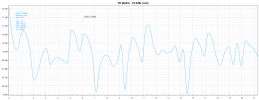
I will ABX them even though I know I will just be guessings. I doubt anyone can pass an ABX on those. -85dB RMS difference, -77.5 PK metric.

edit: also, since using the Level EQ improves the matching so much, can we conclude this ripple shows the main difference in the recordings? If @Josh83 thinks he might be able to hear passband ripple, then that could easily be tested in a much easier way than using the comparator box. Josh, would you be interested in doing that? You can respond in the AS thread if you wish. Also there is a long thread on AS about passband ripple and how it is the same as adding a minor pre and post echo (different than Gibbs phenomenon) into the track. Which some there said was audible. But I tried to test that myself and could not hear it, even though I artificially created a much larger echo than my own dac would have.

1786204592680.png
 
Last edited:
Probably yes. I had a positive result on these files. Please let me answer later, I am now sitting in a garden restaurant
:)
 
Probably yes. I had a positive result on these files. Please let me answer later, I am now sitting in a garden restaurant
:)
If you were able to pass ABX on that, maybe passband ripple (echo) is what Josh is very good at hearing. So maybe he could validate with tests isolating just that effect. This is an example of how @Josh83 providing recordings could have possibly led to finding a way to validate what he heard.
 
Passband ripple would be the only explanation, to me.
 
Last edited:
Back
Top Bottom