• Welcome to ASR. There are many reviews of audio hardware and expert members to help answer your questions. Click here to have your audio equipment measured for free!

DAC listening test files - updated with new filters files

If it had been a positive result, i.e. 27/32, we would have considered it statistically significant, but apparently either you have a real ability to identify and reverse the differences or we simply need to realize how, on a few attempts, luck can be a factor, both positively and negatively.
By my side, I would also consider luck doing the opposite (extreme, yes) if I couldn't say what was my tell.
Yes, general feeling can be a good guide sometimes, but we can't get anything out of it.
 
I will not disclose completely, but I'll give a strong hint.

file_1 against original data file:
View attachment 550002

file_2 (that is level matched and drift corrected) vs. uncorrected recorded file:
View attachment 550005

Level matching, drift correction:

Initial peak values Reference: -0.1dB Comparison: -0.007dB
Initial RMS values Reference: -13.578dB Comparison: -13.586dB

Final peak values Reference: -0.1dB Comparison: 0.01dB
Final RMS values Reference: -13.59dB Comparison: -13.581dB
Gain= -0.0169dB (0.9981x) DC=0 Phase offset=-0.00005ms (-0.005 samples)
Speaking just for myself, you are way overestimating my ability to use your disclosures to do better on the ABX!
 
I will not disclose completely, but I'll give a strong hint.

file_1 against original data file:
View attachment 550002
(please note it is bit perfect)

file_2 (that is level matched and drift corrected) vs. uncorrected recorded file:
View attachment 550005

Level matching, drift correction (and trim):

Initial peak values Reference: -0.1dB Comparison: -0.007dB
Initial RMS values Reference: -13.578dB Comparison: -13.586dB

Final peak values Reference: -0.1dB Comparison: 0.01dB
Final RMS values Reference: -13.59dB Comparison: -13.581dB
Gain= -0.0169dB (0.9981x) DC=0 Phase offset=-0.00005ms (-0.005 samples)
You're too fast for me , but looking at FR it's to wide for me, ... so clearly could not hear any difference.
Will attempt to motivate a member of next generation to test.
 
I will not disclose completely, but I'll give a strong hint.

file_1 against original data file:
View attachment 550002
(please note it is bit perfect)

file_2 (that is level matched and drift corrected) vs. uncorrected recorded file:
View attachment 550005

Level matching, drift correction (and trim):

Initial peak values Reference: -0.1dB Comparison: -0.007dB
Initial RMS values Reference: -13.578dB Comparison: -13.586dB

Final peak values Reference: -0.1dB Comparison: 0.01dB
Final RMS values Reference: -13.59dB Comparison: -13.581dB
Gain= -0.0169dB (0.9981x) DC=0 Phase offset=-0.00005ms (-0.005 samples)
So the first test was just one recording of a DAC compared to the original file. The phase delta looked good though. You have no HP filter in the ADC?
 
I will not disclose completely, but I'll give a strong hint.

file_1 against original data file:
View attachment 550002
(please note it is bit perfect)

file_2 (that is level matched and drift corrected) vs. uncorrected recorded file:
View attachment 550005

Level matching, drift correction (and trim):

Initial peak values Reference: -0.1dB Comparison: -0.007dB
Initial RMS values Reference: -13.578dB Comparison: -13.586dB

Final peak values Reference: -0.1dB Comparison: 0.01dB
Final RMS values Reference: -13.59dB Comparison: -13.581dB
Gain= -0.0169dB (0.9981x) DC=0 Phase offset=-0.00005ms (-0.005 samples)

I jump ship. This is not remotely possible to hear.
 
I jump ship. This is not remotely possible to hear.
Don't worry too much about the hint. Those graphs and statistics are not file_1 (file_1 being the original track) compared to file_2 (the recording), which do not null nearly as well when compared in DeltaWave. I think @pma will get to comparing two different DAC outputs on the next test.
 
The test (file_1 vs. file_2) is an original file 96/24 (shorted duration and bit perfect) vs. DAC/ADC path recorded in 96/24 format as well to E1DA Cosmos ADC. The recorded file is time aligned to the original file, level matched (in average rms level) and the clock drift is corrected in DeltaWave. Clock drift is in fact the only possible technical issue of the DAC/ADC path, but only for analysis reason. 96/24 format is chosen to avoid possible filter ringing in the audio band. If the files are time aligned, level is properly matched and DAC frequency response is reasonably flat in the audio band, then there is no audible difference. Of course I speak about DACs without evident design flaws like extra high nonlinear distortion. This test is to show that the DAC/ADC path is audibly transparent. DAC/ADC path audible non-transparency is the main argument of those who rely on sighted impressions exclusively and do not admit to deal with recorded test data.

I almost forgot to mention what is the biggest difference between the test files, in technical terms, regarding possible audibility and what to get concentrated on during listening. As Deltawave delta file shows, after you put the files into Deltawave, the “biggest” technical difference is at lowest frequencies. This is most probably due to very low Cosmos input impedance in combination with its input electrolytic coupling capacitors. The low input impedance may also play a game if the DAC has output coupling capacitors. The big question is if the lowest frequencies slight difference might be audible at all, take into account human ear insensitivity in this frequency region. So, we need more ABX results, and get concentrated on bass, the test files have plenty of it.
 
Last edited:
I'm DAC-deaf anyway (tried it a few times over the years) so attempting this would only lead to a different report number, Its like flipping coins IMO where one can get a range of results.
So instead of torturing myself yet again as I have done in the past (listening to differences that science says I could not possibly detect) I did that just for fun 4 years ago, results below.

I flipped a coin 16 times.
10x tails, 6x heads

Also threw dice 16x and counted odd/even and did this 4 times
1: 7 even, 9 odd
2: 9 even, 7 odd
3: 10 even, 6 odd
4:
12 even, 4 odd

When tails and even would be the same I would have had 48/80 and if I were to say 6 heads = even the result would be 44/80.
I reckon if I did that 10 more times I would get really close to 50% score.
A considerable contrast to just reporting a best attempt (4/16 or 12/16) of which some would say is possibly a noticeable difference (was just dice).
 
Last edited:
Yeah, that’s it. Same or similar here with random check. That’s statistics and randomness. One times 9/10 is nothing. One times 12/16 is also not enough. So it goes, but we need at least some criterion, though it is painful to pass. And in fact, possible tiny differences are absolutely pointless during normal listening. So we are where we were before, Audio is Belief.
 
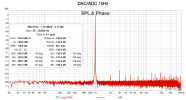
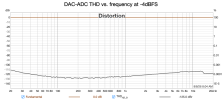
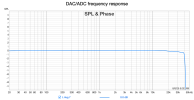
DAC/ADC path measurements


DAC-ADC_1kHz.png DAC-ADC_thdfreq.png DAC-ADC_FR.png
 
I installed Foobar + ABX on my mac and tried the ABX via the 3.5mm output and my DT-880.
Failed a few times.
I'm waiting for a new cable for my Sennheisers, so I can connect them via 4.4mm balanced to the Fiio K11.
Then, I will of course ace the tests :)
 
Yeah, that’s it. Same or similar here with random check. That’s statistics and randomness. One times 9/10 is nothing. One times 12/16 is also not enough. So it goes, but we need at least some criterion, though it is painful to pass. And in fact, possible tiny differences are absolutely pointless during normal listening. So we are where we were before, Audio is Belief.

That begs the question where Josh's results came from.
The way I see it is either actual audible differences between, just barely, different enough DACs + many training rounds with pieces of music that could make those differences detectable for just under middle aged trained man, or some not accounted for tell or (hopefully not) dishonesty, as there is no way to check for that and all attempts made by ASR to ask for 'proof' (recordings, valuable measurements) were not obliged.
 
@Josh83 : 8/10 is statistically irrelevant, if it is the single run. 8/10 you easily get by random clicking at A or B buttons. 10 trials is not enough. You would need to get it three times in a row and not to discard worse results. Cherry picking is not allowed.
—————
Edit: From our DM I see that you understood my message as accusation. No. The main meaning is that a single 8/10 is not enough statistically valid for the reason of possible randomness and should be repeated to be meaningful. The note about cherry picking is not an accusation, it is to tell readers in general that cherry picking is not allowed in these tests. People often do not know.
 
Last edited:
@Josh83 : 8/10 is statistically irrelevant, if it is the single run. 8/10 you easily get by random clicking at A or B buttons. 10 trials is not enough. You would need to get it three times in a row and not to discard worse results. Cherry picking is not allowed.

Example better than hundreds of explanations: Almost perfect result, hoorah, or rather not? :)The answer is no.

Code:
foo_abx 2.1 report
foobar2000 v2.0
2026-08-08 10:19:45

File A: file_1.wav
SHA1: 21b718084cbefae84cc1723ec49976b3c9ffa9ee
File B: file_2.wav
SHA1: 53949d842b273ee3b08edcc880344359b6e6ad50

Output:
ASIO : Focusrite USB ASIO
Crossfading: NO

10:19:45 : Test started.
10:20:26 : 01/01
10:20:40 : 02/02
10:21:19 : 03/03
10:21:33 : 04/04
10:21:46 : 05/05
10:22:00 : 06/06
10:22:14 : 06/07
10:22:29 : 07/08
10:22:44 : 08/09
10:22:58 : 09/10
10:22:58 : Test finished.

 ----------
Total: 9/10
p-value: 0.0107 (1.07%)

 -- signature --
e25daaa470c6d4f2dbd66313982523f7c7f0a3bd

And so what?? I got 9/10, p = 0.0107, by listening. But I am hiding that I had about three unsuccessful test runs before. And they all have to be taken into account. This is a random result based on not enough trials during the test.
 
Tried but gave up. No difference.
 
At the moment I prefer to keep everything undisclosed, because any disclosure leads to prejudice and preliminary judgements. In case we collect some feedback and listening test results, I will definitely disclose the test conditions.

The complete Deltawave test report is attached as a pdf below.
file_1.wav is an original data file
file_2.wav is a record from Topping DX5 XLR outputs to E1DA Cosmos ADC.
REW measurements of the DAC/ADC path shown in this post.
 

Attachments

The complete Deltawave test report is attached as a pdf below.
file_1.wav is an original data file
file_2.wav is a record from Topping DX5 XLR outputs to E1DA Cosmos ADC.
REW measurements of the DAC/ADC path shown in this post.
Group delay in bass?
 
Back
Top Bottom