• Welcome to ASR. There are many reviews of audio hardware and expert members to help answer your questions. Click here to have your audio equipment measured for free!

DAC listening test files - updated with new filters files

What equipment did you use for your latest ABX test?

EDIT: Maybe we should make a habit out of posting that info with every ABX result. I didn't do it before, either. But it can't hurt.
I would say it not anything fancy so I would not swear of it. It is the intrinsic headphone output of my MacBook Pro M5 and my usual headphone DT150 with DT100 pads. I know older computer headphone outputs have been too poor due to IM, and I did pass tests with those in the past due to the IM distorsion. But I think the macs are quite good nowadays regarding quality. I set the sampling rate at 96 kHz, 24 bit, in the midi setting. My own "natural ear" measurements of the DT150 was limited to 20 kHz, but I guess there is some energy left past 20 kHz.

DT150.png
 
Absolutely. There is a huge space for HW/SW mistakes. There must be no resampling, no sample rate converters, and ASIO or Wasapi Exclusive should be used. No OS file manipulation.
For the record, some of my previous ABX posted in this thread did use SRC in the path because that is the normal setting for my dac/headphone amp. I will bypass that from now on.
 
p = 0.0035, passed easily
Yes, but with a lower success rate than would be needed to claim the difference was clear or obvious. That's part of the reason I asked about the 'tell' - it may be something that's clear (so nearly 100%) once you know what you're listening for, rather like trained listeners being able to identify things most untrained people can't. Equally it could be something that's audible (hence easy pass), but not clearly so, and the second run was just luckier than the first.
 
Yes, but with a lower success rate than would be needed to claim the difference was clear or obvious. That's part of the reason I asked about the 'tell' - it may be something that's clear (so nearly 100%) once you know what you're listening for, rather like trained listeners being able to identify things most untrained people can't. Equally it could be something that's audible (hence easy pass), but not clearly so, and the second run was just luckier than the first.
The tell is a very slight brighter hit of the first cymbals in the beginning. Very short clip was used. So i got 10/16, 10/16 and 14/16 in a row. Nothing before, after or inbetween.
 
Yes, but with a lower success rate than would be needed to claim the difference was clear or obvious. That's part of the reason I asked about the 'tell' - it may be something that's clear (so nearly 100%) once you know what you're listening for, rather like trained listeners being able to identify things most untrained people can't. Equally it could be something that's audible (hence easy pass), but not clearly so, and the second run was just luckier than the first.
Clear and obvious is a fuzzy line. But I really think the success rate to shoot for should be something like 38/48 (p=0.00003), or similar a p value with more than 48 tests. But this suggestion hasn't been very well received because of the extremely low p value. But is 38/48 really that hard if you are sure you can hear something?
 
A brickwall at 14, 16, 18 kHz could be useful to test.
 
The tell is a very slight brighter hit of the first cymbals in the beginning. Very short clip was used. So i got 10/16, 10/16 and 14/16 in a row. Nothing before, after or inbetween.
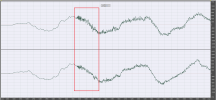
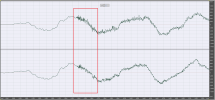
This area, right? Shows both the filter delay and HF reduced amplitude.

dchesorig1.png dchesF4.png
 
This area, right? Shows both the filter delay and HF reduced amplitude.

View attachment 558046 View attachment 558045
Could be, but I can’t say for sure since I have not looked at the files Not home right now but it could be good to test incremental increase in brickwall 14-16-18 to get statistics on how easy it is. Logically statistics will follow a pattern ”easy to hard”. If not we can probably forget the results above.
 
A brickwall at 14, 16, 18 kHz could be useful to test.
I have some problems with usefulness of the brickwall filters. When we go down below 20kHz, like the above proposed sequence, we may not be sure if we evaluate the limited bandwidth effect or the effect of their nasty time domain response on music transients .
 
I have some problems with usefulness of the brickwall filters. When we go down below 20kHz, like the above proposed sequence, we may not be sure if we evaluate the limited bandwidth effect or the effect of their nasty time domain response on music transients .
Understand. The Butterworth filters could be ok but they also reduce the difference. 12-14-16-18?
 
Last edited:
@pma I'll pick up the original. I have some ideas for FIR filters that might be interesting. Classical cheby or ellip are what the very first players used. Then some higher ripple (due to length) FIR equiripples came into play, and some of them might be interesting or not, I don't know.

I'll try to pick up the original over the weekend. Can you PM how to get in touch via email, maybe?

Yes, of course. And I will send info about the filters used.
 
Yes, of course. And I will send info about the filters used.
Just a note regarding brickwall 14-16-18. Purpose of the test is validating regardless of mechanism. It should be harder as it goes up. If no correlation to that it is not supporting my previous result of 34/48 at 20k.
 
Yes, of course. And I will send info about the filters used.
I sent you rather a lengthy email reply. One thing we can also explore is brickwall FIR at various frequencies vs. much slower slope FIR's with the same passband and same final rejection.
 
I sent you rather a lengthy email reply. One thing we can also explore is brickwall FIR at various frequencies vs. much slower slope FIR's with the same passband and same final rejection.
Email received and reply sent, hope it will reach you safely.
 
You don't need a high success rate if you have a large number of samples.
It depends what your purpose is. With enough samples you can show that statistically a 55% success rate is unlikely to be pure luck, so demonstrating some small degree of audibility. That may be useful from an academic viewpoint. As a guide for a purchasing decision, being able to tell which is which only slightly more reliably than a coin toss when listening intently under ideal conditions means that for everyday use the difference is effectively inaudible.
 
It depends what your purpose is. With enough samples you can show that statistically a 55% success rate is unlikely to be pure luck, so demonstrating some small degree of audibility. That may be useful from an academic viewpoint. As a guide for a purchasing decision, being able to tell which is which only slightly more reliably than a coin toss when listening intently under ideal conditions means that for everyday use the difference is effectively inaudible.

Perhaps knowing that probability would help consumers, however. One also must allow for defective equipment that makes errors more obvious, I must also point out.
 
Back
Top Bottom