I'm unsure "people" are saying this, rather pointing out that there is a gap in the published empirical data, and also pointing out that different nuclei process different modalities e.g. tone vs location. BAER was raised as an objective test. No audibility claims were ever made.Do I understand that the two fastest Tr in the study are 10 us and 500us? And then people are wanting to use this to say we can detect rise times as fast as 10us, instead of concluding we can detect rise times faster than 500us?

-
Welcome to ASR. There are many reviews of audio hardware and expert members to help answer your questions. Click here to have your audio equipment measured for free!
You are using an out of date browser. It may not display this or other websites correctly.
You should upgrade or use an alternative browser.
You should upgrade or use an alternative browser.
DAC listening test files - updated with new filters files
- Thread starter pma
- Start date
It seemed that some thinking on AS is that a takeaway from the study is that audio testing should expand the band of interest beyond 20Hz to 20000 Hz. Instead of investigating whether rise times anywhere close to 10us matter.I'm unsure "people" are saying this, rather pointing out that there is a gap in the published empirical data, and also pointing out that different nuclei process different modalities e.g. tone vs location. BAER was raised as an objective test. No audibility claims were ever made.
There is a danger in assuming a study is comprehensive and conclusive. The paper is old, that said lots of people quote old papers as gospel. When measuring things (not audio per se) I prefer to have 5x resolution but that's not always possible. Newer equipment makes higher resolution measurements more straightforward. These threads get contentious when people drop the "possibly". This was sparked by looking at areas where things might not be ideally measured. The mantra is that testing is limited to 20-20k and thats not true either.It seemed that some thinking on AS is that a takeaway from the study is that audio testing should expand the band of interest beyond 20Hz to 20000 Hz. Instead of investigating whether rise times anywhere close to 10us matter.
I guess what I meant to say, and what I thought you were saying also about lack of time grained time steps:There is a danger in assuming a study is comprehensive and conclusive. The paper is old, that said lots of people quote old papers as gospel. When measuring things (not audio per se) I prefer to have 5x resolution but that's not always possible. Newer equipment makes higher resolution measurements more straightforward. These threads get contentious when people drop the "possibly". This was sparked by looking at areas where things might not be ideally measured. The mantra is that testing is limited to 20-20k and thats not true either.
If the fastest Tr in the test is 10us, the next fastest is 500us, and 20KHz gives in between these, then the test doesn't say anything about whether 20KHz bandwidth is good enough. I don't understand why it was brought up for discussion.
OP

- Thread Starter
- #465
If the fastest Tr in the test is 10us, the next fastest is 500us, and 20KHz gives in between these, then the test doesn't say anything about whether 20KHz bandwidth is good enough. I don't understand why it was brought up for discussion.
Exactly. It seems that Tr = 10us (should be specified more exactly what they meant in fact) is the best what they had, the intrinsic system response. Then they added “something” (RC filter?) to get long Tr. Must be noted that Tr = 500us would affect amplitude and phase shift of the 1kHz wave as well. Instrumentation possibilities in 1978 were not great to create sophisticated test signals. Such test, if performed as seems to be, could not tell anything about 20kHz BW limit audibility on transients.
exactly … perhaps it was brought up for discussion because it’s an objective test who’s results haven’t been fine tunedI guess what I meant to say, and what I thought you were saying also about lack of time grained time steps:
If the fastest Tr in the test is 10us, the next fastest is 500us, and 20KHz gives in between these, then the test doesn't say anything about whether 20KHz bandwidth is good enough. I don't understand why it was brought up for discussion.
Last edited:
OP
- Thread Starter
- #467
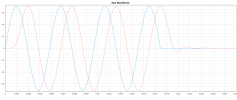
BTW, we can prepare testing sine bursts, started at zero, passing through a known rise time LPF, more than well. Below is an example, the system rise time is only 3.5us (100kHz BW), bursts with center frequency 2kHz. It is recorded from a DAC + headphone amp. It is no problem to prepare almost anything. But there are 2 questions -
Anyway it is much more than a mere discussion and debate.
- can the user replay it properly, at Fs = 384kHz
- does it make any sense, is it worth time spared, what would we get
Anyway it is much more than a mere discussion and debate.
Attachments
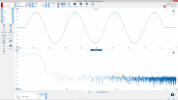
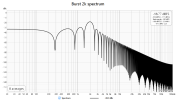
My DAC and headphone amp should more or less make the voltage waveform, but what would I use to make a sound with that rise time?BTW, we can prepare testing sine bursts, started at zero, passing through a known rise time LPF, more than well. Below is an example, the system rise time is only 3.5us (100kHz BW), bursts with center frequency 2kHz. It is recorded from a DAC + headphone amp. It is no problem to prepare almost anything. But there are 2 questions -
- can the user replay it properly, at Fs = 384kHz
- does it make any sense, is it worth time spared, what would we get
Anyway it is much more than a mere discussion and debate.
OP
- Thread Starter
- #469
what would I use to make a sound with that rise time?
- make sure your system can create requested shortest rise time, you need to feed the DAC with a step (= square wave of base frequency 100Hz - 1kHz and you will zoom to rising edge only). You will need an oscilloscope to check the rising edge shape and duration.
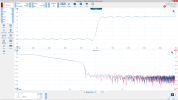 . Or something like Cosmos ADC operating at least at Fs = 384kHz. This will tell you the DAC (+amp) system limit.
- download the burst I created with 384kHz Fs, attached below as a zip.
- put the RC LPF behind the DAC or headphone amp. Calculate LPF Fc(-3dB) frequency as Fc = 1/(2piRC). Rise time of such circuit is Tr = 0.35/Fc. R has to be at least 5x higher than the Zout of the DAC or headphone amp.
- You may prepare several RC LPF circuits with various Tr.
- You might also downsample my file from 384kHz to 48kHz (i.e. 8x) to get rise time about 20us (if you do not want to build analog LPF) but you will insert pre-ringing then
Attachments
Last edited:
I think I misunderstood your purpose for posting the burst. It was not for listening?It is quite a lot of real work guys, not only a mere debate.
- make sure your system can create requested shortest rise time, you need to feed the DAC with a step (= square wave of base frequency 100Hz - 1kHz and you will zoom to rising edge only). You will need an oscilloscope to check the rising edge shape and duration. View attachment 557241. Or something like Cosmos ADC operating at least at Fs = 384kHz. This will tell you the DAC (+amp) system limit.
- download the burst I created with 384kHz Fs, attached below as a zip.
- put the RC LPF behind the DAC or headphone amp. Calculate LPF Fc(-3dB) frequency as Fc = 1/(2piRC). Rise time of such circuit is Tr = 0.35/Fc. R has to be at least 5x higher than the Zout of the DAC or headphone amp.
- You may prepare several RC LPF circuits with various Tr.
- You might also downsample my file from 384kHz to 48kHz (i.e. 8x) to get rise time about 20us (if you do not want to build analog LPF) but you will insert pre-ringing then
OP
- Thread Starter
- #471
I thought that the method discussed at AS used bursts. I think I’ll take a break from ASR for a while. It is only a lot of work and time spent without any impact.
Attached are bursts in 384/24, full speed (Tr 2.6 us approx) and 5kHz 6-order Bessel LPF (no pre-ringing) limited (rise time about 70us). Time for DBT abx.
Attached are bursts in 384/24, full speed (Tr 2.6 us approx) and 5kHz 6-order Bessel LPF (no pre-ringing) limited (rise time about 70us). Time for DBT abx.
Attachments
Last edited:
Yes it is, appreciated. We currently have no idea what different rise times cause in the brain, i.e. it is not thought to correlate with a tone and may not have a traditionally audible correlate, rather, for example, may effect sound localization in space. I say this because of how bats use clicks. It might be that a faster rise time results in a more precise 3D localization of e.g. a cymbal. While that might allow a human to distinguish DAC A from DAC B (position in space) testing whether this is the case does involve some thought and real work.It is quite a lot of real work guys, not only a mere debate.
OP
OP
- Thread Starter
- #474
AFAIK we know quite enough about minimum detectable ITD (between the channels). Depending on test signal sample, it seems to be somewhere just below 10us (some say even 2us). Not sure about one channel Tr, if it is not too high to affect the spectrum as a LPF. We have 2 mechanisms of (ear) hearing, right. ITD sensitivity seems to be highest between 600Hz and1kHz, and more sensitivity for band limited noise in this 600Hz - 1kHz range than for pure tones.It might be that a faster rise time results in a more precise 3D localization of e.g. a cymbal.
and working out the necessary sampling frequency for a click with a rise time of 10 us might give (I say might give because assumptions) a necessary bandwidth of 500kHz (that's for 2 us ITD) ... well no one knows what the minimum rise time detectable might be but you can see how the necessary bandwidth to capture this can easily go to 35kHz->70kHz->500kHz ... see 44-48kHz works for sine waves, but when the rise time of a square wave itself embedded in a complex signal is considered then these numbers aren't necessarily accurate, and I am saying absolutely nothing about what frequencies we can hear as tones. Of course now that sampling at 768kHz is more readily available these questions might be answered.AFAIK we know quite enough about minimum detectable ITD (between the channels). Depending on test signal sample, it seems to be somewhere just below 10us (some say even 2us). Not sure about one channel Tr, if it is not too high to affect the spectrum as a LPF. We have 2 mechanisms of (ear) hearing, right. ITD sensitivity seems to be highest between 600Hz and1kHz, and more sensitivity for band limited noise in this 600Hz - 1kHz range than for pure tones.

RandomEar
Major Contributor
- Joined
- Feb 14, 2022
- Messages
- 1,459
- Likes
- 3,851
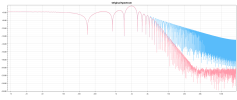
I would guess that a good first assumption would be that it is equivalent to the steepest gradient in a 20 kHz sine wave (or maybe 15 kHz, for the older members amongst uswell no one knows what the minimum rise time detectable might be
 ). If you assume your signal goes from -1 to 1 and constantly follows that maximum gradient, it should take around 16 µs for the transition (using 20 kHz). Is there any evidence that this general limit was surpassed by a human?
EDIT: It doesn't really make sense to define a rise time anyway, right? Because the gradient is the relevant measure.
EDIT 2: Converted the example to a full scale signal in the digital domain.
Last edited:
OP
- Thread Starter
- #477
and working out the necessary sampling frequency for a click with a rise time of 10 us might give (I say might give because assumptions) a necessary bandwidth of 500kHz (that's for 2 us ITD) ..
Oh no, this is a usual misunderstanding how sampling and reconstruction works. Tr = 10us has Fc = 35kHz approx. I have explained a relation between Tr and Fc in this post. You get Tr = 10us approx. with 96kHz sampling rate.
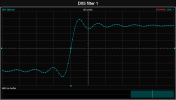
With 384 kHz sampling and proper reconstruction linear phase filter, you get rise time about 2.5us
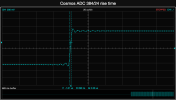
Even if a headphone amp with its Tr about 2us is added behind the Topping D10s DAC, the combination has Tr = 3.5us with Fs = 384kHz.
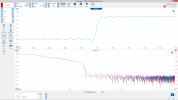
So no need for extravagant sampling frequencies. And please do not forget that all of these fast transients vanish when the real electro-acoustical transducer output is to be examined.
Now for ITD DAC sampling requirements. You do not listen to individual samples, but to a reconstructed signal. Analog output signal is reconstructed from digital samples by means of a digital oversampling reconstruction filter + analog low order LPF. To get 2us between L and R channels, you do not need 500kHz sampling at all. Sub-sample duration shift is possible due to reconstruction process and you can get it even with 48kHz sampling. @j_j has explained it many times, for example in this post. An assumption that 44.1kHz sampling can distinguish no better than 22us ITD is an audiophile myth. Myths like this prevent me from registering at AS, I could not stand similar reasoning.
Last edited:
Sorry for my imprecise language. I accept your point: a 2 μs ITD does not require 500 kHz sampling -- that was an offhand number. I conflated the delay between channels with the bandwidth needed to preserve the click’s shape.Oh no, this is a usual misunderstanding how sampling and reconstruction works. Tr = 10us has Fc = 35kHz approx. I have explained a relation between Tr and Fc in this post. You get Tr = 10us approx. with 96kHz sampling rate.
What I meant to discuss was rise time and ITD together. Approximately 10 μs rise time is achievable at 96 kHz; approximately 2 μs at 384 kHz might be achievable, depending on the filters and the rest of the signal chain. Those are not exact.
My conjecture is that changing a click’s rise time might affect its localization amid ambient sound. Your ITD argument explains why sub-sample delays survive reconstruction, but does not by itself settle whether changing the waveform’s bandwidth affects localization.
The study, as discussed here, doesn’t establish the relevant threshold nor whether a brainstem-response translates into audible spatial difference. Repeating it with finer rise-time increments, calibrated acoustic output, and a localization task would be interesting but not so easy to do unless you are an audiologist with time on her hands.
Any connection to audible differences between DACs is separate. I was conjecturing that the reported differences in cymbals might relate to this -- in the end I have no idea
Last edited:
OP
- Thread Starter
- #479
@welwynnick :
Did you adjust level? Square and sine have different rms value and different base frequency amplitude. Second, transducer intermodulation was checked? The last but not least is ear intermodulation, that can explain a lot of possible wide BW signal discernibility.
That was what I did. I could hear the difference between 7kHz sine and square waves.
If the 20-20k paradigm was correct, it should have been impossible to hear the difference.
Did you adjust level? Square and sine have different rms value and different base frequency amplitude. Second, transducer intermodulation was checked? The last but not least is ear intermodulation, that can explain a lot of possible wide BW signal discernibility.
welwynnick
Major Contributor
- Joined
- Dec 26, 2023
- Messages
- 1,508
- Likes
- 1,920
That was intentionally posted on AS, not ASR. It's already been discussed here.@welwynnick :
Did you adjust level? Square and sine have different rms value and different base frequency amplitude. Second, transducer intermodulation was checked? The last but not least is ear intermodulation, that can explain a lot of possible wide BW signal discernibility.
Similar threads
- Replies
- 6
- Views
- 442

- Replies
- 63
- Views
- 5K
- Replies
- 11
- Views
- 1K
- Replies
- 3
- Views
- 531
- Replies
- 14
- Views
- 1K