• Welcome to ASR. There are many reviews of audio hardware and expert members to help answer your questions. Click here to have your audio equipment measured for free!

DAC listening test files - updated with new filters files

The video seems to deal with intersample overs, which has been broadly discussed at ASR


and is not difficult to test. Sorry I viewed only about one minute of the video, I hate to lose my time watching audio related videos.
 
It should be understood that in this post the step response of the DAC operating at 96/24 is sampled by ADC at 384/24, so density of the ADC samples is 4x higher than that of the DAC samples and the eventual IS overs appears non-existent. But IS overs issue would be a DAC issue here, if it was the case.
 
EDIT: Incidentally, a good ADC like the E1DA, with a suitably high sample rate, ought to be able to capture those sorts of DAC differences.

Really? So, will the Cosmos ADC in 384/24 mode, with rise time of 2.30 us, be good enough to catch those DAC nuances that audiophile ears easily discern? I am curious to learn about speakers that would deliver this to our ears and how such signals would find the path to our eardrum, and, last but not least, suggestion of music with such signals. (BTW the source rise time in my measurements below is 8 nanoseconds).

Cosmos step 384-24.png


Cosmos risetime 384-24.png


Cosmos 50kHz sine 384-24.png


Cosmos ADC 155kHz sine
Cosmos 155kHz sine FFT.png
 
Last edited:
Step responses of Topping DX5 DAC in 96/24 format with its 3 filters. Please note that the "Minimum phase filter 2" (no pre-ringing) has the longest (slowest) rise time Tr(10% - 90%) of the step response. Filter 3 is "something in between" minimum and linear phase. Filter 1 is a linear phase filter and the right choice. So what? In case of 96kHz and higher sampling, it is still the pass band behaviour (ripple) that counts. Those ultrasound nuances are inaudible and cannot be initiated by music signal to have enough energy to become potentially audible.

DX5 filter 1 step.png


DX5 filter 2 step.png


DX5 filter 3 step.png
 
I think we are in violent agreement.
Just a note, you cannot ask if “10 us rise time is audible”. Remember that a single impulse with duration approaching to zero has infinite bandwidth. Depending on its energy (amplitude) it is easily audible. A rectangular impulse of 10us width has almost uniform spectrum from 0Hz to 100kHz. So it is easily audible, depending on its amplitude. A step with 10us rise time has again wide spectrum from 0Hz, though decaying with frequency. You can ask if someone hears a difference between a step with 10us vs. 12us rise time or such step with ringing or not. If they say yes, give them an abx test with such signals.
 
Just a note, you cannot ask if “10 us rise time is audible”. Remember that a single impulse with duration approaching to zero has infinite bandwidth. Depending on its energy (amplitude) it is easily audible. A rectangular impulse of 10us width has almost uniform spectrum from 0Hz to 100kHz. So it is easily audible, depending on its amplitude. A step with 10us rise time has again wide spectrum from 0Hz, though decaying with frequency. You can ask if someone hears a difference between a step with 10us vs. 12us rise time or such step with ringing or not. If they say yes, give them an abx test with such signals.
I asked whether 10us rise times could be distinguished.
There seemed to be some sort of assumption that was the case, but I have some doubt.
I try to keep my posts short, but perhaps I should be more explicit.
 
Last edited:
Any other rise time.
Try it. Below you have repeating impulses of the same width, rise and fall time 10us in one file and 20us in the other one. You need to be able to play Fs 384kHz files. ABX please. You may share the files at AS, if you like.
 

Attachments

I think we are talking at cross-purposes. I was suggesting (badly!) that it wasn't possible to hear the difference between 10µs and 20µs rise times, rather than the other way round. This was a discussion for AS, not ASR, where there could have been no doubt. I was gently trying to steer them in what I thought would be the right direction without being hostile or disrespectful. I should have thought twice, as I have other things to do and both threads don't seem to be going anywhere until Amir posts his AVA ABX test results, so I'm going to drop out for a while. regards, Nick
 
Below you have repeating impulses of the same width, rise and fall time 10us in one file and 20us in the other one.
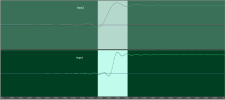
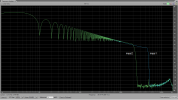
This is the rise time comparison and spectrum comparison of those impulses. 1 sample = 2.6 us.

imps1+2.png imps1+2_spectrum_.png
 
Last edited:
This is the rise time comparison and spectrum comparison of those impulses. 1 sample = 2.6 us.

View attachment 557062 View attachment 557064
Before folks go off on a tangent, the 10 microsecond rise time came from an older paper studying BAER in an effort to perform quantitative measurements of human auditory response. One wouldn’t repeat that with listening tests, rather BAER and although the paper is suggestive, you’d need to do more fine grained rise time steps before concluding that the human auditory system can actually respond to a signal effectively 30kHz
 
Before folks go off on a tangent, the 10 microsecond rise time came from an older paper studying BAER in an effort to perform quantitative measurements of human auditory response. One wouldn’t repeat that with listening tests, rather BAER and although the paper is suggestive, you’d need to do more fine grained rise time steps before concluding that the human auditory system can actually respond to a signal effectively 30kHz
Excuse me, "fine grained rise time steps" means what? And beware of simple relations between rise time and bandwidth (or spectrum range). It s true that there is a simple relation between Tr(10%-90%) and F(-3dB) cut off frequency of a 1st order low pass filter and it is

Tr = 0.35/F(-3dB), or F(-3dB) = 0.35/Tr. This makes F(-3dB) = 35kHz for Tr = 10us. The formula is not empirical, it comes from single-exponential step response of the RC filter with Tau = RC, where V = Vo[1 - exp(-t/Tau)]. Calculated for 10% and 90% time difference we get the Tr. And also frequency F(-3dB) = 1/2piTau.

This simple formula Tr = 0.35/Fc works quite well even for more complex transfer function than that of the 1st order filter.
But we cannot narrow down possible or impossible audibility to a mere test signal rise time parameter. It would strongly depend on distribution of energy vs. frequency in the test signal. For this reason I would appreciate if you could post a link to that BAER paper.

The test signals I posted, with rise time (and the same fall time) 10us and 20us, are 10ms wide rectangular impulses (thus 100Hz comb effect in the spectrum) with 1s repetition. Spectrum up to 48kHz in one case and 24kHz for the other one. I doubt there would be anyone to hear a difference.
 
Last edited:
For this reason I would appreciate if you could post a link to that BAER paper.
It's this one:
Effects of signal rise time and frequency on the brainstem auditory evoked response

Two experiments studied the effects of signal rise time and frequency on the brainstem auditory evoked response. In Experiment 1, five different rise times were presented, fast (10 microseconds), 0.5, 1, 2.5, and 5 msec at a center frequency of 1000 Hz at three sensation levels, 20, 40, and 60 dB. As rise time was increased, response amplitude and detectability decreased and response latency increased. In Experiment 2, tonal pips were presented at 250, 500, 1000, 2000, 4000, and 8000 Hz at 40-dB sensation level. Although the effects of frequency and signal rise time were confounded, no frequency effect was apparent.
Apparently that "fast (10 microseconds)" is suggestive, but for the life of me I don't know why it would be.
 
It's this one:

Apparently that "fast (10 microseconds)" is suggestive, but for the life of me I don't know why it would be.

Thank you, however I do not seem to be interested in paying $15 for a 1978 paper with this abstract:

Abstract​

Two experiments studied the effects of signal rise time and frequency on the brainstem auditory evoked response. In Experiment 1, five different rise times were presented, fast (10 µsec), 0.5, 1, 2.5, and 5 msec at a center frequency of 1000 Hz at three sensation levels, 20, 40, and 60 dB. As rise time was increased, response amplitude and detectability decreased and response latency increased. In Experiment 2, tonal pips were presented at 250, 500, 1000, 2000, 4000, and 8000 Hz at 40-dB sensation level. Although the effects of frequency and signal rise time were confounded, no frequency effect was apparent.

10us, 0.5ms (=500us), 1ms, 2.5ms and 5ms?? On a 1000Hz wave probably started from zero through a LPF with Fc corresponding to listed "rise times"? I guess it was (must have been) audible, but what would a huge jump between Tr = 10us and Tr = 500us, thus LPF with Fc = 35kHz and Fc = 700Hz, tell about audibility threshold stated as Tr = 10us??
 
Excuse me, "fine grained rise time steps" means what? And beware of simple relations between rise time and bandwidth (or spectrum range). It s true that there is a simple relation between Tr(10%-90%) and F(-3dB) cut off frequency of a 1st order low pass filter and it is...
You had time to give a detailed discussion so silly me assuming you had read the quoted paper:


The paper doesn't discuss audibility at all.

Apropos (this was also quoted):


Now "fine grained rise time steps" means that 1 microsecond vs 2 microseconds, 10 microseconds etc wasn't tested so really we don't know what bandwidth would be needed to capture the rise time steps that the brainstem responds to/can differentiate.

You went off on a tangent about audibility.
 
Now "fine grained rise time steps" means that 1 microsecond vs 2 microseconds, 10 microseconds etc wasn't tested so really we don't know what bandwidth would be needed to capture the rise time steps that the brainstem responds to/can differentiate.
Do I understand that the two fastest Tr in the study are 10 us and 500us? And then people are wanting to use this to say we can detect rise times as fast as 10us, instead of concluding we can detect rise times faster than 500us?
 
Back
Top Bottom