Would a sound recording of transformer hum look like that?

-
Welcome to ASR. There are many reviews of audio hardware and expert members to help answer your questions. Click here to have your audio equipment measured for free!
You are using an out of date browser. It may not display this or other websites correctly.
You should upgrade or use an alternative browser.
You should upgrade or use an alternative browser.
DAC listening test files - updated with new filters files
- Thread starter pma
- Start date

solderdude
Grand Contributor
G3 note of some instrument ?
OP

- Thread Starter
- #423
Bingo! You are the best! (as always). Electrical guitar G-string.G3 note of some instrument ?
Last edited:
OP
- Thread Starter
- #424
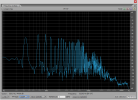
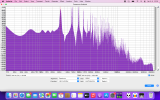
Little more deep view into electric guitar spectrum and transients. Yes, it is related to the debate about necessary system bandwidth and "rise time". Several shots of el guitar string and chord strikes are attached below. The guitar pickup is loaded with low capacitance cable and load impedance of 1MOhm. Sampling frequencies during recording are from 192kHz (ADC) up to 3.13MHz (scope). Both time domain and spectra are shown. The spectral content that might have some importance ends at about 30kHz. This would correspond to rise time about 12us. So, the 96kHz sampling would be enough for good fidelity of signal capture, not speaking about limitations of human hearing and electro-acoustic transducers.
Attachments
-
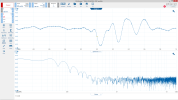 El_Guitar_1.png122.2 KB · Views: 50
-
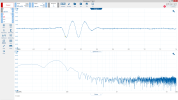 El_Guitar_2.png119.4 KB · Views: 45
-
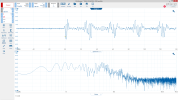 El_Guitar_3.png136.4 KB · Views: 45
-
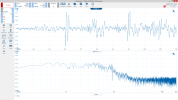 El_Guitar_4.png143.5 KB · Views: 49
-
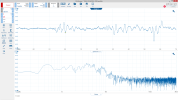 El_Guitar_5.png127.2 KB · Views: 41
-
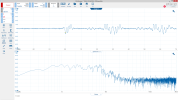 El_Guitar_6.png123.1 KB · Views: 45
-
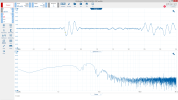 El_Guitar_7.png123.9 KB · Views: 46
-
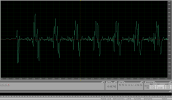 El_Guitar_9.png85.5 KB · Views: 52
-
 El_Guitar_8.png62 KB · Views: 48
-
 Screen Shot 2026-09-05 at 10.26.18.png2.3 MB · Views: 50

morillon
Major Contributor
- Joined
- Apr 19, 2022
- Messages
- 2,368
- Likes
- 632
The headroom required for transients at 96kHz/24-bit—with a bandwidth of around 30kHz—has been understood since the 1990s and early 2000s.
However, regarding the signal chain upstream of the chips: if you factor this in, the bandwidth limitations (and other constraints) of many microphones and their preamp stages also enter the final equation.
;-)
For anyone who doesn't very frequently experience live acoustic music etc, these remain tricky matters to grasp.
Last edited:
OP
- Thread Starter
- #426
We all know that. But it does not prevent audiophiles of speculating about not enough bandwidth, Fs need 768kHz or more, though the only benefit are complications.The headroom required for transients at 96kHz/24-bit—with a bandwidth of around 30kHz—has been understood since the 1990s and early 2000s.
Here.
morillon
Major Contributor
- Joined
- Apr 19, 2022
- Messages
- 2,368
- Likes
- 632
(That said, it really is a genuine issue when it comes to transducers... and the advantage often highlighted regarding ESL technology... for those who listen to a lot of highly acoustic music ;-) )We all know that. But it does not prevent audiophiles of speculating about not enough bandwidth, Fs need 768kHz or more, though the only benefit are complications.
Here.
transients , at the very end of all the reproduction chain, are among the elements most obviously "compromised."
OP
- Thread Starter
- #428
(That said, it really is a genuine issue when it comes to transducers... and the advantage often highlighted regarding ESL technology... for those who listen to a lot of highly acoustic music ;-) )
transients , at the very end of all the reproduction chain, are among the elements most obviously "compromised."
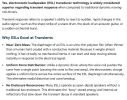
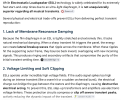
So, you seem to agree with the below AI - generated nonsense:
... and, depending how you ask, you get contradictory content:
But enough, there is a whole thread about it here at ASR.
Attachments
morillon
Major Contributor
- Joined
- Apr 19, 2022
- Messages
- 2,368
- Likes
- 632
Probably , in partSo, you seem to agree with the below AI - generated nonsense:

Hihi
Last edited:
welwynnick
Major Contributor
- Joined
- Dec 26, 2023
- Messages
- 1,498
- Likes
- 1,900
I'm a great fan of electrostatics, and believed all that until a few years ago. Most people do. Now I believe all that is complete rubbish, but very important anyway. I'm on holiday and will explain shortly.So, you seem to agree with the below AI - generated nonsense:
... and, depending how you ask, you get contradictory content:
But enough, there is a whole thread about it here at ASR.
EDIT: I used to work in a high end HiFi shop, and got play with lots of great gear. A kid in a sweet shop.
The only speakers that impressed me were Audiostatic ES200. I assumed they were good because of the light diaphragms etc. Since then I collected many 'stats.
I became the (subjective) retained amplifier reviewer for AVForums, and the differences between amps were mostly easy to spot with the better 'stats. It felt like cheating.
Going back to moving coil speakers always made those differences much more elusive and hard to spot, so 'stats were always king for me.
I tolerated their downsides because their transparency and transient response was to die for.
John Atkinson published the step response (1) for the Quad ESL2805 (and others) which is close to the ideal response (2).
Even the best moving coil speakers are nowhere near as good (3), so that perfectly explained the transparency. Except it didn't.
The Fujitsu Ten Eclipse with a single moving coil cone had a similar response, and so did the otherwise disappointing Meyer MM-4XP.
Sound pressure level doesn't come from displacement, it comes from the second derivative, acceleration, and a heavy cone can start accelerating just as quickly as the air it's pushing. A light diaphragm doesn't give you fast response, it just gives you high efficiency. It's fundamentally because speakers are dynamic transducers.
Moving coil drive units can actually have good time domain response in isolation, but partner them with a cross-over and you usually get a phase discontinuity at the XO frequency. Some active Neumann, Genelec, Kef, Buchardt, Kii, and Dynaudio speakers have phase linearity correction. The direct connection between phase linearity and time domain response isn't covered very widely, but here's what happens when you get both amplitude and frequency response right with the Neumann KH-150:
Speakers achieve those sorts of results when the phase response in the mid-range is linear to within around +/- 45 deg, within the middle decade between about 200Hz to 2kHz. A similar effect is achieved with some digital room correction processing like Dirac, Trinnov, Audiolense and RePhase. The principle is simple - good time domain response is achieved when you have BOTH linear amplitude and linear phase response.
The principle also applies to bass performance in the bottom decade below 200Hz, where speakers suffer from low-frequency roll-off, reflex ports, ABRs, and room effects, which all contrive to mess up phase response. In the sub-woofer world it's usually called group delay, which is directly related.
And the reason all this is relevant to DACs is because if you want good time domain / transient response, then the DAC, too, needs to have BOTH linear amplitude and linear phase response. The former is often measured, but the latter less so. I mention all this because many of the "tells" between different DACs come from high frequency percussive sounds. Like many at ASR, I have a firm conviction that measurements can tell us what sounds good. However I don't think noise, distortion and dynamic range measurements are going to tell us much any more. I think we should be looking closely at what the reconstruction filter does to both amplitude & phase in that top decade above 2kHz.
Last edited:
OP
- Thread Starter
- #431
Now about responses. Below are comparisons of the electrical system response (includes DAC, mediocre class D amplifier, and ADC) vs. complete electro-acoustical path (DAC, class D amp, conventional 2-way speaker, ECM8000 microphone and ADC). The microphone calibration curve has not been used, thus the hump between 6 - 20kHz at high frequencies)
Frequency responses

Step responses

(BTW, the step response of the el. system calculated by REW by integrating impulse response that is again calculated from the frequency sweep response is incorrect)
Distortion

Though a mediocre class D amplifier has been used, it is evident that frequency response of the electrical path is much wider and that distortion (despite the fact of MLCC coupling capacitors LF distortion) is much lower, except for the range above 10kHz, where nobody hears it. But, the conventional electrodynamic tweeter does a good job re initial part of the step response, where it almost copies the el. system response. So there is no need to worry about fast transients.
Frequency responses
Step responses
(BTW, the step response of the el. system calculated by REW by integrating impulse response that is again calculated from the frequency sweep response is incorrect)
Distortion
Though a mediocre class D amplifier has been used, it is evident that frequency response of the electrical path is much wider and that distortion (despite the fact of MLCC coupling capacitors LF distortion) is much lower, except for the range above 10kHz, where nobody hears it. But, the conventional electrodynamic tweeter does a good job re initial part of the step response, where it almost copies the el. system response. So there is no need to worry about fast transients.
Last edited:
welwynnick
Major Contributor
- Joined
- Dec 26, 2023
- Messages
- 1,498
- Likes
- 1,900
I'm afraid to say that this sort of thing might have something to do with it:@welwynnick : You post here and there, do you have an idea why do we stick in their craw at AS?
And yet you then go on to discuss ultrasonic signals and associated very short rise times.They (at AS) have “discovered” that a sine wave that is suddenly started at t = 0 has infinite bandwidth. And they speculate they need rise time Tr ==> 0 to transfer it.
I've lost interest in that AS thread, but all they're doing is discussing scientific papers assessing the detectability of very short transient rise times like 10 or 12 µs, which suggest a system bandwidth of around 30kHz is needed for transparency. It's a conversation could equally have happened over here.Sampling frequencies during recording are from 192kHz (ADC) up to 3.13MHz (scope). Both time domain and spectra are shown. The spectral content that might have some importance ends at about 30kHz. This would correspond to rise time about 12us.
I've been thinking for a while that time domain / transient behaviour is what differentiates good DACs. Googlebot on Hydrogen Audio successfully ABX tested 44.1 vs 96 audio. Even though he couldn't hear tones over 17kHz, he said of CW and transient sounds:
These are increasingly frequent comments. Maybe it's about actual bandwidth, or maybe it's down to maintaining linear phase response within that bandwidth - I'm not sure. But if the bandwidth is substantially increased, then the phase and transient response within the audible band tends to improve with it.I do not think, that I actually hear the presence or absence of stationary HF content. But what I am hearing is louder and somewhat smeared sounding transients in the Redbook version
OP
- Thread Starter
- #433
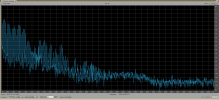
The goal is to show that suddenly started sine wave at time t = 0 does not exist in the real world, and even less in the world of musical instruments. The sine wave started at t = 0 from zero does not have one single line in the spectrum, it has a spectrum spread to infinity and needs a system with infinite bandwidth to be reproduced without time domain distortion. The transients that I have shown have spectrum spread to about 30 kHz, but you will not find repetitive waves with such frequencies in the time domain records posted. The spectrum spread to 30 kHz is a result of the shape of the start of the transient wave, which does not happen with a sudden change in the signal slope (derivative), but it happens gradually. It is not intuitive to evaluate the time domain signal shape and it is not intuitive to see relation of frequency and time domain. And even less intuitive is to debate about audibility of such phenomena.And yet you then go on to discuss ultrasonic signals and associated very short rise times.
El. guitar E4 note strike:
Attachments
Last edited:
OP
- Thread Starter
- #434
John Atkinson published the step response (1) for the Quad ESL2805 (and others) which is close to the ideal response (2).
Even the best moving coil speakers are nowhere near as good (3), so that perfectly explained the transparency. Except it didn't.
Yes, but it is just one isolated parameter from many, measured at one point. Other parameters, like lateral responses (Fig.3, 4) are sub-optimal. So is the fast decay above 10kHz (Fig.2). Please read what @Floyd Toole wrote about ESL63 here and here.
My deep opinion is that the only way to use electrostatic speaker driver sensibly is the horn loaded pressure tweeter.
US3590169A - Electrostatic horn loudspeaker - Google Patents
An electrostatic pressure loudspeaker with a diaphragm vibrating at the rhythm of a signal frequency actuated by electrostatic forces operating between the diaphragm and at least one back electrode. At least one side of the diaphragm is connected with a horn through the input cross section of...
patents.google.com
This had had flat response 1kHz - 20kHz and aperiodic response to square impulse.
Last edited:
welwynnick
Major Contributor
- Joined
- Dec 26, 2023
- Messages
- 1,498
- Likes
- 1,900
But, the conventional electrodynamic tweeter does a good job re initial part of the step response, where it almost copies the el. system response. So there is no need to worry about fast transients.
Yes, but it is just one isolated parameter from many, measured at one point. Other parameters, like lateral responses (Fig.3, 4) are sub-optimal. So is the fast decay above 10kHz (Fig.2). Please read what @Floyd Toole wrote about ESL63 here and here.
Yes, I don't think ESL's are the answer, they were part of the journey, illustrating the benefit of linear phase response. Given the right amplitude and phase equalisation, I think the moving mass of dynamic speakers is not the impediment to fidelity that people imagine. Sound on Sound (recording studio magazine) tested Dirac Live for Studio on the Kef LS50 , paying particular attention to time domain response. Here is the corrected single sample impulse response, followed by the impulse response of the Eversolo DMP-A8 with the Short Delay, Slow Roll-off filter, and then with the sharp linear phase filter. I cropped the images to make them directly comparable, and note the whole time scale corresponds to 1ms in each case.
Scaling off the charts, they all have a pulse duration of around 35 to 40 µs.
With phase EQ, I think the little Kef stands up to a high quality DAC better than many might expect.
The DAC has several other filters, but the slow roll-off was probably most comparable to the speaker impulse response.
The image rejection of that filter was not good, though. The sharp filters had better stop band attenuation, but added the usual pre- and/or post-ringing.
Yes, ESL's have good time domain response, but moving coil speakers can be good too.
Linear phase makes all the difference, and I think it applies at all frequencies and to all the components in an audio system.
The difference in noise and distortion between good DACs is probably inaudible, so I think the audible differences may lie in phase / transient response.
EDIT: Incidentally, a good ADC like the E1DA, with a suitably high sample rate, ought to be able to capture those sorts of DAC differences.
OP
- Thread Starter
- #436
Look, such plots are tricky and lead to misinterpretation viewing them. I can give you a similar measured example (at 96kS/s):Here is the corrected single sample impulse response, followed by the impulse response of the Eversolo DMP-A8 with the Short Delay, Slow Roll-off filter, and then with the sharp linear phase filter. I cropped the images to make them directly comparable, and note the whole time scale corresponds to 1ms in each case.
Looks like almost optimal DAC/ADC time response, right? And it is not.
Speculations, based on wrong audiophile style interpretations. And marketing dept explanations.
welwynnick
Major Contributor
- Joined
- Dec 26, 2023
- Messages
- 1,498
- Likes
- 1,900
I wasn't suggesting that there was anything wrong with the DAC impulse plots. I know a lot of people complain about the ringing but not me.Look, such plots are tricky and lead to misinterpretation viewing them. I can give you a similar measured example (at 96kS/s):
Looks like almost optimal DAC/ADC time response, right? And it is not.
Speculations, based on wrong audiophile style interpretations. And marketing dept explanations.
My point was how important it was for all devices to have linear phase response, which allows even a speaker to get close to the transient response of a DAC.
OP
- Thread Starter
- #438
And they absolutely do not understand that "ringing" in a 96/24 format is at frequency near 45kHz and can only by initiated by an individual impulse of microsecond order duration or a step with Tr < 10 us. It is all a phantasmagoria, nobody hears it.I know a lot of people complain about the ringing but not me.
Ziofrenko
Member
Sorry for posting here, we can open a new topic if necessary, but 3 days ago Benchmark shared a really interesting video about inner mod distortion and how to measure it accurately (they use AP products as well), claiming that these tests aren't even done on ASR...
I remembered that the 12k test was for this very purpose Instead it was the jitter test.
It would be wonderful if @amirm would also respond.
This is the link
I remembered that the 12k test was for this very purpose Instead it was the jitter test.
It would be wonderful if @amirm would also respond.
This is the link
Similar threads
- Replies
- 6
- Views
- 422

- Replies
- 63
- Views
- 5K
- Replies
- 11
- Views
- 1K
- Replies
- 3
- Views
- 436
- Replies
- 14
- Views
- 1K