• Welcome to ASR. There are many reviews of audio hardware and expert members to help answer your questions. Click here to have your audio equipment measured for free!

DAC audible differences are finally proven with ABX?

In this case I don't think it's necessarily down to the filters so much as the rest of the electronics and the tuning choices that each manufacturer has made.

It doesn't matter whether it's down to the filters or anything else. That's a distraction. The frequency responses are different.
I think there's a misunderstanding: The frequency responses you have shown are different only for 44.1 kHz material due to the filter response roll-off close to Nyquist. They may not be different at all up to 40++ kHz for the 96 kHz material used in the ABX test. One would have to check this for each DAC.
 
A DMM does not have to be accurate in an absolute sense for comparative measurements of pure sine waves.

Other than the cheap meters that have 200VAC or even 20VAC as the lowest setting my experience is that most DMMs will measure accurately enough to get within 1% (0.1dB) by lack of other means. At least when it comes to relative measurements (not absolute) but for level matching 1V AC or 2V AC at 100Hz those will be enough.
 
I'll find you a diyaudio, old scrutiny about consistency and precision as well.
Hint: it goes with the price :p
Point is, this is important! Because most DMMs will land in the top right corner. It’s perfectly valid to compare two measurements. Just don’t expect to have absolute accuracy.
 
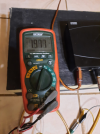
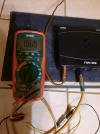
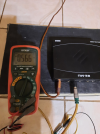
(let alone Truth vs freq, even with a TrueRMS like this:

1785666937319.png
80Hz

1785666988343.png
10kHz

1785667020268.png
20kHz
 
That's why Amir suggested 100Hz and my experience with various meters is anything between 100Hz and 400Hz is fine
(let alone Truth vs freq, even with a TrueRMS like this:


80Hz


10kHz


20kHz
 
All that is true, but it's also moot, because Josh also measured the output of the headphone amp with an E1DA ADC and REW to confirm the levels were matched.
..and that's the best way as I see it.

You calibrate REW with the same DMM and then ADC takes over just fine.
But *any* DMM alone? Nope.
 
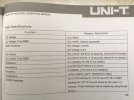
Your spec sheet offers accuracy numbers until 1 kHz. Expecting anything useful at 10 or 20 kHz is just silly.
Yep, and it's a half decent one, imagine the no-name ones around.

(don't imagine people measuring mains with those though, that's a horror story)
 
A DMM does not have to be accurate in an absolute sense for comparative measurements of pure sine waves.

Other than the cheap meters that have 200VAC or even 20VAC as the lowest setting my experience is that most DMMs will measure accurately enough to get within 1% (0.1dB) by lack of other means. At least when it comes to relative measurements (not absolute) but for level matching 1V AC or 2V AC at 100Hz those will be enough.
Listening levels by DAC side (additive, full spectrum) for nicely recorded songs are at the 300mV-400mV range, tops (plus peak for some), calibrating for 1V or 2V at 1kHz does not seem right to me.
Better with an analyzer and a good interface.
 
I think there's a misunderstanding: The frequency responses you have shown are different only for 44.1 kHz material due to the filter response roll-off close to Nyquist. They may not be different at all up to 40++ kHz for the 96 kHz material used in the ABX test. One would have to check this for each DAC.
I understand what you're saying, but I don't think it matters. I don't think those FR's are a function of the filter or the sample rate.
Both Stereophile and SoundStageNetwork measure DAC FR at different sample rates, and the envelope of the response is generally the same.
The first examples I found, here are the Chord Dave, the Denafrips Ares II, and the Musical Fidelity M6x:

1785667984226.png
1785668031337.png
1785668465639.png


In each case, the overall, bounding, frequency response is seen in the highest sample rate, and lower sample rates simply cut off steeply near the Nyquist frequency.
There are countless more similar examples.
I think what we're seeing in the examples I gave in post 731 are the bounding FRs, rather than the filter responses.

 
Listening levels by DAC side (additive, full spectrum) for nicely recorded songs are at the 300mV-400mV range, tops (plus peak for some), calibrating for 1V or 2V at 1kHz does not seem right to me.
Better with an analyzer and a good interface.
It does because it is all about the peak level which for nearly all SE out DACs is 2Vrms and most recordings hit or are just under 0dBFS.
So using a file with 100 (to 400Hz) sine at -3dBFS or -6dBFS would be very measurable and accurate because of the linearity.
At 0dB this would indeed not be a good idea as some DACs tend to compress a bit near 0dBFS in which case it could lead to incorrect matching.
 
Last edited:
I understand what you're saying, but I don't think it matters. I don't think those FR's are a function of the filter or the sample rate.
Both Stereophile and SoundStageNetwork measure DAC FR at different sample rates, and the envelope of the response is generally the same.
The first examples I found, here are the Chord Dave, the Denafrips Ares II, and the Musical Fidelity M6x:

View attachment 548790 View attachment 548791 View attachment 548792

In each case, the overall, bounding, frequency response is seen in the highest sample rate, and lower sample rates simply cut off steeply near the Nyquist frequency.
There are countless more similar examples.
I think what we're seeing in the examples I gave in post 731 are the bounding FRs, rather than the filter responses.
That's caused by the fixed post filter, the steep ones are the digital filters.
The worst offender, on the right, is 30kHz -0.5dB so not an audible issue. But sure the one on the right is -0.1dB at 12kHz.
Maybe, just maybe that particular DAC could be distinguished by young folks with the right music.
There is not much energy in recordings around 20kHz anyway.
 
Last edited:
Regarding digital voltmeters for level matching I took a look to the specs of my HP 34401A 6.5 digits meter which was a good one at the time and probably still is compared to actual ones. More expensive meters have additional one or two digits.
My analog audio measurement meters (e.g. ST 1710A +- 0.2 dB +- 2% 20 Hz - 20 kHz) are not so accurate but still a 0.1 dB deviation can be very good seen. And when the pointer is on a scale line then matching can be done better yet.

HP_34401A_DC_AC_Specs.jpg
HP_34401A_Front.jpg
 
You do not need absolute accuracy. You only need relative accuracy when comparing level from 2 devices under A/B test.
Of course, I know this. When accuracy is better then the deviation between readings will be less.
 
By the way. Due to my progressed age and thus old ears I am not able to distinguish between sounds when there are only small nuances different when especially in the upper frequencies. I am limited to approx. 12 kHz depending on sound pressure level. When young I could hear easily up to 19 kHz. Sad that this is gone.
Therefore a very specialized ABX box does not make sense for me. But I still keep looking the posts from a technical viewpoint.
 
Back
Top Bottom