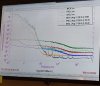
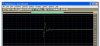
Now, what if we send an "impulse" through that filter? An impulse is a quick sound pulse for an infinitesimally short period of time, like a really quick perfectly damped drum hit (there are no impulses in the real world because of the physics of air and materials and microphones, but we're dealing with mathematical models here). Here's the actual signal that comes out of that filter:
This is a perfect reconstruction of what we've sampled, in terms of sampling theory. In the real world, if we're trying to represent a percussion instrument like a drum, the waves before the impulse are not a perfect reconstruction.