• Welcome to ASR. There are many reviews of audio hardware and expert members to help answer your questions. Click here to have your audio equipment measured for free!

Connector or soldering to speaker contacts in Yamaha NS 700x when converting to DSP crossovers.

Argentum 05

Member
Joined
Aug 29, 2025
Messages
87
Likes
45
Location
Amber
Hello everyone!
I'm converting my Yamaha NS 700x speaker systems to DSP crossovers, replacing the factory passive ones.
The plan is to directly connect the speakers from each band to their own amplifier.
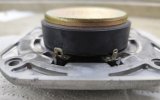
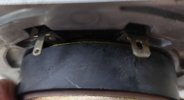
Currently, the speakers are connected using factory connectors, using a spade clamp made of white-gray metal. The copper wire is clamped at the base of the connector.
I have a question: what's the best way to connect the new speaker wire to the speaker spades?
Option 1: soldering. But I don't know how solder will adhere to this metal. I have limited soldering experience, but it's not very good.

Option 2: install a connector on the wire similar to the one that came with it at the factory. There are kits of these connectors on AliExpress. The metal is yellow, similar to brass.

I realize this is an old thread, and the solder resistance is 10 times higher than that of copper, but the soldering area is larger. The connector with the spade oxidizes over time. But, still, maybe someone will express their opinion, possibly based on personal experience.
 
Maintaining maximum sound quality is a priority. I've seen some mentions that soldering can reduce quality, but this hasn't been confirmed by any measurements, so I have little confidence in it. Also, there's an argument to be made: Yamaha used crimped connectors at the factory. Perhaps this was for ease of installation, not for the best sound quality.
Basically, I need your opinions.
 
Soldering is fine - look at any PCB.
Crimped connectors are based on lower production costs/assembly speeds.
Don't fret it.
 
Soldering is fine - look at any PCB.
Crimped connectors are based on lower production costs/assembly speeds.
Don't fret it.
Yes, I completely agree that there's a lot of soldering along the entire signal path, from the source's electronic circuit boards to the DSP processor, then to the RCA cable connectors, and then to the amplifiers.

However, the signal on the circuit boards in the equipment and the finished signal sent to the speakers may have different requirements. I'm not an expert in this area. I'm a music listener who, at my own risk and out of curiosity, decided to undertake this modification.
Perhaps there are technical measurements that could confirm or refute the possible differences in the wiring methods in the speaker system.
 
"However, the signal on the circuit boards in the equipment and the finished signal sent to the speakers may have different requirements. I'm not an expert in this area. I'm a music listener who, at my own risk and out of curiosity, decided to undertake this modification."

Speaking as an electronic engineer, it does not matter at all - solder or crimp your connectors, it's merely a matter of what you are able to do. To crimp, you will ideally need a crimp tool to do a neat job. And some practice. It's audio - relatively low power and low frequency stuff.
 
it does not matter at all - solder or crimp your connectors, it's merely a matter of what you are able to do.
I'd certainly prefer to avoid soldering, as I'm afraid of overheating and damaging the terminal on my old Yamaha speakers. Plus, I don't know what kind of metal it is and how it will react to soldering.
A crimping tool can be purchased at a hardware store or on a marketplace. The necessary pliers cost about $10-15.
 
I'd certainly prefer to avoid soldering, as I'm afraid of overheating and damaging the terminal on my old Yamaha speakers. Plus, I don't know what kind of metal it is and how it will react to soldering.

Overheating is likely not an issue, the metal if properly prepared and fluxed, not an issue. The issue would be bad flow from not knowing how to get the right temperature.

Spade clamp for you, 100%, is the way to go. Not that you can't solder, but that you won't be confident in the results when done, or over the long term.

If you want to solder, and it is a good skill to have, practice on spare parts and wire. Good youtube videos exist. Once you get the touch, you'll be able to solder with confidence.
Well, I can solder a resistor to a printed circuit board or twist and solder the end of a capacitor to speaker wire.
I'll have to order a DIY kit someday and solder some Chinese electronic toy to practice my skills.
In this case, I don't want to experiment with an unknown metal on the speaker terminals. The AI says you can't heat the terminal on the speakers for more than two seconds.
 
The AI says you can't heat the terminal on the speakers for more than two seconds.

Not speaking to the quality of AI, but get a kit with some heat sinks. That's what they are for, soldering close to heat sensitive components in the circuit.

Unless it's just wire, I generally use them so I don't have to worry about what might be heat sensitive... given my less than wonderful skills. I might solder once every couple of years, so I am not the fastest gun in the west.
 
I found an interesting video on YouTube that addresses my issue. According to measurements, soldering is 1.5 times more efficient than using a connector.
The video is in Russian.

 
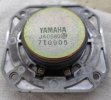
I wonder what this metal is? It's non-magnetic and not yellow inside—I scraped it a bit with a knife.
I tried soldering it, but the solder didn't stick very well.
 

Attachments

  • JA 0580 02.jpg
    JA 0580 02.jpg
    112.6 KB · Views: 53
  • JA 0580 03.jpg
    JA 0580 03.jpg
    41.5 KB · Views: 56
  • JA 0580.jpg
    JA 0580.jpg
    127.5 KB · Views: 52
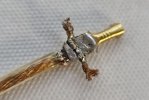
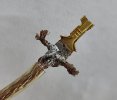
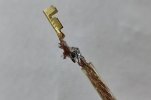
This contact is similar to those on speakers. Do you think this soldering quality is sufficient?
Is there a special soldering method for these contacts?
 

Attachments

  • 01.jpg
    01.jpg
    61.5 KB · Views: 60
  • 02.jpg
    02.jpg
    59.4 KB · Views: 61
  • 03.jpg
    03.jpg
    73.3 KB · Views: 62
No offence, but that's a dog's dinner. But a little more practice and you'll be fine. What's the cross wire doing?
You have also soldered the wrong end.
Not everything that is metal is solderable - flux always helps though.
A good soldering iron helps too - you need to heat the joint rapidly so as not to melt insulation, plus modern high-tin solder needs a higher temp to melt.
The end is correct. This connector mimics the speaker contact. I'll be soldering the wire to the speaker.
The cross formed itself. It's improvised. I divided the wire into four sections, threaded two through the hole, and tied them crosswise with the other two. The goal is to press the wire as tightly as possible to the contact to minimize the solder layer.
Again, this is improvised. If anyone can suggest a better method, I'd be grateful.
You soldered the wire onto the "spade end" which is meant to slide into a female receptacle - you'd normally solder a wire into the crimpable end of the connector. I give up! Have fun!

male or female - the bit you solder is the same:

Capture5.JPG
 
You soldered the wire onto the "spade end"
I know this part doesn't fit the speaker. I used it for practice because it matches the shape of the speaker connector, which I've already written twice. You might not understand me because I'm using Google Translate.
Above is a photo of the speakers. Look at their contacts. I was going to solder a wire to them and used this contact as a practice run.
I KNOW IT CAN'T BE CONNECTED THERE.
Thank you for trying to help me.
 
Back
Top Bottom