Sure, but that is an overkill for a tpa3255. For reference, one single 8mm flat pipe fits perfectly it's power padThis may be too complicated for DIY, but it's evidently possible to mill a flattened heat pipe so it presents a really flat surface for good coupling to the heat source.
View attachment 546068

-
Welcome to ASR. There are many reviews of audio hardware and expert members to help answer your questions. Click here to have your audio equipment measured for free!
- Forums
- Audio, Audio, Audio!
- Amplifiers, Phono preamp, and Analog Audio Review
- Stereo and Multichannel Amplifier Reviews
You are using an out of date browser. It may not display this or other websites correctly.
You should upgrade or use an alternative browser.
You should upgrade or use an alternative browser.
Class D amp long term reliability
- Thread starter sophie smith
- Start date
here's food for thought... if i never visited this place chances are i'd probably still be on class a/b 19" wide behemoths
i wonder what is the oldest but still operational class d amps you own?
i own a harmon bds280 bluray combo amp w/ bluetooth and all the trimings and its probably close onto 12-14 yrs old and still going.... last firmware was 2016
i wonder what is the oldest but still operational class d amps you own?
i own a harmon bds280 bluray combo amp w/ bluetooth and all the trimings and its probably close onto 12-14 yrs old and still going.... last firmware was 2016

I'm now feeling nostalgic for Edmund Scientific Corp. They used to have all kinds of things that I found useful for many, many projects that I did when I was a teenager and young adult. I think I remember them having heat pipes at one point.
 en.wikipedia.org
Edmund Scientific Corporation - Wikipedia
Sure, but that is an overkill for a tpa3255. For reference, one single 8mm flat pipe fits perfectly it's power pad
Yes, I agree. What you had written about having to use thermal paste just reminded me that I had seen heat pipes lapped flat to cool CPUs. This was a picture I found after a short search. I didn't mean that it would be perfectly suited for a tpa3255.


Cogito
Senior Member
- Joined
- Dec 29, 2019
- Messages
- 372
- Likes
- 485
That brings back memories! I always looked forward to their new catalogs every year.I'm now feeling nostalgic for Edmund Scientific Corp. They used to have all kinds of things that I found useful for many, many projects that I did when I was a teenager and young adult. I think I remember them having heat pipes at one point.
Edmund Scientific Corporation - Wikipedia
Many years ago I was given a small quantity of heatsink fluid. I think it was some kind of fluorocarbon? It came in a sealed, flat plastic pouch. The idea was that you could slip the pouch in between a heat-producing component and a case or heat sink when the heat source wasn't a flat surface.
I used it between the power xformer and case of a Dynaco PAS 3 - just because. It did seem to reduce the temp of the xformer, although I'm not sure it was solving any real problem since those transformers last a very long time without it.
I've also seen some kind of non-electrically-conductive liquid (that does conduct heat well) being used to cool submerged computer components. Not likely to be usable for cooling amplifier chips, but it was a neat demonstration when I saw it at a trade show. (https://datacenterworld.com/afcom-association/)
The fluid in a pouch would be more useful, but I don't remember the name of the company that was selling it. (It was probably several decades ago.)
I used it between the power xformer and case of a Dynaco PAS 3 - just because.
It did seem to reduce the temp of the xformer, although I'm not sure it was solving any real problem since those transformers last a very long time without it.I've also seen some kind of non-electrically-conductive liquid (that does conduct heat well) being used to cool submerged computer components. Not likely to be usable for cooling amplifier chips, but it was a neat demonstration when I saw it at a trade show. (https://datacenterworld.com/afcom-association/)
The fluid in a pouch would be more useful, but I don't remember the name of the company that was selling it. (It was probably several decades ago.)
There are also things like Honeywell PTM7950 that changes phase when it gets to a certain temperature. I believe they are used in computers as alternative to regular paste. Indium works similarly but is conductive and melts at a relatively high temp.Many years ago I was given a small quantity of heatsink fluid. I think it was some kind of fluorocarbon? It came in a sealed, flat plastic pouch. The idea was that you could slip the pouch in between a heat-producing component and a case or heat sink when the heat source wasn't a flat surface.
I used it between the power xformer and case of a Dynaco PAS 3 - just because.
I've also seen some kind of non-electrically-conductive liquid (that does conduct heat well) being used to cool submerged computer components. Not likely to be usable for cooling amplifier chips, but it was a neat demonstration when I saw it at a trade show. (https://datacenterworld.com/afcom-association/)
The fluid in a pouch would be more useful, but I don't remember the name of the company that was selling it. (It was probably several decades ago.)
There are also things like Honeywell PTM7950 that changes phase when it gets to a certain temperature. I believe they are used in computers as alternative to regular paste. Indium works similarly but is conductive and melts at a relatively high temp.
I just found this: https://immersion-cooling.thermaltake.com/ It isn't the company that I had seen demoing, but it's much the same concept.

Count Arthur
Major Contributor
- Joined
- Jan 10, 2020
- Messages
- 3,173
- Likes
- 8,351
I just found this: https://immersion-cooling.thermaltake.com/ It isn't the company that I had seen demoing, but it's much the same concept.
People have been building DIY fully immersed PCs for a while, using aquarium tanks and mineral oil. It looks great, but by all accounts it's a pit of a palaver; it's not exactly convenient should you want to change a component. In addition, the oil/fluid needs to be replaced periodically as it picks up contaminants and goes opaque over time.
Getting back to Class D amp reliability/longevity, it's interesting that so many amps just use the case as their heatsink.
I've been using the Noctua NT-H1 thermal paste for a long time. It doesn't seem to get as crusty after being in place on a CPU for several years as some other thermal pastes do. I've been very pleased with it.
I tried Artic Silvera couple times. Found it is conductive.
Back in my single ended mosfet amp building I lapped heat sinks and transistors. Did not hurt heat transfer. Maybe helped.
I've been using the Noctua NT-H1 thermal paste for a long time. It doesn't seem to get as crusty after being in place on a CPU for several years as some other thermal pastes do. I've been very pleased with it.

SampleSizeOne
Member
- Joined
- Apr 19, 2026
- Messages
- 52
- Likes
- 23
When it comes to cooling I've used the Honeywell thermal pads on other projects with good success lately.
For example this one:
I bought it via AliExpress a while ago and the link is just an example. But the PTM7950 worked really well for me.
For other projects I've used 'thermal putty' where the space is too big for usual thermal paste. The conduction is slightly lower, but for a Class D amp it might still work good enough.
Waveform Fidelity
Senior Member
- Joined
- Oct 9, 2025
- Messages
- 382
- Likes
- 238
I built a 6CH amp using ICEPower modules, and had a big heatsink in my parts box… this thing will not run hot!Getting back to Class D amp reliability/longevity, it's interesting that so many amps just use the case as their heatsink.
I've been using the Noctua NT-H1 thermal paste for a long time. It doesn't seem to get as crusty after being in place on a CPU for several years as some other thermal pastes do. I've been very pleased with it.
Attachments
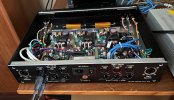
The revox power amps of the same era, had a similar heatpipe based setup...I'm replying a bit late, but...
Sansui AU-D11. Heat pipes often use a small amount of distilled water, so it's possible this was "water-cooled." Heat pipes are used in a lot of PCs and I think Gamers Nexus had a youtube video showing how heat pipes are made. (One of their "factory tour" videos.)
View attachment 546056
If you do a thermal inspection using a FLIR camera, you will find that there are components on the boards that get quite hot - and run without heatsink pretty much universally.Getting back to Class D amp reliability/longevity, it's interesting that so many amps just use the case as their heatsink.
I've been using the Noctua NT-H1 thermal paste for a long time. It doesn't seem to get as crusty after being in place on a CPU for several years as some other thermal pastes do. I've been very pleased with it.
In a perfect world, I would like to see no component running over 50c, for longevity - but nowadays many class D designs have components running at over 60c or 70c - all within specs for the components involved - but long term longevity (10 years+) is most likely compromised by the temperature.

wadude
Addicted to Fun and Learning
I’ve had an icepower amp in a professional application since 2010 (or so) and it is still going strong.here's food for thought... if i never visited this place chances are i'd probably still be on class a/b 19" wide behemoths
i wonder what is the oldest but still operational class d amps you own?
i own a harmon bds280 bluray combo amp w/ bluetooth and all the trimings and its probably close onto 12-14 yrs old and still going.... last firmware was 2016

Nc252 amp still going strong, no problems. 7-8 years.I don't think we have enough years with the new modules to fully understand reliability. But they are cheaper and more energy efficient, so even if they don't last as long, they may be more cost-efficient.
I've had an nc252-based design for a couple of years with no problems.
Roland68
Master Contributor
This applies only to components like capacitors (electrolytic, film, etc.), which are usually easy to replace. But even those often last much longer in reality than is assumed here.If you do a thermal inspection using a FLIR camera, you will find that there are components on the boards that get quite hot - and run without heatsink pretty much universally.
In a perfect world, I would like to see no component running over 50c, for longevity - but nowadays many class D designs have components running at over 60c or 70c - all within specs for the components involved - but long term longevity (10 years+) is most likely compromised by the temperature.
Components such as amplifier ICs, many transistors, and op-amps have a lifespan that easily exceeds 20–30 years, even at temperatures of 60–70°C.
Examples include op-amps ranging from the NE5532 to the OPA627; these are often salvaged from measuring instruments and other industrial equipment after 10, 20, or even 30 years of service, yet they continue to function perfectly and deliver flawless readings.
We see the same thing in the industrial sector, where control systems, power electronics, and switching power supplies operate inside sealed enclosures; with ambient temperatures of 35–50°C, internal temperatures often reach 60–70°C. Many of our customers have boards or devices that have been running for 15–30 years, with only the critical capacitors replaced perhaps once during that time.
I also own several Mean Well and TDK switching power supplies that were replaced preventively after more than 10 years of service at such temperatures, yet they still work perfectly.
Another example is found in many older amplifiers and AV receivers (AVRs); they reach internal temperatures exceeding 50°C but still easily last 20–30 years.
The ICs inside AVRs, in particular, often reach temperatures above 60°C and yet remain functional for such long periods.
I increasingly see unfounded scaremongering on this forum regarding the "heat death" of components and devices—claims that lack any substance or evidence.
It is very strange: older amplifiers have functioned for 20–40 years at these operating temperatures, yet people claim all the new devices are dying—but where are all these failed units?
I have owned two seperate generations of AVR's which both failed with different issues, but in both cases heat was a major contributing factor.This applies only to components like capacitors (electrolytic, film, etc.), which are usually easy to replace. But even those often last much longer in reality than is assumed here.
Components such as amplifier ICs, many transistors, and op-amps have a lifespan that easily exceeds 20–30 years, even at temperatures of 60–70°C.
Examples include op-amps ranging from the NE5532 to the OPA627; these are often salvaged from measuring instruments and other industrial equipment after 10, 20, or even 30 years of service, yet they continue to function perfectly and deliver flawless readings.
We see the same thing in the industrial sector, where control systems, power electronics, and switching power supplies operate inside sealed enclosures; with ambient temperatures of 35–50°C, internal temperatures often reach 60–70°C. Many of our customers have boards or devices that have been running for 15–30 years, with only the critical capacitors replaced perhaps once during that time.
I also own several Mean Well and TDK switching power supplies that were replaced preventively after more than 10 years of service at such temperatures, yet they still work perfectly.
Another example is found in many older amplifiers and AV receivers (AVRs); they reach internal temperatures exceeding 50°C but still easily last 20–30 years.
The ICs inside AVRs, in particular, often reach temperatures above 60°C and yet remain functional for such long periods.
I increasingly see unfounded scaremongering on this forum regarding the "heat death" of components and devices—claims that lack any substance or evidence.
It is very strange: older amplifiers have functioned for 20–40 years at these operating temperatures, yet people claim all the new devices are dying—but where are all these failed units?
Each of these lasted around 4 to 5 years
The earlier one, the heat triggered capacitor failure, and in the later one the heat triggered a failure in the main DSP processor chip.
I also own amps from the 1970's - all of which are still running reliably - but they all have cool running and effective heat sinking as a factor in common.
In terms of class-d, I have a pair of Crown XLS2500's purchased circa 2012 running perfectly (but they are capable of huge output, and the load that I put on them is tiny, their fans never seem to spin up as a result... presumably because they are running cool... - they have never felt more than marginally lukewarm to the touch)
In my opinion the base technology of silicon chips resistors and capacitors is heat sensitive, and its lifetime is directly related to how hot they run. (bad batches of capacitors can be more sensitive to heat than their spec... but will last decades if run well under their spec temperature, even though they are a bad batch...)
Looking at the common op amps - they don't run hot... - and in most circuits that I have seen, don't require any heatsinking to do their job at perfectly acceptable temperatures (well under 50C) - but you can do a search for FLIR photos of various switching technology designs, power amps and power supplies - they have serious hot spots, which old world op amps don't have.
Roland68
Master Contributor
There were several AVR models where DSP chips failed, but heat wasn't the culprit; rather, it was defective DSP chips and poor soldering—issues that subsequently led to thermal problems.I have owned two seperate generations of AVR's which both failed with different issues, but in both cases heat was a major contributing factor.
Each of these lasted around 4 to 5 years
The earlier one, the heat triggered capacitor failure, and in the later one the heat triggered a failure in the main DSP processor chip.
I also own amps from the 1970's - all of which are still running reliably - but they all have cool running and effective heat sinking as a factor in common.
In terms of class-d, I have a pair of Crown XLS2500's purchased circa 2012 running perfectly (but they are capable of huge output, and the load that I put on them is tiny, their fans never seem to spin up as a result... presumably because they are running cool... - they have never felt more than marginally lukewarm to the touch)
In my opinion the base technology of silicon chips resistors and capacitors is heat sensitive, and its lifetime is directly related to how hot they run. (bad batches of capacitors can be more sensitive to heat than their spec... but will last decades if run well under their spec temperature, even though they are a bad batch...)
Looking at the common op amps - they don't run hot... - and in most circuits that I have seen, don't require any heatsinking to do their job at perfectly acceptable temperatures (well under 50C) - but you can do a search for FLIR photos of various switching technology designs, power amps and power supplies - they have serious hot spots, which old world op amps don't have.
One of the most well-known examples of this involved the Pioneer AVR series LX-73/83/75/85/76/86. This caused lasting damage to Pioneer's reputation, as the company failed to address the issue, leaving €2,500 AVRs with nothing but scrap value after just 3 to 5 years.
One also needs to look more closely at capacitor failures in AVRs.
Especially in the past—roughly from the 90s to around 2010—capacitors used in switching regulator applications (DC/DC converters, power supplies, Class-D amplifiers, SMPS units, etc.) were frequently underspecified or incorrectly rated; consequently, they would overheat and fail. This was easily identified by bulging tops or electrolyte leaking from the base, often occurring within just a few months to a few years. Again, this had nothing to do with high ambient temperatures.
In both instances, uninformed people spread the idea that thermal issues were causing the failures—a claim that is absolute nonsense and technically incorrect regarding the root cause.
The same thing happened both here on the forum and elsewhere—for example, with the Topping PA5 amplifiers (first version), which were prone to failure. In those cases, too, there was never a heat problem.
Do you see the pattern?
Similar threads
- Replies
- 9
- Views
- 897
- Replies
- 3
- Views
- 401
- Replies
- 9
- Views
- 681
- Replies
- 2
- Views
- 2K
- Replies
- 16
- Views
- 859
