• Welcome to ASR. There are many reviews of audio hardware and expert members to help answer your questions. Click here to have your audio equipment measured for free!

Can you Bi-Amp from the SAME Amp?

vibe

Member
Joined
Mar 30, 2022
Messages
15
Likes
1
I have the Cambridge CX81 (though looking into other options) powering my KEF R3s and SVS SB-1000 sub.
The Cambridge has 2 sets of speaker outs. Could I use those to "Bi-Amp" the R3s or do I really need to use 2 different amps?
I have two A07 on order for bi-amping. But am skeptical that they will sound as good as the Cambridge, which I think could sound better
Thanks.
 
I have the Cambridge CX81 (though looking into other options) powering my KEF R3s and SVS SB-1000 sub.
The Cambridge has 2 sets of speaker outs. Could I use those to "Bi-Amp" the R3s or do I really need to use 2 different amps?
I have two A07 on order for bi-amping. But am skeptical that they will sound as good as the Cambridge, which I think could sound better
Thanks.
Depends on what you mean by bi amp.
 
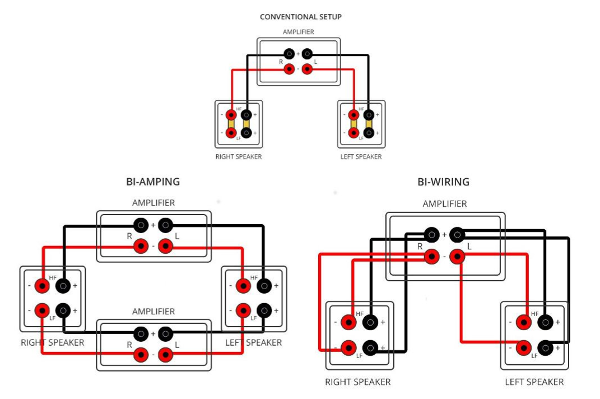
What you're suggesting would be more accurately described as bi-wiring. In order to qualify as bi-amping, a separate amplifier would be required. The four sets of speaker terminals on the CX81 are wired to just two distinct amps.

In my experience, bi-amping and bi-wiring do not produce an audible difference. Bi-amping does give you more headroom.
 
The Cambridge has 2 sets of speaker outs. Could I use those to "Bi-Amp" the R3s or do I really need to use 2 different amps?
You need 2 amps to "Bi-Amp" one speaker. Having multiple sets of output terminals from an amp doesn't help. You need two different stereo amps to "Bi-Amp" a pair of speakers.

Bi-wiring is another matter and neither of these strategies are of much value.
 
Thank you all. Very helpful responses. The entirety of these subjects are incredibly confusing for newcomers like me.
I appreciate the clarity provided in these forums from experienced folks.
 
The tri-amplified system in my van uses ONE five-channel amplifier with a built-in crossover. ;) Previously, I had 3 stereo amps and a separate active crossover.
That is semantically confused. You had five ONE-channel amplifiers on one chassis with a built-in crossover.
 
I would welcome any comments from bi-amp enthusiasts here

 
I have the Cambridge CX81 (though looking into other options) powering my KEF R3s and SVS SB-1000 sub.
The Cambridge has 2 sets of speaker outs. Could I use those to "Bi-Amp" the R3s or do I really need to use 2 different amps?
I have two A07 on order for bi-amping. But am skeptical that they will sound as good as the Cambridge, which I think could sound better
Thanks.
NO that would be bi wiring and there is no benefit.
 
Since you are relatively new here I strongly suggest you get a clear understanding of the fundamentals of "Bi-amping".

This phrase can be misused and misconstrued quite easily.

Head over to Rod Elliot's ESP Audio pages and read both articles on Bi-Amping.
Unless you really understand the process you may be setting out to spend lots of money on things that may make no improvement.
The wording of your question indicates the need for full understanding.
 
In most cases when an amp has 2 sets of binding posts (or 4 places to insert banana plugs into) and the speaker A/speaker B/speaker AB setting, this is not to 'bi amp', but to connect two different sets of speakers and switch between them.

For example my CA Azur 550A has one set of binding posts connected to my front towers and the other to a pair of speakers that i use for as my PC's rears.. and I switch between the two depending on what i want.

My understanding of 'bi-amping' is that this is a mode where there is some form of DSP, four pre-amps feeding four separate amplifiers, with two being for the lower frequencies and two being for the higher frequencies for both the left and right, and then you connect these to speakers that are compatible with this arrangement - i.e. the ones with four binding posts, and not two.

My Edifier S350DBs are biamped, and what this allows is for much tighter control of treble, mid, and bass.
 
Last edited:
Back
Top Bottom