• Welcome to ASR. There are many reviews of audio hardware and expert members to help answer your questions. Click here to have your audio equipment measured for free!

Can cheap units make good speakers?

DNCAgain

Member
Joined
Mar 28, 2026
Messages
74
Likes
16
When discussing Ascilab with some speaker DIY enthusiasts, I often hear their complaints that the C6B uses one of the cheapest driver units from SB Acoustics. While they have no doubts about its sound quality, the idea of using a budget unit makes them uneasy.

At the same time, according to Klippel measurement data, the C6B performs exceptionally well. If that’s the case, what noticeable advantages would come with using higher‑end drivers? And compared to the F6B, A6B, and S6B, what is the C6B still lacking?
 
Last edited:
ASR is an international forum, so please use English.
 
If that’s the case, what noticeable advantages would come with using higher‑end drivers?
None. https://www.diyaudio.com/community/...200hz-no-audible-difference-whatsover.353554/

And compared to the F6B, A6B, and S6B, what is the C6B still lacking?
The A6B and S6B have Purifi woofers and PRs which greatly increase bass output capability compared to the F6B and C6B.

Between the F6B and C6B there are some differences in distortion profile caused by the different woofers, but nothing really that would make one clearly superior to the other:

The different tweeters between the two seem largely inconsequential.

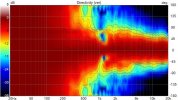
And lastly, the S6B's Purifi tweeter upgrade over the A6B results in wider directivity.
 
None. https://www.diyaudio.com/community/...200hz-no-audible-difference-whatsover.353554/


The A6B and S6B have Purifi woofers and PRs which greatly increase bass output capability compared to the F6B and C6B.

Between the F6B and C6B there are some differences in distortion profile caused by the different woofers, but nothing really that would make one clearly superior to the other:

The different tweeters between the two seem largely inconsequential.

And lastly, the S6B's Purifi tweeter upgrade over the A6B results in wider directivity.
Thanks for your patience!
 
Could someone recommend a good but reasonably priced Woofer driver from this collection?

10" is ideal, for use in a small passband MBM Coupler box, under 1.5 cuft smaller the better.

Say 50Hz up to 200-250Hz at good SPL, am I right to not look at drivers designed for trueSub even if they claim top F3 higher than that?

Prefer power handling 200+ Wrms, ideally decent efficiency.

so far, Peerless SLS 10" 830668 looks like the one to beat
 
Dayton RSS should be good. Used both the RSS 225 and 390HF, and sonically and visually, I really like them both.... so I can only imagine the 10" being pretty good too.
Your challenge is sensitivity, regarding whether you run it passive or active... since some subwoofers are actually really good for this range... But needs dedicated power and EQ to fit with the SPL of most midranges and tweeters.
 
When discussing Ascilab with some speaker DIY enthusiasts, I often hear their complaints that the C6B uses one of the cheapest driver units from SB Acoustics. While they have no doubts about its sound quality, the idea of using a budget unit makes them uneasy.
Are they also uneasy about Kii using a customised variant of the even more budget Peerless SBS-160F35AL01-04 in a much more expensive speaker? Or the cheap Tectonic mid in the Philharmonic BMR?
 
It's an interesting question. I think the general answer is "better" drivers distort less:


Whether the distortion from a particular driver is audible will depend on the listening levels and how it is crossed over.

The crossover can make a cheap driver sound great, and a good driver sound awful.
 
ASR is an international forum, so please use English.
An international forum where everyone is expected to use English. Because nothing says “international” quite like having a single mandatory language.
 
That’s a broad question. You have to start with drivers that have a reasonably flat frequency response within a specific range. Ideally, you’d use an 18-inch or 15-inch woofer (or something similar), and then apply a crossover—with a slope steep enough to handle the point where the response rolls off. That’s the job of the crossover network—a challenge that, unfortunately, hasn't been perfectly solved yet.
Fortunately, the midrange and high-frequency ranges are less critical.
So, my answer would generally be "no," though there are excellent "inexpensive" drivers (sometimes costing around ten dollars or pounds) from brands like Monacor, Peerless, and Visaton—just be sure to steer clear of foam surrounds, as they simply don't last.
 
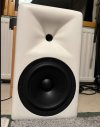
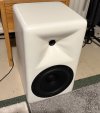
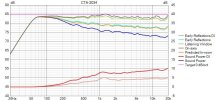
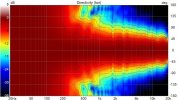
These costed me about 500€ to build for the pair and imo perform pretty well. They use SB Acoustics SB26ADC and SB23NBAC. SB26ADC is one of the lowest distortion tweeter there are regardless of the price and it costs 50€.
 

Attachments

  • SB23K.jpg
    SB23K.jpg
    104.1 KB · Views: 91
  • SB23K2.jpg
    SB23K2.jpg
    113.4 KB · Views: 91
  • VituixCAD CTA-2034asdasd.jpg
    VituixCAD CTA-2034asdasd.jpg
    64.5 KB · Views: 98
  • Directivity (hor) SB Acoustics.jpg
    Directivity (hor) SB Acoustics.jpg
    50.2 KB · Views: 86
  • Directivity (ver) SB Acoustics.jpg
    Directivity (ver) SB Acoustics.jpg
    51.8 KB · Views: 90
> 10" is ideal, for use in a small passband MBM Coupler box, under 1.5 cuft smaller the better.

> Say 50Hz up to 200-250Hz at good SPL, am I right to not look at drivers designed for trueSub even if they claim top F3 higher than that?

I realise it might be too general a question but still hoping to get answered. The key issue is I want low Mms with high BL so higher Fs, right? low Qes for high EBP? PR bandpass enclosure.
 
It's an interesting question. I think the general answer is "better" drivers distort less:


Whether the distortion from a particular driver is audible will depend on the listening levels and how it is crossed over.

The crossover can make a cheap driver sound great, and a good driver sound awful.
Yes. And good drivers can have some wild artifacts aside from distortion.

For example, the Seas W18E001 that Linkwitz showed to have the lowest distortion, also has nearly the worst breakup mode (roughly tied with the Accuton driver).
1787329616522.png

That peak at 4.5kHz is massively audible (I've built a few speakers with these Seas Excel drivers). As you say, despite how good they are for distortion, the crossover needs to take this peak into account or it will sound bad. It really makes a horrible shrieking noise during sweeps unless you notch out the peak. Extra credit is to use a series notch like this PuriFi White Paper suggests to not only deal with the peak, but also reduce the harmonic distortion that results from the breakup mode. The peak is the audible problem here, not the spray of distortion from the breakup mode.

It's a costly driver that sounds like crap if the peak isn't dealt with in the crossover, just as you say. :cool:
 
Yes. And good drivers can have some wild artifacts aside from distortion.

For example, the Seas W18E001 that Linkwitz showed to have the lowest distortion, also has nearly the worst breakup mode (roughly tied with the Accuton driver).
View attachment 553392
That peak at 4.5kHz is massively audible (I've built a few speakers with these Seas Excel drivers). As you say, despite how good they are for distortion, the crossover needs to take this peak into account or it will sound bad. It really makes a horrible shrieking noise during sweeps unless you notch out the peak. Extra credit is to use a series notch like this PuriFi White Paper suggests to not only deal with the peak, but also reduce the harmonic distortion that results from the breakup mode. The peak is the audible problem here, not the spray of distortion from the breakup mode.

It's a costly driver that sounds like crap if the peak isn't dealt with in the crossover, just as you say. :cool:
I use a quad of W18E001s in each speaker, but I cross at 761Hz 4th order. That crushes the peak pretty well.
 
  • Like
Reactions: MAB
When discussing Ascilab with some speaker DIY enthusiasts, I often hear their complaints that the C6B uses one of the cheapest driver units from SB Acoustics. While they have no doubts about its sound quality, the idea of using a budget unit makes them uneasy.

At the same time, according to Klippel measurement data, the C6B performs exceptionally well. If that’s the case, what noticeable advantages would come with using higher‑end drivers? And compared to the F6B, A6B, and S6B, what is the C6B still lacking?
It definitely does not. The SB17CAC35 is right now on Madisound over $100/unit. I'm sure it's cheaper in large volumes, but even so, it's not a cheap driver. The tweeter is $65 on Madisound as well.

The only place where it's using a particularly cheap part is the passive radiator - and guess what, a port is cheaper than a passive radiator!

Anyway.

Expensive doesn't always equal better with drivers, but sometimes it does. Usually the improvement is lower distortion, whether or not that's audible is a different question. I'm never going to argue that lower distortion isn't better, but it's hard to argue that most speaker based harmonic distortion is actually meaningfully audible. It's almost all low order (D2, D3) and those, especially D2, are not audible until you get to pathological levels. The concern is more intermodulation distortion, and even then you're usually better served by adding another way than buying a more expensive driver.
 
An international forum where everyone is expected to use English. Because nothing says “international” quite like having a single mandatory language.
The concept of lingua franca sound familiar to you? Be glad it isn't still French. :p
 
The concept of lingua franca sound familiar to you? Be glad it isn't still French. :p
Oh, I’m perfectly familiar with the notion of a lingua franca. As a native French speaker myself, I’m also rather aware of how that particular lingua franca got demoted.

But “international forum” and “English-only forum” aren’t quite synonyms. One describes who may participate; the other dictates the language in which they may do so.

In short, “international” doesn’t normally mean “English-speaking by decree”... unless, of course, I’ve somehow misunderstood both the English language and what “international” actually means.
 
Last edited:
Oh, I’m perfectly familiar with the notion of a lingua franca. As a native French speaker, I’m also painfully aware of how that particular lingua franca got demoted.

But “international forum” and “English-only forum” aren’t quite synonyms. One describes who may participate; the other dictates the language in which they may do so.

In short, “international” doesn’t normally mean “English-speaking by decree”... unless, of course, I’ve somehow misunderstood both the English language and what “international” actually means
What you've apparently misunderstood - or forgotten for a moment - that English is the de facto standard language, especially online. Internationally. ;)
 
Back
Top Bottom