

vintagegale
Member
- Joined
- Oct 3, 2026
- Messages
- 6
- Likes
- 2
I'm a massive Gale fan and the rather proud owner of a rare-as-hen's-teeth Gale GT2101. As an owner, I've become increasingly frustrated by how little properly documented history there is surrounding this extraordinary turntable. There is quite a lot written about the GT2101 online, but much of it ultimately seems to lead back to the same source.
For many years, a chap called John Maybury ran the GaleAudio website. John did a huge amount of work collecting information about Gale, its products, its people and its history. The site became the main reference point for Gale information on the internet and was subsequently referenced by other people writing about the company. Unfortunately, the website is now offline, so a lot of that information has effectively disappeared from public view.
Rather than letting that work disappear, I've started building a Gale archive on GitHub. The idea is to preserve as much of John's research as possible, while also trying to separate documented evidence from information that has simply been repeated over the years. I'm collecting original drawings, patents, contemporary magazine articles, photographs, advertisements, company documents and, perhaps most importantly, firsthand recollections from people who actually worked at Gale or DCA. Wherever possible, I'm also trying to trace claims back to their original source.
While digging through all of this, I came across something that I think is considerably more significant than it initially appeared.
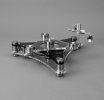
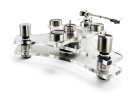
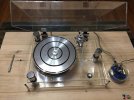
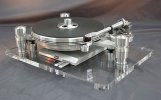
The designer was Kenneth Freivokh, who was then a student at the Royal College of Art in London. In 1971/72, Freivokh produced his final-year thesis, A Transcription Turntable Unit. This wasn't simply a paper exercise. He actually built the turntable, and I now have a copy of the thesis together with photographs of the machine.
This is where I think things get particularly interesting. The chassis is a three-pointed, star-shaped structure made from acrylic, and it is suspended at three points.
Three-point suspension itself was certainly not new. The principle had already been used in turntables such as the Acoustic Research XA, introduced in 1961, so I'm not suggesting that Freivokh invented three-point suspension. What appears to be much more distinctive is the combination of the three-point geometry with a skeletal, star-shaped acrylic chassis. That particular aspect of Freivokh's work seems to have received remarkably little attention.
This is important because the eventual Gale machine wasn't simply Freivokh's student turntable with a Gale badge attached. DCA carried out substantial engineering work on the design and turned it into something considerably more sophisticated.
The production GT2101 incorporated direct drive, optical speed sensing, a quartz reference, digital speed indication, a sophisticated servo system and the rather extraordinary magnetic bearing arrangement. According to Nigel Hobden, DCA were responsible for the electronics of the control tower and the servo loop. The end result was a remarkably advanced piece of engineering for the mid-1970s.
There is also contemporary evidence that a working GT2101 prototype existed by the 1974 International Audio Festival at Olympia. A November 1974 article in Felix, the Imperial College newspaper, photographed and described the prototype. Interestingly, the article identifies its designer as Dennis Arnall, whom it describes as a former gyroscope designer.
The 1974 Audio Fair programme adds another fascinating detail. It described the GT2101 as having been under development for more than two years and said that its technology had more in common with inertial guidance systems than conventional high-fidelity record players.
So the development starts to look something like this:
Freivokh's 1971/72 student design → Ira Gale acquires the design → further development → DCA engineering → 1974 GT2101 prototype → production GT2101
For me, this provides a much clearer starting point for the GT2101 story than the rather vague descriptions of "Gale prototypes" that I had originally encountered.
Once you know what Freivokh's 1972 machine looked like, some later turntables start to look rather familiar. The Oracle Delphi appeared in 1979, while the Sao Win SDC-10 also appeared around the same period with a highly stylised acrylic and metal construction. Then, in the early 1980s, came the Michell GyroDec with its striking skeletal geometry and acrylic construction.
I'm not suggesting that Oracle, Michell or Sao Win copied Freivokh. I don't currently have the evidence to make that claim, and I'm deliberately not making it. What I do think is worth pointing out is that this very distinctive design language can be seen in a fully realised turntable at the Royal College of Art in 1972, several years before these later high-end designs appeared.
Michael Fremer also noted the visual similarity between the Gale GT2101 and the later Oracle Delphi in his 2012 article about the Gale, while pointing out that the Gale came first. That observation was actually one of the things that sent me further down this particular rabbit hole.
But I do think Kenneth Freivokh's contribution has been largely lost in the story.
His 1972 thesis gives us something that is extremely valuable when trying to reconstruct the history of a product: a dated, original document showing the physical design before the Gale GT2101 existed.
It gives us a starting point that we can actually see and document, rather than relying solely on later recollections or websites that have subsequently become the source for other people's accounts.
And that's really why I'm posting this. I'm not claiming to have solved the entire history of the GT2101, and there are still plenty of gaps. I'm simply trying to put Freivokh's name back into the story and show the evidence for the design that appears to have started it all.
The Birth of the Star-Shaped Turntable Chassis, 1972.
The Freivokh turntable photographs accompanying this post have been carefully cleaned up using AI-based image restoration, as the originals available to me are photocopies of photographs contained in Freivokh's thesis. No design details have been added or altered. The original images are retained in the archive for comparison.
For many years, a chap called John Maybury ran the GaleAudio website. John did a huge amount of work collecting information about Gale, its products, its people and its history. The site became the main reference point for Gale information on the internet and was subsequently referenced by other people writing about the company. Unfortunately, the website is now offline, so a lot of that information has effectively disappeared from public view.
Rather than letting that work disappear, I've started building a Gale archive on GitHub. The idea is to preserve as much of John's research as possible, while also trying to separate documented evidence from information that has simply been repeated over the years. I'm collecting original drawings, patents, contemporary magazine articles, photographs, advertisements, company documents and, perhaps most importantly, firsthand recollections from people who actually worked at Gale or DCA. Wherever possible, I'm also trying to trace claims back to their original source.
While digging through all of this, I came across something that I think is considerably more significant than it initially appeared.
The "Gale prototypes" weren't quite what I thought
A number of photographs traditionally associated with the early development of the Gale GT2101 show what appear to be early Gale prototypes. However, after finding the original documentation, I'm increasingly convinced that at least some of these machines actually pre-date Gale.The designer was Kenneth Freivokh, who was then a student at the Royal College of Art in London. In 1971/72, Freivokh produced his final-year thesis, A Transcription Turntable Unit. This wasn't simply a paper exercise. He actually built the turntable, and I now have a copy of the thesis together with photographs of the machine.
This is where I think things get particularly interesting. The chassis is a three-pointed, star-shaped structure made from acrylic, and it is suspended at three points.
Three-point suspension itself was certainly not new. The principle had already been used in turntables such as the Acoustic Research XA, introduced in 1961, so I'm not suggesting that Freivokh invented three-point suspension. What appears to be much more distinctive is the combination of the three-point geometry with a skeletal, star-shaped acrylic chassis. That particular aspect of Freivokh's work seems to have received remarkably little attention.
From the Royal College of Art to Gale
According to the history I've been able to reconstruct, Ira Gale saw Freivokh's turntable at the Royal College of Art exhibition and "acquired" (Freivokh said he received no money) the design. From there, it went into further development and eventually into the hands of David Carter Associates, or DCA.This is important because the eventual Gale machine wasn't simply Freivokh's student turntable with a Gale badge attached. DCA carried out substantial engineering work on the design and turned it into something considerably more sophisticated.
The production GT2101 incorporated direct drive, optical speed sensing, a quartz reference, digital speed indication, a sophisticated servo system and the rather extraordinary magnetic bearing arrangement. According to Nigel Hobden, DCA were responsible for the electronics of the control tower and the servo loop. The end result was a remarkably advanced piece of engineering for the mid-1970s.
There is also contemporary evidence that a working GT2101 prototype existed by the 1974 International Audio Festival at Olympia. A November 1974 article in Felix, the Imperial College newspaper, photographed and described the prototype. Interestingly, the article identifies its designer as Dennis Arnall, whom it describes as a former gyroscope designer.
The 1974 Audio Fair programme adds another fascinating detail. It described the GT2101 as having been under development for more than two years and said that its technology had more in common with inertial guidance systems than conventional high-fidelity record players.
So the development starts to look something like this:
Freivokh's 1971/72 student design → Ira Gale acquires the design → further development → DCA engineering → 1974 GT2101 prototype → production GT2101
For me, this provides a much clearer starting point for the GT2101 story than the rather vague descriptions of "Gale prototypes" that I had originally encountered.
Then look at what happened afterwards
This is where things get really interesting.Once you know what Freivokh's 1972 machine looked like, some later turntables start to look rather familiar. The Oracle Delphi appeared in 1979, while the Sao Win SDC-10 also appeared around the same period with a highly stylised acrylic and metal construction. Then, in the early 1980s, came the Michell GyroDec with its striking skeletal geometry and acrylic construction.
I'm not suggesting that Oracle, Michell or Sao Win copied Freivokh. I don't currently have the evidence to make that claim, and I'm deliberately not making it. What I do think is worth pointing out is that this very distinctive design language can be seen in a fully realised turntable at the Royal College of Art in 1972, several years before these later high-end designs appeared.
Michael Fremer also noted the visual similarity between the Gale GT2101 and the later Oracle Delphi in his 2012 article about the Gale, while pointing out that the Gale came first. That observation was actually one of the things that sent me further down this particular rabbit hole.
So who deserves the credit?
I'm not trying to take anything away from Ira Gale or DCA. Quite the opposite. The GT2101 is an extraordinary piece of engineering, and Ira Gale clearly played an important role in taking the original concept and turning it into a commercial product. David Carter and the engineers at DCA also deserve recognition for the considerable engineering work that transformed the design into the GT2101 we know today.But I do think Kenneth Freivokh's contribution has been largely lost in the story.
His 1972 thesis gives us something that is extremely valuable when trying to reconstruct the history of a product: a dated, original document showing the physical design before the Gale GT2101 existed.
It gives us a starting point that we can actually see and document, rather than relying solely on later recollections or websites that have subsequently become the source for other people's accounts.
And that's really why I'm posting this. I'm not claiming to have solved the entire history of the GT2101, and there are still plenty of gaps. I'm simply trying to put Freivokh's name back into the story and show the evidence for the design that appears to have started it all.
The Birth of the Star-Shaped Turntable Chassis, 1972.
The Freivokh turntable photographs accompanying this post have been carefully cleaned up using AI-based image restoration, as the originals available to me are photocopies of photographs contained in Freivokh's thesis. No design details have been added or altered. The original images are retained in the archive for comparison.
Attachments
Last edited:


