• Welcome to ASR. There are many reviews of audio hardware and expert members to help answer your questions. Click here to have your audio equipment measured for free!

B&W signature sound

caccarot81

Member
Joined
Dec 18, 2020
Messages
36
Likes
1
Hi Guys
I've a pair of B&W 602 S3
I'm trying to understand How they sound.
Speakers have 90 db spl and go down to 3 ohms of minimum impedance and therefore need a rather robust amplifier if I want to get full potential
Anyway,I wanna talk about the sound
Are these speakers too bright in the High mids?
It seems to me that the sound is too thin and too detailed.
I'm right?
 
They used to sting viciously up-top when new I remember and I remember the S2's being similar (the Series 1's weren't so bad I felt). bass I *thought* was better than the slightly loose boom of the previous ones but this would very much depend on room and placement within it.

The thing is, these speakers are twenty or so years old and tweeters *can* change tonally over the years for various genuine reasons. A pair of well loved 601 series 1's came in for a dem at several years old and they sounded very sweet, which was a far cry from the hashy 'splatter' when they were new (we had numerous demo pairs and out of the box they were all similar).
 
I drive them with a Marantz PM400.
To have a balanced system, taking into account the "bright sound" of the speakers,is wise to have an amplifier with a warm sound?
 
You're typically much better off getting different speakers than attempting to dramatically change their sound signature by swapping amps.
 
You're typically much better off getting different speakers than attempting to dramatically change their sound signature by swapping amps.

You are right But I cant afford a change.
I have to keep the speakers that are basically in Mint Condition.
To attenuate a high range that is a bit too much in evidence, a warm amplifier could somehow "soften" the sound. Marantz and Denon, for example, how do they sound?
I've read B&W+Rotel Is a very bad coupling.
Rotel is too much analitical Sound
 
To attenuate a high range that is a bit too much in evidence, a warm amplifier could somehow "soften" the sound. Marantz and Denon, for example, how do they sound?
This isn't really true unless the amp seriously rolls off the top end. No, if you want to "fix" your speakers - use an EQ.
 
EQ is probably the best option, agree with dfuller, because a amp does not influence that much of the voicing of the speaker and it's specific character.
 
Be better off getting a MiniDSP and using Dirac to clean up the parts of the FR that you find problematic.
 
I've read B&W+Rotel Is a very bad coupling.
Rotel is too much analitical Sound
That seems like goobly gook talk. I've heard Rotel amps and they sounded like the other good amps that I've heard. All good amps with speakers that are not a really difficult load sound pretty much the same. If you want a different sound get different speakers or use parametric EQ. Parametric EQ will give you the single biggest improvement other than totally different speakers.
 
OP, did you already play with toe in? You can try no toe in (pointing straight instead of towards you).

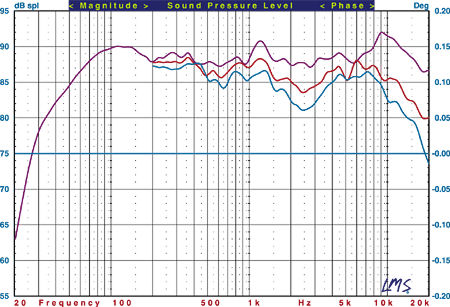
Looking at the measurements at
It would seem no toe in should help.
 
You are right But I cant afford a change.
I have to keep the speakers that are basically in Mint Condition.
To attenuate a high range that is a bit too much in evidence, a warm amplifier could somehow "soften" the sound. Marantz and Denon, for example, how do they sound?
I've read B&W+Rotel Is a very bad coupling.
Rotel is too much analitical Sound
B&W either do, or used to distribute Rotel in the UK if nowhere else...

I seem to recall response plots of the 602S3 showing a narrow 'spike' at 9 - 10kHz. if that's the case, you'll have a darned hard job minimising it I reckon. Firing them straight ahead and thereby sitting off axis may help if I read the plots right. (Chap above beat me to it :D )

903bw.fig1.jpg
 
I drive them with a Marantz PM400.
To have a balanced system, taking into account the "bright sound" of the speakers,is wise to have an amplifier with a warm sound?
Your amplifier might be a little underpowered if you listen at higher volumes, but if your amplifier operates within its specifications it will sound exactly the same as any other amplifier. Barring any extreme distortion of noise issues. In terms of frequency response its going to be flat.

So if you think your speakers are too bright either buy new speakers or try to correct it with a DSP/tonecontrols. The latter will be harder, especially with speaker that don't have smooth directivity.
 
You are right But I cant afford a change.
I have to keep the speakers that are basically in Mint Condition.
To attenuate a high range that is a bit too much in evidence, a warm amplifier could somehow "soften" the sound. Marantz and Denon, for example, how do they sound?
I've read B&W+Rotel Is a very bad coupling.
Rotel is too much analitical Sound
The whole amp/speaker "synergy" thing is a myth pushed by audio retailers to take a greater share of your wallet. Use EQ to achieve what you can with those speakers and a linear, clean amp (not terribly expensive).
 
You are right But I cant afford a change.
I have to keep the speakers that are basically in Mint Condition.
To attenuate a high range that is a bit too much in evidence, a warm amplifier could somehow "soften" the sound. Marantz and Denon, for example, how do they sound?
I've read B&W+Rotel Is a very bad coupling.
Rotel is too much analitical Sound
I used to install a lot of B&W and Rotel gear together. I always thought the Rotel gear sounded soft and pleasant when paired with speakers from other brands, such as Dynaudio etc..... with the B&W speakers, not so much. The B&W speakers were too sharp for my tastes until the D3 series arrived.

As mentioned above, an equalizer would seem to be your best, most cost effective bet.
 
The sound of the B&W speakers is not too bright. That is because the amp is too bright. Any high end speaker is capable of accurately expressing what it receives. Try an old amp that has not been rebuilt. You will find its sound very warm.
 
Thanhky1985,

1. You replied to a thread from 2022.

Any high end speaker is capable of accurately expressing what it receives. Try an old amp that has not been rebuilt. You will find its sound very warm.
2. You've got that completely backwards. ;) An amplifier's job is to amplify the sound signal without making any changes (ignoring tone controls or EQ). Most amplifiers are capable of that unless overdriven into clipping/distortion. (The amp in your avatar may be an exception. ;) ) With modern electronics it's cheap and easy to make good amp (depending on how much power you want).

Similarly, a speaker's job is to accurately convert electrical signals into sound. Speakers are not as good as amplifiers and you can almost always hear a difference between two speakers 9aor two different headphones). Speakers are generally the weak link. The main characteristic of speaker sound quality/character is on-axis and off-axis frequency response. The speaker interacts with room acoustics so it will sound different in a different room.

Some tube amps have (relatively) high output impedance (often expressed as a low damping factor). Since speaker impedance is not flat across the frequency range, if the amp's output impedance isn't low compared to the speaker (if the damping factor is too low) those impedance variations are translated to frequency response variations. So the speaker won't perform as-specified or as-tested with a good amp. If that happens to create a bump in the bass range you could end-up with what you might call a warm* sound but it's an unpredictable and uncontrollable way of applying bass boost or other EQ.


* Sometimes "warm" means a mid-bass boost, which is how I used to use the word. But some people describe slight "pleasing'' distortion as "warmth" so now I try to avoid the word. (And I try to avoid the thousands of other non-scientific undefined or poorly defined "audiophile" words.)
 
The sound of the B&W speakers is not too bright. That is because the amp is too bright. Any high end speaker is capable of accurately expressing what it receives. Try an old amp that has not been rebuilt. You will find its sound very warm.
Measurement, I.e. objective reality, disagrees. It departs from flat in the treble-so "too bright"vs. reference, or neutral. Virtually all of the modern models I’ve seen exhibit a treble hump like this. In all likelihood it is intentional to make it sound “revealing” in a showroom (but irritating to my ears).

It can be tamed with EQ.

Those humps are large. 1db is audible and the 5db here amounts to 1.78X the reference sound pressure.

So not only are they "too bright", they are much too bright.

1759249829137.png


1759251144987.png
 
Last edited:
Back
Top Bottom