
-
Welcome to ASR. There are many reviews of audio hardware and expert members to help answer your questions. Click here to have your audio equipment measured for free!
You are using an out of date browser. It may not display this or other websites correctly.
You should upgrade or use an alternative browser.
AuraEngine Converter
- Thread starter Erogen
- Start date

OP

Erogen
Active Member
- Joined
- Feb 9, 2026
- Messages
- 255
- Likes
- 60
- Thread Starter
- #162
The problem with Aura Engine is that trying to recommend this program on Facebook results in your account being blocked.
 toxadev.github.io
"Content cannot be shared because this link violates our Community Standards." - Facebook

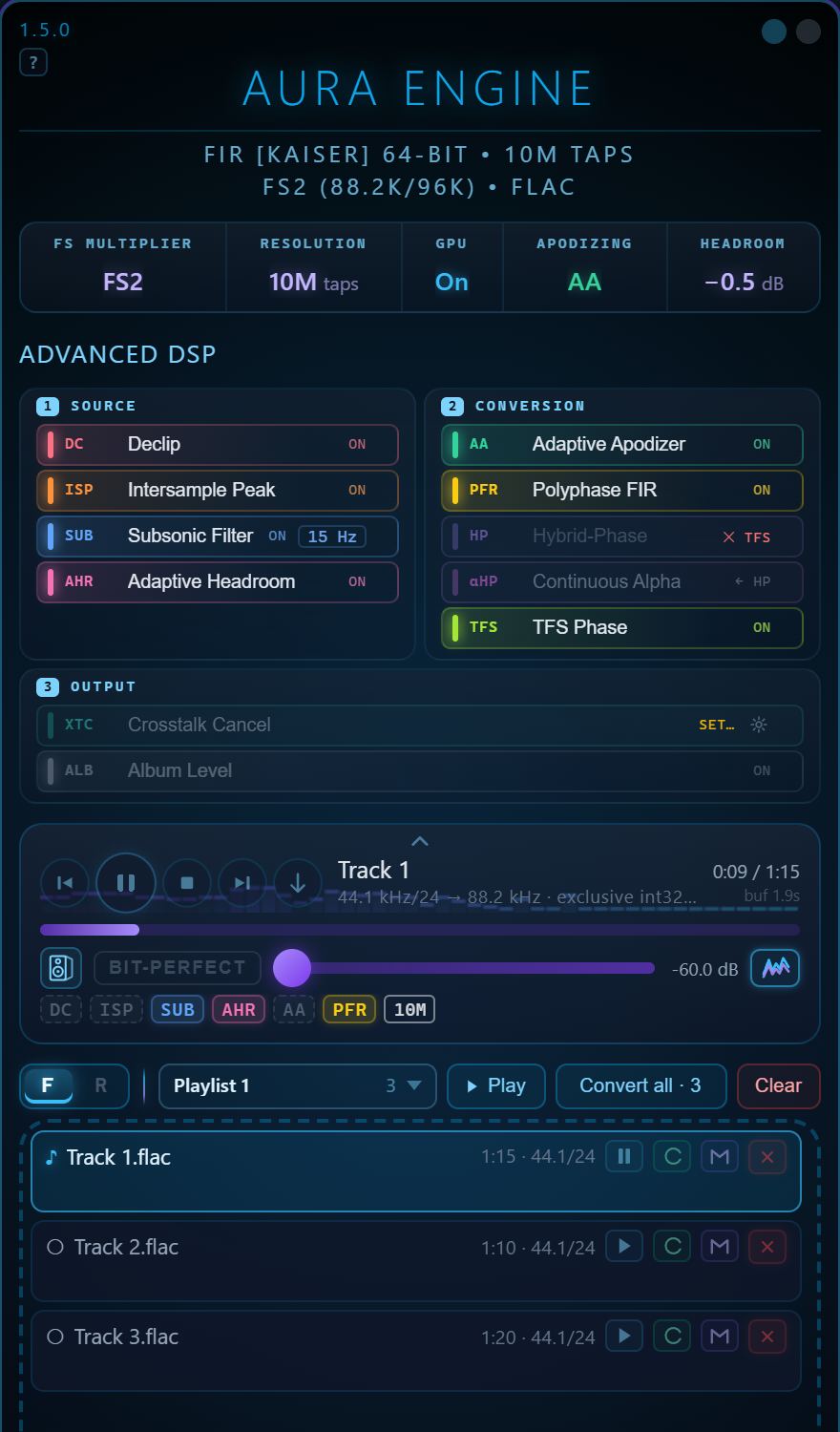
AuraEngine — FIR upsampler and player: 30M-tap filters on an ordinary CPU
Multistage upsampling: a 30M-tap filter at ×8 on 27 ms of CPU per second of music on four efficiency cores, no graphics card needed. Free for Windows.
"Content cannot be shared because this link violates our Community Standards." - Facebook

ToxaDev
Member
- Joined
- Apr 10, 2026
- Messages
- 39
- Likes
- 40
Thanks for trying to share it, and for letting me know.The problem with Aura Engine is that trying to recommend this program on Facebook results in your account being blocked.
AuraEngine — FIR upsampler and player: 30M-tap filters on an ordinary CPU
Multistage upsampling: a 30M-tap filter at ×8 on 27 ms of CPU per second of music on four efficiency cores, no graphics card needed. Free for Windows.
"Content cannot be shared because this link violates our Community Standards." - Facebook
That message comes from Facebook's automatic link filter, not from a person reading the page. Facebook doesn't say why it blocks a link, so this is my best guess. The site is on github.io, a shared domain where anyone can host a page, and it gets used a lot for phishing and fake "free software" downloads. On top of that, the page has about 40 direct download links (installers and filter zips). To an automated filter, that pattern looks like malware distribution.
What should work for now:
- Link the GitHub repo instead: https://github.com/ToxaDev/aura-engine
- If Facebook offers "Let us know" (or similar) under the block, that sends the link for review. Sometimes the block gets lifted.
ToxaDev
Member
- Joined
- Apr 10, 2026
- Messages
- 39
- Likes
- 40
Yes, on paper the spot is tight. The free-field model (computed, not measured in a room) says about 2 cm of head movement already costs roughly half of the cancellation.I thought XTC working required keeping your head within a very tight MLP?
My own experience is more relaxed: I sit normally in front of the speakers and still hear the effect within about ±15 cm. Sighted, one listener, no ABX. Off-centre it's probably no longer full cancellation, and part of what I hear may just be a wider side.
Speakers only, never headphones. And it's baked into the converted file for that one setup.
OP
Erogen
Active Member
- Joined
- Feb 9, 2026
- Messages
- 255
- Likes
- 60
- Thread Starter
- #166
I won’t be posting links to this program on Facebook, as Facebook has placed a 24-hour restriction on my ability to post replies.Thanks for trying to share it, and for letting me know.
That message comes from Facebook's automatic link filter, not from a person reading the page. Facebook doesn't say why it blocks a link, so this is my best guess. The site is on github.io, a shared domain where anyone can host a page, and it gets used a lot for phishing and fake "free software" downloads. On top of that, the page has about 40 direct download links (installers and filter zips). To an automated filter, that pattern looks like malware distribution.
What should work for now:
- Link the GitHub repo instead: https://github.com/ToxaDev/aura-engine
- If Facebook offers "Let us know" (or similar) under the block, that sends the link for review. Sometimes the block gets lifted.
Today, they extended that restriction to 72 hours.
ToxaDev
Member
- Joined
- Apr 10, 2026
- Messages
- 39
- Likes
- 40
You can use this link for shareI won’t be posting links to this program on Facebook, as Facebook has placed a 24-hour restriction on my ability to post replies.
Today, they extended that restriction to 72 hours.
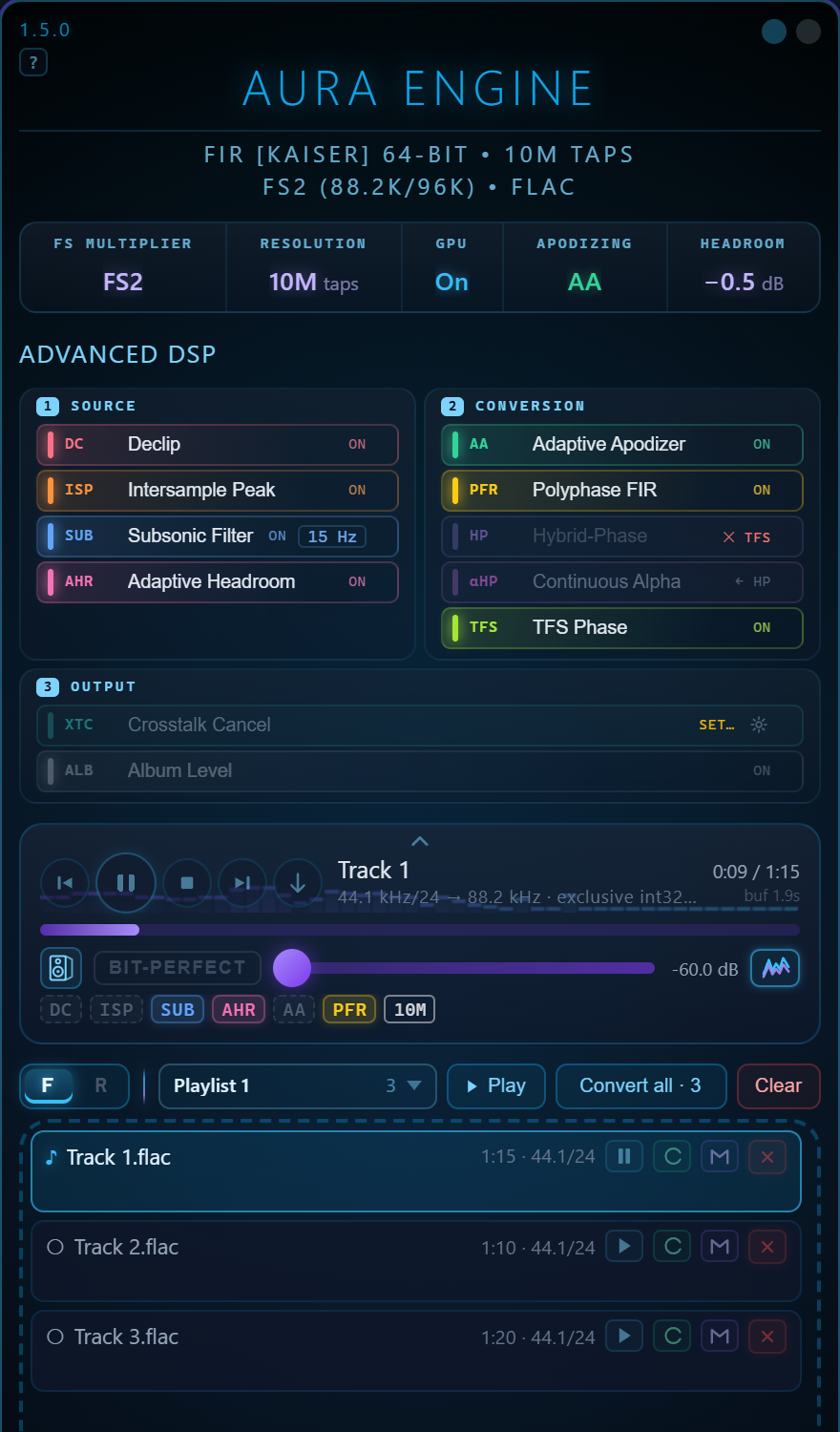
AuraEngine — FIR upsampler and player: 30M-tap filters on an ordinary CPU
Multistage upsampling: a 30M-tap filter at ×8 on 27 ms of CPU per second of music on four efficiency cores, no graphics card needed. Free for Windows, Linux and macOS.
OP
Erogen
Active Member
- Joined
- Feb 9, 2026
- Messages
- 255
- Likes
- 60
- Thread Starter
- #168
I will try once the restriction is removed.You can use this link for share
AuraEngine — FIR upsampler and player: 30M-tap filters on an ordinary CPU
Multistage upsampling: a 30M-tap filter at ×8 on 27 ms of CPU per second of music on four efficiency cores, no graphics card needed. Free for Windows, Linux and macOS.aura-engine.app
Stefano_Milano
Member
I noticed that the latest release also includes a parametric EQ and balance control. With XTC, nothing is missing anymore.
You can use it directly as a player without wasting time on conversions. On my little Acer Swift 3, the processor doesn't struggle at all, and the fan is practically always off.
was re XTC
so now nothing needs to be baked in? No need to run parallel libraries/playlists?it's baked into the converted file for that one setup.
Stefano_Milano
Member
Just two or three seconds from hitting play. All options enabled, except for adaptive headroom.but isn't there a lot of latency?
Loudness Contour autovariable with user adjustment of Volume level? See RME ADI-2 DAC, Schiit Forkbeard e.g. Mimir
Your quoting implies you're talking about a Loudness Contour functionJust two or three seconds from hitting play. All options enabled, except for adaptive headroom.
AFAIK not present in the "player part" of the project, hence my requesting that.
So if not, what were you intending to respond to with
> All options enabled, except for adaptive headroom.
?
I am aware of the processing delay, not a problem for me
Stefano_Milano
Member
I don’t have any particular technical expertise. I just wanted to say that I am using Aura-Engine as a player, and it works well—especially now that it includes an equalizer and balance control. I can easily set it to 30M taps without any issues.Your quoting implies you're talking about a Loudness Contour function
AFAIK not present in the "player part" of the project, hence my requesting that.
So if not, what were you intending to respond to with
> All options enabled, except for adaptive headroom.
?
I am aware of the processing delay, not a problem for me
The only option I don’t use is "Adaptive headroom."
ToxaDev
Member
- Joined
- Apr 10, 2026
- Messages
- 39
- Likes
- 40
@Stefano_Milano — thank you, and thanks for the push on balance; it came out of our conversation. Glad the Swift 3 stays quiet with it.
@john61ct — fair question. A long linear-phase FIR does delay the signal by half its length, and with our filters that would be anything from milliseconds to minutes. When you play a file, the player simply reads ahead, so the delay never reaches you. What you notice is the wait after pressing Play:
Where latency is real is the live path: the virtual ASIO input (foobar2000, Roon, JRiver, or Spotify through a bridge) outputs about 2.3–2.6 s after the source player, or 1.5 s without the subsonic filter (ASIO input). That's fine for music, but it's no good for video lip-sync, games or monitoring. For those, use something else; AuraEngine is built for listening to music.
Loudness contour: good suggestion. The Aura EQ has only a fixed "Loudness" preset at the moment. A version that follows the volume control, with a user-set reference level like the RME ADI-2's Loudness, fits well because the volume and the EQ already sit next to each other at the end of the chain. I've put it on the list. One caveat: if you set your volume on the DAC or amp and leave AuraEngine at 0 dB, the app can't know how loud you are listening. In that case it would rely on the manual offset.
@john61ct — fair question. A long linear-phase FIR does delay the signal by half its length, and with our filters that would be anything from milliseconds to minutes. When you play a file, the player simply reads ahead, so the delay never reaches you. What you notice is the wait after pressing Play:
- 30M taps, CPU only: first sound 0.4–0.8 s after Play on all cores of an i9-14900K, 1.2–1.9 s pinned to four efficiency cores (numbers).
- Hybrid-Phase with the instruments pack on a track it hasn't seen before: 5–7 s since 1.9.8, down from about 30 s, because the drum lists are now built in parts while the track plays (details).
- A seek keeps the old position playing until the new one is ready, then crossfades over about 250 ms (player behaviour).
Where latency is real is the live path: the virtual ASIO input (foobar2000, Roon, JRiver, or Spotify through a bridge) outputs about 2.3–2.6 s after the source player, or 1.5 s without the subsonic filter (ASIO input). That's fine for music, but it's no good for video lip-sync, games or monitoring. For those, use something else; AuraEngine is built for listening to music.
Loudness contour: good suggestion. The Aura EQ has only a fixed "Loudness" preset at the moment. A version that follows the volume control, with a user-set reference level like the RME ADI-2's Loudness, fits well because the volume and the EQ already sit next to each other at the end of the chain. I've put it on the list. One caveat: if you set your volume on the DAC or amp and leave AuraEngine at 0 dB, the app can't know how loud you are listening. In that case it would rely on the manual offset.
Thanks. I'm planning an active system that starts with a 2.1 stream, but gets upmixed to 5.1
and then each front LCR gets xover split to 3- or 4-way "stacks", plus the mono LF channel maybe 3-4 overlapping trueSub using say MSO to wrangle room modes, total say 20ch
The digital transport side at 24-bit gets very expensive, USB not being clock sync'd, with ADAT or S/PDIF going past 48Hz just to 96kHz even with AES can mean buying double the hardware costs per channel.
Thus IF thinking what AuraEngine does isvworthwhile, this layout means cannot use the conversion to static files, must be done live on the fly each playback session downstream of DSPs used for speaker EQ, crossovers, bass management and DRC.
I'm thinking "Modularised DSP" for AuraEngine using multiple RPi5 nodes out at the downstream edges, handling say 3-8 output channels each.
Possible? all feedback welcome.
ToxaDev
Member
- Joined
- Apr 10, 2026
- Messages
- 39
- Likes
- 40
Thanks for spelling it out — that's a serious system. Honest answer: not today, and not something I can promise soon.Thanks. I'm planning an active system that starts with a 2.1 stream, but gets upmixed to 5.1
and then each front LCR gets xover split to 3- or 4-way "stacks", plus the mono LF channel maybe 3-4 overlapping trueSub using say MSO to wrangle room modes, total say 20ch
The digital transport side at 24-bit gets very expensive, USB not being clock sync'd, with ADAT or S/PDIF going past 48Hz just to 96kHz even with AES can mean buying double the hardware costs per channel.
Thus IF thinking what AuraEngine does isvworthwhile, this layout means cannot use the conversion to static files, must be done live on the fly each playback session downstream of DSPs used for speaker EQ, crossovers, bass management and DRC.
I'm thinking "Modularised DSP" for AuraEngine using multiple RPi5 nodes out at the downstream edges, handling say 3-8 output channels each.
Possible? all feedback welcome.
- Channels. AuraEngine is stereo end to end: the rack, XTC, the EQ's balance and M/S, the ASIO input (two channels). A 20-channel graph with upmix, crossovers and bass management is a different program — CamillaDSP already does that well, including on a Pi.
- Where it would sit. Conceptually your layout is the right one for it: the reconstruction filter belongs last, right before each DAC, after the crossovers and DRC. And as long as every output uses the same linear-phase filter, it is a near-Nyquist low-pass identical on all ways, so it doesn't disturb crossover summing or MSO alignment. Hybrid-Phase would — it switches phase per transient, so it has no place inside a multi-way speaker.
- Latency. Live, the filter's delay is real: half its length. The live path today is about 1.5–2.6 s behind the source (ASIO input). Fine for music, not for video unless the video is delayed too.
- Pi 5. Never tried. For scale: a 30M filter at ×8 takes 27 ms of CPU per second of music for a stereo pair on four efficiency cores of an i9-14900K (numbers); a Pi 5 is several times slower per core and would run 2–4 pairs. Short filters (1M) look plausible; 30M I doubt.
- The hard part is the clock. Each node with its own USB DAC runs on its own crystal, so 20 channels across several boxes drift apart unless they share a word clock or are slaved over something like AES67/PTP — or each node runs an ASRC, which partly defeats the point. That's the part I'd solve first, and it's outside what AuraEngine does.
Yes I figured.
A "Stereo only Critical Music" mode switch for testing then, turn off the Center, RS and mono string, F-L/R "stacks" only
Latency is NP
The rest will be co-located separate single driver boxen, MBM Couplers from 70-80Hz, then two true subs 15Hz and up, split maybe at 45Hz?
Each stack's speaker EQ, crossovers, time/phase tweaking all handled upstream so each presentsvas ifca single cohesive full-range floorstander.
An RPi5 for each stack (or x86 nodes with more DSP capacity if 30M filters prove necessary)
dedicated to your upsampling, each RT sysClock sync'd to microseconds level via PTPv2, Grandmaster disciplined to nanoseconds level heartbeat via GPS, 1PPS + 10MHz inputs
each DSP outputs via mch DACs that are BNC word clocked.
No clock drift, nor ASRC used, for sure.
This setup requires no changes to AuraEngine as it stands now?
A "Stereo only Critical Music" mode switch for testing then, turn off the Center, RS and mono string, F-L/R "stacks" only
Latency is NP
The only multi-way enclosure is a pair of OG LS50 at the FR top of the F-L/R stacks, HPF'd ~ 180Hz.it has no place inside a multi-way speaker
The rest will be co-located separate single driver boxen, MBM Couplers from 70-80Hz, then two true subs 15Hz and up, split maybe at 45Hz?
Each stack's speaker EQ, crossovers, time/phase tweaking all handled upstream so each presentsvas ifca single cohesive full-range floorstander.
An RPi5 for each stack (or x86 nodes with more DSP capacity if 30M filters prove necessary)
dedicated to your upsampling, each RT sysClock sync'd to microseconds level via PTPv2, Grandmaster disciplined to nanoseconds level heartbeat via GPS, 1PPS + 10MHz inputs
each DSP outputs via mch DACs that are BNC word clocked.
No clock drift, nor ASRC used, for sure.
This setup requires no changes to AuraEngine as it stands now?
ToxaDev
Member
- Joined
- Apr 10, 2026
- Messages
- 39
- Likes
- 40
Clean plan — with PTP plus GPS and word-clocked DACs you've taken drift off the table, and with the LS50s high-passed and everything else single-driver, my Hybrid-Phase worry mostly goes away too. But no, it wouldn't work as AuraEngine stands today. What's missing on the AuraEngine side:Yes I figured.
A "Stereo only Critical Music" mode switch for testing then, turn off the Center, RS and mono string, F-L/R "stacks" only
Latency is NP
The only multi-way enclosure is a pair of OG LS50 at the FR top of the F-L/R stacks, HPF'd ~ 180Hz.
The rest will be co-located separate single driver boxen, MBM Couplers from 70-80Hz, then two true subs 15Hz and up, split maybe at 45Hz?
Each stack's speaker EQ, crossovers, time/phase tweaking all handled upstream so each presentsvas ifca single cohesive full-range floorstander.
An RPi5 for each stack (or x86 nodes with more DSP capacity if 30M filters prove necessary)
dedicated to your upsampling, each RT sysClock sync'd to microseconds level via PTPv2, Grandmaster disciplined to nanoseconds level heartbeat via GPS, 1PPS + 10MHz inputs
each DSP outputs via mch DACs that are BNC word clocked.
No clock drift, nor ASRC used, for sure.
This setup requires no changes to AuraEngine as it stands now?
- A live input on Linux. The player takes files, internet radio, or the virtual ASIO input, and that input is Windows-only. A Pi node has no way to receive your upstream DSP's stream.
- More than two channels. Each node's stack is 3–5 channels after the crossover, and the engine is stereo end to end. It opens the DAC exclusively, so you can't run one instance per pair on a multichannel DAC either.
- Headless operation. It's a desktop GUI app. A Pi node at the edge needs a service with a config file.
- ARM. Never built or tested on a Pi.
- Identical, fixed delay on every node, starting on the same sample.The player is built for one machine. Several things in it adapt per track or per load, and each one would desync your nodes:
- "Lower taps under load" drops 1G → 10M when the CPU falls behind, and that changes the delay mid-play.
- Hybrid-Phase, Declip, ISP and Adaptive Headroom decide from the signal they see. Your nodes see different bands, so they would decide differently.
Similar threads
- Replies
- 94
- Views
- 6K

- Replies
- 111
- Views
- 15K

- Replies
- 36
- Views
- 5K


- Replies
- 20
- Views
- 3K
