• Welcome to ASR. There are many reviews of audio hardware and expert members to help answer your questions. Click here to have your audio equipment measured for free!

Audio Lounge – SACD/Native DSD Player with Memory Playback & Its Own Network Audio Protocol

audio_lounge

Member
Audio Company
Joined
Sep 1, 2026
Messages
10
Likes
7
Audio Lounge – SACD/Native DSD Player with Memory Playback & Its Own Network Audio Protocol

Hi everyone,

I’d like to introduce Audio Lounge, a native music player for macOS and iPadOS focused on local libraries, Hi-Res PCM, DSD/SACD, and network audio.

Some of the key features:

  • Memory Playback
  • Gapless playback
  • Bit-perfect PCM
  • DSF / DFF / SACD ISO, including DST-compressed SACD
  • DoP and Native DSD
  • Up to DSD512, depending on hardware
  • Direct playback from local storage, external drives, NAS and SMB shares
One part I wanted to highlight is that I didn’t just add network playback on top of the app — I built a dedicated network audio protocol for Audio Lounge, called HALO (Hi-Res Audio Loop Output).

Conceptually, it serves a similar purpose to the network audio architectures used by systems such as Roon or HQPlayer: the player/controller can be separated from the machine physically connected to the DAC.

For example:

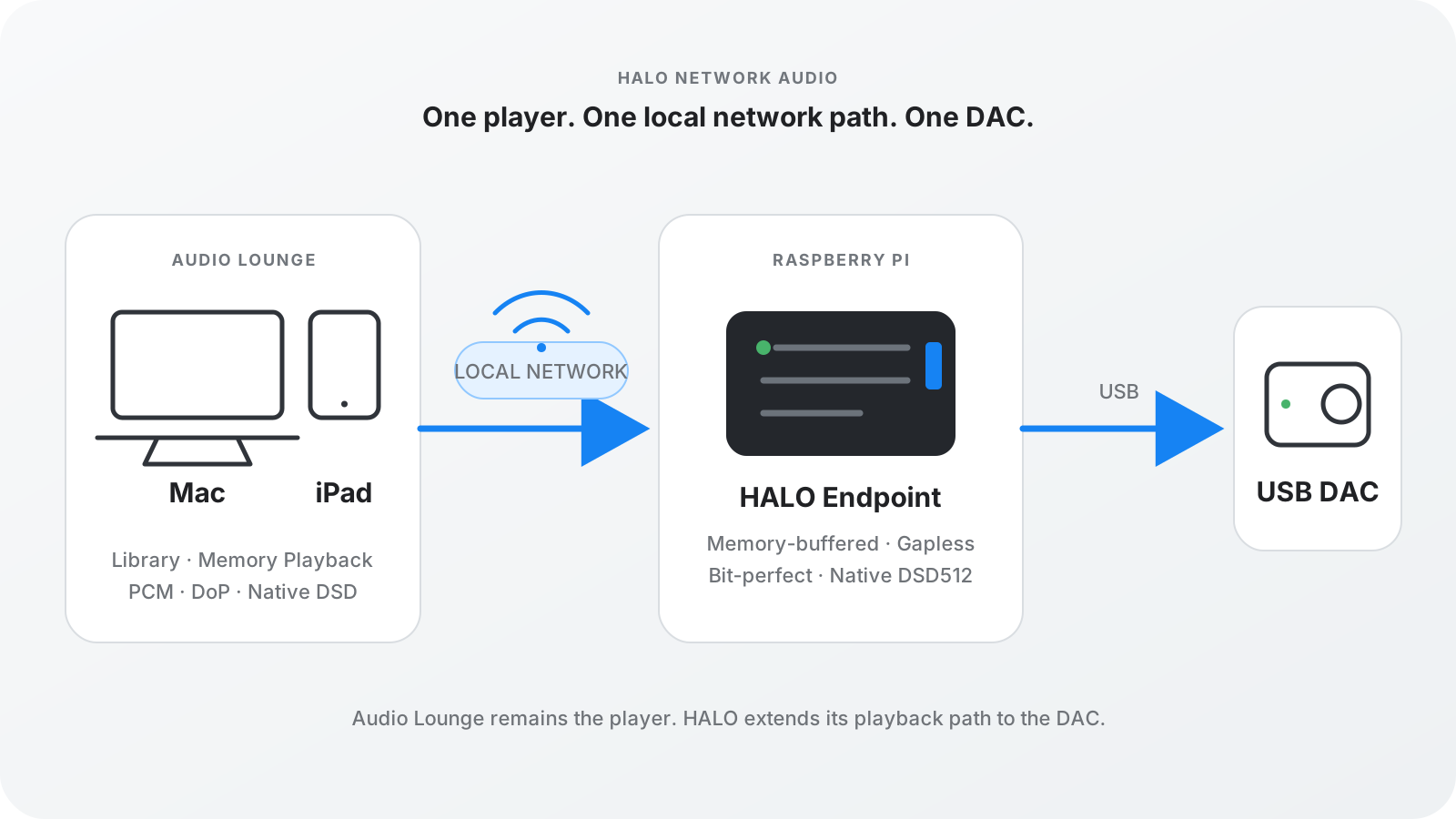
Mac/iPad running Audio Lounge → Network → HALO Endpoint → USB DAC

HALO supports bit-perfect PCM and Native DSD up to DSD512, with lightweight macOS and Linux endpoints.

So an iPad or Mac can handle the library and playback interface, while a small dedicated machine near the audio system handles the DAC connection.

Audio Lounge is designed around music you own rather than streaming, and SACD ISO can be played directly without extracting it into individual DSF files first.

I’m posting here because I’d really appreciate technical feedback from the ASR community, particularly around bit-perfect output, gapless playback, DSD/DoP compatibility, SACD ISO support, and HALO network stability.

Website: https://audiolounge.app
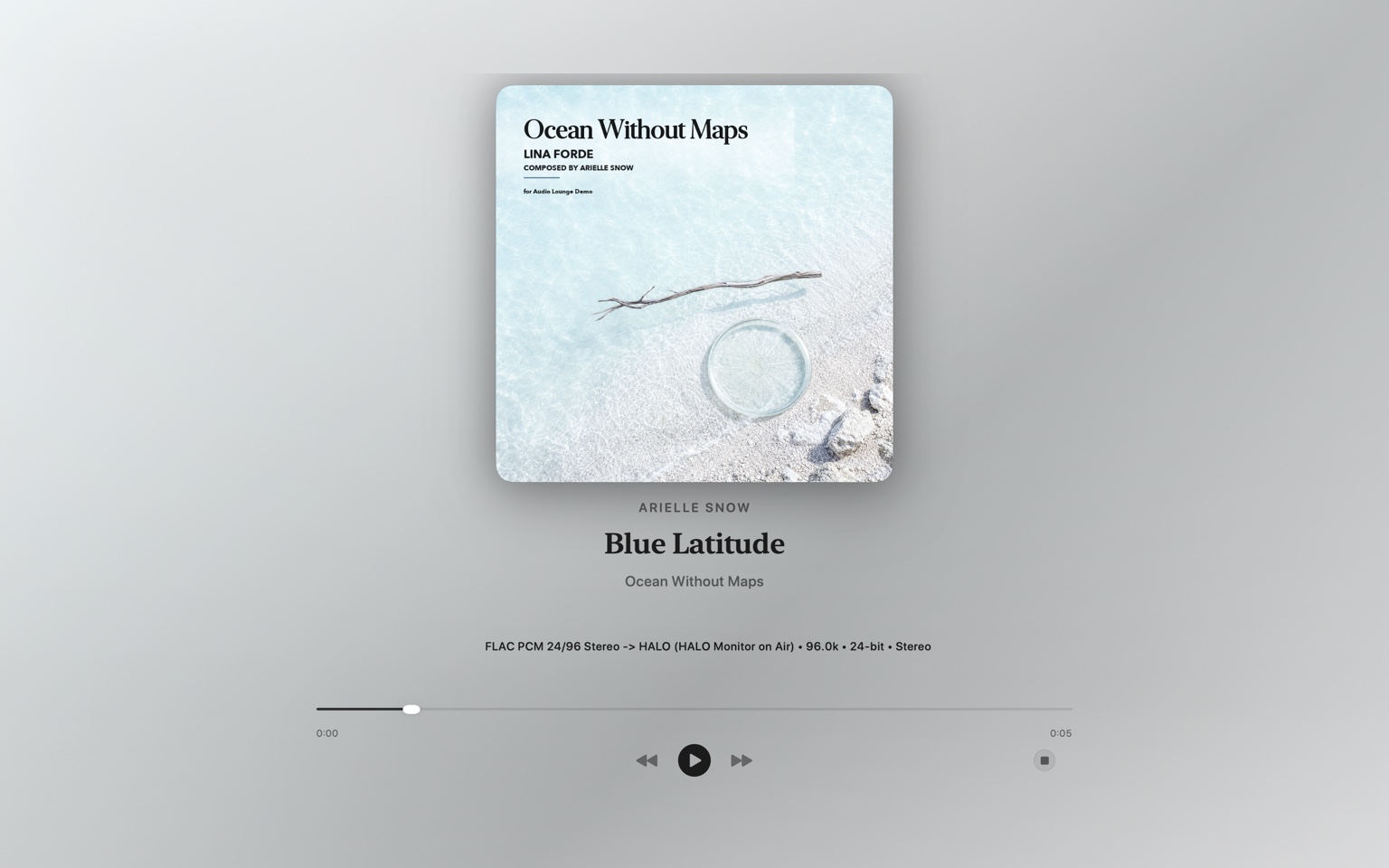
mac-halo-now-playing.jpg
Audio Lounge on Mac or iPad sends audio over the local network to a Raspberry Pi running HALO, then to a USB DAC
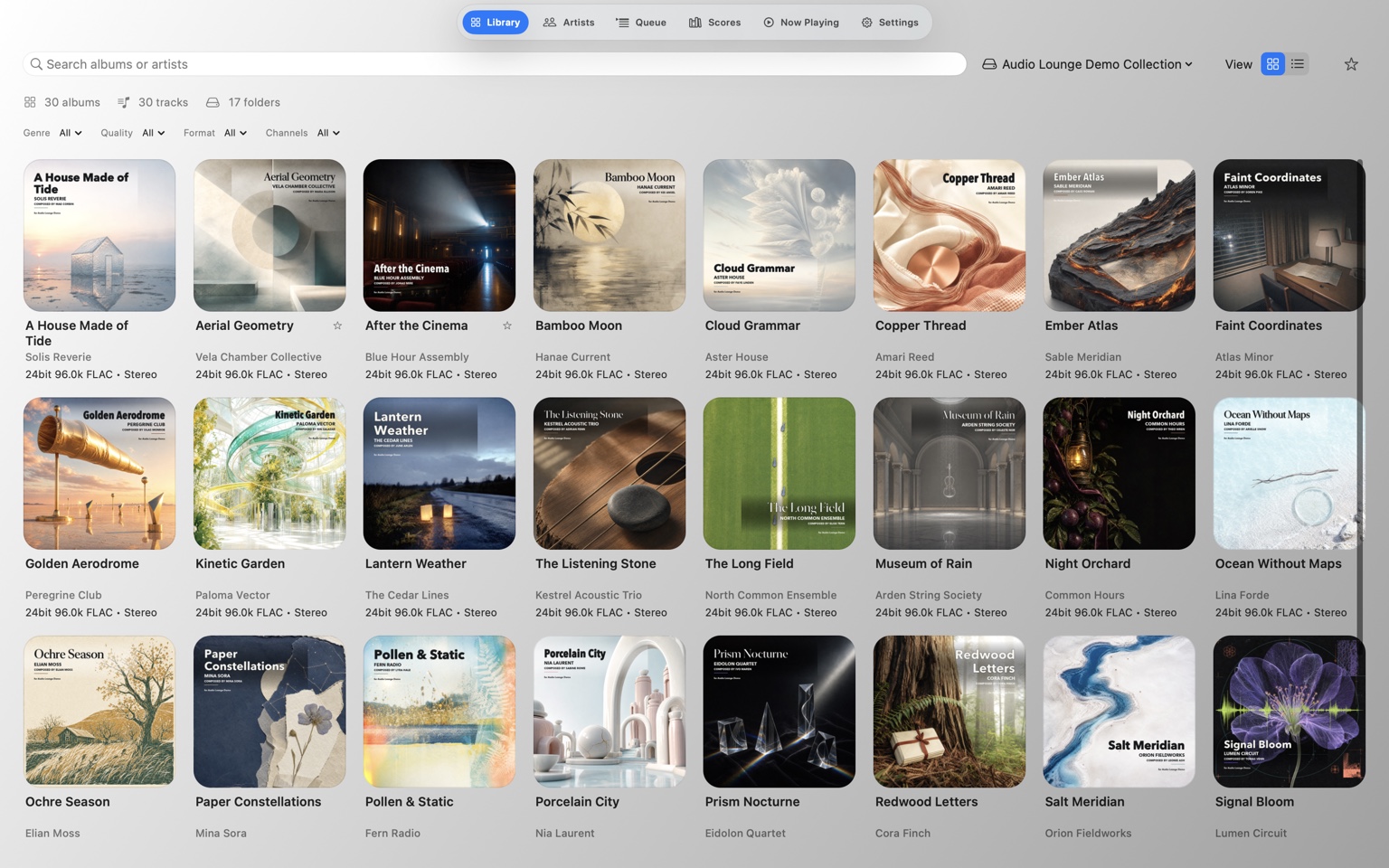
Audio Lounge 1.1.1 library on Mac

Happy to answer technical questions or hear about DAC/NAS setups that would be interesting to test.
 
I am too old to start learning about such stuff. Mine is modest. I still play music in a AMD 486 machine running DOS 7.10 with Mpxplay (several versions) and Soundblaster 16. It has been so since 25 years ago and I like as is.
In any case, thank you and good luck.
 
I am too old to start learning about such stuff. Mine is modest. I still play music in a AMD 486 machine running DOS 7.10 with Mpxplay (several versions) and Soundblaster 16. It has been so since 25 years ago and I like as is.
In any case, thank you and good luck.
Wow, DOS 7.10!!, I still remember when I used DOS 6.22. and play CD-ROM. Good old time!
 
I think that's the first time I've heard MacOS described as lightweight. Compared to Windows perhaps? Is there a reason not to have a cross-platform server like the endpoint?

I'm curious why you decided to create yet another protocol rather than using one of the existing ones. For example Slimproto/LMS can do almost everything in your key features list, and extending its DSDPlayer plugin could add the missing SACD ISO support.
 
Good questions — let me take them one by one.

"Lightweight macOS" — fair catch, sloppy wording on my part. I meant the HALO *endpoint daemon* is lightweight (small footprint, happy on a Raspberry Pi), not that macOS is a lightweight OS.

Why a new protocol instead of Slimproto/LMS? It's really a design-philosophy difference. LMS is a server architecture: the server owns the session and the playback pipeline. I wanted the opposite — the playback engine living in the app in your hand, not on a server somewhere. Memory Playback, decoding, format decisions all happen in Audio Lounge; HALO just extends its prepared audio path to the DAC, like "a long virtual USB audio cable." No second library, no separate core, no other system to manage. Adopting Slimproto would have meant adopting that server model. Nothing wrong with it — LMS does its job well — it's just a different architecture from the one I wanted to build.

There are technical reasons too. One goal was carrying raw native DSD up to DSD512 end-to-end. Slimproto's DSD story is DoP, which packs DSD into 24-bit PCM frames with 8 bits of framing markers — wasting ~50% wire bandwidth — and at DSD512 it would need a 1411.2 kHz PCM carrier that no real chain supports.

The endpoint does the simplest possible job: take the prepared stream and feed it to the DAC. All the intelligence lives in the app. But because both ends speak the same purpose-built protocol, they can still cooperate on app-specific behaviors a generic protocol can't offer. One example: the endpoint keeps a deep buffer, so a brief network drop never reaches your ears — it keeps playing from the buffer while the link re-establishes, and playback simply never stops. That only works because the app and the endpoint were designed together.

Why no cross-platform server? There is no server — that's the point. The Mac/iPad app is the entire system; the endpoint is just a dumb audio output next to the DAC. Nothing to port.
 
Last edited:
Fair enough. It's not for me due to intentionally limited scope, and not being an Apple user.

I hadn't looked into the details of LMS DSD support, but saving bandwidth is a decent reason. I tend to avoid DSD as it seems pointless, and has the drawback of not being able to apply DSP without first converting to PCM. If I'm going to do that anyway I may as well convert once and store that in the library. MQA is likewise pointless and best avoided unless you can first decode it in software. I don't see any reason not to use DSP and/or software volume control, both of which inherently break bit-perfection. I can't really comment on HALO without a protocol specification.
 
Totally fair — there are many great options on Windows. I use Apple platforms primarily, and that's why I built it for them: local libraries, bit-perfect output, gapless, memory playback, upsampling etc.

On DSD: I'm not claiming it sounds better than well-converted PCM — the point is just to not make the choice for you. If your DAC handles native DSD and you have SACDs, you can play them as-is; if you'd rather convert once and store PCM, that's equally valid, and the app plays that bit-perfectly too. The point is preserving the option, not prescribing it.

On DSP: the app doesn't do its own DSP — volume control can go through the iOS/macOS system as one option, or bypass the system straight to the DAC. Software volume breaks bit-perfection by definition, which is a fine trade-off if you want it.

On HALO — fair point, there's no published wire spec, but at a high level it works like this: the app stays the player — library, decoding, format decisions and Memory Playback all happen in Audio Lounge. The endpoint is a lightweight daemon beside the DAC: discovered via mDNS (_halo._tcp), it receives the prepared PCM or raw DSD stream over the network, buffers it deeply, and feeds it straight to the ALSA hardware device. No server, no second library, no playlist logic on the endpoint. Happy to go into more detail if there's interest.
 
Okay what apple products play SACD ?
Sorry for the confusion — Audio Lounge is a player app: software for Mac and iPad, not hardware. No Apple product plays physical SACD discs. The app plays SACD ISO files (disc images) and sends the audio to a USB DAC.
 
Sorry for the confusion — Audio Lounge is a player app: software for Mac and iPad, not hardware. No Apple product plays physical SACD discs. The app plays SACD ISO files (disc images) and sends the audio to a USB DAC.
Thanks for the clarification. Seems a pretty small market segment?
 
Yes, it's a niche — deliberately so. I'm an independent developer; the app doesn't need a mass market to be sustainable.

And SACD is just one format it plays — the app handles your whole local library: Hi-Res PCM, DSF/DFF/DSD, gapless, bit-perfect output to your speakers, headphones, or USB DAC.
 
Yes, it's a niche — deliberately so. I'm an independent developer; the app doesn't need a mass market to be sustainable.

And SACD is just one format it plays — the app handles your whole local library: Hi-Res PCM, DSF/DFF/DSD, gapless, bit-perfect output to your speakers, headphones, or USB DAC.
That's what threw me off as without a disc player, it's not SACD.....but not an apple guy in any case but good luck!
 
Totally fair — there are many great options on Windows.
I'm not a Windows user either, but still there are plenty of options.
On DSP: the app doesn't do its own DSP — volume control can go through the iOS/macOS system as one option, or bypass the system straight to the DAC. Software volume breaks bit-perfection by definition, which is a fine trade-off if you want it.

On HALO — fair point, there's no published wire spec, but at a high level it works like this: the app stays the player — library, decoding, format decisions and Memory Playback all happen in Audio Lounge. The endpoint is a lightweight daemon beside the DAC: discovered via mDNS (_halo._tcp), it receives the prepared PCM or raw DSD stream over the network, buffers it deeply, and feeds it straight to the ALSA hardware device. No server, no second library, no playlist logic on the endpoint. Happy to go into more detail if there's interest.
So presumably if someone is using a system-wide DSP option for iOS/macOS they have the option to use that DSP, but to use DSP on the Pi-based network endpoint they would have to modify the OS image to include whatever DSP system they wanted.
 
I'm not a Windows user either, but still there are plenty of options.

So presumably if someone is using a system-wide DSP option for iOS/macOS they have the option to use that DSP, but to use DSP on the Pi-based network endpoint they would have to modify the OS image to include whatever DSP system they wanted.
Good question. On the Mac/iPad, the system audio path is exactly that — system volume and any system-wide DSP apply if you go through it; the bypass-to-DAC path skips the system entirely, which is the bit-perfect route.

On the endpoint side, no image modification needed: DSP would live in the app, not the endpoint. DSP in the app is limited to optional upsampling today (alongside optional DSD-to-PCM conversion), and any DSP would go there too, before the prepared stream is handed off. The endpoint stays what it is — take the stream and feed it to the ALSA hardware device.
 
I’ve released Audio Lounge 1.1.3 for Mac and iPad.

This is a focused maintenance release rather than a major feature update. It fixes several library-related edge cases and improves overall reliability.

What’s improved in 1.1.3:

  • Fixed an issue where album tracks could fail to appear after restoring the library database.
  • Improved recognition of multi-disc albums stored in numerically named folders.
  • Additional stability and reliability fixes throughout the app.
Audio Lounge remains focused on locally owned music libraries, with support for local storage, external drives, NAS/SMB shares, Hi-Res PCM, DSD, SACD ISO, USB DAC output, and HALO network audio.

The free version now provides a 30-second preview of every track. A one-time purchase unlocks full-length playback. There is no subscription and no album-count limit.

Mac:
https://apps.apple.com/us/app/audio-lounge/id6767935421?mt=12

iPad:
https://apps.apple.com/us/app/audio-lounge-air/id6797962758

More information:
https://audiolounge.app/

Disclosure: I’m the developer of Audio Lounge. Feedback and bug reports are always welcome.
 
Back
Top Bottom