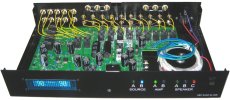
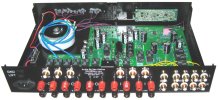
This is a review and measurements of the Audio by Van Alstine (AVA) ABX Comparator. It is discontinued but I purchased it for US $1,300.

This is a multipurpose AB testing device, capable of switching and level matching both amplifiers and sources:

This it third and last known ABX comparator that I know of. Reviewer, Josh Mound used this very box to perform blind testing of a few DACs. Results were remarkable with reviewer being able to confidently tell the DACs apart going way past any conventional wisdom. With the exception of two tests which were 15 correct outcomes out of 16, the rest were 16 out of 16! As a trained listener, even when I find differences between files, it is very difficult to get such perfect scores when differences become vanishingly small.
As you can imagine, massive thread was generated on validity of the results and potential for errors that would lead to such extreme results. Ultimately though, we could not get far just reading the words of the self administrating tester. I won't bore you with the details but eventually members and I managed to purchase the comparator to test.
I am going to reveal the punchline now. Josh in his article mentions: " A small, uniform click sounds with every button press, concealing whether an actual switch has occurred." This is key as switching is done by a relay which can naturally sound different when pulled closed by a magnetic field and then let back open via a spring. One of the earliest adopters of ABX testing was the Boston Audio Society. They put a subjectivist under ABX testing with professor Vanderkooy as a guest observer. Even though the subject failed the test, Vanderkooy made this critical observation:
"I expressed my desire to try the test, and Remington went to cue up the record again, but I requested to be allowed to undertake the test with no signal passing though the system. Before realizing the import of what he was saying, Vanderkooy interjected: "Ah! You're going to listen to the sound of the relays." Yes, there is indeed a slight audible difference between the acoustic "click" made when the "A" and "B" relays pull in. This is due to the unavoidable differences in the mounting positions of the relay on the A/B/X box chassis and, although slight, it can be heard if one listens for it. I replied that I was going to listen to the difference in background hiss, and the subsequent series of blind trials showed conclusively that the two signal paths could be reliably distinguished on this basis alone."
Naturally I tested the same by pressing the 1 and 2 buttons on the remote which switch sources. The distinction was clear. In one direct the sound went "up" with more of a high frequency accent and the other more muted droop. I wanted to make sure I was right so I invited my wife to come and listen. I told her to listen to the sound and that there could, or could not be a difference. She immediately said they sounded different. Wanting to make sure I asked her what the difference was and she explained it exactly as I did! I tried recording the sound using my phone but the mic is not good enough to record the full spectrum.
Now, if you have the unit far away and using it to switch amplifiers while playing loud, you may have a hard time hearing the difference. But in close proximity, testing DACs with headphones/IMEs, it would be trivial to intentionally game the system and listen for the relay difference. The device makes this easy as you can go backward in the sequence so even if you forgot what the last relay sounded like, you can refresh your memory.
The system is simply not fit for any testing for external publishing. For your own, you can choose to block the sound and such. But as evidence of audible difference in sources at least, it is useless.
I also have to wonder how someone who says he can tell the difference between DACs can't hear differences between relay clicks!
Basically the job is done now but let's measure the thing while we have it anyway.
Audio by Van Alstine ABX Comparator Measurements
I set the level to max 99 and fed the input A 2 volts and measured output A:

I expected less than stellar performance but this is entirely too much distortion. There is also a bunch of power supply noise which I could not impact with any grounding scheme. I think in the long thread we talked about poor routing of cables and such, making the unit susceptible to noise pick up.
Yes, it is the same impact on both devices under test but surely this level of distortion easily dwarfs distortion spikes in original DACs that are orders of magnitude lower. As a way of reference, this is the dashboard for one of the DACs tested by the reviewer:

Noise performance is not bad but again not appropriate for testing DACs and some high performance amplifiers:

We were told that there were passive attenuators used for level matching. So I tested frequency response at different levels of attenuation:

If you are a young person and have to really adjust levels down, then it is possible that you can tell the impact on that source due to roughly 0.4 dB extra attenuation at 20 KHz.
I didn't see a reason to keep testing.
EDIT: I performed some listening tests and additional measurements, showing variable output impedance impacting level matching: https://www.audiosciencereview.com/...tine-abx-comparator-review.73737/post-2695263
Conclusions
It should be obvious that there was no reason for us to go through the expense and effort of testing this ABX comparator. There is clear mechanical noise which gives away the identity of the source. The reviewer claim that the sound is "uniform" shows either extremely poor ability to listen for differences, or dishonest reporting of the device characteristic.
Even ignoring that, the measurements show dramatic level of distortion and to some extent, noise, impacting source DACs. We are talking whopping 50 dB extra distortion! Heck, you could almost replace the comparator with a tube amp and more or less be just as badly situated. No way any characteristics of the original DAC sound is left to analyze. Any super human detection ability would be seriously offended by this massive increase in distortion. The fact that the reviewer was not experiencing such, shows lack of ability to hear clear impairments. We could use this as some kind of control and dismiss the listener as not being qualified to enter the next phase of detecting differences in DACs.
Much thanks to member @NTTY for initiating and helping fund purchase of the comparator.
Not that you could buy one but if you wanted to, better wait for the community version being designed.
------------
As always, questions, comments, recommendations, etc. are welcome.
Appreciate any donations using: https://www.audiosciencereview.com/forum/index.php?threads/how-to-support-audio-science-review.8150/
This is a multipurpose AB testing device, capable of switching and level matching both amplifiers and sources:
This it third and last known ABX comparator that I know of. Reviewer, Josh Mound used this very box to perform blind testing of a few DACs. Results were remarkable with reviewer being able to confidently tell the DACs apart going way past any conventional wisdom. With the exception of two tests which were 15 correct outcomes out of 16, the rest were 16 out of 16! As a trained listener, even when I find differences between files, it is very difficult to get such perfect scores when differences become vanishingly small.
As you can imagine, massive thread was generated on validity of the results and potential for errors that would lead to such extreme results. Ultimately though, we could not get far just reading the words of the self administrating tester. I won't bore you with the details but eventually members and I managed to purchase the comparator to test.
I am going to reveal the punchline now. Josh in his article mentions: " A small, uniform click sounds with every button press, concealing whether an actual switch has occurred." This is key as switching is done by a relay which can naturally sound different when pulled closed by a magnetic field and then let back open via a spring. One of the earliest adopters of ABX testing was the Boston Audio Society. They put a subjectivist under ABX testing with professor Vanderkooy as a guest observer. Even though the subject failed the test, Vanderkooy made this critical observation:
"I expressed my desire to try the test, and Remington went to cue up the record again, but I requested to be allowed to undertake the test with no signal passing though the system. Before realizing the import of what he was saying, Vanderkooy interjected: "Ah! You're going to listen to the sound of the relays." Yes, there is indeed a slight audible difference between the acoustic "click" made when the "A" and "B" relays pull in. This is due to the unavoidable differences in the mounting positions of the relay on the A/B/X box chassis and, although slight, it can be heard if one listens for it. I replied that I was going to listen to the difference in background hiss, and the subsequent series of blind trials showed conclusively that the two signal paths could be reliably distinguished on this basis alone."
Naturally I tested the same by pressing the 1 and 2 buttons on the remote which switch sources. The distinction was clear. In one direct the sound went "up" with more of a high frequency accent and the other more muted droop. I wanted to make sure I was right so I invited my wife to come and listen. I told her to listen to the sound and that there could, or could not be a difference. She immediately said they sounded different. Wanting to make sure I asked her what the difference was and she explained it exactly as I did! I tried recording the sound using my phone but the mic is not good enough to record the full spectrum.
Now, if you have the unit far away and using it to switch amplifiers while playing loud, you may have a hard time hearing the difference. But in close proximity, testing DACs with headphones/IMEs, it would be trivial to intentionally game the system and listen for the relay difference. The device makes this easy as you can go backward in the sequence so even if you forgot what the last relay sounded like, you can refresh your memory.
The system is simply not fit for any testing for external publishing. For your own, you can choose to block the sound and such. But as evidence of audible difference in sources at least, it is useless.
I also have to wonder how someone who says he can tell the difference between DACs can't hear differences between relay clicks!
Basically the job is done now but let's measure the thing while we have it anyway.
Audio by Van Alstine ABX Comparator Measurements
I set the level to max 99 and fed the input A 2 volts and measured output A:
I expected less than stellar performance but this is entirely too much distortion. There is also a bunch of power supply noise which I could not impact with any grounding scheme. I think in the long thread we talked about poor routing of cables and such, making the unit susceptible to noise pick up.
Yes, it is the same impact on both devices under test but surely this level of distortion easily dwarfs distortion spikes in original DACs that are orders of magnitude lower. As a way of reference, this is the dashboard for one of the DACs tested by the reviewer:
Noise performance is not bad but again not appropriate for testing DACs and some high performance amplifiers:
We were told that there were passive attenuators used for level matching. So I tested frequency response at different levels of attenuation:
If you are a young person and have to really adjust levels down, then it is possible that you can tell the impact on that source due to roughly 0.4 dB extra attenuation at 20 KHz.
I didn't see a reason to keep testing.
EDIT: I performed some listening tests and additional measurements, showing variable output impedance impacting level matching: https://www.audiosciencereview.com/...tine-abx-comparator-review.73737/post-2695263
Conclusions
It should be obvious that there was no reason for us to go through the expense and effort of testing this ABX comparator. There is clear mechanical noise which gives away the identity of the source. The reviewer claim that the sound is "uniform" shows either extremely poor ability to listen for differences, or dishonest reporting of the device characteristic.
Even ignoring that, the measurements show dramatic level of distortion and to some extent, noise, impacting source DACs. We are talking whopping 50 dB extra distortion! Heck, you could almost replace the comparator with a tube amp and more or less be just as badly situated. No way any characteristics of the original DAC sound is left to analyze. Any super human detection ability would be seriously offended by this massive increase in distortion. The fact that the reviewer was not experiencing such, shows lack of ability to hear clear impairments. We could use this as some kind of control and dismiss the listener as not being qualified to enter the next phase of detecting differences in DACs.
Much thanks to member @NTTY for initiating and helping fund purchase of the comparator.
Not that you could buy one but if you wanted to, better wait for the community version being designed.
------------
As always, questions, comments, recommendations, etc. are welcome.
Appreciate any donations using: https://www.audiosciencereview.com/forum/index.php?threads/how-to-support-audio-science-review.8150/
Last edited: