This is a review, detailed measurements, listening tests and equalization for Arendal 1610 SLIM 8 speaker. It was sent to me by the company and costs US $2,800 for a pair.

This doesn't come across in the picture but this is an incredibly well built and solid speaker. The design is gorgeous as well with a curved front panel. And that 8 inch woofer surround.... is way too manly to belong in such a compact enclosure! As the name indicates, this is the shallow version of 1610 with just 6.5 inches of depth. Back panel shows screw mounts indicating ideal application for attaching to walls in a home theater (especially for side surrounds):

It is very difficult to find shallow high performance speakers and we have an example of it here.
Arendal 1610 SLIM 8 Speaker Measurement
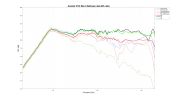
As usual, we start with our anechoic frequency response measurements:

EDIT: Sensitivity should say 85 dB.
The combo mid-range and tweeter module delivers nearly flat response but its integration with the woofer shows a dip near 300 Hz. There is also a dip around 13 kHz in tweeter response. But overall, this is very close to what we want to see.
Off-axis response again shows the low frequency dip to be a deviation:

It seems to balance out very well in predicted in-room response if you ignore that:

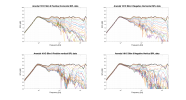
In power sweeps, I was most impressed by the absence of much audible distortion in bass which we can see in the measurements:


Typical ported bookshelf speaker reaches and exceeds 100% distortion. Here, is far more controlled.
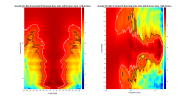
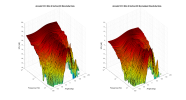
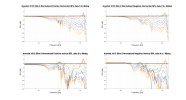
Beam width is not super even:


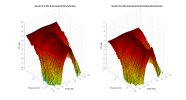
And despite inclusion of a mid-range, vertical directivity still mandates listening at tweeter axis:

Impedance dips quite low to 2.8 ohm:

Combined with slightly lower sensitivity than normal and you better have stout amplification driving the SLIM 8.
Arendal 1610 SLIM 8 Listening Tests and Equalization
On first listen, the 1610 sounded very good. I threw sub-bass at it and while it did not play it very loud, distortion was minimal. But I was curious about the frequency response errors so applied a couple of filters by eye:

Bass was now full, resulting in warmer sound but then treble came in with more detail and air. Kind of a mild "showroom sound" addition that was at the border of how far I would want to go with it. Likely for longer term listening, I would turn down the treble a bit.
I was curious if a machine would do better so asked ChatGPT Pro to create filters. Even though I instructed it to give me just two filters, it ignored that and gave me 6!

This EQ sounded more neutral but at the same time, a bit less exciting. I would put it half-way between no EQ and my EQ. It is certainly a better baseline than out of box tuning. I need to instruct it in the future to not give me more than one decimal place.
BTW, you can do the same. Just feed it my exported frequency response measurements and ask it to produce this (I told it to normalize on-axis but it chose to do listening window).
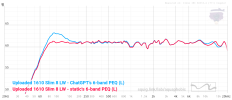
Unlike my version, you get to see before an after response as computed by ChatGPT:

Note that the low frequency correction may need modifications due to your room response.
With these filters in place, every one of my reference tracks sounded beautiful. And I was able to go to max volume on my Topping LA90 amplifier. It ran out of power before it bothered SLIM 8 in the slightest.
Conclusions
The SLIM 8 comes beautifully and powerfully packages in a hard to find shallow, sealed enclosure. Objective measurements show only a couple of minor flaws that are easily corrected in EQ. Once there, you have an excellently sounding speaker ready to go on your wall or any other place where shallow depth is beneficial. Cost is up there but so is the component and build quality.
I am going to recommend the Arendal 1610 SLIM 8 speaker.
-----------
As always, questions, comments, recommendations, etc. are welcome.
Any donations are much appreciated using: https://www.audiosciencereview.com/forum/index.php?threads/how-to-support-audio-science-review.8150/
This doesn't come across in the picture but this is an incredibly well built and solid speaker. The design is gorgeous as well with a curved front panel. And that 8 inch woofer surround.... is way too manly to belong in such a compact enclosure!
As the name indicates, this is the shallow version of 1610 with just 6.5 inches of depth. Back panel shows screw mounts indicating ideal application for attaching to walls in a home theater (especially for side surrounds):It is very difficult to find shallow high performance speakers and we have an example of it here.
Arendal 1610 SLIM 8 Speaker Measurement
As usual, we start with our anechoic frequency response measurements:
EDIT: Sensitivity should say 85 dB.
The combo mid-range and tweeter module delivers nearly flat response but its integration with the woofer shows a dip near 300 Hz. There is also a dip around 13 kHz in tweeter response. But overall, this is very close to what we want to see.
Off-axis response again shows the low frequency dip to be a deviation:
It seems to balance out very well in predicted in-room response if you ignore that:
In power sweeps, I was most impressed by the absence of much audible distortion in bass which we can see in the measurements:
Typical ported bookshelf speaker reaches and exceeds 100% distortion. Here, is far more controlled.
Beam width is not super even:
And despite inclusion of a mid-range, vertical directivity still mandates listening at tweeter axis:
Impedance dips quite low to 2.8 ohm:
Combined with slightly lower sensitivity than normal and you better have stout amplification driving the SLIM 8.
Arendal 1610 SLIM 8 Listening Tests and Equalization
On first listen, the 1610 sounded very good. I threw sub-bass at it and while it did not play it very loud, distortion was minimal. But I was curious about the frequency response errors so applied a couple of filters by eye:
Bass was now full, resulting in warmer sound but then treble came in with more detail and air. Kind of a mild "showroom sound" addition that was at the border of how far I would want to go with it. Likely for longer term listening, I would turn down the treble a bit.
I was curious if a machine would do better so asked ChatGPT Pro to create filters. Even though I instructed it to give me just two filters, it ignored that and gave me 6!
This EQ sounded more neutral but at the same time, a bit less exciting. I would put it half-way between no EQ and my EQ. It is certainly a better baseline than out of box tuning. I need to instruct it in the future to not give me more than one decimal place.
BTW, you can do the same. Just feed it my exported frequency response measurements and ask it to produce this (I told it to normalize on-axis but it chose to do listening window).
Unlike my version, you get to see before an after response as computed by ChatGPT:
Note that the low frequency correction may need modifications due to your room response.
With these filters in place, every one of my reference tracks sounded beautiful. And I was able to go to max volume on my Topping LA90 amplifier. It ran out of power before it bothered SLIM 8 in the slightest.
Conclusions
The SLIM 8 comes beautifully and powerfully packages in a hard to find shallow, sealed enclosure. Objective measurements show only a couple of minor flaws that are easily corrected in EQ. Once there, you have an excellently sounding speaker ready to go on your wall or any other place where shallow depth is beneficial. Cost is up there but so is the component and build quality.
I am going to recommend the Arendal 1610 SLIM 8 speaker.
-----------
As always, questions, comments, recommendations, etc. are welcome.
Any donations are much appreciated using: https://www.audiosciencereview.com/forum/index.php?threads/how-to-support-audio-science-review.8150/
Attachments
Last edited: