• Welcome to ASR. There are many reviews of audio hardware and expert members to help answer your questions. Click here to have your audio equipment measured for free!

Are there RCA/TRS cables with great interference protection?

PashkaTLT

Member
Joined
Sep 6, 2025
Messages
82
Likes
52
Location
New Jersey, USA
Hello,

An RCA to TRS pair between my turntable and my ADC (miniDSP FLex) is hidden behind my speaker & subwoofer, and there are also other cables nearby, and it catches interference.
It's normally not audible, but when I do vinyl rips, I want them to be perfect, so I have to move this cable every time to a different location, away from all other cables & devices and this helps.

I wonder if there are RCA/TRS cables with very good intereference protection so that I could keep such cable anywhere and not get intereference?

The cable I'm currently using is:

"Pig Hog PD-R1410 Dual RCA (Male) to Dual 1/4" Mono (Male) Cable, 10 Feet" (not sure if I can insert Amazon links here, but you can find it on Amazon exactly how I wrote it).
I don't think it's STP. I think it's a single conductor with a spiral shield per channel. Center conductor goes RCA tip → TS tip, shield goes RCA sleeve → TS sleeve, shield used as the return at both ends.
Source is a TEAC TN-300 turntable using its built-in phono preamp (line out on RCA). The 1/4" end plugs into a miniDSP Flex Balanced, which has balanced TRS inputs, so the TS plug is shorting ring to sleeve and the input is running unbalanced.

My plan is to replace it with a pseudo-balanced cable: 2-core shielded, RCA tip → TRS tip, RCA sleeve → TRS ring, shield → TRS sleeve at the TRS end only. Does that sound right, or would you connect the shield at both ends?
 
Last edited:
Is the cable using STP? How are the shielding and cores wired to the RCA plug and the TRS plug?
 
Is the cable using STP? How are the shielding and cores wired to the RCA plug and the TRS plug?
Sorry, I should have specified it in my post. I've added this to my post now:

The cable I'm currently using is:

"Pig Hog PD-R1410 Dual RCA (Male) to Dual 1/4" Mono (Male) Cable, 10 Feet" (not sure if I can insert Amazon links here, but you can find it on Amazon exactly how I wrote it).
I don't think it's STP. I think it's a single conductor with a spiral shield per channel. Center conductor goes RCA tip → TS tip, shield goes RCA sleeve → TS sleeve, shield used as the return at both ends.
Source is a TEAC TN-300 turntable using its built-in phono preamp (line out on RCA). The 1/4" end plugs into a miniDSP Flex Balanced, which has balanced TRS inputs, so the TS plug is shorting ring to sleeve and the input is running unbalanced.

My plan is to replace it with a pseudo-balanced cable: 2-core shielded, RCA tip → TRS tip, RCA sleeve → TRS ring, shield → TRS sleeve at the TRS end only. Does that sound right, or would you connect the shield at both ends?
I'd use STP wiring and do:

RCA Signal -> red core -> 1/4" Tip
RCA GND -> black core -> 1/4" Ring
RCA GND -> shield -> 1/4" Sleeve

You can also try connecting the shield to GNDing spades on both ends instead, to connect to dedicated GND ports on your Flex and turntable.

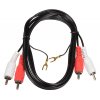
av-link-twin-rca-phono-to-twin-rca-phono-cable-with-ground-wire-1-2m-p6510-24085_image.jpg

In theory, this shouldn't perform any differently than connecting it between RCA GND and 1/4" Ring, but who knows.
 
@staticV3 thank you. I agree with your wiring. I'll try to find such a cable. If I can find it within $100 (for a pair, ideally I'd want 12ft), I'd probably prefer to just buy it, otherwise I can try to solder myself...
Please let me know if you know where to buy such a cable.
 
@staticV3 thank you. I agree with your wiring. I'll try to find such a cable. If I can find it within $100 (for a pair, ideally I'd want 12ft), I'd probably prefer to just buy it, otherwise I can try to solder myself...
Please let me know if you know where to buy such a cable.
Sally I do not know of a manufacturer that makes such a cable.

I'd highly encourage you to try making your own cables though. It's very rewarding, and can save a lot of money.
 
Which flex do you have, bal or unbal?

Cause the interference you mention can be a combination both by cable and poor performance in case of balanced flex:


flex.PNG
 
12' for unbalanced?

Better to go digital instead?

Or at least do a balanced cable over the distance, proper "symmetrizer" close to the source SE RCA output.

examples from Google:

1. Douk Audio U1 Active Balanced Converter

Active Differential Line Driver IC. It utilizes a specialized high-performance Texas Instruments/Burr-Brown DRV134 cross-coupled differential amplifier chip to mirror and drive a true, low-impedance balanced signal.


2. Nobsound NS-05P PRO Bi-Directional Converter

Active Op-Amp Differential Circuitry. It relies on powered active operational amplifier stages configured into an independent, fully differential circuit topology to synthesize a true balanced output from the single-ended input.


3. Radial Engineering Twin-Iso Line Isolator (DI)

Passive Magnetic Transformer Coupling. This passive option uses two premium, world-class Jensen (or high-performance Eclipse) isolation transformers. It transfers the signal electromagnetically across an isolated physical gap, natively creating a balanced output while completely blocking DC ground currents to eliminate hum.
 
So the turntable has line-level outputs on RCA connectors which should be a strong signal... What version of "miniDSP Flex" is doing the ADC?
 
When you have a balanced input, then use it, by all means! Extend the "balancedness" with an XLR cable and put an RCA to XLR-Male adapter right to the turntable output (or use a custom cable termination to RCA at the source end).

What you need is this (note the right to left signal direction in this pic):
1793525401942.png

Edit: I see you have TRS inputs, but the scheme remains the same: The cable must be 3-conductor.
 
Sally I do not know of a manufacturer that makes such a cable.

I'd highly encourage you to try making your own cables though. It's very rewarding, and can save a lot of money.

I guess I can try making it myself...

So I can take a TRS cable, like 2 of these:
or one 25' this:
https://www.amazon.com/Rockville-RCTR125B-Cable-Black-Copper/dp/B01DP0GYBU (and cut it in half, and use halves as separate cables)
and then I take these RCA plugs:

And just solder 3 wires from TRS to the plugs. Right?
 
Which flex do you have, bal or unbal?

Cause the interference you mention can be a combination both by cable and poor performance in case of balanced flex:


View attachment 568575

Could someone please explain, does this mean there will be this mentioned performance drop if I try to make a balanced RCA to TRS cable between my Teac TN-300 turntable and my balanced miniDSP Flex?
 
So the turntable has line-level outputs on RCA connectors which should be a strong signal... What version of "miniDSP Flex" is doing the ADC?
balanced version
 
I guess I can try making it myself...

So I can take a TRS cable, like 2 of these:
or one 25' this:
https://www.amazon.com/Rockville-RCTR125B-Cable-Black-Copper/dp/B01DP0GYBU (and cut it in half, and use halves as separate cables)
and then I take these RCA plugs:

And just solder 3 wires from TRS to the plugs. Right?
Right.
 
a balanced RCA to TRS cable
This is not a thing. At best, "Pseudo-Balanced", unbalanced-source, balanced-receiver line. Which can be an improvement over SE, but true balanced on both ends of the run is better

Also, lower voltage is not necessarily "lower performance", it's about matching the source output, impedance issues, the sensitivity of the sink device, input gain options there...
 
Last edited:
This is not a thing. At best, "Pseudo-Balanced", unbalanced-source, balanced-receiver line. Which can be an improvement over SE, but true balanced on both ends of the run is better
No. See my posts in you recent thread. The core of the misunderstandings is the non-adequate wording. Balanced transmission has little to to with anything being balanced or not (or symmetrical, the term use in Germany). The main idea is the remote sensing of the source voltage and taking the GND/Shield connection completely out of the signal transmission.
 
Could someone please explain, does this mean there will be this mentioned performance drop if I try to make a balanced RCA to TRS cable between my Teac TN-300 turntable and my balanced miniDSP Flex?
According to miniDSP, yes, you will have this performance drop if you connect an unbalanced source to the balanced flex.

(seems weird and it's the first time I see such a thing it's usually the other way around that needs care)

Their warning is more than clear.
 
According to miniDSP, yes, you will have this performance drop if you connect an unbalanced source to the balanced flex.
Their warning is more than clear.
So I have this performance drop already with my current unbalanced cable since the RCA outputs on my Teac TN-300 are unbalanced? And making a custom cable (as we've discussed above in this thread) will not change performance (it's already dropped, right?), but will remove interference, right?
 
According to miniDSP, yes, you will have this performance drop if you connect an unbalanced source to the balanced flex.
Source link, please.
The miniDSP team doesn't have a track record of being experts on analog circuits, so they indeed might have screwed this up.
 
Back
Top Bottom