• Welcome to ASR. There are many reviews of audio hardware and expert members to help answer your questions. Click here to have your audio equipment measured for free!

Apollon 1ET6525SA ST Amplifier Review

Rate this amplifier:

  • 1. Poor (headless panther)

    Votes: 0 0.0%
  • 2. Not terrible (postman panther)

    Votes: 3 1.0%
  • 3. Fine (happy panther)

    Votes: 34 11.5%
  • 4. Great (golfing panther)

    Votes: 259 87.5%

  • Total voters
    296
Prior to purchasing my new Nord Acoustics 9040 MK2 monos, I had eyed the premium version of the Apollon amplifier and compared the specifications in detail. While I acknowledged the minor improvements it offered, the 6.2K euro price of the premium model and its long production times were enough to put me off, especially when the standard Nord 9040 MK2 came in at around 3.2K GBP (roughly 3.8K euros, depending on conversion and taxes). I’ve since been very happy with the Nord’s build quality and particularly enjoy the gain‑setting switch added to the 9040 MK2 model, as it helps me optimise the signal path and maintain better gain integrity across different sources and preamp setups. My monos have been set to the lowest gain (14.4 dB), which helps preserve the soundstage and detail when listening at low to moderate volume. You cannot go wrong with either amplifier.
Notice that there are different 9040 monos from Apollon:

Premium - from 2,745.00€ each

Regular - from 1,190.00€ each

The regular is more comparable to Nord as the Premium has an additional linear power supply for the modulator.

PS: not listed but there should be the Lux version, which is the same as regular but thicker aluminum chassis, but without the linear PS. @Apollon Audio
 
Last edited:
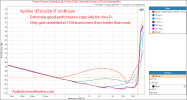
Hi guys, can you tell me ?, How bad this distortion in 15kHz ?
I want try use a AMP class D, and the 1et6525 is the better AMP in this class in measurements, but can I have problem with this distortion ?
I hear swip tone in 16kHz and I listem nusic more than 2 watss sometimes
 

Attachments

  • Apollon Purifi 1ET6525SA ST stereo class D amplifier gain 20 distortion vs frequency vs power ...png
    Apollon Purifi 1ET6525SA ST stereo class D amplifier gain 20 distortion vs frequency vs power ...png
    33.6 KB · Views: 103
Hi guys, can you tell me ?, How bad this distortion in 15kHz ?
I want try use a AMP class D, and the 1et6525 is the better AMP in this class in measurements, but can I have problem with this distortion ?
I hear swip tone in 16kHz and I listem nusic more than 2 watss sometimes
FAQ #7, and welcome to ASR.
 
I can show it to you whenever you want... and if you'd like, we can compare them too, okay?
 
...is it ok to ask how this amp compares to the Buckeye 6525 stereo amp...???...
 
Notice that there are different 9040 monos from Apollon:

Premium - from 2,745.00€ each

Regular - from 1,190.00€ each

The regular is more comparable to Nord as the Premium has an additional linear power supply for the modulator.

PS: not listed but there should be the Lux version, which is the same as regular but thicker aluminum chassis, but without the linear PS. @Apollon Audio
Fair point — the Nord Three 1ET9040BA MKII is not a “simple” Apollon-style Purifi build if it’s fitted with Nord’s REV D buffer, switchable gain, and Weiss OP2 option. Nord’s own page says the MKII uses a revised input buffer with 4 gain settings and op-amp choices, while Apollon Premium uses Weiss OP2-BP op-amps plus a dedicated linear supply for that stage. So I’d say the Nord MKII is closer in class to the Apollon Premium than to the regular Apollon, though the two still differ in how the front end is powered and implemented.
 
Well xlrs turned up, made some cables, turned the gain down to the lowest setting and placebo be damed it sounds better haha. Yeah I know. The magic of knowing the gain structure is correct
Can you me explain in short words what you exactly mean and how and why this impacts 'better sound'?!
Thx in advance!

PS: have since around 1 month a NAD C298 (Purifi 1ET400A) for LR (Gain is easy to change, has also rotary control) and think to expand/change soon my SetUp with an Purifi Eigentakt 1ET6525SA Apollon* 5 Channel PowerAmp. Prozessor is an Anthem AVM 70 8k.
PPS*: like also the
Primare A35.8 Power Amp, but this one costs around CHF 1'200.- more and is 'only' very close to the end-game-level... :D
 
Can you me explain in short words what you exactly mean and how and why this impacts 'better sound'?!
Thx in advance!
[...]
Welcome to ASR! The gain of an amp has absolutely zero influence on the sound, apart from possible noise issues. The member himself hinted that his impression was just placebo.

You should always use the lowest gain on your amp which allows you to reach the desired peak SPL. Otherwise, you're just amplifying the noise from your source unnecessarily. You can search "gain staging" on the forum for more details.
thx! I'm since a couple of months here around... and yes I like it, learn a lot, very interesting and a lot of people (most of them) they really know what are they talking about.
As you saw, I put 'better sound' in quotation marks. ;) And yes I will look into 'gain staging', thx!

PS: I was just wundering, because I have this possibilities with my new NAD;
-Stereo Mode Gain - Line-Eingang - Symmetrisch und Unsymmetrisch Fixed Gain Mode: 28.6 dB
-Variable Gain Mode: 8.5 dB – 28.5 dB
and I choosed fixed gain mode, have only XLR
Source is Tidal, Qobuz and Apple Music, the LR are my old Focal Diva Utopia Be (Sensitivity 89dB), living-room is 25m2, so how I understand in my case, with this size of room,
'amplifying noise' is not any issue, or I'm wrong?
 
Good day, may I ask for an advice regarding opamp swap in this amplifier? :) If I decide to install Sparkos 2590 would I need double or single opamp per chenel? Thank you
 
Good day, may I ask for an advice regarding opamp swap in this amplifier? :) If I decide to install Sparkos 2590 would I need double or single opamp per chenel? Thank you
Do you have the means to measure the before an d the after? (electrically)
If you don't, just leave the poor amp alone.
 
Good day, may I ask for an advice regarding opamp swap in this amplifier? :) If I decide to install Sparkos 2590 would I need double or single opamp per chenel? Thank you
If you look at the open case pictures and then at the buffer board, you see one dip8 opamp socket per channel.

But my advice is to stick with the opa1656. There is nothing to be gained. If you want to spend more money, think about the same amp in the lux case.
 
Hello,

I am considering using an Apollon 1ET6525SA ST stereo power amplifier with my Denon X4800H as a preamp.

The planned connection would be:

Denon X4800H front pre-outs via RCA directly into the RCA inputs of the Apollon.

My main question is whether this combination is electrically a good match for the Denon X4800H, especially regarding gain, input sensitivity and achievable output power. I want to avoid a situation where the Denon cannot drive the power amplifier sufficiently.

I have currently tested a Behringer A800. In my setup, it produces very strong hum unless I use a Behringer HD400 hum eliminator between the Denon and the A800. However, I would prefer not to have any hum eliminator in the signal path.

Would the Apollon 1ET6525SA ST, connected directly to the Denon via RCA, be a sensible solution to avoid this problem? Or are there still specific points I should pay attention to?

Thank you.
 
Denon X4800H front pre-outs via RCA directly into the RCA inputs of the Apollon.

My main question is whether this combination is electrically a good match for the Denon X4800H, especially regarding gain, input sensitivity and achievable output power. I want to avoid a situation where the Denon cannot drive the power amplifier sufficiently.
The amp allows you to adjust the gain. With a setting of high and 29db it should be fine in terms of overall power, even with the output voltage a little bit under 2V from the Denon. If you want to be sure 100% power from the amp could be reached, it would need to be calculated exactly.

Then there is the different output voltage behaviour from the Denons. If the AVR is still in amp mode or set to pre-amp mode (has it's amps off). With the X4800H that is supposedly possible for selected outputs, not just "all or nothing" like with the X3800H. If the output voltage changes in mixed mode I don't know.

You could get into details to check everything out, but I don't think there is much to it. At best you could find that you don't need the highest gain setting to get more than enough power from the external amp.

The hum problem is something different. With rca in and the external amp using the same 3-prong power connector there would be no change over the Behringer as to how it is connected. You have to check out where that comes from. Can be other things connected to the Denon, or the Behringer, can be cables or something with the power distribution. The easiest way in my opinion is by starting to unplug everything (power and to amps). Just have the two amps powered and connected, see if the hum is gone. If not change the rca cable and power cables.
 
Power = 10 ^ (gain / 10) * voltage * voltage / resistance
So, with input voltage of 2V, gain of 29dB and 4ohm speakers:

Power = 10 ^ (29/10) * 2 * 2 / 4 = 794W, which is a lot more than the 425W spec, or the 276W that Amir measured.

Alex
 
And the X4800H does output 2V for pre-outs if I remember the review correctly.

So it's quite possible the highest gain setting isn't even needed.

I would suggest starting with low gain and going into the 60-80% volume range of the pre-amp anyway. See how that turns out in terms of SPL. It makes no sense to ramp up the gain of the amp to the max. and then turn the volume of the pre-amp down into areas, where it can't start to produce the best signal-noise ratio.
According to Amir, the gain on the analog inputs is 28.7dB, so if the internal amps are being used for the other channels - and assuming their gain is 28.7dB - you need to set the gain of the external amp to as close to that as possible.

Alex
 
According to Amir, the gain on the analog inputs is 28.7dB, so if the internal amps are being used for the other channels - and assuming their gain is 28.7dB - you need to set the gain of the external amp to as close to that as possible.
It's probably a good idea if the AVR uses internal and external amps. So the internal adjustment range of +-12db does not have to account for an artificial difference. And measurement shows the actual suggestions derived from the amps using about the same overall gain.
 
Back
Top Bottom