
...T4 is the temperature of the water at the CPU while T5 is the temperature of the water at the radiator; we can take T5 to be equal to T4 with negligible error
If T4 and T5 are the same, then what is the radiator doing?

...T4 is the temperature of the water at the CPU while T5 is the temperature of the water at the radiator; we can take T5 to be equal to T4 with negligible error
Quite right, they are not the same, and I am being imprecise, thanks for pointing it out. There are differences among all of those temperatures, and T1 > T2, T2 > T3, T2 > T4, T5 > T3 and T5 > T4. The water temperature is raised from T4 to T5 in going through the CPU water block and drops back from T5 to T4 in going through the radiator. (q1=) mdot*cp*(T5-T4) is the bulk heat heat change for the water side at both the CPU water block and the radiator. There is also a water convection coefficient and temperature drop on the water side of the radiator, which I omitted on purpose.If T4 and T5 are the same, then what is the radiator doing?
The water temperature is raised from T4 to T5 in going through the CPU water block and drops back from T5 to T4 in going through the radiator
The convective heat transfer coefficient is typically based on taking the driving temperature difference potential to be the difference between the solid wall surface temperature and the bulk or "infinity" or "free-stream" temperature of the incoming fluid. Although some authors use a "film" temperature when preparing their convective coefficient correlation; you have to examine the provenance of the particular coefficient correlation. Consistent with that, at the CPU water block, the convective heat transfer coefficient h4 is calculated based on the incoming water temperature T4. After diffusion of heat across the cross-section, the bulk water temperature is raised to a higher value T5, which is then the bulk temperature of the incoming water at the radiator, upon which the heat transfer coefficient h5 is based. After passage through the radiator, the bulk water temperature drops back to T4 for return to the CPU water block. So I think I have T4 and T5 the right way around. There is also a small rise in water temperature in passing through the pump (the pump work raises the stagnation enthalpy of the water, which enables it to overcome the frictional forces in the circuit), but I am neglecting such details in the interest of seeing the big picture.I think you have T4 and T5 the wrong way around.
but I am neglecting such details in the interest of seeing the big picture.
True enough, but I am just interested in seeing the big picture that using only convective cooling, even when done to perfection, the best you can hope for is to lower the CPU surface temperature T2 to the available sink temperature T3 in the extreme limit. And with the better air-coolers taking us most of the way there, there is limited scope for improvement, which explains the trend of why water-cooling is not much more effective than the best air-cooling. For years, there were legions of people, particularly gamers, paying oodles of money for water-cooling probably without realizing why water-cooling was limited by the same ambient sink temperature that heat is ultimately rejected to; though water-cooling has gotten cheaper now.The 'big picuture' includes the case and all the other components and cables within it. The CPU + cooler is not a closed system.


Very interesting analysis. I haven't looked into this since I don't have any sort of high performance PC, so it is not something that I am concerned with. However, a significant portion of my professional work is in thermal analysis/management, and why not take this opportunity and have my own look at the PC cooling system.TL;DR : Water-cooling costs more, is noisier, does not lower the max CPU temp by much more than what the best air-coolers achieve, while introducing some small risk of catastrophic electronics failure due to liquid leakage. The diminishing returns are due to the limitation that the lowest CPU surface temperature that these convective cooling methods can produce is that of the ambient air temperature. This limitation could be overcome by using a refrigeration cycle device instead of liquid-cooling. ...
 www.1-act.com
From what I read some time ago the water cooler is better at removing heat faster when the processor load is reduced or as the processor load increases and decreases during normal operation. Where a heat pipe air cooler system needs more time to conduct the heat to the air cooler fins due to thermal resistance in the metal and due to the heat mass in the cooler causing a decrease in the temperature differential between the CPU and the heat pipe causing less thermal conduction. I noticed when torture testing my AIO cooler and processor that the temps when the processor load is decreased drop very rapidly as in maybe 2-3 seconds at most. When observing a heat pipe air cooler I saw the temp drop over a much longer period of time. Not sure how this relates to overclocking a PC if the max temp heat dissipation @100% load is all one is concerned with.Very interesting analysis. I haven't looked into this since I don't have any sort of high performance PC, so it is not something that I am concerned with. However, a significant portion of my professional work is in thermal analysis/management, and why not take this opportunity and have my own look at the PC cooling system.
In a high level view, after breaking down the system into its sub-components/sections, the heat flow path is (with many of the finer details left out):
Air cool:
CPU die → internal thermal interface material (TIM) → integrated heat spreader → cooler baseplate → heat pipes → "radiator"/fan → ambient airLiquid cool:
CPU die → internal thermal interface material (TIM) → integrated heat spreader → cooler baseplate → cooling liquid → "radiator"/fan → ambient air
So basically the primary difference between the 2 systems is air cooling uses heat pipes to move the heat from the baseplate to the radiator fins, and liquid cooling uses liquid transport. Conceptually, the other items can be made equivalent, e.g. cooler baseplate, radiator size, fan speed/flow rate, etc. Therefore, it is mostly down to the difference between the heat transfer effectiveness of heat pipes vs liquid transport.
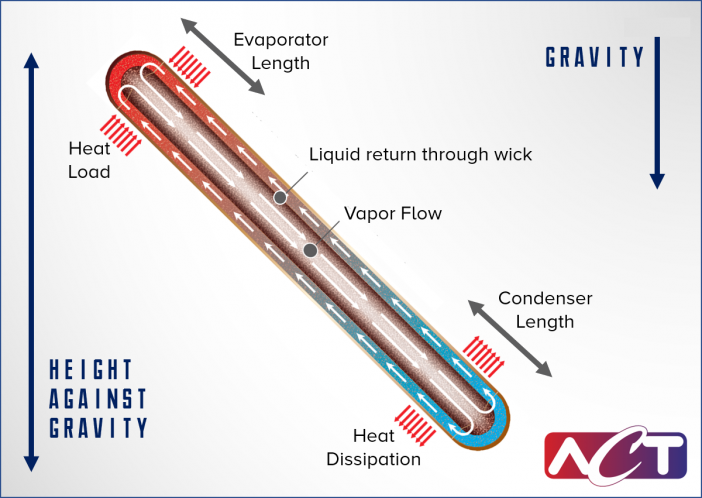
Heat pipe cross-section (from ACT):
View attachment 163981
Heat pipes work optimally at their design temperature range. The way a heat pipe works is for the liquid inside it to vaporize and absorb the heat at the heat-input end (hot end). The vapor flows to the heat-output end (cold end) due to the pressure differential (pressure goes up at the hot end due to liquid vaporizing, and goes down at the cold end when the vapor condenses). The vapor condenses at the cold end and releases the heat, thereby transporting the heat from the hot end to the cold end. The condensed liquid then flows back to the heat-input end by capillary action and gravity assist, if the hot end is at a lower elevation than the cold end. (Heat pipes perform better with the cold end on top and hot end at the bottom.) Because a heat pipe works poorer at a lower temperature than at its optimal operating temperature, it tends to move the system toward its optimal performance temperature. The liquid boiling temperature is adjusted by the choice of liquid and the pressure inside the heat pipe.
Moving heat with liquid transport is conceptually much simpler, and the liquid cooler works equally well throughout a much wider temperature range. The temperature difference between the hot and cold ends will also be minimal (and less than heat pipes), meaning more effective heat transfer. So I do think liquid coolers should have some performance advantages over air coolers.
An example performance heat pipe performance graph using the ACT heat pipe calculator:
Free Heat Pipe Calculator
Quickly calculate thermal performance and design parameters for heat pipes using ACT’s free online Heat Pipe Calculator – ideal for engineers and system designers.
View attachment 163982
My hypothesis is that the condensed liquid in the heat pipes is not moving fast enough from the cold end back to the hot end. Imagining a scenario that the liquid at the hot end is all vaporized (hot end is dried), with the condensates all stuck at the cold end, dependent on capillary action to migrate back to the hot end.From what I read some time ago the water cooler is better at removing heat faster when the processor load is reduced or as the processor load increases and decreases during normal operation. Where a heat pipe air cooler system needs more time to conduct the heat to the air cooler fins due to thermal resistance in the metal and due to the heat mass in the cooler causing a decrease in the temperature differential between the CPU and the heat pipe causing less thermal conduction. I noticed when torture testing my AIO cooler and processor that the temps when the processor load is decreased drop very rapidly as in maybe 2-3 seconds at most. When observing a heat pipe air cooler I saw the temp drop over a much longer period of time. Not sure how this relates to overclocking a PC if the max temp heat dissipation @100% load is all one is concerned with.
I read that if there is air in the system and the pump in the heatsink mounted on the processor has air run through it can damage the pump. So I don't want too flip my PC upside down.Wonder if you can run an experiment. Position your computer with the cooler radiator on top and the CPU at the bottom, run your test. Flip the computer upside down (so that the CPU is now on top) and test again. See if there is any difference. Theory is that the CPU at the bottom configuration should perform best because gravity assist will help the liquid move from the cold end to the hot end.
 When the last pump failed both of the hoses where pretty hot near the heatsink and the heat was conducting up the hose. That's how it was able to operate with web browsing and average daily use. The pump is in the water block on the processor and with the present configuration gas cannot get to the pump.
Sorry. I didn't make myself clear enough. The test I proposed was only for air cooled system (that relies on heat pipes to move the heat from the CPU to the radiator), not water cooled. Water cooled systems shouldn't be affected by the mounting orientation, except for the practical aspects that you described.I read that if there is air in the system and the pump in the heatsink mounted on the processor has air run through it can damage the pump. So I don't want too flip my PC upside down.
Hehe. I was going to do the test and then I thought nope I just received the AIO cooler back from Corsair California warranty service depot and I don't want to have to send in another so soon. So you almost got test results.Sorry. I didn't make myself clear enough. The test I proposed was only for air cooled system (that relies on heat pipes to move the heat from the CPU to the radiator), not water cooled. Water cooled systems shouldn't be affected by the mounting orientation, except for the practical aspects that you described.
That and I realized that if there is no air in the loop and the pump is cycling coolant then the orientation should not matter what the orientation is. Additionally the air is forced up out the top of the case and laying it down on the top would block the vents.  I read too much into your comment. Going on 6 hours of sleep last night so I'm not in tip top condition.


If you’re buying the latest and greatest hardware, size and thermals are a problem, allowing the liquid to naturally rise and sink isn’t enough especially if you’re going to be running systems like a 12900K with something like a 3090. You’re looking at easily over 500W loads. Forget sub-ambient, there no way you’re going to achieve that passively with a top spec system running gaming or rendering duty. And if it’s not passive, I don’t know enough about having active cooling of the liquid (running loops to cool it?).These newer specialty dielectric fluids are quite a leap from the typical mineral oil immersion in terms of longevity and other characteristics. They can easily last 5-10 years or longer and come with warranty for that long if desired. Performance wise, it may not be that much greater than a typical high performance water/glycol cooling loop but it offers lots of distinct benefits on top of marginally better thermals, namely cost savings. For example, I plan on always buying at least 1-2 of the latest/greatest GPU available every generation, and spending money on water blocks is not necessary with an immersion setup. Buying waterblocks and a few sets of good thermal pads over the life of the fluid will easily cost $2000+ for a couple pairs of gpus over that time period. There may be unforseen CPU socket changes which now needs a new CPU water block which further adds more to the cost. The fittings and hosing/piping for all those blocks also have a cost, and blocks should require semi-regular maintenance which also takes time and effort, coolant swaps etc.
Another huge advantage is that immersing in this fluid allows for subambient cooling with zero risk of condensation. Subambient cooling is already quite inefficient and can rarely be done unattended or without elaborate insulated and controlled setups, but this makes it effortless and viable for continuous 24/7 operation. So if I opt for this I further increase performance and component longevity.
A large tank isn't really necessary- it only needs to be large enough to submerge the motherboard and gpu(s) so for my specific setup with traditionally horizontally mounted gpus is only 15L (10" x 12" x 8") which is smaller than most small form factor cases. If one only has one GPU and mounts it vertically, it can be done with nearly half that volume- 7.5L. You can even fill in the void space with things like pieces of acrylic to use even less volume of fluid. 20L of this fluid ranges from about $300-600 depending on quality/warranty option, typically about $400-500. Other than the one off cost of building a small custom tank/case, this is already significantly cheaper than buying a number of water blocks.
Also regarding cleanup- it is an extra step but it is trivial all things considered. I used to be into LN2/extreme overclocking so I am no stranger to motherboards coated in vaseline and craft putty. Dunking a motherboard or gpu in an ultrasonic cleaner with some isopropyl alcohol and leaving it for an hour or so basically has it coming out newer than it looked coming out of the retail box. Mineral oil is simply too volatile and takes up ions too easily/poor materials compatibility which is what causes so many problems for people. These diaelectric fluids also have a specialised solvent for them which costs $100 (and can be reused multiple times) that you can wash all the PCBs with and leave to air/blow dry and there is no way of knowing it ever touched this fluid. Second hand sales are not a problem at all, and the components basically look like they have never been used if you do the process properly.
Honestly, the biggest issue with this is that component swaps are a bit more involved to do them properly because of the cleanup. This also scales extremely well. If I wanted to add more gpus lets say, I would at most have to add maybe another 0.5-1 L of fluid each, and in many cases I would have to use even less fluid per component as the component itself displaces volume, depending on the configuration of the vessel.
Oh, it's definitely not passive. The continuous load is at least 700W when "idle" (cryptomining when they aren't being used) and even higher when it is being used on other tasks. The tank itself will be connected to an external radiator setup. Specifically, there will be a pump circulating the heat from the top of the tank on one side to the bottom of the tank on the other, and in between this line will be a small brazed heat plate exchanger.If you’re buying the latest and greatest hardware, size and thermals are a problem, allowing the liquid to naturally rise and sink isn’t enough especially if you’re going to be running systems like a 12900K with something like a 3090. You’re looking at easily over 500W loads. Forget sub-ambient, there no way you’re going to achieve that passively with a top spec system running gaming or rendering duty. And if it’s not passive, I don’t know enough about having active cooling of the liquid (running loops to cool it?).


 www.chilldyne.com
Efficiency is often used up to increase performance of processors. That creates more heat. Yours was designed with a different goal.I appreciate that the most powerful computers will need cooling for a long time to come. However, with increasing energy efficiency of computers fewer and fewer users will need that. I recently replaced my ageing desktop computer with a modern NUC i7 10th generation (with plenty of memory and a big SSD), and fitted it into an Akasa Turing FX fanless case. The computer is pretty fast, and with this fanless case it is totally silent. I waited a few years until fanless computers would be fast enough for my use case. I am sure that fanless will be a viable option for and more more intensive applications, and sooner rather than later. Energy efficiency is an increasingly important design target.


