• Welcome to ASR. There are many reviews of audio hardware and expert members to help answer your questions. Click here to have your audio equipment measured for free!

Any Known DIY kits or designs for stereo speakers that measure well on spinorama & play very loud?

audioresearch

Member
Joined
Jul 15, 2023
Messages
20
Likes
14
Are there any known diy kits or designs for stereo speaker systems (can, but do not have to, include one or more subs) that perform well on spinorama, handle full range 20hz to 20khz plus/minus very few db, can output continuously long term 120db spl over full range and 135db over lower bass range (not giving def for now of lower bass, can get detailed later if anything ballpark is available) due to human hearing fall-off there, and do all this with no audible distortion. If you know of none, please let me know what you think comes closest. Thanks.
 
for those numbers you prob need something with multiple drivers and its not gonna be a small build
 
Before the suggestions start rolling in, what kind of budget are you working with? After all, what you’re looking for isn’t cheap. We just want to know if your budget is realistic or not.

Obviously, they can’t be tiny speakers, but is there an upper limit on how physically large they can be? Maximum length, width, depth?
 
Sounds like you want PA speakers. And probably subs. And are the dB numbers at 1m or listening position?
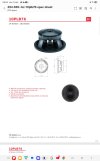
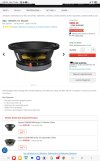
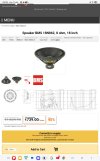
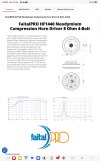
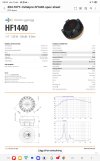
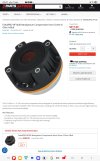
Some type of three-way speaker with good PA drivers—for example these feature an 18-inch bass driver, a 10-inch mid-range driver, and a compression driver?

Screenshot_2026-10-11_085439.912.jpgScreenshot_2026-10-11_085448.956.jpgScreenshot_2026-10-11_085508.117.jpgScreenshot_2026-10-11_085631.821.jpgScreenshot_2026-10-11_085652.352.jpgScreenshot_2026-10-11_085830.730.jpgScreenshot_2026-10-11_085901.476.jpgScreenshot_2026-10-11_090716.300.jpg
I am setting aside the actual design and everything that entails. The total cost of the drivers is around $3,000.
Note that this is just an example; you might be able to find another, lower-priced compression driver that would work well. Also, I don't know if that mid-bass driver is any good—I just picked it based on its power handling and sensitivity so it would reach the desired SPL.

The 18-inch BMS 18N862 is a well-known, proven, and excellent bass driver. I think @gnarly has good things to say about it. He might also have some general input to offer in the thread.

Edit:
Sorry, I missed the 135 dB... and 135 dB in the lower bass range...
In that case, at least two BMS 18N862s. So, around $4,500 in total for all the drivers.
Screenshot_2026-10-11_093640.881.jpg
(Gemini AI)

And if 135 dB at 20 Hz is a strict requirement, you’ll probably need four of those BMS 18N862 drivers in each speaker.
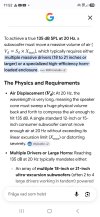
Hence my initial question about budget and maximum size. Multipel drivers and size as @smygolf also pointed out in #2. As do Gemini AI:
Screenshot_2026-10-11_115247.737.jpgScreenshot_2026-10-11_115308.663.jpg
 
Last edited:
I actually saw some DIY PA subwoofer designs on a website recently that would probably be useful for this project, but I can't for the life of me remember what it was called. :eek:
 
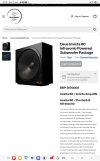
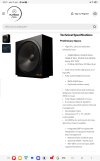
By the way, according to the manufacturer, this subwoofer meets the TS's requirements, reaching within 1 dB at 20 Hz.:)
Screenshot_2026-10-11_101554.706.jpgScreenshot_2026-10-11_102132.217.jpg

If you have the space and a creative streak, there are options like horn speakers, for instance. One Swedish speaker manufacturer used his entire basement to build a masonry horn speaker, with the mouth opening up into the living room floor. It likely reached down to 20 Hz with—almost certainly—hellish SPL.:);)
 
Last edited:
Seems to me that you'd want a pair of JMOD and SKRAM, a bit bulky in the living room perhaps but will do what you want to.

Yes, those were the ones I was thinking about too. :)
 
Seems to me that you'd want a pair of JMOD and SKRAM, a bit bulky in the living room perhaps but will do what you want to.
Yes, those were the ones I was thinking about too. :)
Josh Ricci’s SKHORN—the one with dual 21-inch bass drivers that I saw in the link. Hell of an SPL.
It doesn't quite hit 135 dB at 20 Hz, though.

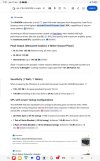
Peak Output (Measured Outdoor, 2-Meter Ground-Plane)
    • At 31.5 Hz: 135 dB (Native tuning, all vents open)
    • At 40 Hz: 139 dB
    • Above 80 Hz: Up to 145 dB [1]
SPL with Lower Tuning Configurations
The SKHORN features adjustable port tunings by blocking pairs of internal vents. While dropping the tuning frequency extends the lower bass response, it reduces the maximum overall SPL at higher frequencies: [1, 2]

    • All Vents Open (~29 Hz tuning): Yields maximum possible SPL and punch above 30 Hz.
    • 1 Pair of Vents Blocked (~25 Hz tuning): Achieves 118 dB down to 20 Hz.
    • 2 Pairs of Vents Blocked (~18 Hz infrabass tuning): Achieves 116 dB down to 16 Hz. [1, 2]
    Screenshot_2026-10-11_110724.795.jpg
    (Gemini AI)

 
Seems to me that you'd want a pair of JMOD and SKRAM, a bit bulky in the living room perhaps but will do what you want to.
+1, the only DIY plans I know of that will at least get in the ballpark of what OP is talking about.

Definitely PA stuff, 135dB bass is not just a technical and budget challenge, but a legal one if you have neighbors closer than 2Km...
 
You have to go BIG or go home. There is no other way. Also, bring cash, lots of it. Then by golly you will be good to go! Good Luck on your build.
 
Are there any known diy kits or designs for stereo speaker systems that... handle full range 20hz to 20khz plus/minus very few db, can output continuously long term 120db spl over full range and 135db over lower bass range...

If I was tasked with designing home audio or studio speakers for "continuously long term" operation a 120 dB, I would want the drivers to be operating at no more than 10% of their rated AES power handling at 120 dB at the specified distance. The reason is, we could probably expect ballpark 1 dB of thermal compression at 10% of the rated AES power handling (which is typically 1/2 of the optimistically-named "continuous" power handling and 1/4 the "peak" power handling). In other words, that's a tall order.

... and do all this with no audible distortion.

That's even less likely. As the SPL goes up the ear tends to become increasingly sensitive to distortion. So even if the system has zero non-linear distortion (that is, no distortions which increase faster than the SPL increases), distortions which were benign at 90 dB may well be like icepicks in the ears at 120 dB.

... that perform well on spinorama

It is unlikely that a DIY system will have been measured on a Klippel nearfield scanner or similar measurement system. But this is where all those hours reading ASR threads finally pay off! You can probably eyeball a design and guesstimate what its radiation pattern will look like, and if the radiation pattern is good then the system will respond more favorably to EQ than if the radiation pattern was all over the place. And an intelligently-designed system using prosound drivers will probably have a good radiation pattern.

Seems to me that you'd want a pair of JMOD and SKRAM, a bit bulky in the living room perhaps but will do what you want to.

@audioresearch, ^^this^^ may well be about as close as you're going to get.

And, something like this might also be in the ballpark:


The downloadable plans are linked on this page, and they include DSP settings, an on-axis curve, and both horizontal and vertical polar maps:

 
Are there any known diy kits or designs for stereo speaker systems (can, but do not have to, include one or more subs) that perform well on spinorama, handle full range 20hz to 20khz plus/minus very few db, can output continuously long term 120db spl over full range and 135db over lower bass range (not giving def for now of lower bass, can get detailed later if anything ballpark is available) due to human hearing fall-off there, and do all this with no audible distortion. If you know of none, please let me know what you think comes closest. Thanks.
Close enough IMHO
 
Last edited:
Never get that SPL out of them.

Rob :)
Well his requested spec's are pretty hard to complete across the board, I'm wondering what the listening conditions he wants them to perform under?
The M2's would come pretty close in SPL if combined with a monster sub or two to handle the bottom octave or so.

Do sound very good!
Now that's where we get to the root of the matter. Yep the M2's sound very near todays Hi-Fi SOTA and will provide a quite good "spinorama", which is where most PA designs will fail. The detailed answers are in the links I posted. I can't think of many/any others in a reasonably sized home audio speaker that will come as close to his requested specs while still providing TOTL sound quality and radiation pattern. ;)
 
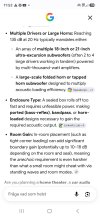
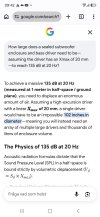
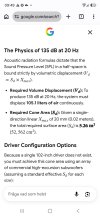
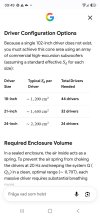
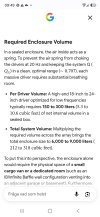
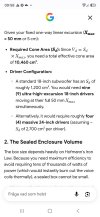
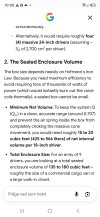
There’s no point aiming for a sealed subwoofer, anyway. I mean, just look here—if Gemini is right, it’s completely out of the question: :oops:
Screenshot_2026-10-12_094235.680.jpgScreenshot_2026-10-12_094917.144.jpgScreenshot_2026-10-12_094925.671.jpgScreenshot_2026-10-12_094936.285.jpg
If you simply run the numbers using an Xmax of 50 mm instead of 20 mm, you end up needing fewer enclosures—though, of course, having nine 500-liter subwoofer cabinets (each with an 18-inch driver) would be physically quite impractical for a standard living-room listening space. Naturally, this considers only Xmax, enclosure type (sealed), and cone area; in reality, all the necessary driver parameters would need to be taken into account. Still, it does provide an indication:

    • Total Enclosure Size: For an array of 9 drivers, you are looking at a total sealed enclosure volume of 135 to 180 cubic feet—roughly the size of a commercial cargo van or a large walk-in closet.

Screenshot_2026-10-12_095830.919.jpgScreenshot_2026-10-12_100955.666.jpg
But what wouldn't you do for bass? Throw the clothes out of that large walk-in closet and turn it into a monster-sized sealed subwoofer.:);)
However, an 18-inch bass driver with 50 mm Xmax likely won't be easy to find.

Edit:
Or use an entire wall—put up a partition wall, maybe 30–60 cm deep (depending on the wall's width and height). Then seal it up. Load the wall with a bunch of big-ass drivers.
 
Last edited:
Back
Top Bottom