
The one and only. LOLOh Sal - we are out there to discuss anything. But not sure where you get to clothes detergents? A new fetish? If so can give you a few tips as like my laundry perfect. Feel free to PM me so we don't contaminate the thread.


The one and only. LOLOh Sal - we are out there to discuss anything. But not sure where you get to clothes detergents? A new fetish? If so can give you a few tips as like my laundry perfect. Feel free to PM me so we don't contaminate the thread.

If you only use 2 subs there is little reason to pay 2x the price for the 90. I use my 70 with a Anthem MCA amp and an Outlaw moniblock for the LCR and a 8 channel Marantz power amp for the surround and height channels, that works well enough fof me for 2 ch stereo as well.Hi all! I'm new to this forum and am considering the Anthem AVM70 or 90 for a HT room I'm hoping to build this next year. 50/50 music and movies. It is not a huge sloping theater in a billion dollar mansion - about 16' wide by about 30'+ deep. The main listening area will be at the front of this room and behind it will be more of a lounge area. Having read all 22 pages of this thread I have a couple of questions. I only have two large (10"-12") subs (Hsu and SVS) at this time and not sure I would really want to place two more into the lounge area of this room, but could go with the 90 for future-proofing I guess. I will most likely only add 2-4 overhead speakers for Atmos and am not sure I will be able to add side surround speakers to the side walls. I understand that the DACs in the 90 are better and the noise floor is generally said to be better than the 70. I'm wondering if going with the 70 and saving about $3K would be a better choice for me if I decided I didn't need the two extra subs? If so, would it make sense to use the savings to buy a better implemented external DAC? Also, coming from a more traditional 7.1 system what amps are most of you using with either the 70 or 90 to power all these newer channels? I'd really rather not have to buy multiple amps, but not every manufacturer is making amps with more than 5-7 channels although there are some. what would your recommendations be? Thanks! I also have a number of vintage gear (Denon TT, Citation 16, Teac R2R, Marantz 2270, etc) in great shape that I am hoping to find a way to incorporate into this room for 2 channel listening. Not sure how I will manage all that in one room, but I'd like to try!!!
Thanks Mark! I would like to separate power supplies from the other componentry in this set up. I have had multiple Denon AVRs in the past, but I think I would prefer to change out only the Pre-Pro if I need to in the future for any upgrades.Pre-amp in the MRX1140 is better than the AVM's, it's cheaper and you get some amps to boot. https://www.audioholics.com/av-receiver-reviews/anthem-mrx-740-1140-receivers
Thanks Peng! So 3 amps in your setup. I think you probably have suited each amp nicely to the speakers they power. I would like to possibly use a couple of MCA 525's, but I think that would be pretty expensive along with the admittedly less costly 70, and that would only be 10 channels driven. Am I missing any stellar amps to pair with the 70 that wouldn't break the bank??? Thx!If you only use 2 subs there is little reason to pay 2x the price for the 90. I use my 70 with a Anthem MCA amp and an Outlaw moniblock for the LCR and a 8 channel Marantz power amp for the surround and height channels, that works well enough fof me for 2 ch stereo as well.
Pre-amp in the MRX1140 is better than the AVM's, it's cheaper and you get some amps to boot. https://www.audioholics.com/av-receiver-reviews/anthem-mrx-740-1140-receivers
No, the MRX 1140 is NOT better than the AVM90.
 www.audioholics.com
Thanks Peng! So 3 amps in your setup. I think you probably have suited each amp nicely to the speakers they power. I would like to possibly use a couple of MCA 525's, but I think that would be pretty expensive along with the admittedly less costly 70, and that would only be 10 channels driven. Am I missing any stellar amps to pair with the 70 that wouldn't break the bank??? Thx!
I have had those amps for a long time, if I were to do it now then of course I would just grab a Marantz MM8003 (got 8 channels, if you can find one in the used market) or the MM8077 (7 channels only) plus a 4 channel Hypex NC series buckeyeamp the affordable NC502MP will be fine.Thanks Peng! So 3 amps in your setup. I think you probably have suited each amp nicely to the speakers they power. I would like to possibly use a couple of MCA 525's, but I think that would be pretty expensive along with the admittedly less costly 70, and that would only be 10 channels driven. Am I missing any stellar amps to pair with the 70 that wouldn't break the bank??? Thx!
 www.soundandvision.com
Then I remembered something the company representative had told me. That for some internal reason, if you don't enable subwoofer, it costs you 10 dB of performance. He was right:
Certainly no audible difference for us mere mortals.
"It’s no surprise that the preamp outputs of these Anthem receivers are quiet. 110dBSNR @ 2Vrms with a 0dBFs input signal is excellent and among the best I’ve measured."
"The Anthem MRX740 and MRX1140 AV receivers have world class processing and internal preamplifiers. They are extremely low noise and have plenty of drive to work optimally for any home theater or audiophile amplifiers you’d like to use with them. One could easily make the argument for picking up one of these units instead of spending more on a dedicated Pre/Pro and just adding external amplification to better power more demanding low impedance speakers. In fact, I will make such an argument that the MRX740 is one of the best 11CH AV processors currently on the market and the MRX1140 for15CH of processing. The MRX1140 has a slight advantage in a better power supply IF you’re using the internal amplifiers as well as dual independent subwoofer outputs and more channels of processing with two more channels ofamplification."

Anthem MRX 740 & 1140 AV Receivers Comparison Bench Test Results! -page 2
In this bench test report of the Anthem MRX 740 & 1140 AV receivers, preamp & amplifier performance is evaluated and compared. We cover Bass management and amplifier matrixing performance recommendations.| page 2
If you don't need 4 sub outputs, it's a no brainer to choose a MRX over an AVM.
| Feature | Anthem MRX 1140 | Anthem AVM 90 |
| Processing capacity | Up to 15.2 channels | Up to 15.4 channels |
| Built-in amplification | 11 channels | None |
| Maximum practical setup | Commonly 7.2.4 or 9.2.2 using internal amps; more with external amplification | Up to 9.4.6 with suitable external amplifiers |
| Subwoofer outputs | 2 independently configurable | 4 independently configurable |
| Room correction | ARC Genesis | ARC Genesis |
| Audio formats | Dolby Atmos, DTS:X Pro, IMAX Enhanced | Dolby Atmos, DTS:X Pro, IMAX Enhanced |
| HDMI/video | 8K/4K-120 support on current 8K versions | 7 HDMI 2.1 inputs, 8K/4K-120 support |
| Analog bypass | More limited | Can bypass analog-to-digital conversion, though this disables ARC and bass management |
| Expansion | Add external amplification later | Requires external amplification from the beginning |
| Best suited to | Most dedicated theaters and advanced living-room systems | Reference-level theaters with separate amplifiers |
| Anthem MRX 1140 | Anthem AVM 90 | |
| DAC specification | 32-bit / 768 kHz | 32-bit / 768 kHz |
| DAC implementation | AKM AK4458VN is commonly identified in the MRX 1140 | Anthem does not prominently publish the exact chip on its current product page; reports identify the AVM 90 as using higher-end AKM AK4499EQ and/or ESS Sabre circuitry, depending on the board/version discussed |
| Output architecture | Receiver preamp/DAC section plus 11 internal power amplifiers | Dedicated processor with separate analog output stages and no power amplifiers |
| Balanced outputs | No full balanced output set for every channel | Balanced XLR and RCA outputs for the processed channels |
| Independent subwoofer DAC paths | 2 | 4 |
| Published AVM/MRX headline rating | 32-bit / 768 kHz | 32-bit / 768 kHz |
Hi all! I'm new to this forum and am considering the Anthem AVM70 or 90 for a HT room I'm hoping to build this next year. 50/50 music and movies. It is not a huge sloping theater in a billion dollar mansion - about 16' wide by about 30'+ deep. The main listening area will be at the front of this room and behind it will be more of a lounge area. Having read all 22 pages of this thread I have a couple of questions. I only have two large (10"-12") subs (Hsu and SVS) at this time and not sure I would really want to place two more into the lounge area of this room, but could go with the 90 for future-proofing I guess. I will most likely only add 2-4 overhead speakers for Atmos and am not sure I will be able to add side surround speakers to the side walls. I understand that the DACs in the 90 are better and the noise floor is generally said to be better than the 70. I'm wondering if going with the 70 and saving about $3K would be a better choice for me if I decided I didn't need the two extra subs? If so, would it make sense to use the savings to buy a better implemented external DAC? Also, coming from a more traditional 7.1 system what amps are most of you using with either the 70 or 90 to power all these newer channels? I'd really rather not have to buy multiple amps, but not every manufacturer is making amps with more than 5-7 channels although there are some. what would your recommendations be? Thanks! I also have a number of vintage gear (Denon TT, Citation 16, Teac R2R, Marantz 2270, etc) in great shape that I am hoping to find a way to incorporate into this room for 2 channel listening. Not sure how I will manage all that in one room, but I'd like to try!!!
 www.audiosciencereview.com
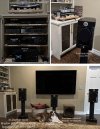
Very fair comments, fantastic post! The 1140 can be a great choice depending on one’s use case.I'm sure the MRX models are nice options and meet most basic needs. @Fritzjr mentioned 2-channel is 50% of his listening and music is a top reason many choose the AVM90.
I can link to sources as well, or compile a GTP summary (pasted below). If budget and TV is a priority, opt for the MRX. It is an excellent product. If 2-channel and building a premium overall system is the goal, the AVM90 is a top option. I sure enjoy mine.
"The simplest way to think about them is:
MRX 1140: a high-end AV receiver—processor plus power amplifier in one chassis.
AVM 90: a flagship AV processor—processing only, requiring separate power amplifiers.
The AVM 90’s important advantages are not simply “more channels.” Its four independently managed subwoofer outputs allow separate distance, phase, and level optimization for four subwoofers. That is useful in a large theater with multiple subwoofer locations, but much less important if you use one or two subs. It also uses more elaborate audio circuitry and premium DACs, and provides balanced XLR outputs for long cable runs or professional-style installations. anthemav.com1
Feature Anthem MRX 1140 Anthem AVM 90 Processing capacity Up to 15.2 channels Up to 15.4 channels Built-in amplification 11 channels None Maximum practical setup Commonly 7.2.4 or 9.2.2 using internal amps; more with external amplification Up to 9.4.6 with suitable external amplifiers Subwoofer outputs 2 independently configurable 4 independently configurable Room correction ARC Genesis ARC Genesis Audio formats Dolby Atmos, DTS:X Pro, IMAX Enhanced Dolby Atmos, DTS:X Pro, IMAX Enhanced HDMI/video 8K/4K-120 support on current 8K versions 7 HDMI 2.1 inputs, 8K/4K-120 support Analog bypass More limited Can bypass analog-to-digital conversion, though this disables ARC and bass management Expansion Add external amplification later Requires external amplification from the beginning Best suited to Most dedicated theaters and advanced living-room systems Reference-level theaters with separate amplifiers
The MRX 1140 is generally the more practical choice. Its eleven internal amplifier channels are rated at 140 watts per channel for the first five channels under Anthem’s stated test conditions, with additional channels rated lower. It can also reassign unused amplifier channels for surround, height, bi-amping, or a second zone. anthemav.com
A key point: the AVM 90 will not automatically sound dramatically better than an MRX 1140 simply because it costs more. Much of the final result will depend on the quality and power of the external amplifiers, speakers, subwoofers, room acoustics, and ARC Genesis calibration. The AVM 90 becomes more compelling when you have demanding speakers, a large room, multiple subwoofers, a 15-channel layout, or a desire to upgrade amplifiers independently.
Choose the MRX 1140 if:
You want a simpler, more cost-effective system.
You are running up to around 11 amplified channels.
Your speakers are reasonably efficient.
You have one or two subwoofers.
You may add one external amplifier later.
You want to avoid a rack full of amplifiers.
Choose the AVM 90 if:
You already own, or plan to buy, high-quality external amplifiers.
You want four independently optimized subwoofers.
You are building a 15-channel or 9.4.6-class theater.
You need balanced XLR connections.
You want maximum separation between processing and amplification.
You expect to upgrade amplifiers over time.
For most systems, the MRX 1140 offers the better overall value. The AVM 90 is the better foundation for a no-compromise dedicated theater, but only if the rest of the system—including amplification and room—can take advantage of it.
DAC comparison
The important point is that the 32-bit/768 kHz label does not mean the two units use an identical DAC implementation. The MRX 1140 is generally associated with the AKM AK4458VN, a competent multichannel DAC. The AVM 90 uses a more elaborate, premium conversion and analog-output design; published third-party descriptions identify AKM AK4499EQ and ESS Sabre devices, although Anthem’s current public specification emphasizes performance and capability rather than clearly listing every DAC chip. anthemav.com4
Anthem MRX 1140 Anthem AVM 90 DAC specification 32-bit / 768 kHz 32-bit / 768 kHz DAC implementation AKM AK4458VN is commonly identified in the MRX 1140 Anthem does not prominently publish the exact chip on its current product page; reports identify the AVM 90 as using higher-end AKM AK4499EQ and/or ESS Sabre circuitry, depending on the board/version discussed Output architecture Receiver preamp/DAC section plus 11 internal power amplifiers Dedicated processor with separate analog output stages and no power amplifiers Balanced outputs No full balanced output set for every channel Balanced XLR and RCA outputs for the processed channels Independent subwoofer DAC paths 2 4 Published AVM/MRX headline rating 32-bit / 768 kHz 32-bit / 768 kHz
In practical use, the AVM 90’s advantage is broader than the DAC chip itself. It has a more isolated power supply and analog section, balanced outputs, higher output capability, and four independently processed subwoofer outputs. Those design differences matter more than the nominal bit depth or sampling rate. audioguru.com1
The MRX 1140’s DAC section should not be considered poor. With digital sources, ARC Genesis, and normal listening levels, its audible performance can be excellent. Its main limitation is that the conversion and analog circuitry share a chassis with eleven power amplifiers, whereas the AVM 90 is designed solely around low-level processing and line-level output.
For movies, the difference may be modest because room correction, speaker positioning, subwoofer integration, and amplification usually dominate. For two-channel music, the AVM 90 has a stronger case—especially when connected to high-quality external amplifiers through XLR outputs. The improvement is most likely to appear as cleaner low-level detail, greater channel separation, and more effortless dynamics rather than a radically different tonal balance.
One caveat: using the AVM 90’s analog direct/bypass path can avoid unnecessary digital conversion, but it also bypasses features such as ARC Genesis and digital bass management. For most home-theater listening, the normal processed path is more useful.
Bottom line: the AVM 90 has the superior DAC implementation and analog output stage, but the MRX 1140 offers most of the practical digital-audio quality at a much lower system cost. Choose the AVM 90 for high-end external amplification, four independently calibrated subwoofers, balanced connections, and serious two-channel listening—not merely because it says “32-bit/768 kHz.”

My SINAD can beat yours!
Sheesh, will we ever get off this audiophile neurosis and chest beating!
The Anthem AVM's for 2 channel stereo music is overkill, a waste of money IMO. You're using 10% of the features/options and pissin' off the rest.
I should probably add that the LCR speakers I have are slightly older Paradigm Reference Studio 100 V2(?) Series ones (don't have the exact model info right at hand). 8 Ohms and 91dB sensitivity. I had their matching on-wall side surrounds in my old place but the Ex didn't want to deal with holes in the wall, so I left them lol. I have 8 NIB NHT SuperOne 2.1's, that I could maybe use as side and rear surrounds. I also have 4 vintage AR-3a's. All my vintage gear has been completely redone to in some cases to better than factory specs.
Thoughts?
Yes Peng, I was thinking of using the 1140's amps only for the surround/height channels and the Buckeyes for the LCR.The so called 8 ohms Studio 100 V2 would behave more like 4 ohm speakers based on the impedance/phase angle vs frequency, that, combined with the unbalanced outputs only on the MRX1140, I would say the AVM70 is probably a better match, when paired with those buckeyeamps that typically offers around 25-25.5 dB gain, because the balanced output gives you 2X the voltage of unbalanced outputs. Other than that, the AVR is a great option if you can use the build in amps, at least for the surround/height channels if not the LCR.


 .