
• Welcome to ASR. There are many reviews of audio hardware and expert members to help answer your questions. Click here to have your audio equipment measured for free!

Announcement: A new kid on the block, introducing Osmium Sound

The Capstan

Active Member
Joined
May 4, 2020
Messages
135
Likes
134
IMG_5114.jpeg


I would like to introduce Osmium Sound, a new software-based music server and network streamer that has just entered Public Beta.

Following several weeks of development, testing and refinement, the initial private-beta phase has been successfully completed and Osmium is now available to a wider group of users.

What is Osmium Sound?

Osmium Sound is a software platform designed to turn a standard x86 PC or mini-PC into a self-contained music server and network streamer.

It is based on Debian 13 and integrates Lyrion Music Server and Squeezelite into a dedicated environment designed to operate like an audio appliance, rather than a collection of separately installed and configured components.

Its main features currently include:
  • guided installation from a dedicated ISO;
  • integrated Lyrion Music Server and Squeezelite;
  • operation as either a standalone server/player or a player connected to an external LMS;
  • support for local displays and touchscreens;
  • New modern and polished local GUI (you’ll love it!), to include a dedicated Now Playing interface with artwork, track information and VU meters;
  • integrated Tailscale support for remote access;
  • a dedicated interface for system configuration and control;
  • headless operation when no local display is required.
  • Compatible with Lyrplay
  • Provision of a dedicated companion App for Android
The objective is to combine the flexibility of an LMS-based system with an installation and user experience closer to that of a purpose-built appliance.

Public Beta
The private-beta programme allowed us to verify all the main functionality and make substantial improvements to the installation process, stability, graphical interface and hardware-resource usage.

Osmium is already fully functional and suitable for regular music playback. The purpose of the Public Beta is now to test it across a broader range of x86 hardware configurations and gather additional feedback before the final release.

We are therefore looking for users willing to install Osmium on their own hardware and share their experience, including hardware compatibility information, observations about installation and usability, and suggestions for further refinement.

The installation ISO, instructions and feedback form are available at:

https://osmiumsound.it

Many thanks to Adriano, the developer of Osmium Sound, and to everyone who contributed to the private beta through testing, ideas and detailed feedback.

On a personal note, my experience with Osmium has been extremely positive. After using Daphile for a long time, I see Osmium as a natural evolution of the same appliance-oriented concept: it retains the convenience of a dedicated, self-contained music system while adding a modern interface, touchscreen support, integrated remote access and a more guided overall experience.

Its focus on standard x86 hardware also seems particularly relevant at a time when the cost of building a Raspberry Pi-based system is reaching increasingly high levels. Repurposing an existing PC or using an affordable thin client or mini-PC can provide a practical and cost-effective alternative, often with greater processing power and storage flexibility.

If you have an x86 PC or mini-PC and would like to try a self-contained LMS-based music server and network streamer, the Osmium Sound Public Beta is now open.

Alessandro
 
Last edited:
Cool!
Given that it's based on Lyrion MS, can I assume it works with DLNA renderers and controllers?
 
Cool!
Given that it's based on Lyrion MS, can I assume it works with DLNA renderers and controllers?
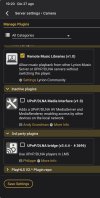
Yes, it is actually a Lyrion feature, I have not tested but should be supported. As you can see there are three plugins related to DLNA in Lyrion, one enabled by default.
 

Attachments

  • IMG_0520.jpeg
    IMG_0520.jpeg
    195.8 KB · Views: 84
View attachment 554592

I would like to introduce Osmium Sound, a new software-based music server and network streamer that has just entered Public Beta.

Following several weeks of development, testing and refinement, the initial private-beta phase has been successfully completed and Osmium is now available to a wider group of users.

What is Osmium Sound?

Osmium Sound is a software platform designed to turn a standard x86 PC or mini-PC into a self-contained music server and network streamer.

It is based on Debian 13 and integrates Lyrion Music Server and Squeezelite into a dedicated environment designed to operate like an audio appliance, rather than a collection of separately installed and configured components.

Its main features currently include:
  • guided installation from a dedicated ISO;
  • integrated Lyrion Music Server and Squeezelite;
  • operation as either a standalone server/player or a player connected to an external LMS;
  • support for local displays and touchscreens;
  • New modern and polished local GUI (you’ll love it!), to include a dedicated Now Playing interface with artwork, track information and VU meters;
  • integrated Tailscale support for remote access;
  • a dedicated interface for system configuration and control;
  • headless operation when no local display is required.
  • Compatible with Lyrplay
  • Provision of a dedicated companion App for Android
The objective is to combine the flexibility of an LMS-based system with an installation and user experience closer to that of a purpose-built appliance.

Public Beta
The private-beta programme allowed us to verify all the main functionality and make substantial improvements to the installation process, stability, graphical interface and hardware-resource usage.

Osmium is already fully functional and suitable for regular music playback. The purpose of the Public Beta is now to test it across a broader range of x86 hardware configurations and gather additional feedback before the final release.

We are therefore looking for users willing to install Osmium on their own hardware and share their experience, including hardware compatibility information, observations about installation and usability, and suggestions for further refinement.

The installation ISO, instructions and feedback form are available at:

https://osmiumsound.it

Many thanks to Adriano, the developer of Osmium Sound, and to everyone who contributed to the private beta through testing, ideas and detailed feedback.

On a personal note, my experience with Osmium has been extremely positive. After using Daphile for a long time, I see Osmium as a natural evolution of the same appliance-oriented concept: it retains the convenience of a dedicated, self-contained music system while adding a modern interface, touchscreen support, integrated remote access and a more guided overall experience.

Its focus on standard x86 hardware also seems particularly relevant at a time when the cost of building a Raspberry Pi-based system is reaching increasingly high levels. Repurposing an existing PC or using an affordable thin client or mini-PC can provide a practical and cost-effective alternative, often with greater processing power and storage flexibility.

If you have an x86 PC or mini-PC and would like to try a self-contained LMS-based music server and network streamer, the Osmium Sound Public Beta is now open.

Alessandro
Looks interesting. On your webpage, why is a USB stick necessary for installation? Can't you just put a downloadable standard application program for installation on Windows (in my case 11 pro) ?
 
Looks interesting. On your webpage, why is a USB stick necessary for installation? Can't you just put a downloadable standard application program for installation on Windows (in my case 11 pro) ?
It's an OS unto itself which AFAIK is unusual to have a windows installer for. You will be converting the computer to a Linux machine for this.
 
Yes, it is actually a Lyrion feature, I have not tested but should be supported. As you can see there are three plugins related to DLNA in Lyrion, one enabled by default.
OK, good. I recall trying lyrion, but 'in the raw' it was clunky, compared with say, UMS or the Media Server on my NAS...

So, if I have this right, Osmium has a nice GUI running locally on top of lyrion, to provide a nice PC media player, but also has nice app that runs on a phone/tablet. But, the app is a controller that lets a phone control music playing on the (server) PC, and lets you pull files from the PC to play on the phone/tablet if you want. Does the app let you direct the server to play on other devices? I may be asking stupid questions, but I'm trying to scope out "'oo does what to 'oo" as we say here, compared with my DLNA setup...
 
It's an OS unto itself which AFAIK is unusual to have a windows installer for. You will be converting the computer to a Linux machine for this.
Yes C.F. Volumio et al.
One question is whether you can "live boot" it off USB without installation on a PC to try it or not....
 
One handy way to compare any Linux with another, is to use Ventoy - it lets you put loads of ISOs on a USB stick and at boot time, you pick one of the ISOs to boot from. Many Linux distros (and some audio distros) let you try without installation to disk - not sure about Osmium yet...

Most other bootable USB apps - like Rufus et al. - only give you one ISO per USB stick.

For the nerds:

Hi i am the developer of osmium, Yes you can try it live, of course it will not save anything and you will loose it at reboot
 
OK, good. I recall trying lyrion, but 'in the raw' it was clunky, compared with say, UMS or the Media Server on my NAS...

So, if I have this right, Osmium has a nice GUI running locally on top of lyrion, to provide a nice PC media player, but also has nice app that runs on a phone/tablet. But, the app is a controller that lets a phone control music playing on the (server) toPC, and lets you pull files from the PC to play on the phone/tablet if you want. Does the app let you direct the server to play on other devices? I may be asking stupid questions, but I'm trying to scope out "'oo does what to 'oo" as we say here, compared with my DLNA setup...
Hi, I have to say I have not tested the Android Companion App, since I haven’t an Android device at hand. However I have tested with Lyrplay which is a similar app for iOS (it’s not part of Osmium development, it’s in Apple’s App Store, developed by Eric Miller) and not only allows you to control the “kiosk player” with the DAC connected to it, but it also becomes a separate endpoint. So Lyrion streams content to the device.
In combination with Tailscale (which is installed by default in Osmium) you can then access and stream your content in mobility.
Lyrplay can use different codecs, I tested realiably MP3 and direct FLAC streaming. MP3 means that each content is encoded on the fly (usually at 320kb/s) via LAME. Streams that are already MP3/AAC - like radio streams - pass transparently without being re-encoded.
FFMPEG is also preinstalled so I need to play a bit more to achieve AAC/OGG/Opus encoding, which is also supported in Lyrplay. Not that I am a fan of compressed formats, but when you are out of home, streaming FLAC can endanger your mobile data plan.
 
But I could put 512G of music on my phone (or more, if I bought a bigger micro SD) - why would I need to stream from my home server when I was out? And why would anyone need to convert music on the fly?
 
But I could put 512G of music on my phone (or more, if I bought a bigger micro SD) - why would I need to stream from my home server when I was out? And why would anyone need to convert music on the fly?
Sure — if carrying your whole library on a large microSD works for you, that is obviously a perfectly valid approach.

My use case is different. I have a 128 GB phone and I have no interest in filling a large part of its storage with music when the same library is already available on my home server.

More importantly, for me the real advantage is not simply “being able to play my local files remotely”. It is having the same unified Lyrion experience everywhere: my local library, Qobuz, my selected internet radio stations, playlists and the same familiar interface, whether I am at home or using Lyrplay remotely.

That continuity is exactly what I value. I do not want one application and one music library at home, and then a completely separate mobile setup when I am away.

As for on-the-fly transcoding, that is simply useful when network conditions or the remote connection make the original bitrate impractical. It is not something everybody necessarily needs, but it is a useful option to have.

So I would not say one approach is “necessary” and the other is not — they simply address different preferences. For me, having one music ecosystem and one interface across home and mobile is far more convenient than maintaining a separate copy of my library on the phone.

My two cents.
 
Looks really cool. If I already have a Lyrion Music Server, could I still use it for its front-end?
 
It's an OS unto itself which AFAIK is unusual to have a windows installer for. You will be converting the computer to a Linux machine for this.
Not unlike how you would use a USB created using Windows Media Creator if you needed to install Windows on a brand new computer; or to completely overwrite a previous windows install.

Unless, of course, your PC has an IPMI port (such as a SuperMicro motherboard) — in which case you can just remote mount it over the network. :cool:
 
But I could put 512G of music on my phone (or more, if I bought a bigger micro SD) - why would I need to stream from my home server when I was out?
Some people don't have that much space on their phone, and may not have a uSD slot to expand it.
And why would anyone need to convert music on the fly?
@The Capstan already mentioned the mobile network conditions. Another reason is to stream to an endpoint that doesn't support the native format.
 
I would like to introduce Osmium Sound, a new software-based music server and network streamer that has just entered Public Beta.
Great, please also note the below;
@RickS


JSmith
 
Great, please also note the below;
@RickS


JSmith
Hi Jsmith.

To clarify, this is not a commercial product. This is free open source project. Nothing on sale, to be clear.

Alessandro
 
Back
Top Bottom
