
Not impossible, but I doubt it. You can take it apart.

-
Welcome to ASR. There are many reviews of audio hardware and expert members to help answer your questions. Click here to have your audio equipment measured for free!
You are using an out of date browser. It may not display this or other websites correctly.
You should upgrade or use an alternative browser.
You should upgrade or use an alternative browser.
Alsozone /3e Audio GaN Monoblocks | New Comer
Michael Kohler
Member
- Joined
- Feb 20, 2026
- Messages
- 88
- Likes
- 16
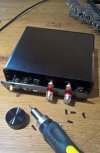
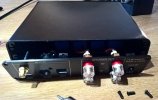
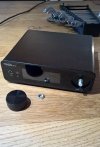
I just tried to open the little YJCO D816. To take some photos. It doesn’t work. 1.) The mainboard is visibly glued to the case, so it’s secured against slipping 2.) The second, small board at the front can’t be removed because it’s screwed to the front, and the front is glued to the case. Inside you can see glue, but no screws or threads holding the front panel. Someone who professionally repairs phones might be able to get it open without breaking anything. But I don’t repair phones for a living.
Attachments
Michael Kohler
Member
- Joined
- Feb 20, 2026
- Messages
- 88
- Likes
- 16
What annoys me a bit, and unfortunately it’s typical for Chinese audio manufacturers right now, is the (sorry) exaggerated lying about the technical specs. The YJCO is one of many examples. The Chinese claim a power of 300 watts, which is a nice round number and makes impression, but of course they forget to mention that this power can’t be achieved with a 48-volt 5-amp power supply, and not even with a 10-amp one. If the amplifier's efficiency really is at 95%, with the 5A power supply you’d get at most 115 watts (per channel) and with the 10A power supply, 230 watts. Actually great, but they just write 300 watts on it. Maybe the amp could do it, but I don’t know any power supply that beefy. Is there even one you can buy?

I just tried to open the little YJCO D816. To take some photos. It doesn’t work. 1.) The mainboard is visibly glued to the case, so it’s secured against slipping 2.) The second, small board at the front can’t be removed because it’s screwed to the front, and the front is glued to the case. Inside you can see glue, but no screws or threads holding the front panel. Someone who professionally repairs phones might be able to get it open without breaking anything. But I don’t repair phones for a living.
Thanks for the effort. But we know what there is inside the YJCO ) We just need the teardown of the AlsoZone mono gan )
See below :

NEW GaN Amplifier : Dual ACM8816 GaN amplifier chips + AK4118AEQ [YJCO D816]
Hi amigos, I’m sharing another discovery I made by chance while chatting with a guy on an audio forum. There is a GaN amplifier based on dual ACM8816 chips that features very comprehensive connectivity. This is actually a true dual-mono amplifier; the ACM8816 chip is inherently a mono chip with...
www.audiosciencereview.com
What annoys me a bit, and unfortunately it’s typical for Chinese audio manufacturers right now, is the (sorry) exaggerated lying about the technical specs. The YJCO is one of many examples. The Chinese claim a power of 300 watts, which is a nice round number and makes impression, but of course they forget to mention that this power can’t be achieved with a 48-volt 5-amp power supply, and not even with a 10-amp one. If the amplifier's efficiency really is at 95%, with the 5A power supply you’d get at most 115 watts (per channel) and with the 10A power supply, 230 watts. Actually great, but they just write 300 watts on it. Maybe the amp could do it, but I don’t know any power supply that beefy. Is there even one you can buy?
I quote : "Shenzhen Yongfukang Technology Co., Ltd. is now vigorously promoting the first domestic gallium nitride Class D audio amplifier chip - ACM8816, which integrates 7mΩ Rdson GaN gallium nitride. When powered by 48V, it can output 1×340W of power within 10%THD+N when driven to 4Ω. It is packaged in QFN-48 chip and does not require an external heat sink to assist in heat dissipation."
Source :
Between the nonsense (bad translation?) like "7mΩ Rdson" and the useless 10% figure, one thing really sticks out:I quote : "Shenzhen Yongfukang Technology Co., Ltd. is now vigorously promoting the first domestic gallium nitride Class D audio amplifier chip - ACM8816, which integrates 7mΩ Rdson GaN gallium nitride. When powered by 48V, it can output 1×340W of power within 10%THD+N when driven to 4Ω. It is packaged in QFN-48 chip and does not require an external heat sink to assist in heat dissipation."
Source :
"Does not require external heatsink".
That, if remotely true, is a biggie in practice.
OP

Guddu
Major Contributor
- Joined
- Feb 10, 2020
- Messages
- 2,107
- Likes
- 2,239
- Thread Starter
- #167
Somehow makes me think this could possibly be a good thing for AVRs.I quote : "Shenzhen Yongfukang Technology Co., Ltd. is now vigorously promoting the first domestic gallium nitride Class D audio amplifier chip - ACM8816, which integrates 7mΩ Rdson GaN gallium nitride. When powered by 48V, it can output 1×340W of power within 10%THD+N when driven to 4Ω. It is packaged in QFN-48 chip and does not require an external heat sink to assist in heat dissipation."
Source :
Miercoles2022
Member
There are no leads on the e-cap.I wonder if that's a computer-generated (AI) image at 4:27

Wtf lol, totally missed that!There are no leads on the e-cap.

There are no leads on the e-cap.
Well done ))))

antcollinet
Grand Contributor
Rdson is a transistor specification. Resistance drain to source when switched on. It's not a bad translation.Between the nonsense (bad translation?) like "7mΩ Rdson"
LOTS of audiophiles use analog sources!Does anyone know why they have analog inputs?
And even lots of still-used preamps, tone controls, crossovers and other etc signal processors work i n the analog domain.
Why Wiim Ultra, all-digital streamer/preamp has RCA in and out as well in addition to S/PDIF and USB.
All this in itself is not a problem so long as the ADC / DAC format converters and connections are good quality, you can go back and forth repeatedly without SQ audible downsides, I've seen well structured tests with 18 roundtrips pass!!
So even at the low end, putting a miniDSP PocketADC into the D816 may well be just as good as direct digital in the end.
Better than what 3e uses? dunno, needs testing.
Analog connectors means, a bigger market, that is all.
Globally, those only using digital signals before the amp are likely still a small minority.
Just silly. With multichannel gear, 5.1, 9.1.6 etc are very common.
With active crossovers, bi- tri- amping, I may get up to 22 channels, or 23 there is no reason to think odd numbers are rare!
And few if them are "stereo", mono signals and gear are commonplace.
The only place I know that a pair of channels must technically be L/R is in stupid windows setting, which I haven't touched for decades
Globally, those only using digital signals before the amp are likely still a small minority.
Wut?The problem is quite simple: digital connections are ALWAYS stereo.
Just silly. With multichannel gear, 5.1, 9.1.6 etc are very common.
With active crossovers, bi- tri- amping, I may get up to 22 channels, or 23 there is no reason to think odd numbers are rare!
And few if them are "stereo", mono signals and gear are commonplace.
The only place I know that a pair of channels must technically be L/R is in stupid windows setting, which I haven't touched for decades
Michael Kohler
Member
- Joined
- Feb 20, 2026
- Messages
- 88
- Likes
- 16
Yeah, great. 10% distortion. And we're arguing here about "transparent sound," which might be somewhere around 0.001%. Exactly my kind of humor.I quote : "Shenzhen Yongfukang Technology Co., Ltd. is now vigorously promoting the first domestic gallium nitride Class D audio amplifier chip - ACM8816, which integrates 7mΩ Rdson GaN gallium nitride. When powered by 48V, it can output 1×340W of power within 10%THD+N when driven to 4Ω. It is packaged in QFN-48 chip and does not require an external heat sink to assist in heat dissipation."
Source :
Serious: Maybe someone here deals with Chinese businessmen or technicians. They could bring it up with them. The truth is, the devices are today so good that they don’t even need such a kid's party anymore.
Michael Kohler
Member
- Joined
- Feb 20, 2026
- Messages
- 88
- Likes
- 16
I only know one analog source: the record player. Everything else is digital, but because, for example, CD players use RCA or XLR analog connectors, some people call that an 'analog' source. Okay, fine by me. We're in a forum with technical experts, from whom I can learn a lot, right? Are we really going to start a discussion about comparing the quality of analog connectors vs digital connectors? Sorry, I’m not taking part in that. If you can stay in the digital domain, especially with connectors, of course, you should. But for me, it’s no problem if someone prefers to connect analog. In Germany, we say,LOTS of audiophiles use analog sources!
And even lots of still-used preamps, tone controls, crossovers and other etc signal processors work i n the analog domain.
Why Wiim Ultra, all-digital streamer/preamp has RCA in and out as well in addition to S/PDIF and USB.
All this in itself is not a problem so long as the ADC / DAC format converters and connections are good quality, you can go back and forth repeatedly without SQ audible downsides, I've seen well structured tests with 18 roundtrips pass!!
So even at the low end, putting a miniDSP PocketADC into the D816 may well be just as good as direct digital in the end.
Better than what 3e uses? dunno, needs testing.
"des Menschen sein Wille ist sein Himmelreich".
Man's will is his kingdom of heaven.
You mean in your own direct experience, so limited...I only know one analog source: the record player.
> Everything else is digital
I gave many other input categories which are not.
> CD players use RCA or XLR analog connectors
yes if a DAC is putting out an analog signal, it requires analog inputs downstream. Whether the signal USED TO BE digital upstream or not, is irrelevant to the next device in the chain.
> Are we really going to start a discussion about comparing the quality of analog connectors vs digital connectors?
We are simply responding to the (IMO silly) question you posed.
The issue is not physical connectors. Some people think one category is inherently better than others, or that converting from one to the other and back inherently degrades the audible "purity", as you still seem to think.
I was trying to help you understand that does not need to be the case, there certainly is no justification for that "of course"
LOTS of audiophiles use analog sources!
And even lots of still-used preamps, tone controls, crossovers and other etc signal processors work i n the analog domain.
Why Wiim Ultra, all-digital streamer/preamp has RCA in and out as well in addition to S/PDIF and USB.
All this in itself is not a problem so long as the ADC / DAC format converters and connections are good quality, you can go back and forth repeatedly without SQ audible downsides, I've seen well structured tests with 18 roundtrips pass!!
So even at the low end, putting a miniDSP PocketADC into the D816 may well be just as good as direct digital in the end.
Better than what 3e uses? dunno, needs testing.
More broadly, the point being made was that the ACM8816 is a natively digital GaN chip... There are plenty of other analog solutions based on GaN technology (Orchard Audio, for instance). I just get the feeling that it’s really just a question of price here...
@3eaudio : It would be cool to respond to this thread, seeing as your customers have plenty of questions...
I forgot to specify this information about the ht91808 ADC chip used in Mono GaN
・24Bit Delta-Sigma Stereo ADC
・Single-Ended Voltage Input: 3 Vp-p
・High Performance
- THD+N: -90dB (Typical)
- SNR: 99dB (Typical)
- Dynamic Range: 99dB (Typical)
・Flexible PCM Audio Interface
- Master- or Slave-Mode Selectable
- Data Formats: 24Bit I2S, 24Bit Left-Justified
・Power Down and Reset by Halting System Clock
・Analog Antialias LPF Included
・Sampling Rate: 8 kHz–96 kHz
・System Clock: 256 fS, 384 fS, 512 fS
・Resolution: 24 Bits
・Dual Power Supplies
- 5V for Analog
- 3.3V for Digital
54 days laterAll the Best for the new product.
Will look forward to more details.
way too long...
Similar threads

- Replies
- 88
- Views
- 14K

- Replies
- 326
- Views
- 42K