• Welcome to ASR. There are many reviews of audio hardware and expert members to help answer your questions. Click here to have your audio equipment measured for free!

Additional subwoofers useful for DiracART setup?

napfkuchen

Addicted to Fun and Learning
Joined
Mar 9, 2022
Messages
788
Likes
1,278
Location
Germany
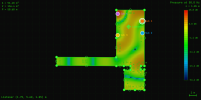
My living room audio layout (5.2.4) currently looks like this (created with room mode calculator):
room-plan_50Hz.png

The living room is open to the kitchen and hallway, and the TV/audio area measures approximately 4 x 4.5 m.
To help visualize the layout, I’ve marked the FL/FR speakers alongside the subwoofers (currently Sub 1 + Sub 2).

Here is the frequency response measurement for Sub 1 + Sub 2 in Dirac:
dirac.png


This aligns quite well with the results from the room mode calculator:
sub1-2fr.png


There is space on the rear wall for two additional subwoofers. I experimented a bit with the placement. The calculated frequency response for the two best positions is shown below.

Subwoofer 3:
sub3-fr.png


Subwoofer 4:
sub4-fr.png


subwoofers 1-4:
sub1-4-fr.png


Currently support range for LCR speakers is set to 40-150 Hz, and for the other speakers 80-150 Hz. Consequently, the 20–80 Hz range is covered solely by the front speakers and subs. Would adding subwoofers at the back wall be a sensible upgrade to further smooth out the frequency response and specifically to address the dip in the 50–70 Hz range?
 

Attachments

  • room-plan_50Hz.png
    room-plan_50Hz.png
    220.4 KB · Views: 34
How does it look today with ART ?
 
Here is a graph including the measured response of both subwoofers and the corrected response of the subwoofer group (bold green line):
1788629439835.png
 
[...] Would adding subwoofers at the back wall be a sensible upgrade to further smooth out the frequency response and specifically to address the dip in the 50–70 Hz range?
While Todd Welti's research showed that the theoretical optimum would be 5000 randomly positioned subwoofers in a room, they came to the conclusion that:

"[...] There is certainly no justification for using more than four. Four subwoofers are enough to get the best results of any configuration tried. Two subwoofers is very nearly as good and has very good low frequency support as well."
It is true that there might be oddly shaped rooms which do not follow this general suggestion, but I wouldn't expect miracles by adding more subwoofers to the 4 you already have.

Your best options are, as far as you can:

1) Try different subwoofer locations and verify by measurements
2) Use bass traps (the more the better); what to expect is shown in Figure 8 in the linked article
 
Is there something wrong on the waterfall or are you lacking output in the ~60hz area?
It sounds awesome (to my ears ...). But I haven't yet been able to compare the sound with other surround setups, so that’s easy to say. No idea whether there is still much potential regarding the RT60. But I do wonder why, even at higher volumes, only one subwoofer does the heavy lifting, while the second subwoofer and the LCR speakers remain relatively quiet in their bass output. This is only perceptible from a distance of half a meter or less. LCR speakers (-18 dB) and the other subwoofer (-24 dB) are supporting LFE.

Waterfall looks like this without DSP:
no DSP.jpg


... and with DiracART:
DiracART.jpg
 
[...] But I do wonder why, even at higher volumes, only one subwoofer does the heavy lifting, while the second subwoofer and the LCR speakers remain relatively quiet in their bass output. [...]
Maybe that's due to how Dirac ART calculates its corrections? PS: Are they all the same subwoofers or is there a performance bottleneck?

Have you tried a different approach for comparison, like with MSO (Multi-Sub Optimizer)?
 
While Todd Welti's research showed that the theoretical optimum would be 5000 randomly positioned subwoofers in a room, they came to the conclusion that:

It is true that there might be oddly shaped rooms which do not follow this general suggestion, but I wouldn't expect miracles by adding more subwoofers to the 4 you already have.
Perhaps I didn't express myself clearly. Currently, two subwoofers are positioned at the front wall and there is the option to add two more.
Your best options are, as far as you can:

1) Try different subwoofer locations and verify by measurements
2) Use bass traps (the more the better); what to expect is shown in Figure 8 in the linked article
Thanks for the advice. :)
1) There is only about 4.5 meters of wall length (rear wall) available for this. I had previously measured various positions using a single subwoofer, and the outer placement (subwoofers 3 and 4 in the room layout overview, first image in my initial posting) resulted in the fewest dips in response.
2) Unfortunately, it is a living room, so implementing that will likely be difficult. There are already three 120x60x15 cm absorbers on the rear wall, and on the front wall I could probably accommodate absorbers of the same 15cm (6") depth covering an area of roughly 3 to 3.5m² (33 to 37 sqft). However, their sound absorption coefficient drops sharply below 100 Hz. Hence the idea that ART can compensate for something.
 
  • Like
Reactions: 829
Maybe that's due to how Dirac ART calculates its corrections? PS: Are they all the same subwoofers or is there a performance bottleneck?
Both SVS, SB 1000 and SB 1000 Pro, so very similar models. It seems to be because only one subwoofer plays the LFE, while the others act as support:
Have you tried a different approach for comparison, like with MSO (Multi-Sub Optimizer)?
Not so far. However, only one of my subwoofers has a parametric EQ, so I would actually need s.th. like a miniDSP. From what I've read, it could also be that DiracART doesn't work well with MSO because of delay/timing issues.
 
  • Like
Reactions: 829
Ah got it @napfkuchen. Maybe I should have read more carefully: so you currently have 2 subwoofers. :)

Unfortunately, nobody will be able to give you precise information on the outcome with (up to) 2 extra subwoofers in your room. I would use the preliminary calculations also only as a rough directive; small movements in placement can already make a huge difference and it's a lot harder to get precise calculations in a room shaped like yours (+ we only see one dimension on your layout).

Best would be if you could get 1 or 2 more subwoofers for a trial, also if they'd differ in headroom but frequency response should be similar. Dirac ART will certainly do its best to reduce decay times (between 20-150 Hz); but frequency response correction is going to be the part of Dirac Bass Control (or MSO).

It certainly is more practical to stay with all Dirac; instead of combining with MSO - which would require a different approach, as the MSO channel should be treated as an entire single channel = one group (correcting let's say up to 4 subwoofers). I threw in MSO, as this is not an ART but rather a Bass Control problem.

Any specific reason why you limited frequency response with your target so steeply at 20 Hz?

Edit:
To be more precise, what you could do with more subwoofers: create one group (2-4 subwoofers) for frequency response correction and another group (1+ subwoofers) to provide the ART "noise canceling" for the first subwoofer group. Of course other supporting groups would be your main loudspeakers and surrounds (if applicable).
 
Last edited:
Best would be if you could get 1 or 2 more subwoofers for a trial, also if they'd differ in headroom but frequency response should be similar. Dirac ART will certainly do its best to reduce decay times (between 20-150 Hz); but frequency response correction is going to be the part of Dirac Bass Control (or MSO).
That’s probably what it will come down to.
It certainly is more practical to stay with all Dirac; instead of combining with MSO - which would require a different approach, as the MSO channel should be treated as an entire single channel (correcting let's say up to 4 subwoofers). I threw in MSO, as this is not an ART but rather a Bass Control problem.
Ah, now I get it. For a less experienced user like me, the practical approach seems better because it is less prone to errors.
Any specific reason why you limited frequency response with your target so steeply at 20 Hz?
It probably isn't necessary because the subwoofers quickly run out of steam below 20 Hz anyway. My reasoning was that the limit could help reduce the strain on them somewhat. The steep roll-off also ensures that the "neighbor tolerance threshold" isn't exceeded, even at higher volumes (80-90 dBSPL).;) For movies, I apply a -4 dB roll-off from 30 Hz down to 20 Hz.
 
[...] My reasoning was that the limit could help reduce the strain on them somewhat. The steep roll-off also ensures that the "neighbor tolerance threshold" isn't exceeded, even at higher volumes (80-90 dBSPL).;) For movies, I apply a -4 dB roll-off from 30 Hz down to 20 Hz.
With Bass Control or MSO the load will significantly reduce on a single unit and combined output will increase; so no need for that and your subwoofers are quite good as well.

The thing is that such steep roll-offs / HPF can cause more phase shift and group delay around cut-off frequency. A shallower apprach like what you do for movies would be less invasive, if required.
 
The thing is that such steep roll-offs / HPF can cause more phase shift and group delay around cut-off frequency. A shallower apprach like what you do for movies would be less invasive, if required.
Again thx, applied a slower roll-off to the target curves. I've also increased the support levels (following this tip) and bass is punchier now. With my reference tracks, I did not notice any negative impact on imaging.

The before/after overlays clearly show the reduction in spread and similar problem areas.

front right:
spread overlay front right.jpg


surround left:
spread overlay surround left.jpg


subwoofer:
1788710160053.png


The Dirac representative also addressed my room layout (open-plan space, subwoofer and speakers with a low F3 only at the front). For Black Friday, I’ll likely focus on room acoustics first, and then later try out an additional subwoofer on the rear wall.
 
  • Like
Reactions: 829
[...] It seems to be because only one subwoofer plays the LFE, while the others act as support:
[...]
Ah okay. I'm not using Dirac ART (yet; if at all) so I wasn't sure how the LFE channel is being treated until I found this setup guide.

[...] For Black Friday, I’ll likely focus on room acoustics first, and then later try out an additional subwoofer on the rear wall.
Sounds like a plan!

But it looks good so far and if it sounds right, it cannot be that far off (your target). ;) I always prefer to verify the results with REW as I found, that sometimes Dirac's predictions are not 100% accurate.
 
I always prefer to verify the results with REW as I found, that sometimes Dirac's predictions are not 100% accurate.
Absolutely! Unfortunately, I’m not particularly familiar with operating REW or interpreting the measurement results. Besides, I’d first have to set up my PC in the living room to do it. That can wait a few months—until the end of the year, even. Dirac has annoyed me enough with all sorts of error messages over the last few days. After all, it’s not as if the results would allow for any major changes to the speaker placement or room acoustics anyway. If it (hopefully) confirms that everything is basically fine, that’s enough for me. ;)
 
  • Like
Reactions: 829
Back
Top Bottom